The Holy Bee’s 2011 Halloween Special, Part 2

The house is getting a warmer, so the Snuggie comes off. Maybe I should put some pants on. Naaaah…

As his motives become somewhat clearer, I am still left with the nagging question: Why is Michael Myers immortal? The other two horror super-franchises, Friday the 13th and Nightmare on Elm Street make no bones (pun intended)(not really a pun) about their villains (heroes?) being of the supernatural realm. But Michael Myers is supposed to be a simple, flesh-and-blood serial killer. As of now, he has at least ten bullets in his torso, and two fired right through the eye holes of his mask. And he definitely bleeds. What’s going on here?

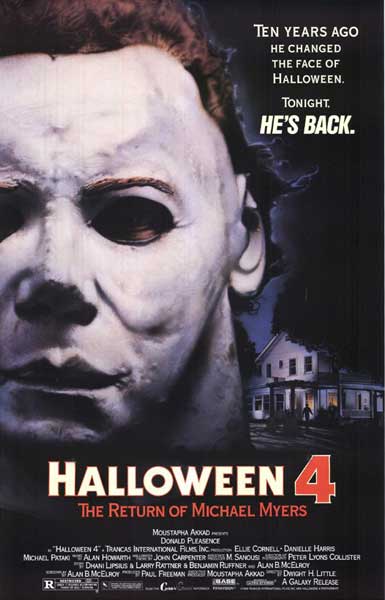
1:50 pm. Halloween 4: The Return of Michael Myers (1988). The coffee has long since been consumed, and I pry the first twist-top off a Bud Light Golden Wheat. (I keep trying to interest Anheuser-Busch in my tagline for this product: “The Cadillac of Shitty Beers.” I haven’t heard back from them yet.)

The swtich from Roman numerals to our more familiar Arabic numerals in the official title indicates our return to the familiar territory of Michael Myers and Dr. Loomis. No Laurie Strode, though. Jamie Lee Curtis was busy making one of my all-time favorite movies, A Fish Called Wanda. It would have been nice to have her, but she clearly made the right choice. Her character is killed off in an unspecified accident about a year before the events of 4, along with the husband she must have married right out of high school. (I suspect it’s supposed to be Lance Guest’s EMT character, Jimmy, who flirted with her in II.) Laurie’s eight-year-old daughter, Jamie Lloyd (daughter of “Jimmy”?),  is adopted by the Carruthers family, and becomes the sister of Rachel Carruthers.

Rachel is played by Ellie Cornell, and manages a performance of wit and toughness almost equal to Curtis in the original. She is, however, outshined by Danielle Harris as Jamie. Harris is pretty extraordinary for a child actress, and really gets put through the wringer in this flick, but is never over-precocious or unnatural. Pleasence once again hams it up delightfully (he usually takes about three syllables to say his favorite word, “eeee-vy-il.”) Non-John Carpenter-related work appears to have dried up for Pleasence, so now instead of shamefacedly slumming in quick-cash slasher flicks between Shakespeare engagements, he appears to have made the Halloween franchise the centerpiece of his career.

2:30 pm. I fix a ham sandwich in honor of Donald Pleasence.

The hellish immolation of Myers and Loomis at the end of Halloween II ten years before is dismissed in the first five minutes as both of them “almost dying” in a fire. Loomis now has a bit of scarring and a limp. Myers has been in a coma under heavy guard. Naturally, he wakes up. With amazing navigational and driving skill for someone who has spent most of his life locked in asylums or comatose, he comes after his lone remaining family member — his niece Jamie. Although it has none of the atmosphere and subtlety of the first film, it also keeps the gore at a pretty tame level. The deaths here are actually milder than a Stallone or Schwarzenegger action flick of the same era. The movie is not good, but after Halloween III it seems like Citizen Kane. Rachel acts as a valiant protector of her adopted sister Jamie, and Michael Myers gets another “death” in a hail of gunfire (and another sheriff’s daughter gets offed in the process.) In a little epilogue just before the credits, it seems Jamie has inherited her uncle’s murderous tendencies.

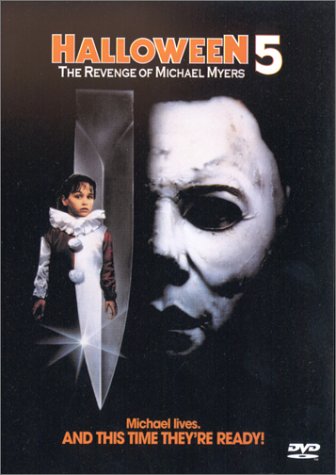
3:28 pm. Halloween 5: The Revenge of Michael Myers (1989). Remember when they used to call empty beer bottles “dead soldiers”? Well, I’ve got three dead soldiers on the floor next to the couch, and a fourth about to fold under my enhanced interrogation techniques. Myers survives his most recent death and appears to have established a telepathic bond with Jamie. Jamie has been thoroughly and understandably traumatized by the events of 4, and after a (failed) Myers-style knife attack on her adoptive mother, now lives full-time in a children’s clinic, experiencing nightmares, seizures, and a total loss of speaking ability. Rachel and her “free spirited” sidekick Tina visit her frequently. (Lots of hairspray and dangly bracelets = zany free-spirit in 80’s movies.) In a move that’s pretty shocking, when Myers hits Haddonfield again one of his first victims is — Rachel. The smart, intrepid heroine of 4 is scissored to death in the first fifteen minutes of 5. Bummer. But in making Myers’ victims someone the audience cares about rather than the typical random stupid teen of the run-of-the-mill slasher movie, there’s some added gravitas that raises the Halloween movies a little above their contemporaries.

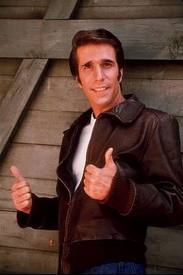
When Rachel meets her demise, the scream-queen torch is passed to wacky Tina for no logical reason, but Tina does not survive the film, either (she nobly sacrifices herself so Jamie can escape.) Pleasence has moved beyond merely chewing the scenery and is now devouring it in great slabs. “I prayed that he would burn in Hell. But in my heart, I knew that Hell would not have him!!” is a typical Loomis line, delivered with spittle-emitting intensity. One of the Jackass Boyfriends is supposed to be a brooding, dangerous punk, but dresses exactly like the Fonz. (Horror movie creators are oddly old-fashioned at times.) The killings come quicker in the later sequels. Fonzie is dispatched with a gardening implement five minutes after being introduced. Ayyyy! Continue reading

1 Comment

Filed under Film & TV

The Holy Bee’s 2011 Halloween Special, Part 1

The concept for my 2011 Halloween Special came to me when I was still writing my 2010 Halloween Special, and I was a little depressed that I would have to sit on such a great idea for a whole year before I could implement it. But October has finally rolled around at last, and now that it’s time to complete what I had planned, I’ve realized that it’s much easier to conjure up these things that to actually do them.

But I’m committed, come hell or high water, to watch every movie in the original Halloween series in a single sitting. That’s eight feature films. None of them are of epic length, mind you, but it’s still a pretty decent chunk of time to have an ass parked on a couch. Luckily, my skill at sitting almost motionless for hours at a stretch is unparalleled, except by certain species of reptile and the more dedicated East Indian fakirs. So all it will really take out of me is time, and I’ve got that. If, last October I had decided that for my 2011 Halloween special I would run October’s Portland marathon in a Jason-style hockey mask you would most assuredly be reading a list of excuses right now.

This is at least somewhat uncharted territory for me. I’ve seen the first Halloween many times, and I actually saw Halloween 5 in 1989 on an ill-advised high school double-date. The rest will be all new to me, because I’m not really a horror aficionado. A well-made one can be great, but too many rely on the lazy technique of someone/thing suddenly lunging into frame accompanied by a loud sting of music. To make an audience jump as an involuntary physical response to a sudden change in volume or visual stimuli is not “horrifying” them, it’s triggering a simple reflex. And it’s poor filmmaking when used too often. From what I’ve heard, the Halloween sequels range in quality from dubious to wretched, so I’m expecting a lot of it-was-only-the-cat “ha ha made you jump” moments.

On with it, then. On Saturday, October 15, armed with only my notebook, a Snuggie, DVDs of Halloween 1 through 6 (and the remaining two  streaming on Netflix Instant View), and a variety of nearby beverages, I settle in to complete the challenge I had set for myself the year before.

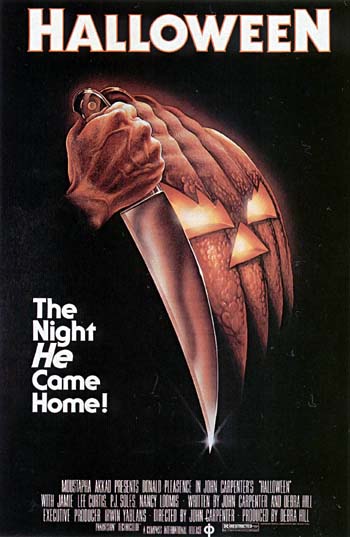
8:53 am. Halloween (1978). The sound of the coffee pot beginning to drip in my kitchen blends in with the classic Halloween theme. Not the first mainstream “slasher” movie (most people give that credit to 1974’s Black Christmas), it’s certainly the best. The opening credits are pretty iconic — a slightly battered, grinning jack o’lantern against a solid black screen with the credits in orange text. And of course, that music.

We start with a Prologue: Haddonfield, Illinois, 1963. Six-year-old Michael Myers is in the side yard of his house, observing his teenage sister and her jackass boyfriend necking on the couch. (All the teen girls in the Halloween franchise come packaged with horny, boorish Jackass Boyfriends as standard equipment.) We don’t see Michael yet, but we see what he sees, in what film geeks call a “POV shot.” (And for it being 1963, the Jackass Boyfriend is certainly rocking some post-Beatles hair. What is it with 70’s actors and their precious, precious hair? Beginning in about the mid-80’s, actors went ahead and committed to accurate period haircuts for TV shows and movies set in the past. But in the 70’s, it didn’t matter if the story was set in the Korean War or 1950’s Milwaukee, you were going to get guys with muttonchops and Jewfros and girls with feathered Farrah Fawcett ‘dos. Had someone with the hair length of a, say, Chachi Arcola actually shown up in 1950’s Milwaukee, he would have been beaten within an inch of his life as a suspected deviant. I’m not saying that’s right, I’m just saying it’s a likely scenario.) Continue reading

2 Comments

Filed under Film & TV

The Best & Worst of the Solo Beatles, Part 2: Paul McCartney

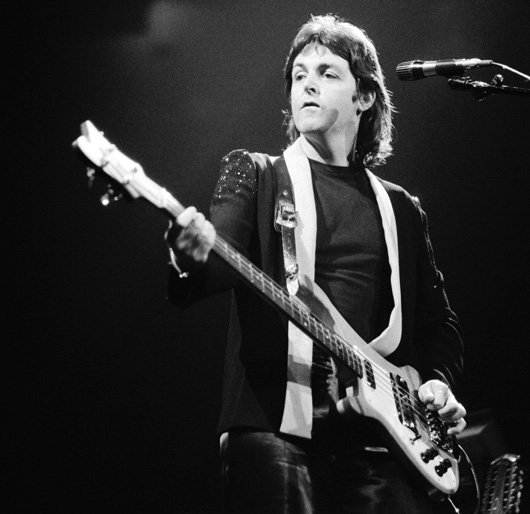
I have a little theory: Paul McCartney is insane. Batshit nuts. I don’t know quite when the cheese slid off his cracker, but I’m guessing about twenty-five years ago. Yes, he’s always been a little goofy, but lately? From his bizarre hair-dying experiments to the interviews that are about equal parts inane platitudes, vegetarian propaganda, and total gibberish accompanied by a cheery thumbs-up, he’s been leaving a trail of crazy wherever he goes since the mid-1980s. It’s not train-wreck, flame-out crazy, like Martin Lawrence wandering through traffic with a  handgun. It’s a subtler crazy, as if during the recording of Press To Play, alien beings had made off with his brain and attempted to replace it with an exact replica, but assembled it from poorly-translated instructions.

That’s not what happened of course. What happened is that his ownership of many valuable song publishing rights kicked in about then, he became a multi-billionaire instead of a multi-millionaire, cut himself off from anything resembling reality, and has been living in a totally self-generated bubble-world ever since. And I don’t blame him. If I became a multi-billionaire, I would reach foaming heights of crazy that would make Andy Dick look like a Presbyterian deacon.

For reasons directly related to his billionaire-induced craziness, Paul has become the most-maligned Beatle. [2022 Ed. Note — Not anymore! The McCartney Renaissance is in full swing, and I say it’s about time!] With every misfire album and every cringe-worthy quote, his light dimmed a little more. But make no mistake — he was the driving creative force of the Beatles in the second half of their career, and that’s no small thing. He always valued the concept of being in a band more than the others. Lennon gets credit for being the witty, rebellious iconoclast, Harrison gets credit for being the quiet mystic, and let’s face it, both of them get double-extra-credit for being dead. Everyone loves a corpse, because they never disappoint. They’re not around to release mediocre albums anymore. But both of them tired of the “band” concept long before Paul did. In the 70’s, Paul tried to keep the idea alive by putting together a bunch of hirelings and calling it “Wings,” but even he knew they weren’t a real band — they were his employees, and various members came and went like the clock-punchers they were.

(At the start of his solo career, he followed the example of Lennon and installed his wife as full creative partner. His second solo album is officially credited to “Paul & Linda McCartney.” On John & Yoko’s joint albums, Yoko contributed full songs. Horrible, horrible songs. But songs, nonetheless. Linda’s contributions consisted of 1) hilariously flat backing vocals placed super-high in the mix, and 2) helping to write some lyrics. The conceit fooled no one, but co-crediting songs kept their royalties from becoming “frozen assets” in the morass of the Beatles break-up lawsuits going on at the time.)

At times, Paul seems to be resented by fans for simply still being alive and somehow tarnishing the image of the Beatles by his very existence as a living, breathing doofus, which can’t be helped**. This can result in some unfair treatment. (There’s a song buried in the second half of Off The Ground — if you make it that far– called “Winedark Open Sea,” a kind of sparse, semi-dreary electric piano ballad that I suspect would be hailed as a “classic” if it came from Springsteen or Neil Young. Those guys can get away with almost anything.) Other times, it’s entirely his own fault. The parallels with George Lucas become obvious if you’re petty enough to examine them (which is my stock in trade). The younger creative genius gives us several gifts we all cherish, things that beyond providing hundreds of hours of entertainment, may even have molded us as people. He then ages into the older billionaire crank and starts doing stupid shit, such as going back and futzing with the legacy. McCartney’s bone-headed attempt to change the songwriting credits on “his” Beatles songs from “Lennon-McCartney” to “McCartney-Lennon” a few years ago is the musical equivalent of Greedo shooting first. Continue reading

23 Comments

Filed under Music -- 1970s-80s, Music -- 1990s, Music -- 2000s

The Best & Worst of the Solo Beatles, Part 1: John Lennon

Everyone has heard the saying “The whole is greater than the sum of its parts.” It’s an old chestnut that must predate the Beatles, but it seems to have been coined with them in mind. I won’t waste your time by piling a bunch of effusive praise on a band that receives little but effusive praise (if you want a time-waster, check out “Face-Off #1” from August), but I’ll just plunge ahead on and say the individual Beatles’ post-1969 careers have been a little patchy. Navigating their solo waters is treacherous, and sometimes you wonder what happened to the white-hot, jaw-dropping level of creative genius that fueled the Beatles in the 1960s. It seems to have just faded away when the four individuals were separated. Much like the Sankara stones in Indiana Jones and the Temple of Doom.

Which isn’t to say there aren’t moments of greatness in the Beatles’ solo discography. There are. Many of them. It just requires a little stick-to-itiveness to separate the wheat from the chaff. So, armed with patience, earbuds, a copy of Madinger & Easter’s Eight Arms To Hold You: The Solo Beatles Compendium, and mp3s of each and every Lennon, McCartney, Harrison, and Starr song (the fewer questions you ask about how I got them, the better), I listened to every note so you don’t have to, and I am here to report back to you so you can fill your iPods with the cream of the solo Beatles’ output, legally purchased from a reputable vendor. And since it’s way more fun to write about things you don’t like, I’ll also be cautioning you on what to avoid.

The format will be as follows: Best Album, Best Hit Single, Best Non-Hit Song (there’s lots of treasures buried halfway through an album side), followed by the Worst of those categories, and — since I never know when to shut up — runners-up for all categories. Only official studio albums of new material will be considered. No live albums, no albums of cover songs, no bootlegs, no film soundtracks, no compilations. Because that would take forever, and hey man, I have a life.

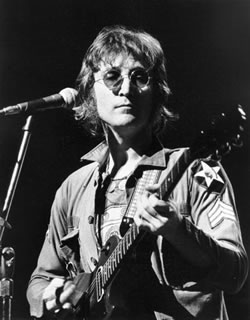
It’s no real surprise that John Lennon has the smallest solo discography — he was murdered just ten years into his post-Beatles career, and he spent half of those ten years in retirement. His official output shrinks even more when you consider that two of his albums were credited jointly to wife/artistic partner Yoko Ono and were only partially filled with Lennon songs, one was a posthumous release containing leftovers from one of the joint albums, and one was an album of oldies covers (1975’s Rock and Roll). When he was still with the Beatles, he and Yoko put out three “experimental” albums of random noise and Yoko’s charming screeching. (Unfinished Music, Vol. 1: Two Virgins (1968), with the infamous nude cover, Unfinished Music, Vol. 2: Life With The Lions (1969), and The Wedding Album (1969)). Since these are not in any sense of the word “music” (unfinished or no), and even I won’t sit through them, they won’t be considered here. So we’re left with only four true solo albums of new material.

Continue reading

16 Comments

Filed under Music -- 1970s-80s

“Tombstone” vs. “Wyatt Earp”

As is often the case with the Holy Bee, to understand the entertainment, we must start with the history…

People of Tombstone, Arizona remembered October 26, 1881 as particularly cold. A bone-chilling wind whipped off the nearby Dragoon Mountains, and many residents assumed a flurry of light, dry snow was on its way to the little silver-mining town. A storm of a different kind came instead. Two groups of men faced off against each other in a nondescript vacant lot. (The OK Corral, which would soon lend this confrontation its name, was actually on another street on the other side of the block. Its rearmost portion could be accessed by a tiny alleyway, the entrance to which was still several yards from the vacant lot. But, as author Jeff Guinn points out, “Shootout at the Vacant Lot on Fremont Street” doesn’t have much of a ring to it.)

Animosity between the larger interests each group represented had been growing for the past eighteen months. A tangled mess of politics, personality clashes, and a long series of incidents such as stolen U.S. Army mules, the semi-accidental shooting of the Tombstone city marshal, and a botched stagecoach robbery just outside of town limits all contributed to the tension that had been humming through the town since early the year before.

On one side of the lot were five men — Joseph Isaac “Ike” Clanton and his younger brother Billy, brothers Tom and Frank McLaury, and Billy Claiborne — who represented the “cowboys.” Small-time ranchers who openly rustled cattle from over the Mexican border less than forty miles south, they were viewed with suspicion by the town leaders and businessmen. Most were legitimate ranch hands with a rowdy streak, coming into town to drink and raise a little hell. Dealing in stolen cattle was something everyone did to keep their ranches afloat, and most people looked the other way (especially if the cattle came from Mexico.) Other cowboys were more sinister — genuine “bad men” from Texas, who fled that area when the legendary Texas Rangers started cracking down on outlawry. Politically Democratic and sympathizers to the old Confederacy, they also had many allies in the town who appreciated their free-spending business and admired their free-spirited resistance to authority.

On the other side were four men — city marshal Virgil Earp, his two brothers Wyatt (a deputy federal marshal) and Morgan (deputy city marshal), and the notorious John “Doc” Holliday (a well-educated dentist-turned-professional gambler) — who represented the order- and community-minded townspeople. The clannish, uptight Earps were never incredibly popular with the people they were charged to protect. Wyatt in particular was viewed as a dour, self-aggrandizing social climber, with a checkered past on both sides of the law, who spent most of his time running card games in a variety of saloons and investing in mines that didn’t pay off. He viewed his off-and-on career as a lawman as a means to an end (that end being authority and respectability that would lead to wealth).  He had formed a close, unlikely friendship with Holliday, who was slowly dying of tuberculosis. Holliday was known to have a vicious temper when drinking (which was most of the time by 1881), and his reputation for unstable behavior and violence preceded his arrival in Tombstone. Wyatt Earp’s own reputation suffered in many people’s eyes due to his association with what many considered a degenerate. But one of Wyatt’s good qualities was loyalty to his friends. The Earps were politically Republican and staunch Unionists, perpetually on the make to enhance their status and make money. The cowboys were a threat to that goal.

The Earps and Holliday confronted those five cowboys that day to disarm them — they were carrying firearms within city limits, against the local ordinance. It was a shaky accusation to make, as the cowboys were ostensibly on their way out of town, and therefore justified in taking the weapons (which they had lawfully turned over on their arrival the day before) with them. They were just taking an awfully long time to make an exit. Lingering. Almost trying to spark a confrontation. Harsh, drunken words and threats had been spouted in the saloons the night before (mostly by the loud-mouthed Ike Clanton), and the Earps had had enough. As they approached the vacant lot, they were stopped by county sheriff John Behan — a friend and ally to the cowboys. He assured the Earps — falsely and dangerously — that the cowboys had already been disarmed. He was ignored, and wisely took cover.

Billy Claiborne fled at the sight of the approaching lawmen. After the tiniest moment’s stand-off, either Wyatt or Billy Clanton fired their weapon.  The unarmed Ike Clanton fled as soon as the shooting started. Thirty seconds later, it was all over, and the remaining three cowboys were dead or dying in the lot and the adjacent street. Tom McLaury was also revealed to be unarmed, but was shot several times as he desperately grabbed at the rifle in his saddle holster. Only Frank McLaury and Billy Clanton had weapons on them. The worst of the cowboys — true outlaws and killers like Curly Bill Brocius and John Ringo — were nowhere near Fremont Street that day.

But it did not end there. Controversy and retributions continued for several months. The Earp party were tried and acquitted of murder. Virgil and Morgan were victims of fearsome ambushes orchestrated by Ike Clanton and the more violent-minded cowboys. Wyatt and Holliday led a posse of dubious legal authority to cleanse the countryside of cowboy influence. The so-called “Vendetta Ride” became almost as legendary as the shootout itself… Continue reading

19 Comments

Filed under Film & TV, History

The Holy Bee of Ephesus has a new home!

Welcome to the new home for my wickedly self-indulgent blog Holy Bee of Ephesus, which has been a Blogspot fixture for the past three years. You’ll get features such as The Holy Bee Recommends, Books of the Holy Bee, the epic ongoing examination of music of the 1990′s This Used To Be My Playground (which runs concurrently on The Institute of Idle Time website), and other random crap. It will all appear here — both new entries and the old stuff. The transfer of the archives was not flawless, so I still have some work to do down in the Vault, correcting images and captions, fixing links, etc. If you want to finally admit to yourself that there’s nothing going on in your life, then there’s a subscription button on the lower left, alerting you via e-mail each time the site is updated. Don’t wait for the Facebook posts (you could miss one, and that’s enough to ruin anyone’s week), get each update while it’s hot and fragrant. C’mon, folks, lower the bar. You can only watch that cat that flushes the toilet on YouTube so many times before you wonder if there’s something even more pointless on the internet. Join the Holy Bee army.

I may keep the Blogspot site open as a “second home,” for those who fear change, but it won’t be forever. The other Holy Bee “second home” was on LiveJournal. I was lured into using LiveJournal by meeting someone who keeps a very literate, well-informed blog on current events there. As it turns out, the person I met was the only living human being who keeps a literate, well-informed blog on LiveJounral. LiveJournal is actually 90% fat, acne-riddled goth girls writing about goth shit, and 10% undecipherable typing by recent Ukrainian immigrants who contribute by tapping lightly on their keyboards with their penises after a long night of huffing nail varnish. Stellar company for some, but not a class act like the Holy Bee of Ephesus. So goodbye, LiveJournal (and Blogspot, eventually), hello WordPress!

Leave a comment

Filed under Random Nonsense

Family Jewels

(NOTE: Edited for minor corrections and updates in 2022.)

Greetings. I hope my summer hiatus from writing hasn’t killed off what little readership I have. I know I said that in a previous post that my work ethic was virtually non-existent during the summer months, but that’s not 100% factual. I have been working, sometimes feverishly. Just not on this blog. On what? You are justified in asking.

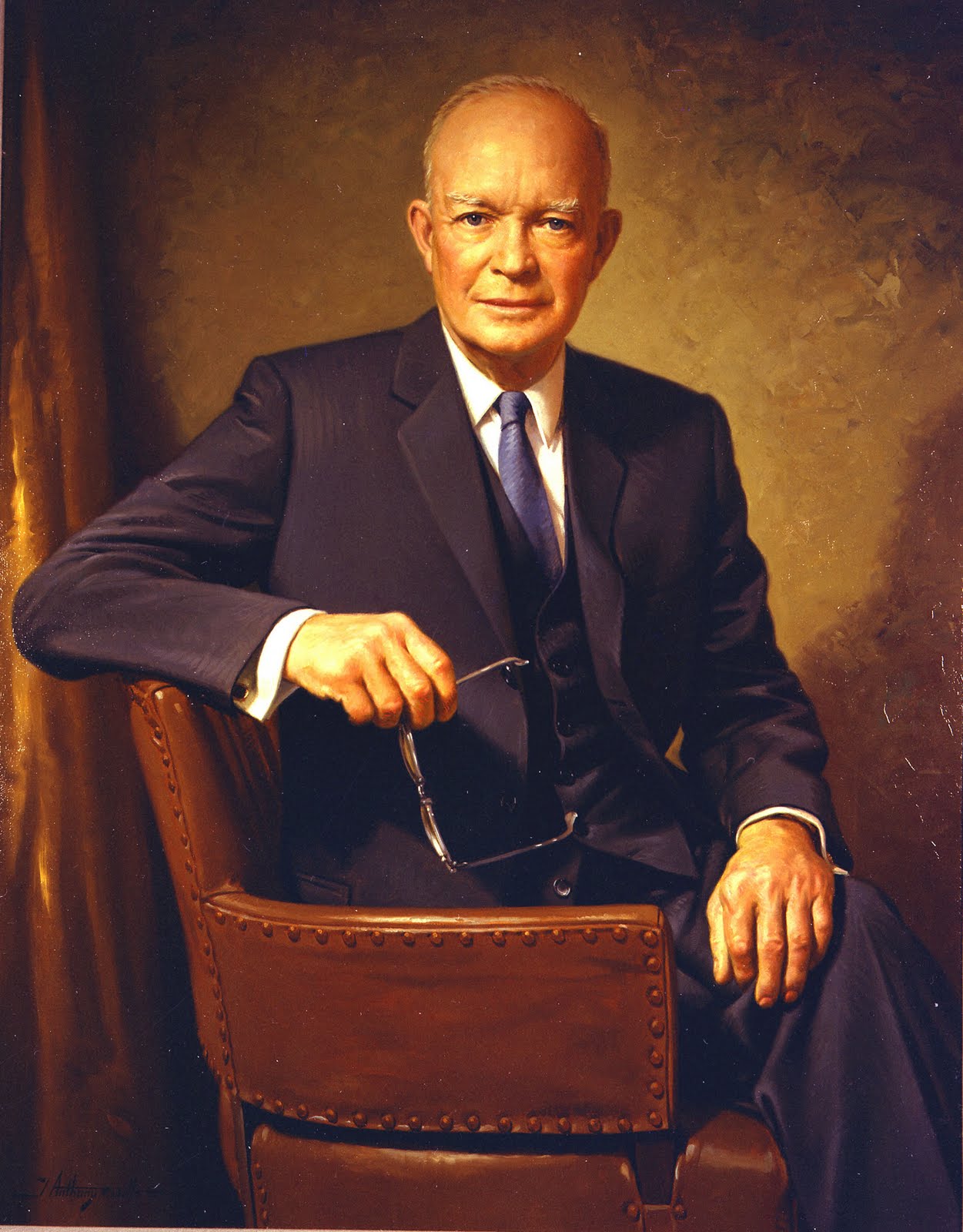
President Eisenhower

On my family history. The Big Summer Project has been scanning, digitizing, and organizing the thousands of family pictures that have come into my possession over the years. Doing this has also revived my periodic interest in genealogy.

Say what you will about obsessing over the Magic: The Gathering or the minutiae of Harry Potter, but exploring genealogy truly outranks them in sheer nerdiness. It’s the hobby of Mormons and retired people (nothing against those folks, it’s just that they’re not your go-to for cutting-edge activities). But I suppose I’m one of them. The only lower rung on the hobby ladder is metal-detecting. Maybe next summer.

As someone with the last name of Isenhower, I have been subjected repeatedly to the well-meaning but irritating question “Any relation to the President?” These instances are diminishing greatly since those with any knowledge that there had once been a President Eisenhower are rapidly dying off. “No, it’s spelled differently,” I would always say.

Out in the retail world, I had a little routine. If there was an older person manning the counter, I would observe them always checking the “E’s” first when I would go to pick up a prescription or my developed film. (The fact that I once picked up developed film is itself evidence that I, too, am heading into the “older person” zone.) I would let them look, and allow them to give me a puzzled, apologetic shrug, before I told them, with exaggerated patience as if it were the most obvious thing in the world, “Check the I’s.”

Yes, I was kind of an ass. Continue reading

10 Comments

Filed under History

Tales From the Apple Box, #2: “Soul Rotation”

The second installment of my “Forgotten (Unjustly — or Sometimes Justly) Albums of the 90’s” series.

“There’s a little man in my head, and he’s drunk all of the time,” the poem began. “He sits there on a bench holding a monkey wrench, sometimes he beats it against my mind.” I was utterly captivated as I sat in my high school creative writing class, listening to a classmate of mine reel off this poem of such humor and surrealism. I looked down at my own stupid teen-angst poem, and was ashamed. I wish I could write like that, I thought. As it turned out, my classmate wished he could write like that, too. He cheerfully admitted later that he had lifted the poem (and several others) entirely from the lyrics of a band called the Dead Milkmen. This tactic quickly bored him, and in short order he discovered marijuana and began stealing Pink Floyd lyrics instead, but I was hooked on the Dead Milkmen.

After years of circulating self-released cassettes, Philadelphia’s Dead Milkmen were finally signed by indie label Restless Records, and put out their official debut, 1985’s Big Lizard In My Backyard. With nary a song lasting over two minutes, and titles like “Veterans Of A Fucked-Up World” and “Takin’ Retards To The Zoo,” BLIMB was the only record in the Milkmens’ catalog that could be defined as truly punk, although that label continued to be applied to them. Over the next three albums, their sound became gentler and more jangly as their musicianship improved (the squeaky-clean guitar lines of Joe Genaro were a favorite element for me), and their snotty childishness grew less aggressive and more whimsical, even adding a touch of melancholy. Fans came to expect certain elements to be included on each album, and by the time of their final release on Restless, 1990’s Metaphysical Graffiti, this had hardened into a formula: A humorous ranting monologue (or two) from lead singer Rodney Anonymous, some sophomoric scatological stuff (“Do The Brown Nose”), some retro pop-culture stuff (“I Tripped Over The Ottoman,” the best Dick Van Dyke Show tribute song you’ll ever hear), and some more “serious” stuff with a light sprinkling of social commentary (“Dollar Signs In Her Eyes”) all played impeccably with a light pop-punk touch. But by Metaphysical Graffiti, the schtick had worn thin, for the band if not their audience. For the first time, the Dead Milkmen sounded a little tired. Continue reading

Leave a comment

Filed under Music -- 1990s, Tales From The Apple Box

More to come…


The Holy Bee hasn’t forgotten you. It’s just that his work ethic is at a very low simmer between June and August.

Keep the faith & stay tuned…Lots of new things cooking…

Leave a comment

Filed under Random Nonsense

Holy Bee Recommends, #7: "On Writing"

Stephen King…the name still conjures images of his 80’s heyday, when his novels about vampires, re-animated corpses, haunted hotels, and psycho killers defined horror fiction. His work took a broader turn beginning about twenty years ago, giving a subtler, more psychological twist to his grim terror tales, and also expanding far beyond the confines of the horror genre.

I am an unabashed fan of King’s work, but not for the reasons one would expect. Nothing that the printed word conveys can truly terrify me (this is the failing of my own imagination, not of King’s skill), so I read King for the clever twists and turns of his stories, and for his authorial voice — informal, highly descriptive, pop culture-savvy, and often laugh-out-loud funny. Continue reading

Leave a comment

Filed under Books, The Holy Bee Recommends