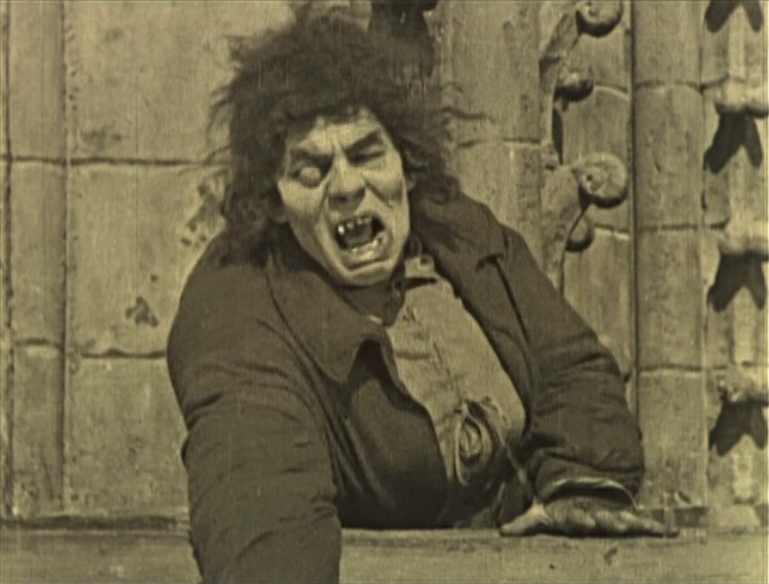
Poe Folks (Karloff & Lugosi)
As soon as Boris Karloff and his Frankenstein’s Monster appeared on the scene, Bela Lugosi’s stock dropped with studio executives, if not necessarily audiences. Film historians have been unable to pin down exactly why. There was certainly room for more than one horror star. Lugosi could be stand-offish but was not difficult to work with — quite the opposite, in fact. Some blame his inability to adapt his old-fashioned, theatrical acting style to more modern cinema standards, but one viewing of Son of Frankenstein should be enough to scotch that theory. Maybe it was his proud refusal to tone down the accent. Could it be interwar xenophobia against someone from eastern Europe? Impossible to say for sure. All that can be definitively said is that Universal (and other studios, but Universal especially) seemed to go out of their way to treat Lugosi shabbily.
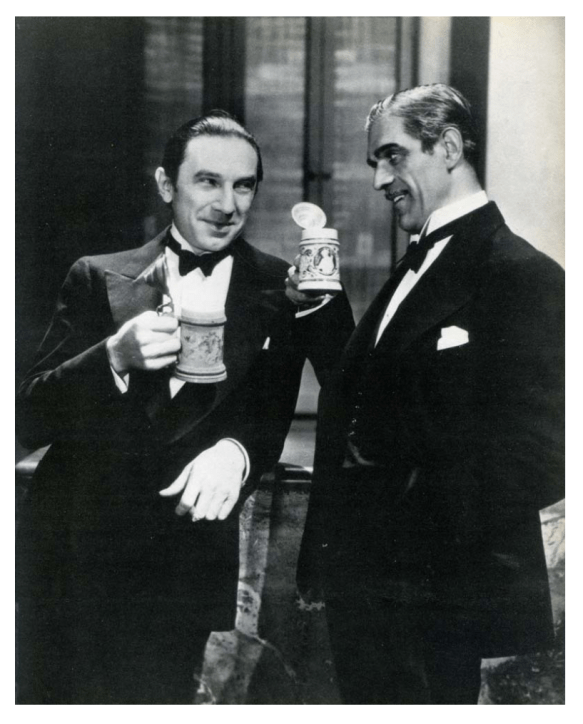
Bela and Boris toast each other in a publicity photo from their first flush of fame, 1932.
In 1934, Lugosi’s name could still draw horror fans, and it was known he worked cheap. And Universal had just renewed Karloff’s contract. The inevitable result was the teaming of the two. Karloff and Lugosi appeared together in five Universal films from 1934 to 1940, one of which was part of the Frankenstein series, two of which were more science fiction than horror, and two of which were very, very loose adaptations of Edgar Allan Poe stories. No matter the part, Karloff always received top billing and lots more money.
The first of these, The Black Cat (May 1934), is probably the most interesting. Lugosi is a traumatized war veteran just released from a Siberian prison and bent on avenging himself against the man (Karloff) who betrayed his wartime companions to the enemy, and stole away Lugosi’s wife and young daughter. Karloff is now an Aleister Crowley-like leader of a Satanic cult and is married to Lugosi’s daughter (the wife having been dispatched as a cult sacrifice long ago). After Karloff callously offs the daughter as well, Lugosi has his revenge, skinning Karloff alive, and then sacrificing himself so the Handsome Young Couple™ who had gotten themselves tangled up in this mess can escape. What does this have to do with the Poe short story “The Black Cat”? Nothing whatsoever, except that Lugosi’s character has a cat phobia, and this comes into play at one crucial point in the story.
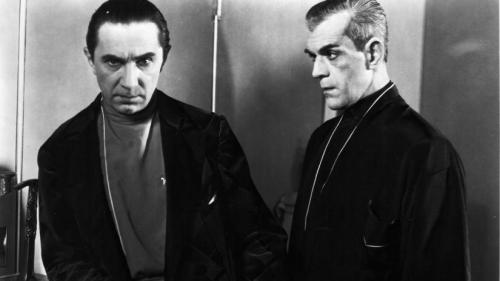
Who has the more piercing stare? The Black Cat (1934)
The Black Cat may be one of the darkest, most twisted films of the 1930s, and merits a mention here even if it has nothing to do with the classic Universal monsters. (And it has one of the most classic lines from any Universal horror movie. When the goings-on are dismissed by the young hero as “superstitious baloney,” Lugosi remarks ominously “Superstitious…perhaps. Baloney…perhaps not.”)
The follow-up, The Raven (July 1935), also has nothing to do with the first shared universe, but has a little more to do with Poe than its predecessor. Lugosi has the madman part here, playing a deeply disturbed plastic surgeon with a Poe fixation, to the point that he has a stuffed raven on his desk. Oh, and he’s also replicated the pit and its bladed pendulum in an extensive torture chamber in his basement. When a Handsome Young Couple™ (and her father) enter his web, terror ensues. Karloff is the B-story — a murderer on the run who asks Lugosi to alter his appearance. Lugosi does — horribly disfiguring the criminal, promising to change it back only after he does his bidding.

Lugosi disfigures Karloff, The Raven (1935)
Was there a long-running Karloff/Lugosi feud or rivalry as has long been speculated? Certainly not on Boris’ part, but because he came out on top, financially and in the public perception, he could afford to be magnanimous. Lugosi’s last two wives insisted that Lugosi really did not much like Karloff, and did give voice to jealousy and resentment in regard to his “rival” on occasion. As portrayed by Martin Landau in Tim Burton’s Ed Wood (1994), the elderly Lugosi would go into a profanity-laced rage at the mere mention of Karloff’s name. Bela’s son was gracious enough to praise Landau’s Oscar-winning performance, but stated that it was a work of fiction. The real Lugosi never used bad language, and never spoke ill of Karloff to anyone beyond private moments with his spouses. During the course of the five films they made together for Universal (plus two for RKO, and several self-parodying radio spots and publicity appearances), no one remembered a cross word between the two. Their relationship was always cordial and professional, although they did not socialize or build a friendship once they clocked out from the day’s work.
A Bride and a Daughter
Yes, Karloff got top billing and a truckload of money for a pretty small part in The Raven. Universal felt justified because Karloff was hot off Bride of Frankenstein — triumphantly revising the role that made him a star in a film that many, then and now, say surpasses the original.
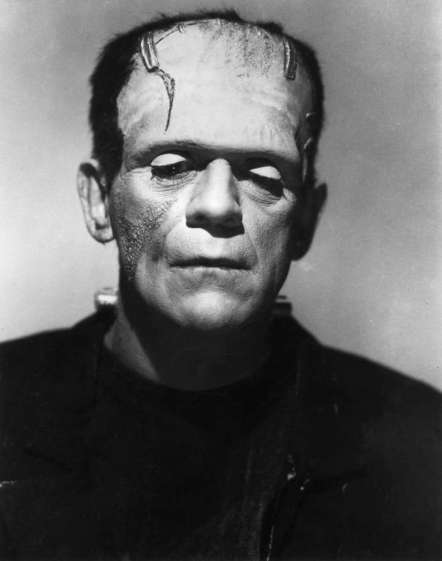
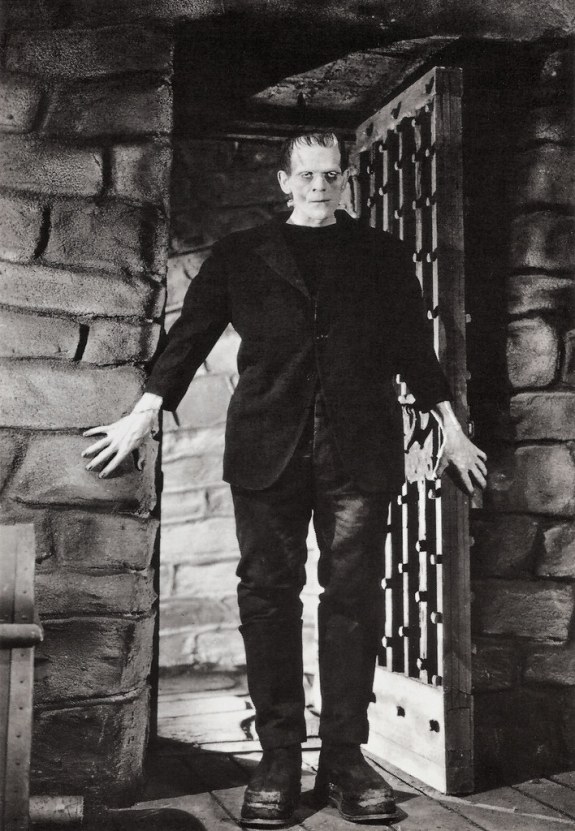
Updated make-up for the Monster — singed hair and scarred cheek after surviving a fire at the end of the original film.
As promised, James Whale got free rein to make the film however he wanted. He abandoned the somber tone of the original, and replaced it with a more personal style — dark comedy, with lots of symbolism, and moments of high camp. Henry Frankenstein has learned his lesson and wants nothing more to do with reanimating dead bodies. The problem is, his creation is still running amok. Knowing this, an old associate of Henry’s, the quite insane Dr. Pretorius, forces Henry to continue his experiments and make his Monster a mate.
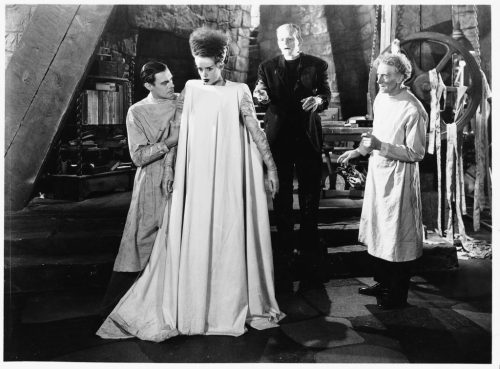
“A new world of gods and monsters” — Henry Frankenstein (Colin Clive) and Dr. Pretorius (Ernest Thesiger) admire their handiwork.
Karloff once again plays the Monster with a pure simplicity that can switch to fearsome menace. He has even learned to speak a few words (a development the actor fiercely opposed.) Colin Clive as Frankenstein is tense and edgy as before. But the movie-stealer is Ernest Thesiger as Dr. Pretorius. The flamboyantly gay Thesiger was an old theatrical crony of Whale’s, and had appeared as one of the very odd inhabitants of Whale’s Old Dark House, which struck a similar tone of suspenseful dread combined with gallows humor. (Thesiger was also a master needlepointer, and referred to himself as the “Stitchin’ Bitch.”) Dwight Frye makes a welcome return as Pretorius’ grave-robbing lackey, Karl.
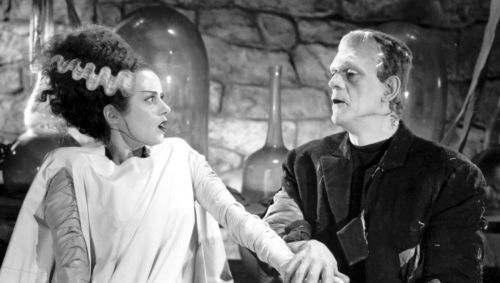
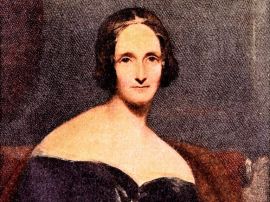
The title plays on the fact that many people were already incorrectly applying the name of the doctor to his creation. (The title can be taken at face value — Henry Frankenstein does get married in the film. Or it can indicate possession, that he’s the creator of the Monster’s mate, as in the “plays of Shakespeare.”) The Monster’s Bride herself is played by bohemian free spirit and former dancer and cabaret performer Elsa Lanchester, who appears as the iconic character only for a few moments at the end, and also plays a dual role as Mary Shelley in the film’s prologue. The Bride’s make-up is another Jack Pierce creation that has lived on in popular culture, and Lanchester said she based the Bride’s jerky movements and hostile hissing on the swans in Regent’s Park. Continue reading

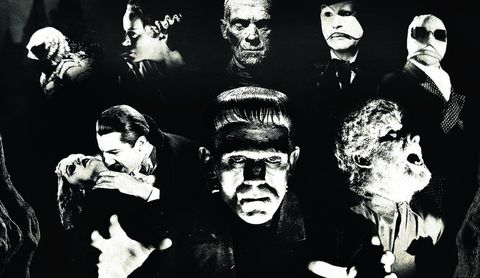
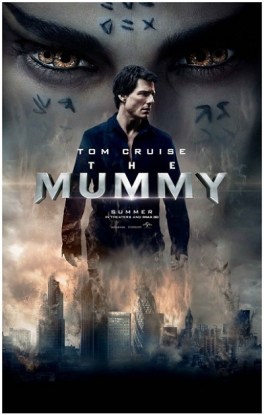 horror elements were laughable, and the characters were cardboard cut-outs existing mostly to spout paragraphs of expository dialogue. It was the cinematic equivalent of a dumpster fire, and barely broke even at the domestic box office. It skulks around at a 16% Fresh on Rotten Tomatoes.
 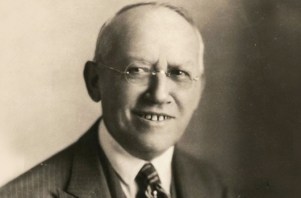 In 1905, German-Jewish immigrant Carl Laemmle was a bored clothing store manager in Oshkosh, Wisconsin. On a trip to Chicago, he noticed lines around the block to experience the “nickelodeon” — a primitive movie theater showing a variety of short films, or offering single-viewer Kinetoscope machines. Inspired, Laemmle decided this would be the new direction of his life, and in less than five years he and several partners had founded Independent Moving Picture Company (IMP) of New York. In 1912, he moved operations to California, and turned IMP into Universal Pictures.
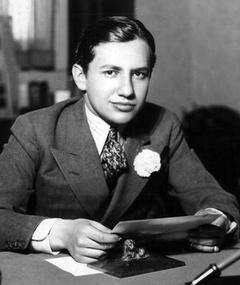 control of the studio to his son, Carl Jr., in 1928. Junior Laemmle demonstrated more enthusiasm than administration skill, but he had a good instinct for stories that would work well on film. One of the first productions he oversaw was the anti-war drama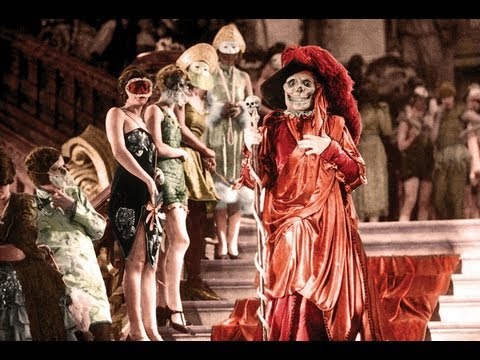
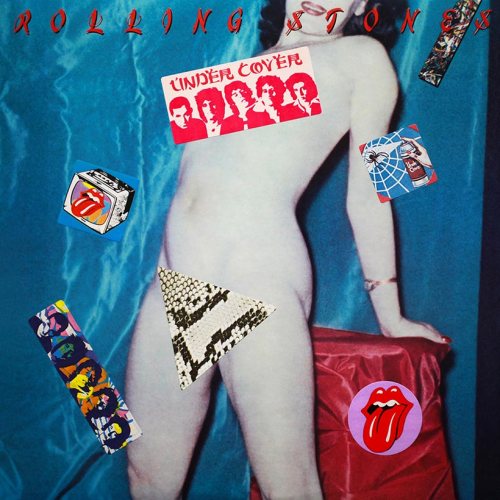
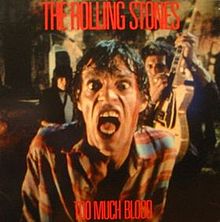 Blood” is the last gasp of the Stones’ side job of creating at least one dance track per album for the discos, a tradition that began with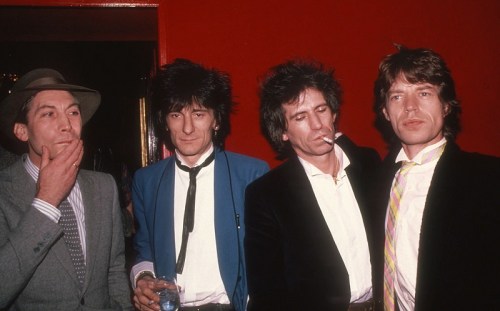
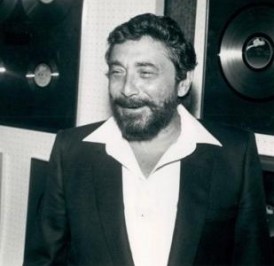
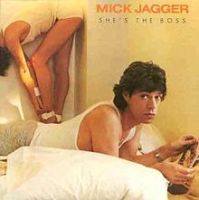 at Pathe-Marconi with an empty tank. No songs, no ideas for songs, no lyrics, no scraps. He had used it all up on his own album,
 Thompson, specifically to work with her father, Henry, on it. The story reflected their own difficult relationship. Location filming on























 Holy Bee of Ephesus