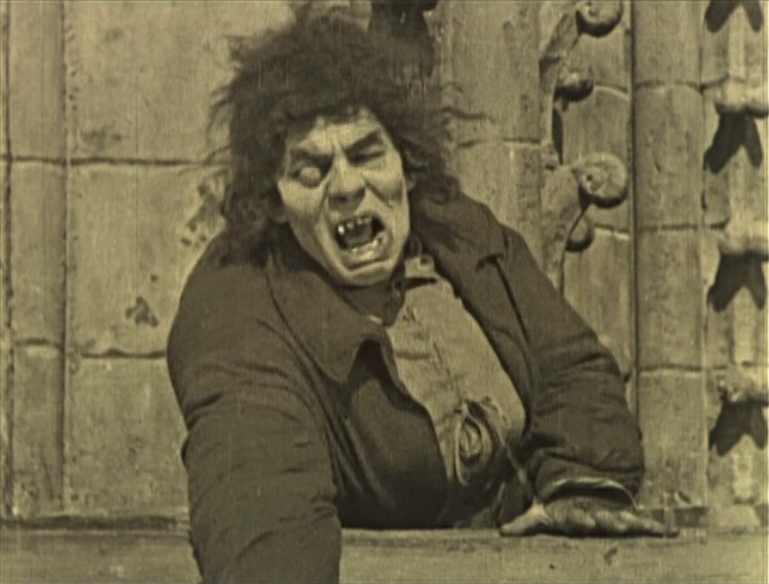
Frankenstein
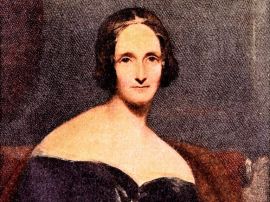 Mary Shelley (1797-1851) was the unconventional offspring of an unconventional couple: early feminist Mary Wollstonecraft and radical anarchist William Godwin. At 16, young Mary ran off with married Romantic poet Percy Bysshe Shelley. Over the next several years, the Shelleys (who married after the fortuitous suicide of Shelley’s abandoned first wife in 1816), along with Mary Shelley’s step-sister Claire Claremont, and Percy Shelley’s friend and fellow poet Lord Byron made up an odd quartet, rambling around Europe, blowing through their ample inheritances, reading, writing, and philosophizing. Speculation about their free-love romantic entanglements in every mathematically-possible combination can (and does) fill a book.
The idea for Frankenstein came to Shelley when they were staying at Byron’s rented villa in Geneva, Switzerland in the summer of 1816. The well-known tale goes that Byron challenged all of his overly-intellectual guests to step down from the lofty heights of poetry and philosophy and write a good old-fashioned ghost story. From the germ of an idea about an obsessed young man who discovers the secret of bringing life to the dead, Shelley worked through that autumn and into the next year, creating a work of heavy philosophy cut through with a few streaks of very effective Gothic horror. Frankenstein; or, The Modern Prometheus was published in 1818 to a mixed critical reception.
Modern readers may be turned off by the interminable philosophical musings about the nature and purpose of existence, and by the fact that the Monster speaks…eloquently and at great length, sounding like John Milton. The Monster’s creator, Victor Frankenstein, is not a “doctor” but a young chemistry student at the University of Ingolstadt in Germany. The Monster is brought to life not in a massive, electrified laboratory, but in Victor’s student apartment (and Shelley is pretty damn vague on the details of the process). But lots of stuff that found its way into the movies over a century later is right there in the pages. Frankenstein’s obsession bordering on madness, hunting through the “damps of the grave…the dissecting room and the slaughter-house” to gather the parts needed for his experiment is one of the best sequences of the book. And when the Monster finally comes to life, Shelley’s description of his form is eerily familiar: “His yellow skin scarcely covered the work of muscles and arteries beneath; his hair was of a lustrous black, and flowing…his watery eyes, his shriveled complexion, his straight black lips.” There’s even a sequence late in the book where Victor creates a “bride” for the Monster, but he never brings her to life.
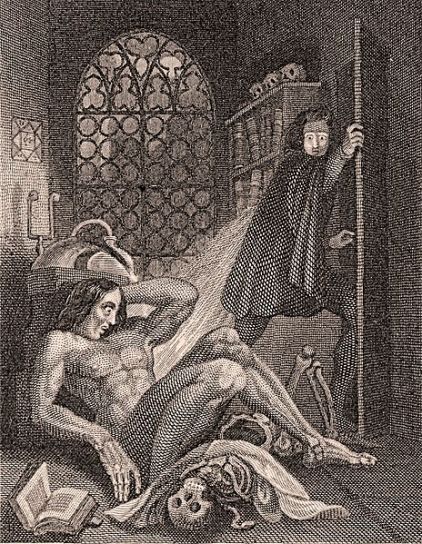
Frontispiece to the 1831 edition of the novel
A stage adaptation of Frankenstein hit the boards as early as 1823, and Shelley’s tale continued to be part of popular lore through the 19th century. A silent film version was produced by Thomas Edison in 1910. Hamilton Deane, who mounted the first stage version of Dracula in 1924, commissioned playwright Peggy Webling to adapt Frankenstein as a follow-up in 1927. Though not as successful as Dracula (Webling’s play never made it to Broadway), Universal was inspired to follow the same pattern, and announced Frankenstein as its next horror property to hopefully capitalize on the success of Dracula.
Writer-director Robert Florey had signed for a one-picture deal with Universal, and jumped on the Frankenstein project. (Florey had recently directed the Marx Brothers’ film debut, The Cocoanuts, for Paramount, and as he watched the Brothers’ performances he kept asking his assistant “This is supposed to be funny?” Florey was just not a comedy guy.) Working with writer Garrett Fort, Florey stripped Shelley’s overstuffed tale down to its bare essence, made multiple changes, and gave the story a solid and fast-moving structure. His work pleased Universal enough that he was assigned to be the film’s director. Bela Lugosi was set to be the Monster, much to his displeasure (see previous entry). Edward Van Sloan and Dwight Frye were invited back, cast in roles similar to their Dracula parts. Waterloo Bridge’s Mae Clark was assigned the role of Frankenstein’s fiancee, Elizabeth. And Universal hoped rising star Leslie Howard would be the doctor (an official offer had yet to be made).
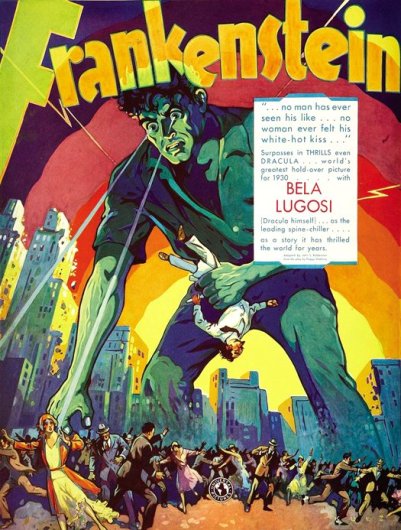
Spring 1931 — A one-off illustration from Universal’s exhibitor’s catalog, hyping films in currently in pre-production. Some were never made at all, some changed drastically.
In June 1931, Florey shot a 20-minute test reel of Lugosi, Van Sloan, Frye, and a few stand-ins on the still-standing Castle Dracula set. Part of the purpose was to see how the heavy Monster make-up would appear on film.
And it appeared totally ridiculous.
The first make-up design for Frankenstein’s Monster was supposedly (the footage has disappeared) based on the German silent film The Golem, another tale about bringing life to dead material. Edward Van Sloan said Lugosi “looked like something out of Babes in Toyland.” Lugosi himself compared his look to a “scarecrow.” The most misguided element was described as a ridiculously wide, shaggy wig, as broad as Lugosi’s shoulders (think Roseanne Roseannadanna). Junior Laemmle reportedly burst out laughing when he screened the footage.
Not long after, James Whale decided he wanted Frankenstein. Universal wanted a happy James Whale. Florey was unceremoniously dumped. Nor did Whale want Leslie Howard as Dr. Frankenstein. He insisted upon having his intense leading man from Journey’s End, Colin Clive. The studio acquiesced, and Clive was flown in from London. (Studio gossip maintained that the bisexual Clive was Whale’s lover. And Leslie Howard did indeed go on to stardom, most notably as Ashley Wilkes in Gone With the Wind.) Nor was Whale happy with Bela Lugosi. For the Monster, he wanted one of Universal’s most notable character actors, Boris Karloff.
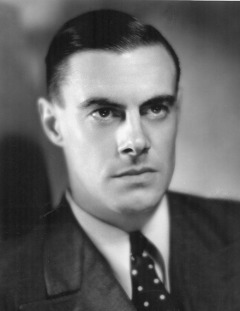
Colin Clive
Keep in mind, Lugosi never wanted the part in the first place, and it’s hard to blame him. Florey’s first-draft script gave the Monster no nuance or pathos, he was presented as merely a mindless killing machine (a persona he would return to later in the series.) And the unintentionally funny test reel didn’t help. But despite his insistence over the years that he turned down the role, in all likelihood Lugosi was replaced with Karloff at Whale’s insistence. (In Bela Lugosi & Boris Karloff: The Expanded Story of a Haunting Collaboration, film historian Gregory Mank credibly maintains that the super-professional Lugosi would have done the part in spite of his misgivings had the decision not been taken out of his hands.)

Whale and crew began filming Frankenstein on August 24, 1931, while southern California was in the grip of a sizzling heat wave. Boris Karloff labored mightily under the weight of his costume and (brilliantly re-designed) make-up as the sun pounded down on the “Little Europe” portion of the Universal backlot. Interior shooting offered no relief, as the bright lights illuminating the sealed-off sound stages often pushed temperatures toward 115°. Universal’s largest stage, Stage 12, was used for the towering laboratory set. Kenneth Strickfaden designed the lab’s iconic electrical equipment, sparking and buzzing their way into film history. Whale drove his sweaty cast mercilessly. A bucket was provided in the corner of the set for urinary relief. One grueling 25-hour shooting day (September 28-29) as Whale struggled to stay on schedule may have planted a seed in the exhausted Karloff’s head which resulted in him becoming a founding member of the Screen Actors’ Guild a few years later.
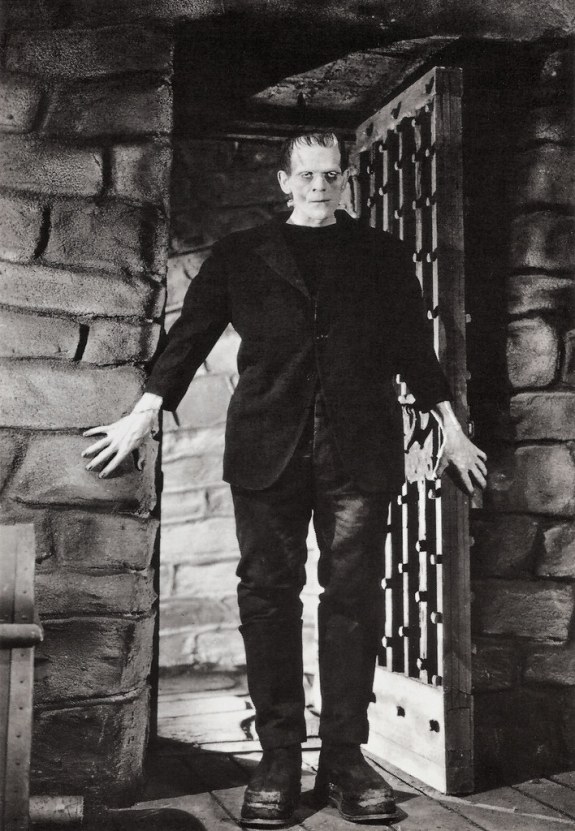
But Jimmy was getting results. Despite his horrific visage, Karloff’s Monster was ultimately a figure to be pitied. In a tremendous job of physical acting, Karloff conveys the Monster’s confused suffering quite convincingly. In his words, he played the Monster “as though Man had been deserted by his God.” Colin Clive, a neurotic, blackout alcoholic prone to fits of nervous hysteria in real life, is riveting as Henry (no longer “Victor”) Frankenstein. Clive raves with insanity gleaming in his eyes during the moment of creation, and later evinces a broken shell of a man as he comes to his senses and realizes what he has wrought. Edward Van Sloan is authoritative as Henry’s mentor, Dr. Waldman, and Dwight Frye adds another unhinged eccentric to his resume. Much like Lugosi did with Dracula, here Frye creates the very template of the crazed, hunchbacked lab assistant with his portrayal of “Fritz” (no, not “Igor” just yet) that would be imitated for decades to come.
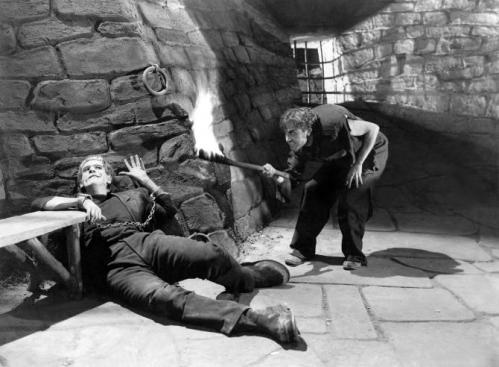
The Monster is tormented by Fritz (Dwight Frye)
Filming wrapped on October 3, and Frankenstein was released in December 1931. It boasted a music score by Berhnaud Kaun, one of the first Universal releases to have that distinction. Despite a prologue featuring Van Sloan warning the audience of the terror to come, Frankenstein was considered even more shockingly horrific than Dracula. Sequences that were considered too shocking were snipped out after the film’s initial run — the Monster throwing a little girl into a lake and (accidentally) drowning her, and Clive’s shouted, blasphemous comparison of himself to God would be missing from the film until its video release far in the future. Continue reading
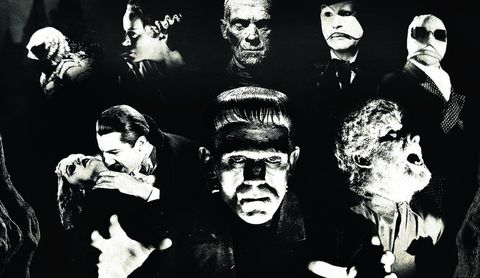
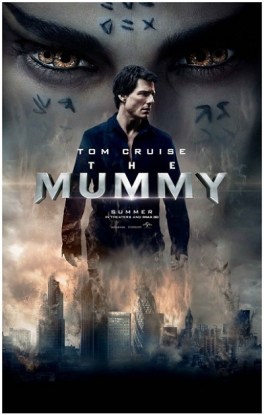 horror elements were laughable, and the characters were cardboard cut-outs existing mostly to spout paragraphs of expository dialogue. It was the cinematic equivalent of a dumpster fire, and barely broke even at the domestic box office. It skulks around at a 16% Fresh on Rotten Tomatoes.
 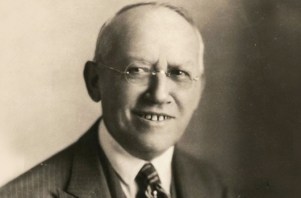 In 1905, German-Jewish immigrant Carl Laemmle was a bored clothing store manager in Oshkosh, Wisconsin. On a trip to Chicago, he noticed lines around the block to experience the “nickelodeon” — a primitive movie theater showing a variety of short films, or offering single-viewer Kinetoscope machines. Inspired, Laemmle decided this would be the new direction of his life, and in less than five years he and several partners had founded Independent Moving Picture Company (IMP) of New York. In 1912, he moved operations to California, and turned IMP into Universal Pictures.
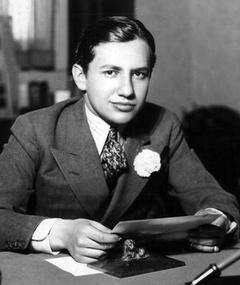 control of the studio to his son, Carl Jr., in 1928. Junior Laemmle demonstrated more enthusiasm than administration skill, but he had a good instinct for stories that would work well on film. One of the first productions he oversaw was the anti-war drama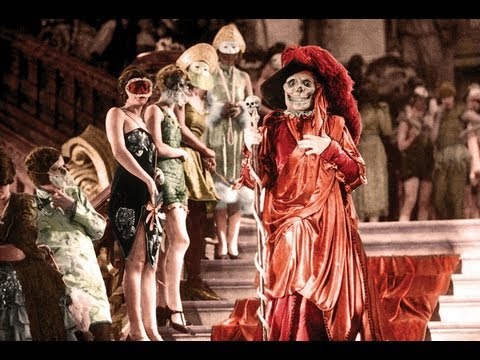



 It can be mildly frustrating being on the dividing line between generations. I am on the younger end of
  often, I (internally) cry out is dismay as the hosts reveal their status as ignorant pups bumbling across my audio lawn by completely misunderstanding — or missing entirely — an older cultural reference that Seinfeld will make from time to time. I can almost hear the whizzing sound as the name or phrase sails over their heads. How can a someone as grown-up as a pharmacist not recognize a reference to A Streetcar Named Desire? (They were baffled by Elaine’s Brando-esque cries of “Stella!” when she encounters someone of that name while stoned out of her gourd on painkillers.) And they seem to not realize Elaine and Jerry’s frequent inside-joke refrain of “all right sir” is quoting
  There is no rhyme or reason to the order that Antenna TV airs the episodes. A


















 Holy Bee of Ephesus