Category Archives: Film & TV

The Holy Bee’s 2011 Halloween Special, Part 2

The house is getting a warmer, so the Snuggie comes off. Maybe I should put some pants on. Naaaah…

As his motives become somewhat clearer, I am still left with the nagging question: Why is Michael Myers immortal? The other two horror super-franchises, Friday the 13th and Nightmare on Elm Street make no bones (pun intended)(not really a pun) about their villains (heroes?) being of the supernatural realm. But Michael Myers is supposed to be a simple, flesh-and-blood serial killer. As of now, he has at least ten bullets in his torso, and two fired right through the eye holes of his mask. And he definitely bleeds. What’s going on here?

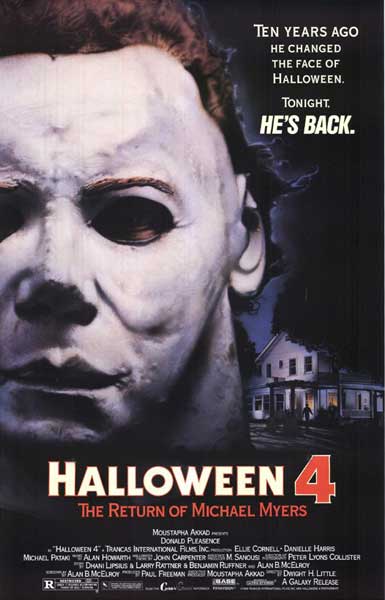
1:50 pm. Halloween 4: The Return of Michael Myers (1988). The coffee has long since been consumed, and I pry the first twist-top off a Bud Light Golden Wheat. (I keep trying to interest Anheuser-Busch in my tagline for this product: “The Cadillac of Shitty Beers.” I haven’t heard back from them yet.)

The swtich from Roman numerals to our more familiar Arabic numerals in the official title indicates our return to the familiar territory of Michael Myers and Dr. Loomis. No Laurie Strode, though. Jamie Lee Curtis was busy making one of my all-time favorite movies, A Fish Called Wanda. It would have been nice to have her, but she clearly made the right choice. Her character is killed off in an unspecified accident about a year before the events of 4, along with the husband she must have married right out of high school. (I suspect it’s supposed to be Lance Guest’s EMT character, Jimmy, who flirted with her in II.) Laurie’s eight-year-old daughter, Jamie Lloyd (daughter of “Jimmy”?),  is adopted by the Carruthers family, and becomes the sister of Rachel Carruthers.

Rachel is played by Ellie Cornell, and manages a performance of wit and toughness almost equal to Curtis in the original. She is, however, outshined by Danielle Harris as Jamie. Harris is pretty extraordinary for a child actress, and really gets put through the wringer in this flick, but is never over-precocious or unnatural. Pleasence once again hams it up delightfully (he usually takes about three syllables to say his favorite word, “eeee-vy-il.”) Non-John Carpenter-related work appears to have dried up for Pleasence, so now instead of shamefacedly slumming in quick-cash slasher flicks between Shakespeare engagements, he appears to have made the Halloween franchise the centerpiece of his career.

2:30 pm. I fix a ham sandwich in honor of Donald Pleasence.

The hellish immolation of Myers and Loomis at the end of Halloween II ten years before is dismissed in the first five minutes as both of them “almost dying” in a fire. Loomis now has a bit of scarring and a limp. Myers has been in a coma under heavy guard. Naturally, he wakes up. With amazing navigational and driving skill for someone who has spent most of his life locked in asylums or comatose, he comes after his lone remaining family member — his niece Jamie. Although it has none of the atmosphere and subtlety of the first film, it also keeps the gore at a pretty tame level. The deaths here are actually milder than a Stallone or Schwarzenegger action flick of the same era. The movie is not good, but after Halloween III it seems like Citizen Kane. Rachel acts as a valiant protector of her adopted sister Jamie, and Michael Myers gets another “death” in a hail of gunfire (and another sheriff’s daughter gets offed in the process.) In a little epilogue just before the credits, it seems Jamie has inherited her uncle’s murderous tendencies.

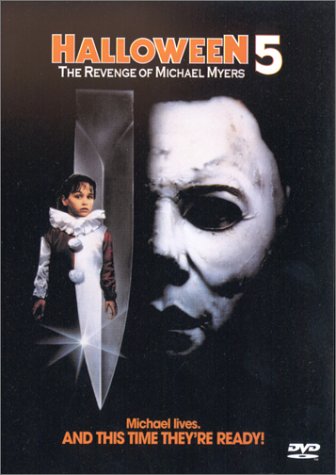
3:28 pm. Halloween 5: The Revenge of Michael Myers (1989). Remember when they used to call empty beer bottles “dead soldiers”? Well, I’ve got three dead soldiers on the floor next to the couch, and a fourth about to fold under my enhanced interrogation techniques. Myers survives his most recent death and appears to have established a telepathic bond with Jamie. Jamie has been thoroughly and understandably traumatized by the events of 4, and after a (failed) Myers-style knife attack on her adoptive mother, now lives full-time in a children’s clinic, experiencing nightmares, seizures, and a total loss of speaking ability. Rachel and her “free spirited” sidekick Tina visit her frequently. (Lots of hairspray and dangly bracelets = zany free-spirit in 80’s movies.) In a move that’s pretty shocking, when Myers hits Haddonfield again one of his first victims is — Rachel. The smart, intrepid heroine of 4 is scissored to death in the first fifteen minutes of 5. Bummer. But in making Myers’ victims someone the audience cares about rather than the typical random stupid teen of the run-of-the-mill slasher movie, there’s some added gravitas that raises the Halloween movies a little above their contemporaries.

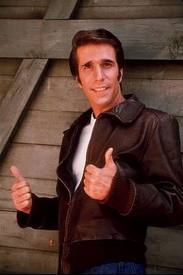
When Rachel meets her demise, the scream-queen torch is passed to wacky Tina for no logical reason, but Tina does not survive the film, either (she nobly sacrifices herself so Jamie can escape.) Pleasence has moved beyond merely chewing the scenery and is now devouring it in great slabs. “I prayed that he would burn in Hell. But in my heart, I knew that Hell would not have him!!” is a typical Loomis line, delivered with spittle-emitting intensity. One of the Jackass Boyfriends is supposed to be a brooding, dangerous punk, but dresses exactly like the Fonz. (Horror movie creators are oddly old-fashioned at times.) The killings come quicker in the later sequels. Fonzie is dispatched with a gardening implement five minutes after being introduced. Ayyyy! Continue reading

1 Comment

Filed under Film & TV

The Holy Bee’s 2011 Halloween Special, Part 1

The concept for my 2011 Halloween Special came to me when I was still writing my 2010 Halloween Special, and I was a little depressed that I would have to sit on such a great idea for a whole year before I could implement it. But October has finally rolled around at last, and now that it’s time to complete what I had planned, I’ve realized that it’s much easier to conjure up these things that to actually do them.

But I’m committed, come hell or high water, to watch every movie in the original Halloween series in a single sitting. That’s eight feature films. None of them are of epic length, mind you, but it’s still a pretty decent chunk of time to have an ass parked on a couch. Luckily, my skill at sitting almost motionless for hours at a stretch is unparalleled, except by certain species of reptile and the more dedicated East Indian fakirs. So all it will really take out of me is time, and I’ve got that. If, last October I had decided that for my 2011 Halloween special I would run October’s Portland marathon in a Jason-style hockey mask you would most assuredly be reading a list of excuses right now.

This is at least somewhat uncharted territory for me. I’ve seen the first Halloween many times, and I actually saw Halloween 5 in 1989 on an ill-advised high school double-date. The rest will be all new to me, because I’m not really a horror aficionado. A well-made one can be great, but too many rely on the lazy technique of someone/thing suddenly lunging into frame accompanied by a loud sting of music. To make an audience jump as an involuntary physical response to a sudden change in volume or visual stimuli is not “horrifying” them, it’s triggering a simple reflex. And it’s poor filmmaking when used too often. From what I’ve heard, the Halloween sequels range in quality from dubious to wretched, so I’m expecting a lot of it-was-only-the-cat “ha ha made you jump” moments.

On with it, then. On Saturday, October 15, armed with only my notebook, a Snuggie, DVDs of Halloween 1 through 6 (and the remaining two  streaming on Netflix Instant View), and a variety of nearby beverages, I settle in to complete the challenge I had set for myself the year before.

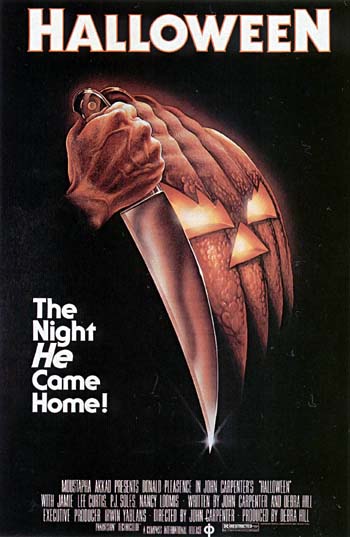
8:53 am. Halloween (1978). The sound of the coffee pot beginning to drip in my kitchen blends in with the classic Halloween theme. Not the first mainstream “slasher” movie (most people give that credit to 1974’s Black Christmas), it’s certainly the best. The opening credits are pretty iconic — a slightly battered, grinning jack o’lantern against a solid black screen with the credits in orange text. And of course, that music.

We start with a Prologue: Haddonfield, Illinois, 1963. Six-year-old Michael Myers is in the side yard of his house, observing his teenage sister and her jackass boyfriend necking on the couch. (All the teen girls in the Halloween franchise come packaged with horny, boorish Jackass Boyfriends as standard equipment.) We don’t see Michael yet, but we see what he sees, in what film geeks call a “POV shot.” (And for it being 1963, the Jackass Boyfriend is certainly rocking some post-Beatles hair. What is it with 70’s actors and their precious, precious hair? Beginning in about the mid-80’s, actors went ahead and committed to accurate period haircuts for TV shows and movies set in the past. But in the 70’s, it didn’t matter if the story was set in the Korean War or 1950’s Milwaukee, you were going to get guys with muttonchops and Jewfros and girls with feathered Farrah Fawcett ‘dos. Had someone with the hair length of a, say, Chachi Arcola actually shown up in 1950’s Milwaukee, he would have been beaten within an inch of his life as a suspected deviant. I’m not saying that’s right, I’m just saying it’s a likely scenario.) Continue reading

2 Comments

Filed under Film & TV

“Tombstone” vs. “Wyatt Earp”

As is often the case with the Holy Bee, to understand the entertainment, we must start with the history…

People of Tombstone, Arizona remembered October 26, 1881 as particularly cold. A bone-chilling wind whipped off the nearby Dragoon Mountains, and many residents assumed a flurry of light, dry snow was on its way to the little silver-mining town. A storm of a different kind came instead. Two groups of men faced off against each other in a nondescript vacant lot. (The OK Corral, which would soon lend this confrontation its name, was actually on another street on the other side of the block. Its rearmost portion could be accessed by a tiny alleyway, the entrance to which was still several yards from the vacant lot. But, as author Jeff Guinn points out, “Shootout at the Vacant Lot on Fremont Street” doesn’t have much of a ring to it.)

Animosity between the larger interests each group represented had been growing for the past eighteen months. A tangled mess of politics, personality clashes, and a long series of incidents such as stolen U.S. Army mules, the semi-accidental shooting of the Tombstone city marshal, and a botched stagecoach robbery just outside of town limits all contributed to the tension that had been humming through the town since early the year before.

On one side of the lot were five men — Joseph Isaac “Ike” Clanton and his younger brother Billy, brothers Tom and Frank McLaury, and Billy Claiborne — who represented the “cowboys.” Small-time ranchers who openly rustled cattle from over the Mexican border less than forty miles south, they were viewed with suspicion by the town leaders and businessmen. Most were legitimate ranch hands with a rowdy streak, coming into town to drink and raise a little hell. Dealing in stolen cattle was something everyone did to keep their ranches afloat, and most people looked the other way (especially if the cattle came from Mexico.) Other cowboys were more sinister — genuine “bad men” from Texas, who fled that area when the legendary Texas Rangers started cracking down on outlawry. Politically Democratic and sympathizers to the old Confederacy, they also had many allies in the town who appreciated their free-spending business and admired their free-spirited resistance to authority.

On the other side were four men — city marshal Virgil Earp, his two brothers Wyatt (a deputy federal marshal) and Morgan (deputy city marshal), and the notorious John “Doc” Holliday (a well-educated dentist-turned-professional gambler) — who represented the order- and community-minded townspeople. The clannish, uptight Earps were never incredibly popular with the people they were charged to protect. Wyatt in particular was viewed as a dour, self-aggrandizing social climber, with a checkered past on both sides of the law, who spent most of his time running card games in a variety of saloons and investing in mines that didn’t pay off. He viewed his off-and-on career as a lawman as a means to an end (that end being authority and respectability that would lead to wealth).  He had formed a close, unlikely friendship with Holliday, who was slowly dying of tuberculosis. Holliday was known to have a vicious temper when drinking (which was most of the time by 1881), and his reputation for unstable behavior and violence preceded his arrival in Tombstone. Wyatt Earp’s own reputation suffered in many people’s eyes due to his association with what many considered a degenerate. But one of Wyatt’s good qualities was loyalty to his friends. The Earps were politically Republican and staunch Unionists, perpetually on the make to enhance their status and make money. The cowboys were a threat to that goal.

The Earps and Holliday confronted those five cowboys that day to disarm them — they were carrying firearms within city limits, against the local ordinance. It was a shaky accusation to make, as the cowboys were ostensibly on their way out of town, and therefore justified in taking the weapons (which they had lawfully turned over on their arrival the day before) with them. They were just taking an awfully long time to make an exit. Lingering. Almost trying to spark a confrontation. Harsh, drunken words and threats had been spouted in the saloons the night before (mostly by the loud-mouthed Ike Clanton), and the Earps had had enough. As they approached the vacant lot, they were stopped by county sheriff John Behan — a friend and ally to the cowboys. He assured the Earps — falsely and dangerously — that the cowboys had already been disarmed. He was ignored, and wisely took cover.

Billy Claiborne fled at the sight of the approaching lawmen. After the tiniest moment’s stand-off, either Wyatt or Billy Clanton fired their weapon.  The unarmed Ike Clanton fled as soon as the shooting started. Thirty seconds later, it was all over, and the remaining three cowboys were dead or dying in the lot and the adjacent street. Tom McLaury was also revealed to be unarmed, but was shot several times as he desperately grabbed at the rifle in his saddle holster. Only Frank McLaury and Billy Clanton had weapons on them. The worst of the cowboys — true outlaws and killers like Curly Bill Brocius and John Ringo — were nowhere near Fremont Street that day.

But it did not end there. Controversy and retributions continued for several months. The Earp party were tried and acquitted of murder. Virgil and Morgan were victims of fearsome ambushes orchestrated by Ike Clanton and the more violent-minded cowboys. Wyatt and Holliday led a posse of dubious legal authority to cleanse the countryside of cowboy influence. The so-called “Vendetta Ride” became almost as legendary as the shootout itself… Continue reading

19 Comments

Filed under Film & TV, History

The Holy Bee Recommends, #6: "Marry him, murder him, do what you like with him."*

I freely confess that I am a library junkie. I realize that this puts me in a category with lonely spinsters and elderly men who can only read a newspaper if it’s threaded through a wooden baton, but it got its claws into me early.

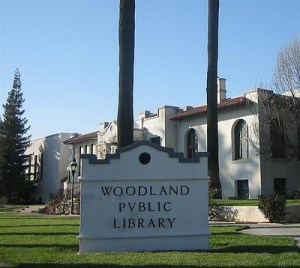
1985? 1986? I know I was barely into the double digits in age when I forsook the beanbag chairs and Betsy Byars books in the children’s section in the basement of the old Woodland Public Library for the adult section upstairs, with its musty-smelling stacks and high-arched windows. And the fireplace! On cold winter days, there was always a blazing fire in the periodicals section (in the fireplace, not actually amongst the periodicals, which would have been quite alarming), and those high-arched, iron-banded windows seemed made to have rain spattered against them. It always seemed to be raining on days I visited the library. Continue reading

1 Comment

Filed under Books, Film & TV, The Holy Bee Recommends

From The Vaults: Top 5 Sidekicks (March 2008)

The next installment of the ever-popular This Used To Be My Playground is being delicately extracted, fossil-like, from the strata of my memory one sentence at a time. I don’t know how long it will take, especially as summer’s over for me and I’m back at my day job. In the meantime, I’m desperate to keep the Holy Bee of Ephesus site alive with viable content, so here’s a bit of recycling. Please enjoy the following brief Golden Oldie from the Institute of Idle Time’s Google Group discussion boards.

The Google Group for the Institute of Idle Time is still there, but sadly underused by its 76 members. In its glory days (summer 2007 – early 2009), it enlivened many a dull workday with debates, random thoughts, and the ever-popular Top 5 lists. As explained before, Top 5 lists were the zygote that grew into the Institute of Idle Time. Anyone was invited to come up with a list topic, and encourage everyone to weigh in with their own entries.

In the spring of 2008, no one had yet seen Indiana Jones and the Kingdom of the Crystal Skull (and thus, no one had yet experienced the crippling disappointment of almost Phantom Menace proportions), but as a tip of the battered fedora to Shia LeBeouf‘s introduction to the series, MDG posted the topic of Top 5 Sidekicks to the group. I was a little late in getting my list posted that day, so the obvious choices like Robin the Boy Wonder and Chewbacca were already taken. (Repeating items from someone else’s list was allowed in extreme cases, but generally frowned upon.) But here’s what I came up with in those heady days of 2 1/2 years ago…

Sidekick Type #5: The Sidekick Who Is Not As Cool As You
Milhouse Van Houten — The Simpsons
A walking, talking self-esteem boost for Bart, the rasping, bespectacled Milhouse would be the sidekick of choice for someone who associates with local psychopaths Dolph, Kearny, and Jimbo. Milhouse can be jettisoned at will, providing a decoy (if the bullies are victimizing Bart), or just because he’s too dorky to hang out (if the bullies are teaming up with Bart). But at the end of the day, Milhouse will always be there, usually stuffed conveniently in a locker. Continue reading

Leave a comment

Filed under Film & TV, Pop Culture

Christmas Bonus: Top 5 Holiday Comedies of All Time

Well, we’re hip-deep in the holiday season, and a serious snafu with my AT&T U-Verse service has caused all my DVR’d shows to be wiped out, along with my HD signal. An early lump of coal in my 42-inch plasma stocking (there’s an image for you). This puts a serious dent in my obsessive, holiday-themed viewing, which I wrote about last year. I can only hope some of the things I had in the archives will be re-run. So while I wait a week for the irritable AT&T maitenance elves to sally forth from their magical workshop and get my shit back in working order, my thoughts turn to movies on DVD…

When the Institute of Idle Time launched its zine in the fall of 2008, I made a promise to myself that the zine would feature exclusive content from the pen of the Holy Bee, and articles from the zine would not reappear online in any form, making the physical copies of the zine valuable collector’s items.
As I’ve observed before, promises to yourself are pretty easy to break. In observance of the season, I couldn’t resist posting (with a few 2009 editorial notes and web links) my article from the Winter 2008 issue of IDLE TIMES — Top 5 Holiday Comedies!

There are two primary categories of holiday movies. The heart-warming family classics (It’s A Wonderful Life, Miracle On 34th Street, etc.), and the broad holiday comedy, which is surprisingly difficult to pull off. For every score, there’s five misses (see the recommendations below). For this Top 5, I decided to go the trickier route. I cast my net for the movies that met the following parameters: 1) it had to deal in some way with one or more of the major year-end holidays, 2) it had to be marketed specifically as a comedy, and 3) it had to be a movie I watch every year like clockwork. When I shared my list with some acquaintances, several took umbrage at what appeared to them to be a glaring omission: The perennial favorite A Christmas Story. Yes, it’s a terrific film, and I own it in multiple formats. But its 24-hour airing on TNT each year has caused a little Red Ryder BB-gun fatigue to set in, plus everything in that movie is on the surface. It wears its heart on its sleeve, and all its cards are dealt face-up.

To make this Top 5, a move must require you to dig a little deeper. Discovering a surprising, soulful, real moment smuggled into a raucous comedy about coping with holiday expectations is like unwrapping a present under the tree. The holidays put us under pressure to be our best selves, and have our best time of the year. Sometimes, the pressure can become unbearable, and we snap…comedy (or tragedy) results.

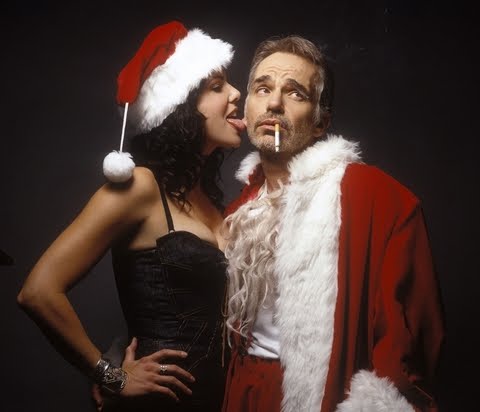
#5. Bad Santa
“Don’t fuck with my beard.”
“It’s not real.”
“No shit. Well, it was real, but you see I got sick and all the hair fell out so I have to wear this fucking thing.”
“How’d you get sick?”
“I loved a woman who wasn’t clean.”
“Mrs. Santa?”
“No, it was her sister.”
–Willie “Santa” Soke & the child on his lap.

You know what really grinds my gears? People who think they’re over and above the holidays. People who smirk and snort and say “It’s all a big commercial” or worse, give an exasperated, eye-rolling sigh and say something like “I hate the fucking holidays” or other surly too-cool-for-schoolisms. This kind of behavior is rampant among folks of my generation. Fine, for the other eleven months of the year, be your awesome, hyper-critical intellectual NPR-listening selves. But when December rolls around, recognize. Accept the fact that in an old photo album at your parents’ house is a picture of you in pajamas on Christmas morning (with a comical case of bed-head) holding up Castle Greyskull or a Pound Puppy and grinning toothlessly ear-to-ear. Accept the fact that that happy little shit is still within you, and needs to be indulged once a year.

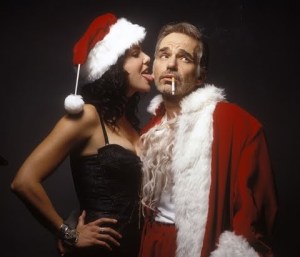
On the surface, Terry (Ghost World) Zwigoff’s Bad Santa is just the sort of movie for the naysayers. The setting is Phoenix with a brief interlude in Miami Beach, the least Christmassy cities in the U.S. (The inclusion of Honolulu would make a perfect trifecta.) There is no element of the beloved St. Nick that Bad Santa does not debase by simply putting a Santa suit on Willie T. Soke (Billy Bob Thornton), an alcoholic, misanthropic career criminal who uses his yearly employment as a department store Santa to rob said department stores blind on his last night of work, Christmas Eve. But before the big payoff, he must subject himself to a month of a crying, urinating toddlers and eternal loops of mindless Christmas carols on the store’s loudspeakers. Willie deals with all of this by lashing out at everyone as profanely and angrily as possible, usually while in costume and on duty. (He is protected from being fired by partnering with an African-American dwarf who threatens costly employment discrimination lawsuits.) If the movie confined itself to merely to laughing at harried middle-class soccer moms and their over-indulged spawn and Willie’s foul-mouthed verbal beatdowns of them, this would just be another corpse in the pit-grave of crass holiday comedies. But the filmmakers (including producers Joel & Ethan Coen, who purportedly had a hand in the writing) are far too clever for that.

Willie is a genuinely dark and damaged human being, who hates all people, but he reserves his most vicious hatred for himself. He is clearly days away from wrapping his whiskered lips around the barrel of a revolver and giving the walls of his cheap motel room a very special kind of Christmas decoration. Then he meets the slow-witted, moon-faced “kid.” The kid latches himself onto Willie, insisting on calling him “Santa” (even when he’s out of costume) and interrogating him on sleigh and reindeer details. It’s just the kind of kid that should provoke the worst in Willie, but…it somehow doesn’t. He discovers the kid lives only with his senile grandmother in a sterile McMansion in the suburbs, and moves himself in. What starts as a crass exploitation of the sweet, trusting child evolves (very) slowly into tolerance, then protectiveness, and finally, affection. (But not before a suicide attempt involving a running car in a closed garage, along with detailed instruction to the kid as to what to do when they come to “bag Santa up.”)

The final segments are as heartwarming as anything found in Prancer. The kid admits to knowing that Willie isn’t really Santa, but it was easier to lose himself in fantasy than to deal with the fact that his mother is dead and his father is in prison. Wille derails his yearly heist to deliver the kid’s single Christmas present. He braves his murderous partner and police pursuers to give a gift to the one human being who has ever shown him unconditional affection. So if Willie T. Soke can be touched by the magic of Christmas, then it can’t be too much of a stretch for all you hipster douchebags to lighten the fuck up and squeeze some joy out of this time of year.

BONUS POINTS: The final screen appearance of John Ritter as the store manager, and Lauren Graham playing the anti-Gilmore Girl, a dimwitted cocktail waitress with an uber-creepy Santa fetish.

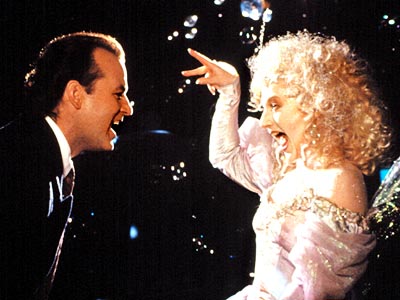
#4. Scrooged
“I’m sorry. I thought you were Richard Pryor.”
–Frank Cross, after tossing water on someone he believed was on fire.

Most people are unaware that Charles Dickens pretty much bullshitted up Christmas as we know it. In the early 1800s, devout Protestants (which is what most Americans were) eyed it suspiciously, as it still reeked to them of solstice-worshipping paganism and/or Roman popery. Those who did celebrate Christmas did so in a low-key, Thanksgiving-ish way. (Thanksgiving as national celebration did not crop up until the 1860s. The “Pilgrims” —another bullshitted-up term— had the first one in 1621, and then it was promptly forgotten about for 240 years). With the publication of Dickens’ novella A Christmas Carol in 1843, all holiday hell broke loose. An immediate smash hit on both sides of the Atlantic, we have Dickens’ highly detailed prose to thank for inventing the “perfect” Christmas. Charles Dickens, it must be remembered, was a pretty good writer. He concocted the very first “winter wonderland”: snow, roasting chestnuts, holly & mistletoe, ringing bells, and ruddy-cheeked festive folks chock-full of goodwill toward men, all colliding together in a giddy orgy of holiday cheer. None of this existed as a whole in the popular conception of Christmas before Dickens’ story. Dickens created a totally idealized holiday scenario to throw the darkness of his main character, Ebenezer Scrooge, into sharp contrast. Its primary function as a literary device has been superseded by its new existence as a template for a perfect Christmas, which cannot exist – but it doesn’t stop many from striving for it (see my #1 Holiday Comedy)
Movie versions of A Christmas Carol have existed for as long as cinema itself…and I love every damn one of them. From the 1938 version starring Reginald Owen (known to Disney geeks as “Admiral Boom” in Mary Poppins) to the “definitive” 1951 version starring Alastair Sim (once voted the most popular actor in Britain, for whatever that’s worth), all are as addictive as Christmas crack to me. I especially enjoy the two made-for-TV versions, the 1999 version starring Patrick Stewart, and the 1984 version starring George C. Scott (the best screen Scrooge in my opinion). Neither spared any expense in effects and casting, and hold up even better than the cinematic offerings. [ED. NOTE: The 2004 musical version with Kelsey Grammer was one of the casualties of my DVR meltdown. Hadn’t seen it yet, but hopes weren’t too high for it, anyway.]

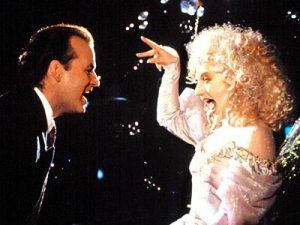
But we are talking theatrical releases here, and we’re talking comedy. Comedic versions of A Christmas Carol have been tried from time to time, but the one that pulls it off the best is 1988’s Scrooged. Directed by Richard (Goonies/Lethal Weapon) Donner, it was co-written by the late Michael O’Donoghue, the misanthropic former SNL scribe who gave us such black-hearted delights as “The Little Engine That Died.” Like Bad Santa, Scrooged mines holiday comedy from really dark territory. Scrooges in other versions tend to play the role with such snarling nastiness that the audience can sense it’s a complete front, and the third act redemption and transformation just seem like fait accompli. In Scrooged, Bill Murray plays Frank Cross, the Scrooge character, not with hammy cinematic crankiness, but rather taps into the pure cynicism that beats at the heart of the literary Scrooge. In his own mind, he is perfectly reasonable, and the rest of the world is delusional. Murray avoids Scrooge clichés by dumping the gruff bluster (let’s face it, George C. Scott cornered the market on that) and infusing Frank Cross with his trademark brand of cool, blank-faced, ironic detachment. This allows us to see a little of our post-modern selves in him, and makes his final transformation all the more unsettling and powerful.

Many Carol adaptations forget that the visits from the Christmas Ghosts are supposed to be creepy and traumatic, otherwise they wouldn’t convince Scrooge/Cross to change his ways. The Ghosts put Cross through a physical and emotional wringer, leading up to the final transformation, which by the way, is a manic, improvised rant filmed in what appears to be a single take. Murray genuinely looks like someone who has reached the end of his rope, and experienced a re-birth. He concludes with a shaky, out-of-breath declaration that he feels “really better” than he’s felt “in a long time.” Sometimes simple words say it best.

And do yourself a favor and read the original story. It’s short (it can be done in one or two sittings), and reminds you why this Dickens fella was such a swingin’ dick back in the day…

BONUS POINTS: A scene capitalizing on Murray’s resemblance to Richard Burton, which I swear no one before or since, to my knowledge, has remarked upon except myself.

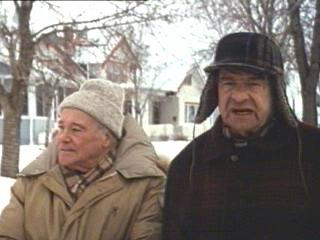
#3. Grumpy Old Men
“What could make two grown men spend the majority of their lives fighting each other?”
“Guess.”
“…A woman.”

–Ariel Truax & John Gustafson

Perhaps the worst title for a good movie ever. I remember when I first heard it, I thought it was a film version of a bad SNL sketch (remember the one with Dana Carvey and Jon Lovitz as cranky octogenarians sitting on a park bench? Of course you don’t.) It turned out the be a late-era classic from frequently-paired duo Jack Lemmon and Walter Matthau. Lemmon and Matthau had a peculiar sweet-and-sour chemistry, best displayed in slightly dark, character-driven comedies, like the 60’s classics The Fortune Cookie and The Odd Couple. I went to see GOM to pay my respects to what I imagined would be the final L&M pairing, as they were getting on in years. (Unfortunately, the unfunny Out To Sea and the downright abominable Odd Couple 2 were still in their short future. Matthau died shortly thereafter, and no wonder.) Imagine my surprise when a bona-fide holiday classic unfolded before my eyes. Not that it deals explicitly with holiday themes, but the comedic action unfolds from the week before Thanksgiving to the night before Christmas. Too many people I know dismissed this movie without seeing it, claiming it was just a couple of old codgers making pre-Viagra limp dick jokes. OK, admittedly, that’s in there…a lot. But there is so much more.
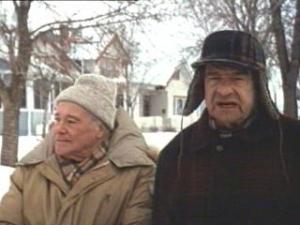
John Gustafson (Lemmon) and Max Goldman (Matthau) are two widowers and next-door neighbors in Wabasha, Minnesota. They have been at odds since 1938, when the local hottie chose one over the other. Although they bicker and snipe, you get the sense that they’re just going through the motions, and that they really don’t care about anything anymore. In fact, the juvenile pranks and name-calling they perpetrate on each other seem to be the only spark of life in these guys…until a new woman, Ariel Traux (Ann-Margaret), comes into their lives, tossing fuel on their smoldering resentment. Pranks mushroom into physical assaults and desperate sabotage…

…and it’s the best thing that’s happened to them in years. Although it may seem like the renewal of real hostilities is a bad thing, it’s quite the opposite. For years, the two men have been dead inside, and just waiting for their bodies to follow suit. (There are few sights sadder than John whiling away a long winter evening playing chess with himself, or Max begging his adult son to stay just a few minutes longer.) The competition snaps them out of their deathwatch, re-invigorates them, and in the end, makes them realize their deep lifelong bond. Max, up until now portrayed as the nastier of the two, ends up doing a number of heartfelt kindnesses for John, who falls seriously ill in the film’s climax. When the hospital nurse asks the visiting Max if he’s “friend or family” of John, the puzzled, emotional pause before he chokes out the word “friend” says it all.

And talk about atmosphere! That’s its greatest assets as a holiday movie. Snow, snow, and more snow. The film’s depiction of a true Midwestern winter is vivid enough to be another character. (Think Fargo without the dismembered bodies in wood-chippers.) For someone born and raised in California who wishes he had real seasons, it’s a fantasyland. I want to ice-fish! I want to put on my heaviest coat and galoshes for the thirty-second walk to the mailbox! I want to trudge blocks through thigh-high snow to enjoy an 8-ounce glass of Miller High Life at a cozy tavern called “Slippery’s.” I’m sure the novelty would wear off fast, though, which is why tuning in to GOM from the comfort of my sofa every November is such a treat.

BONUS POINTS: Sit through the closing credits for a final word from Matthau.

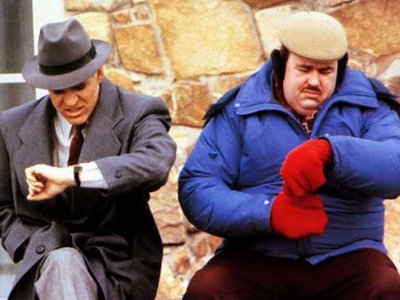
#2. Planes, Trains & Automobiles
“If I wanted a joke, I’d follow you into the john and watch you take a leak. Now are you going to help me, or are you going to stand there like a slab of meat with mittens?”
–Neal Page in a dark moment

One of the best road/buddy movies of all time, and certainly the Ultimate Thanksgiving Movie, PT&A treats us to the sight of a man getting picked up by his scrotum, a man accidentally sleeping with his left hand wedged between another man’s thighs, and a hapless car rental clerk being harangued by a venomous monologue containing 18 f-bombs in less than a minute. But underneath all the tomfoolery is a serious, sometimes sad character study of two people cut off from their loved ones, and Learning An Important Lesson: Don’t take what you have for granted. Be Thankful.

Neal Page (Steve Martin), an uptight, aloof advertising executive, is busting his ass to get from a business meeting in New York to his home in Chicago during the busiest two travel days of the year, right before Thanksgiving. Inclement weather, mechanical failures, and all-around bad luck force Neal to improvise his way home using the titular vehicles (and several others much less comfortable.) Circumstances also force him to team up with Del Griffith (John Candy), an overbearing motormouth of a traveling salesman, whose cheery obliviousness conceals a secret tragedy, evidenced by the occasional wounded flash in his eyes when Neal snaps at him, which is often. But for the most part, nothing can get Del down, not even riding in the back of a hillbilly’s pick-up truck on a frigid morning, unable to move for fear of their fellow passenger, a vicious dog that could attack them at any moment. “Bee-yoo-tiful country, though, isn’t it?” Del chirpily observes. Neal, miserable, can only ask “What do you suppose the temperature is?” and receive the matter-of-fact reply, “One.”

We suspect Neal might not be the most hands-on dad, sacrificing time with his family to provide the cushy, upper middle-class life he thinks they want. What they really want, of course, is to have him around more. (Early on, he calls his wife, and as soon as she tells their daughter who is on the phone, the daughter sighs and mumbles “flight delay,” as if this is the 100th time it’s happened.). Neal’s epiphany comes halfway through the movie, and like most real epiphanies, it doesn’t look like one to an outside observer. Staring into space, toying with his lunch, he says very simply and quietly, “I’ve been spending too much time away from home.” Del’s response, revealing more than it intends to, is an off-handed “I haven’t been home in years.” It’s a wonderful, poignant moment, beautifully underplayed by Martin and Candy, and it’s over in a few seconds.

Neal, naturally, ends up inviting his new friend home for Thanksgiving, and the movie closes on a freeze-frame of Del’s smiling face. But it is a sad smile, because he knows when Thanksgiving dinner is over, he must move on and continue his existence of more or less permanent loneliness. Holiday moments are fleeting, folks. Don’t be a cynical jackass. Enjoy them.

BONUS POINTS: John fucking Candy, people. Acknowledge the genius.

#1. National Lampoon’s Christmas Vacation
“We’re going to press on, and have the hap-hap-happiest Christmas since Bing Crosby tap-danced with Danny fuckin’ Kaye! And when Santa squeezes his fat white ass down that chimney tonight, he’s gonna find the jolliest bunch of assholes this side of the nuthouse!”
–Clark W. Griswold blowing off some holiday steam

Chevy Chase had much to atone for: For the better part of a decade (1976-1986), his cocaine-fueled ego, nasty arrogance, and inflated sense of entitlement alienated anyone who crossed his path. But the high-flying comedy star eventually came a cropper with a series of reversals that everyone took vindictive glee in observing: A plunge in box office bankability that would make Whoopi Goldberg wince, a crippling painkiller addiction, a late night talk show so heinous it smelled like Jeffrey Dahmer’s stovetop (and is still spoken of by TV fans in hushed tones.) The final straw was a 2002 Comedy Central roast that was famously brutal, especially in that not one friend bothered to appear with him, onstage or in the audience. (Fellow amigos Steve Martin and Martin Short appeared in a pre-taped bit so half-assed and perfunctory it was the ultimate insult.) The roast was quietly buried by Comedy Central and has never been re-run, or released on DVD. Chase has recently been reduced to doing direct-to-video comedies in Europe. [ED. NOTE: In the time since this was written, Chase has made a low-key comeback of sorts in a supporting role in the pretty-good sitcom Community.]

The rise and (steep, steep) fall of Chevy is now fading old news. It’s time to let him up easy, if for nothing else, then for giving us the Greatest Christmas Comedy of All Time. Chase has stated that the character of Clark W. Griswold forced him to tap into his inner Nice Guy, and allow that facet of his personality to become dominant as he belatedly grew up and walked away from the smoking ruins of his career.
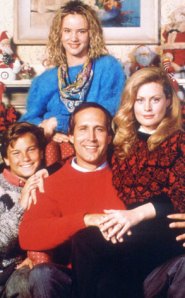
Doting father and husband Clark Griswold (familiar to viewers from two earlier Vacation entries) attempts to have a perfect “fun old-fashioned family Christmas,” by inviting his elderly parents and in-laws for a two-week holiday visit. The results are a perfect screwball farce, a throwback to the anarchic comedies of the 1930s. Unlike more recent comedies where events unfold in an orderly sequence and reach a logical conclusion and everyone grows a little bit (I’m looking at you, Apatow), the comedic situations in NCLV crash into each other like runaway train cars until attractive women are mauled by dogs with sinus conditions, elderly men clutch smoldering toupees to their chests, squirrels are threatened with destruction by hammer, and an ordinarily reasonable housewife greets the SWAT team that just crashed through her picture window by offering the hand that had previously been attached firmly to her husband’s testicles. Toss in an electrocuted cat, some steaming raw sewage, and an odd, pudgy youngster with an “unidentified” lip fungus for good measure. If all of this seems somewhat tasteless, then the true triumph of NCLV becomes clear: it’s not tastelessness for tastelessness’ sake, but woven into a larger tapestry depicting a warm, cheerful celebration of all that Christmas means to the modern American. That this sweet, nostalgic tone is maintained in spite of the grotesque disasters inflicted on poor Clark can be credited to screenwriter/reclusive genius John Hughes [ED. NOTE: RIP] who also gave us Planes, Trains & Automobiles.
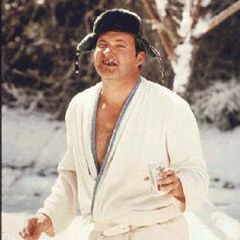
At my house, NCLV is LAW. It must be watched, multiple times if possible, come hell or high water. Christmas itself might as well be canceled if a viewing of NCLV does not occur.

BONUS POINTS: All the Vacation movies have good casting, but this one is particularly stellar: Familiar veteran character actors, including Diane Ladd and E.G. Marshall, play the grandparents, Juliette Lewis makes her debut as daughter Audrey, The Big Bang Theory’s Johnny Galecki turns up in an early role, and mega-MILF Beverley D’Angelo burns a hole in the screen as Clark’s wife Ellen.

Repeat viewings are a must. Throw it on while you clean house or work at your computer. For a dash of variety, play it with the Chase-free cast commentary. D’Angelo, who is either audibly intoxicated or has recently suffered a minor stroke, can’t stop obsessing over her hair.

ALSO CHECK OUT: A Christmas Story, Elf, When Harry Met Sally, The Ref

AVOID LIKE THE PLAGUE: Jingle All The Way, Christmas With The Kranks, all Santa Clause sequels, all Home Alone sequels, Deck The Halls, Surviving Christmas, Four Christmases[ED. NOTE: the last one is a new addition to the “avoid” list], and, most likely, whatever holiday comedy is playing at your local multiplex this year.

Leave a comment

Filed under Film & TV

Holy Bee Recommends, #2: L.A. Noir

One of my many minor obsessions is the seedy underbelly of Los Angeles. Not so much in the present day, but in the middle part of the 20th century. Although many people associate the noir genre with the grimy alleyways of Chicago or the humid waterfronts of New York, its natural home is really Los Angeles. There seems to be more desperate, broken people in Los Angeles than the rest of the world combined. Many were lured there with the dream of making in big in the entertainment industry and found nothing but disappointment and despair, many others just naturally gravitated there to be in the company of thousands of other drifters, losers, hustlers, thugs, eccentrics, and full-blown psychos. What makes the darkness and ugliness of the place more palpable is it’s glamorous surface, beautiful people doing beautiful things under palm trees and hazy SoCal sunshine. But it’s all a sham. The good life in L.A. is lived by about 5% of its population.

Whether it’s a fleabag hotel downtown, or a (relatively) inexpensive apartment in Covina, on the other side of the door, there’s a good chance that someone’s soul is slowly rotting from the inside out.

Every so often, I get the urge to take a drive down to L.A. and explore. Take a cruise past where the Black Dahlia’s corpse was found. Past the nightclub where the unsuccessful hit on Mickey Cohen went down. Past the blocks and blocks of stucco apartments in West Hollywood inhabited by waiters who want to be actors. Down the notorious skid row of Fifth Street (affectionately referred to in Tom Waits songs as “The Nickel”), where any vice is available for rock-bottom prices. Luckily, thanks to Google Street View, I can get a little taste of it without driving almost 800 miles round trip, discover that the location was obliterated for a Quizno’s, or risk my soft suburban neck in insanely dangerous neighborhoods.

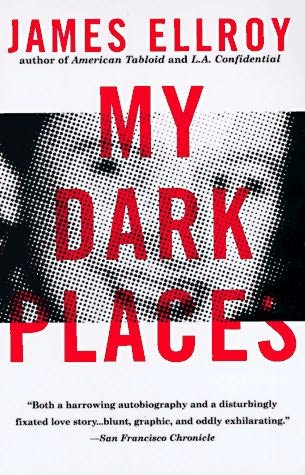
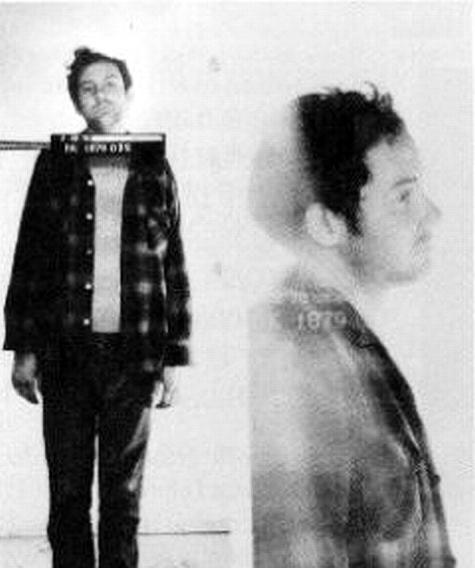
James Ellroy, author of The Black Dahlia and L.A. Confidential, is the greatest current purveyor of period L.A. crime fiction. He knows the subject in and out, because he lived a good deal of his life on the skids in the City of Angels — drunk and pilled up, either homeless or in jail for shoplifting – or breaking and entering plush Wilshire homes to fondle ladies’ underwear.
All of this is revealed in Ellroy’s riveting autobiographical book, My Dark Places: An L.A. Crime Memoir.

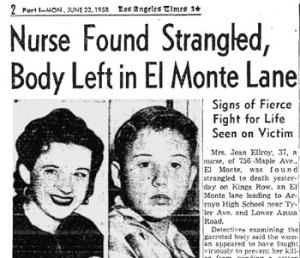
It doesn’t take Freud to uncover the reasons for Ellroy’s downward spiral. It was triggered by the brutal slaying of his mother in 1958, when he was ten years old. Ellroy admits his mother, vivacious redhead Geneva “Jean” Ellroy, was not a model parent: she was an alcoholic who was not particular about the company she kept, and would often leave young Ellroy alone at night to go drinking and dancing at the dive bars that lined Valley Boulevard in El Monte, just east of L.A. One night, she didn’t come home. Her strangled body, pantyhose tied around her neck, was found the next morning in the shrubbery next to Arroyo High School. Despite several strong leads, including several eyewitnesses who spotted her with a swarthy man in a blue convertible, the murder was never solved and the case went cold.

Ellroy was placed in the custody of his father, an embittered invalid who was dead (of natural causes) before Ellroy was out of his teens. Once he went through the crucible of being a drug-addled petty criminal pervert and emerged on the other side as a respected author (“The Demon Dog of American crime fiction”), he became interested in the incident that started him down his life’s path. Working with detectives, Ellroy re-opened his mother’s case, and began sifting through the grisly photos and statements, re-interviewing witnesses, and attempting to come to grips with the psycho-sexual hold his mother had over his subconscious for most of his existence.

There are few dark places darker than Ellroy’s, and his unflinching honesty at examining himself, expressed in the same vivid staccato prose he uses in his fiction, makes for a gripping, if sometimes uncomfortable, read.

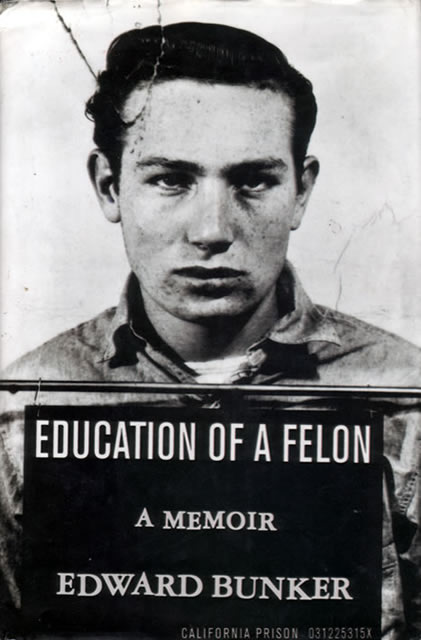
Another young L.A. thug-turned-writer is Edward Bunker. Bunker spent the late 1940s and 1950s in and out of juvenile hall and foster homes, or living on the streets. Bunker was unable to resist the easy money of drug-dealing and armed robbery, despite an off-the-chart IQ and a taste for Shakespeare and Dickens – which he had plenty of time to peruse once he started doing hard time in places like San Quentin and Folsom prisons.

Bunker’s memoir, Education of a Felon, recounts his escapades, both as a criminal and his attempt at a “straight” job: working as an assistant and confidant for the mentally unstable wife of Paramount Pictures’ super-producer Hal B. Wallis. His descriptions of prison life make it sound not so bad for someone who follows the official and unofficial rules, at least until the race wars began in the late 1960s, and suddenly no one was safe. Upon his release in 1975 after almost two decades behind bars, he was already a published author — his autobiographical 1973 novel No Beast So Fierce was adapted into the 1978 film Straight Time, with Dustin Hoffman as the Bunker character. Bunker continued to write and also dabble in bit-part acting – culminating in his crowning achievement, at least as far as most people are concerned: his performance as Mr. Blue in Reservoir Dogs. (“I liked her early stuff – ‘Borderline’ – but when she hit that ‘Papa Don’t Preach’ phase, I tuned out.”)

A special treat: On the bonus disc of the 10th anniversary Reservoir Dogs DVD, there is a driving tour of L.A. with Bunker, where he points out the locations of his nefarious doings. It’s certainly better than ogling the locations on Street View, and you get the benefits of Bunker’s hard-boiled narration. Best part: Bunker’s story of meeting up with future Reservoir Dogs co-star Lawrence Tierney, in the process of putting a beatdown on someone outside of a bar. It was not surprising that Tierney, an actor with one foot in the criminal underworld, and Bunker, a criminal with one foot in the movie world, should have crossed paths in 1950s L.A., almost forty years before they met up again in front of Tarantino’s cameras. This fascinating tour is not included on the most recent (15th anniversary) edition of the DVD. Boo.

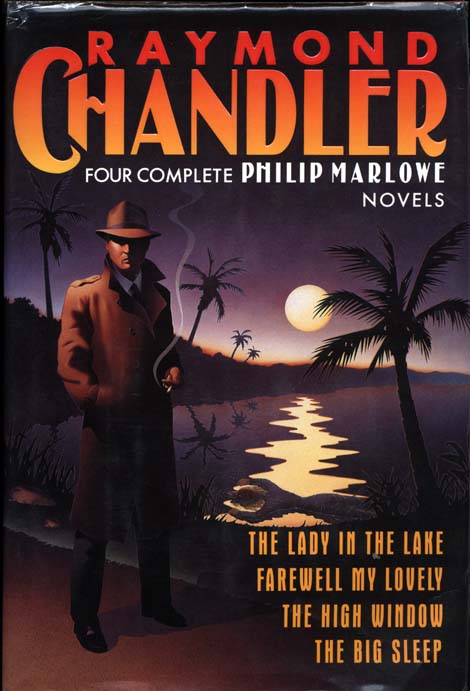
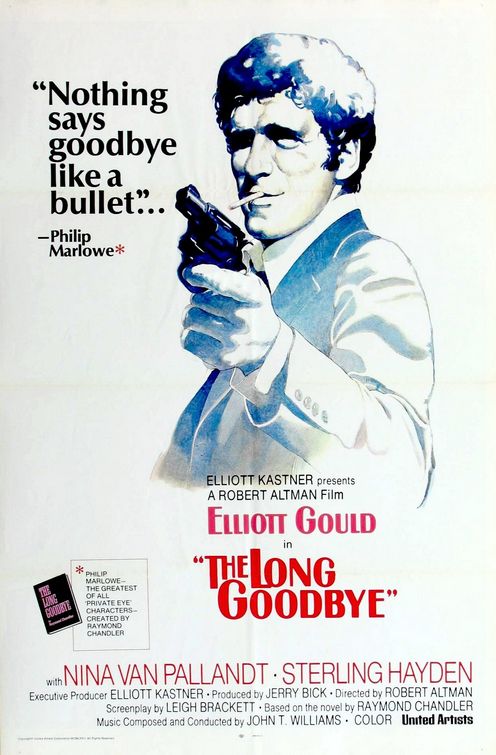
I’ll conclude by acknowledging of the Granddaddy of L.A. Noir, Raymond Chandler. Beginning in 1939, his iconic private eye, Philip Marlowe, smoked, drank, and snooped his way through such classics as The Big Sleep, Farewell My Lovely, and The Long Goodbye. Only Dashiell Hammett equals Chandler as the primary architect of literary noir. Philip Marlowe has been played onscreen by such noted cinematic tough guys as Humphrey Bogart, James Caan, Robert Mitchum and…Elliott Gould?

Yes, Ross and Monica’s father once donned Marlowe’s trench coat and snub-nosed revolver in director Robert Altman’s shaggy-dog 1973 adaptation of The Long Goodbye. Disjointed and quirky as only an Altman film can be, this Long Goodbye is updated from the booze-and-dames 50s to the cocaine-and-nudists 70s. The plot of the book and the plot of the novel are distant cousins, and the new time period allows Altman opportunities to satirize the shallow and hedonistic lifestyles of most of the characters. Gould’s take on Marlowe is decidedly un-heroic, and unlike the rich shadows of traditional film noir, The Long Goodbye utilizes a gauzy palette of washed-out pastels.

Also recommended: The film version of L.A. Confidential (avoid the Black Dahlia film), Wonderland (not a great film, but an incredibly creepy tone and atmosphere), Hollywoodland, Chinatown, any one of Tom Waits’ first seven albums, Chandler’s final Marlowe novel Poodle Springs (unfinished at his death, it was completed thirty years later by Spenser author Robert B. Parker), Ellroy’s novels The Big Nowhere and White Jazz (together with Dalia and Confidential, they make up his “L.A. Quartet”), and what is probably Tarantino’s best film, Jackie Brown (yes, you read that right.)

Leave a comment

Filed under Books, Film & TV, Pop Culture, The Holy Bee Recommends

Holy Bee Recommends, #1: "Too ugly for a leading man, not ugly enough for a villain"

Here at the Holy Bee, music reviews are dealt with in the year-end wrap-up. Movie reviews are nigh on impossible, because I steadfastly refuse to subject myself to the modern movie theater experience, unless it’s under extraordinary circumstances. Even DVDs take me forever to get around to. (To give you an idea how behind the curve I am movie-wise, I just watched Pineapple Express last weekend. It was very good.) In Bruges and Burn After Reading still sit on top of my DVD player.

Which leaves us with books as the last item of mass culture that can be realisitcally reviewed by me. I wouldn’t call myself a voracious reader, but I believe I do get through more books than the average schmuck. Like a lot of people, internet bullshit has cut deeply into my reading time. Who wants to crack a musty old book when there are fucked-up cakes to look at?

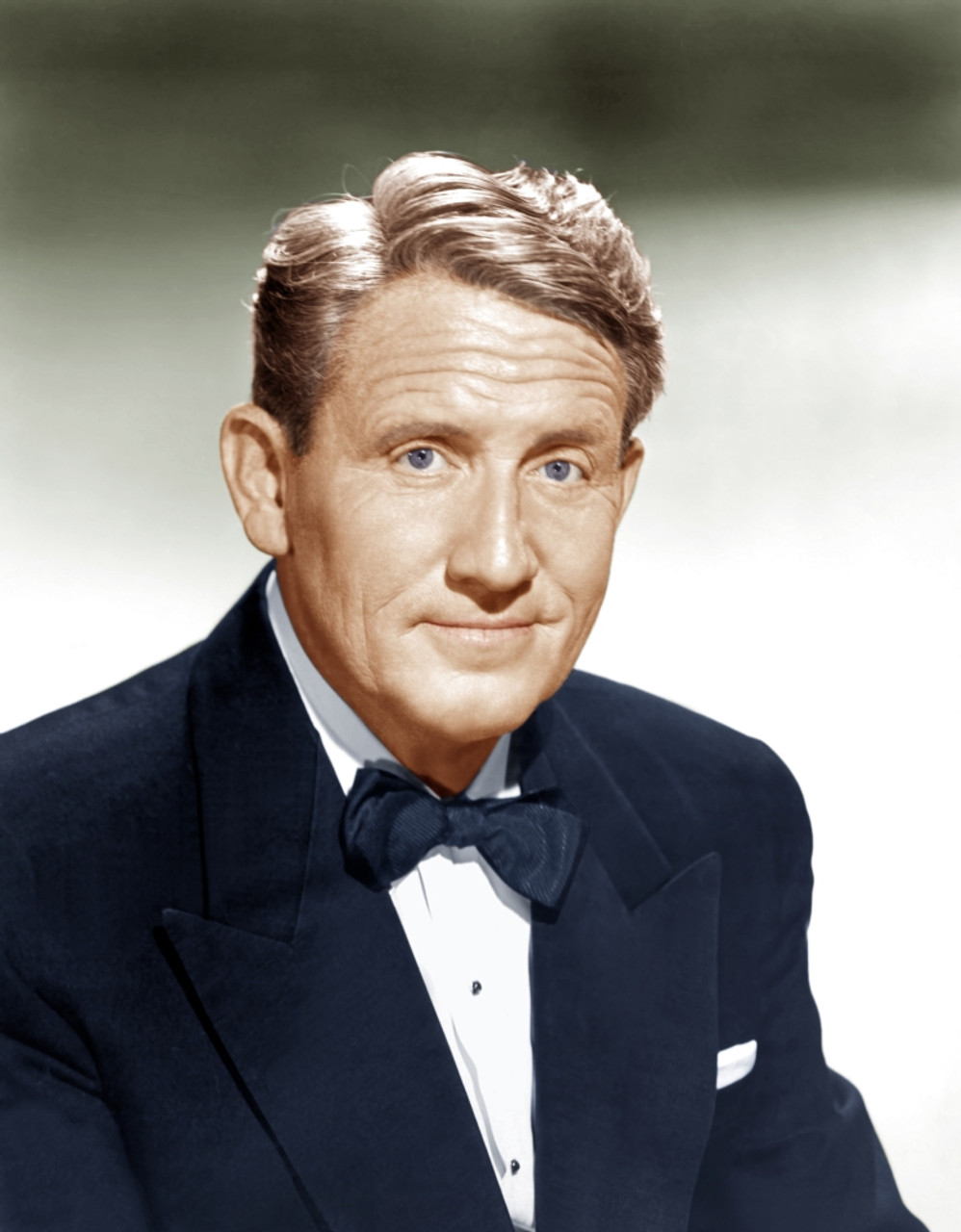
The first item on the Holy Bee Recommends list is the over-dramatically titled Spencer Tracy: Tragic Idol, by Bill Davidson. If you asked any actor working from the late 1930s to the mid 1960s “Who is the finest film actor around?”, most of them would unhesitatingly respond “Spencer Tracy.” The first actor to win back-to-back Oscars (for 1937’s Captains Courageous and 1938’s Boys Town), Tracy was never #1 in audience polls like John Wayne or Humphrey Bogart, but among those working in his profession, he was considered the best.

But Tracy seems fated not to be remembered as well as many of his co-stars by modern audiences, which is sadly ironic because Tracy may have been the first film actor to act in what we would consider a modern style. Unlike the stagey, larger-than-life performances of other actors in mid-20th century films, a Tracy performance could play, unaltered, in a 2009 film and not stand out as mannered or old-fashioned. He inhabited his character without drawing attention to his own “star” persona, which went against the style that prevailed in the 1930s and 1940s. “Comedians are always doing impressions of guys like me and Bogart,” said James Cagney. “Nobody does Tracy.” Every moment was underplayed and thoughtful, built around glances and expressions, and a speaking style that was down-to-earth and absolutely real. No fodder for impressionists and comedians there. That lack of imitatable quirks and mannerisms is probably a factor in why he’s so little known by modern audiences. (Case in point: Jimmy Stewart, who is distratctingly terrible in almost everything I’ve seen him in, is easy to imitate, and thus, still revered.)

Despite Tracy’s quiet style, he managed to dominate his scenes, even alongside noted scene-dominators like Clark Gable, Frederic March, Robert Ryan, Sir Cedric Hardwicke, and the formidable Katharine Hepburn. (“I think I’m a little too tall for you,” said Hepburn when they first met. Tracy, predictably, said nothing. But screenwriter Joe Mankiewicz, who had just introduced them, said “Don’t worry. He’ll cut you down to size.”)

Just as he had refused to showboat in the hammy 30s and 40s, he had no patience for the “method” movement of the 50s and 60s, with all its psychological underpinnings and questions of “motivation.” “Learn your lines and don’t bump into the furniture,” was his famous advice to young actors. He even lost patience with the over-analytical Hepburn on occasion. (“Goddamn it, Katie. Just say the words the writer wrote and do what Stanley tells you to do. Quit talking like you’ve got a goddamn feather up your ass.”) What there was of Tracy’s “technique” was entirely instinctual.

He even managed to make the most stage-bound of acting traditions, the monologue, seem fresh and natural. Most notable in this area are some of his later performances: his cross-examination as the pro-evolution defense cousel in Inherit The Wind, his handing down of the decision in Judgment At Nuremberg, and, especially, his devastating defense of true love in the dated-but-still-good Guess Who’s Coming To Dinner, his final film appearance. Everyone who was on the set when it was being filmed (and every audience member who has seen the film since) could see clearly that he was directing his words to longtime partner Hepburn. Tracy died seventeen days after completing the monologue scene. Hepburn refused to ever watch the finished film.

What’s the tragedy in Tragic Idol? Alcoholism. Tracy was one of Hollywood’s most notorious drunks. Or at least notorious to insiders. Unlike carousing, good-time partiers like John Barrymore and Errol Flynn who used their heavy drinking to further their public personas, Tracy’s drinking was semi-private, and came in massive blackout binges where he would lose all control. Studio publicists covered up a trail of smahed-up hotel furniture, countless broken dishes and plate-glass windows, injured journalists and co-stars, and a myriad of health problems. Everyone close to him knew of his patented “two-week lunch breaks,” where he would disappear from a film currently in production, check into a hotel with a suitcase full of whiskey bottles, strip down, climb in the bathtub, and proceed to drink himself insensible. When the whiskey ran out, he rinsed himself off, checked out with a suitcase full of empty bottles, and returned to work on the film. Tracy’s liver and kidneys were shot by the mid-1950s, and the fact that he lived until 1967 was credited to Katharine Hepburn, who essentially gave up her career for almost ten years to care for him.

It is a shame that Tracy has not received the first-class biography treatment that some of his peers have gotten. Guys like Grant and Gable (neither of whom could touch Tracy as an actor) have had multiple, deeply-researched historical tomes written about them, and the Sperber-Lax bio of Humphrey Bogart moved me to tears. What does Tracy get? A couple of gossipy co-biographies pairing him with Katharine Hepburn, implying he was not interesting enough to carry a bio on his own. And the subject of this blog entry, Bill Davidson’s slightly hack-y, show-bizzy 1987 effort. Davidson is not a writer with pretensions of literary greatness (he’s also cranked out a book on Gary Coleman), but his prose is serviceable, and at a relatively breezy 232 pages, I was able to finish the book in a single afternoon. Davidson has also been a Hollywood hanger-on long enough to get first-hand interviews with people like James Cagney, directors Edward Dmytryk and Stanley Kramer, among several others. Rather than incorporate these interviews into his own writing, Davidson simply plops large quoted passages into the narrative. A very lazy technique, but it does let a lot of the story unfold in people’s own words. The book, for all its flaws, is still recommended as a good introduction to Tracy’s life and work, along with a viewing of Bad Day at Black Rock (one of the best crime-dramas ever), Adam’s Rib (the best Tracy-Hepburn pairing, IMHO), Thirty Seconds Over Tokyo (which demonstrates Tracy’s ability to loom over an entire film despite a smaller role), the original Father of the Bride(showing off Tracy’s skill at light comedy beyond his team-ups with Hepburn — his performance is the only thing funny on purpose in an otherwise embarassingly outdated film), and the films already mentioned above.

4 Comments

Filed under Books, Film & TV, The Holy Bee Recommends

My Top 15 Movies Of All Time

[2022 Ed. Note — Oh my, how this list has changed in the last decade-and-a-half…Consider this an historical artifact.]

Here, in no particular order, is a list of films I either really enjoyed or had a profound impact on me as a film-goer, but didn’t quite make my Top 15 list:

Ghostbusters, Glengarry Glen Ross, Alien, Remains Of The Day, The Wild Bunch, Nixon, The Departed, Unforgiven, The Shining, Monty Python’s Life of Brian, The Big Lebowski, The Good The Bad & The Ugly, Grosse Point Blank, Reservoir Dogs, The Godfather Part 2, Full Metal Jacket, Butch Cassidy & The Sundance Kid, Bridge On The River Kwai, Brazil, O Brother Where Art Thou?, Casablanca, Gangs of New York, When Harry Met Sally, Mary Poppins, Amadeus, Back To The Future, Star Wars Trilogy (Original), The Lord of the Rings Trilogy, The Hunt For Red October, Jackie Brown, Boogie Nights, Batman Begins, Ronin, Swingers, Wag The Dog, Traffic, Paths Of Glory, Schindler’s List, Braveheart, The Searchers, Copland, Fargo, A Fish Called Wanda, Richard III, Raging Bull, Chinatown, The Last Temptation Of Christ, Apollo 13, Clerks, The Lion In Winter, Planes Trains & Automobiles, Midnight Run, Dazed & Confused

Here is a quick rundown of my #6-15:

15. RAIDERS OF THE LOST ARK
Speaks for itself
14. DUCK SOUP
Modern cinematic comedy begins here. None of the gloopy sentimentality of Chaplin, or the mechanical blankness of Keaton. The Marx Brothers were anarchic, surreal, and superhuman. This flick has bonus dose of anti-war satire (most pointedly in the gala musical number “All God’s Chillun Got Guns.”)
13. ALMOST FAMOUS
Anyone who’s ever had their lives enriched by a headlong, reckless plunge into loving music at an early age will recognize themselves in this movie.
12. HEAT
Cops and crooks are equally unhappy with the lives they’ve carved out for themselves. Obsession is unhealthy, folks, no matter what side of the law you’re on. This also boasts one of the best shoot-outs captured on film
11. RIO BRAVO
A reminder that you should always be able to rely on the redemptive power of friendship
10. FARGO
In looking over the Coen Brothers filmography, this is the best of a damn good bunch
9. ED WOOD
A beautiful black-and-white valentine to everyone who has more enthusiasm than talent
8. A HARD DAY’S NIGHT
A white-hot jolt of sheer joy and energy. Director Richard Lester invents the jittery visual vocabulary of the music video, and the Beatles are the fuckin’ Beatles.
7. MASH
Anyone who’s ever been stuck in a crummy place where you can’t really leave, and the people in charge can’t really get rid of you, has tendency to act out in inappropriate ways. Robert Altman’s signature style (episodic plot, overlapping semi-improvised dialogue) has lost some of its uniqueness, but none of it’s anti-authority bite. And on a personal note, the 4077th bears a few superficial similarities to the school I work at. (The leadership style of our principal owes more to Col. Henry Blake than Ed Rooney.) By the way, I’ve always hated the TV show. Hawkeye is Donald Goddam Sutherland, not that smirking bitch Alan Alda.
6. THE GODFATHER Sooo close to the #5 spot, but without it’s tragic, inevitable denouement in Part 2, the story feels unfinished.

And now, the TOP 5:

#5. DR STRANGELOVE OR, HOW I LEARNED TO STOP WORRYING AND LOVE THE BOMB
Filmed by Stanley Kubrick in a straight-faced gritty documentary style, this classic dark comedy tackles the darkest subject of all: global nuclear annihilation. Rogue Air Force General Jack D. Ripper, driven insane by sexual impotence, orders his B-52s to drop their nukes on the Soviets, which would trigger the Soviet’s top-secret “Doomsday Device,” with worldwide destruction to follow. Tone and character are everything in this movie. Lines like “He’ll see everything! He’ll see the big board!” read like nothing on paper, but become perfect comic gems when spouted in context by the likes of Peter Sellers and George C. Scott.

Peter Sellers is nearly forgotten these days, and those who do remember him remember him mainly for the endless series of Pink Panther sequels made by Blake Edwards in the 1970s. Sellers was depressed and frail, dying slowly from heart disease, when he was put through his Inspector Clouseau paces by the overrated hack Edwards in an increasingly desperate series of slapstick-y schtick. The first two Clouseau movies, made a decade earlier, were a delight…which leads me to the Sellers of the swinging 60’s. A comic whirlwind, tossing off surreal radio shows, comedy albums chock full of characters and accents, and his specialty — playing multiple roles in a single film.

He plays three characters in Dr. Strangelove: a very proper British RAF officer, the exasperated President of the United States (based on 50’s politician Adlai Stevenson), and the titular Doctor, an ex-Nazi scientist employed by the U.S. government (but unable to control his prosthetic arm, which continues to throw up the Nazi salute.) The President’s one-sided phone conversation with the Soviet premier is a scene for the ages: “Dimitri, one of our base commanders went a little funny in the head…and went and did a silly thing…”

In any other movie, this tour de force performance would be the highlight (I guarantee you, people unfamiliar with Sellers will not be able to tell it’s him in the different roles), but it must take second place to George C. Scott as Air Force General Buck Turgidson. A perfect portrait of the ultra right-wing military fanatic, Scott’s Turgidson is an eye-rolling, gum-chomping force of nature. He cheerfully believes the U.S. will come out on top in any nuclear exchange: “Now, I’m not saying we wouldn’t get our hair mussed, but I do say no more than ten to twenty million killed, tops. Depending on the breaks.”

Sellers, Scott, and veteran western actor Slim Pickens as B-52 pilot Maj. “King” Kong (who takes the famous hat-waving ride on the descending nuclear bomb) play caricatures, yes, but just realistic enough to remind you that sometimes the people in charge, in real life, are complete idiots.

#4. PULP FICTION
Ah, 1994. A hell of a year. I was 19, occupying a two-bedroom apartment with 4 other junior college students, with a shock of dark hair falling across my forehead like an anime character, and weighing 130 pounds soaking wet. I hung around coffee shops, took creative writing classes. Demon alcohol had not yet passed my lips. It was also the year my eyes were fully opened to the possibilities of cinema.

Despite what a lot of people think, Pulp Fiction did not arrive like a bolt from the blue. I saw Reservoir Dogs on video that spring, and became an instant Tarantino fan. I soon began hearing rumblings on E! reports from Cannes about the new Tarantino film taking the festival by storm. An issue of Entertainment Weekly that summer featured the four principal cast members in costume (but Sam Jackson, strangely, without his jheri-curl wig). Something was brewing, and I wanted in on it. Fevered to the frothing point, I bought my ticket for the 10:15 show on opening night. October 5, 1994. I still have the ticket. It was playing in one of the smaller auditoriums in the cineplex. It was half-full. Six people walked out before it was over. I was blown away. Walking weak-kneed from the theater at one in the morning, I wanted to to do it all over again. I corralled one of my roommates to see it the next night. We left feeling so…fucking…cool. We bought a pack of cigarettes afterwards, and drove around town with the windows down, smoking and being cool.

I had considered myself an avid movie-goer prior to this, but really, to me, movies were divided into two basic categories: Summer Blockbusters (Batman, T2), and Middlebrow Oscar Bait (Rain Man, Dances With Wolves). I enjoyed both equally, but Pulp Fiction showed me there could be more. Tarantino wears his influences on his sleeve (to a fault, sometimes), so following his trail of breadcrumbs sent me down the road to French New Wave, Kurosawa, spaghetti westerns, and indies, indies, indies. If it had the Miramax logo on it, I rented it. Which, a few years later, led to the sad discovery that indie movies could be just as inane and pointless as the mainstream fare they were meant to be “better” than (as anyone who has sat through Basquiat and Search And Destroy can attest.)

Anyway, by Christmas our apartment soon sported a huge Pulp Fiction poster in the dining area, my roommates and I swapped P.F. dialogue, and…P.F.’s true lasting legacy to me…I began watching more and more varied movies, began to truly understand the vocabulary of film, and began to be a critical viewer.

#3 GOODFELLAS
Martin Scorsese is my all-time favorite director. An unoriginal choice, but true. (If you want originality in choices of favorite movie directors, buy me a drink and ask me about Walter Hill.) Scorsese always manages to keep the audience slightly off-kilter, his eye always prowling, without the amped-up hyperness of those who try to imitate his style. The stories he chooses to film are perpetual motion machines, feeding their own flames, inhabited by unpredictable and obsessive characters. I have never looked at my watch during a Scorsese film, which is the highest praise I can give a director. (All right, I sneaked a few peeks during Kundun.)

In Goodfellas, Scorsese strips away the romantic sheen that Coppola’s Godfather films layered over the Mafia lifestyle. The wiseguys in Scorsese’s world drove Cadillacs and wore flashy suits, but had to hustle non-stop to keep up appearances. In one of the character’s own words, they were “blue-collar guys” who could not enjoy the ill-gotten fruits of their labor because they were always looking over their shoulder, worrying about “rats,” or looking ahead to the next score. The violence in Goodfellas was not “movie violence.” It looks like it hurts. When Henry Hill pistol-whips his girlfriend’s neighbor, every bone-shattering blow is punctuated with a sickly “thuck” sound, and the brutal stomping of Billy Batts dispels forever the idea of “honor” among thieves. These are ugly people…and the audience is complicit in their ugliness. Scorsese’s characters are more often than not weighed down with guilt complexes, but there is no guilt among the wiseguys in Goodfellas. The guilty ones are the viewers for being so willingly drawn into the web Scorsese spins. Even the most sympathetic character, Karen Hill, shamefully admits to being “turned on” by Henry’s violent proclivities. She speaks for all of us, whether we admit it or not.

The story ends in a haze of cocaine and paranoia, with the solo Mick Jagger song “Memo From Turner” blaring on the soundtrack. (No one can pick musical cues better than Scorsese, except, maybe…Tarantino.) Scorsese and long-time editor Thelma Schoonmaker build this sequence up to a crescendo, squeezing every last morsel of tension out a man at his wit’s end and coming apart at the seams. As progressive as the filmmaking techniques are, Scorsese is forever looking backwards in terms of storytelling. The day-to-day life of a hoodlum is chronicled with all the matter-of-factness of a black & white TV crime drama of the early 1960s, and Ray Liotta’s rat-a-tat voiceover owes a lot to the 30s-40s pulp tradition of Dashiell Hammett and the film noir he inspired.

#2. APOCALYPSE NOW
This movie has it all: great action, memorable (and highly quotable) dialogue, philosophical undertones, and it’s an epic mind-fuck to boot.

Based on Joseph Conrad’s dense, difficult novel Heart Of Darkness (with 1960s Vietnam replacing turn-of-the-century Africa), it’s the fundamentally simple story of a military intelligence operative (Capt. Willard) sent on a covert mission with a small boat crew up the Nung River through Vietnam and into off-limits Cambodia to “terminate” the command of a rogue officer (Col. Kurtz) who has set himself up as a god among the primitive Degar tribe.

The plot merely serves as a sturdy clothesline for director Francis Ford Coppola’s series of increasingly surreal and disturbing set-pieces that pop off like a string of firecrackers in the viewer’s mind every ten minutes or so. Willard’s pre-mission drunken, sobbing breakdown in his hotel room…the air cavalry attack on the Viet Cong village set to the strains of “Ride of the Valkyries”…the mango hunt in the hazy jungle (photographed in cool, blue light) that results in a face-to-face encounter with a ferocious beast…the USO show where sex-starved soldiers rush the stage to get at a trio of unfortunate Playboy bunnies…the LSD-addled rendezvous with other isolated U.S. personnel at Do Long bridge. “Who’s in charge here, soldier?” asks Willard of one of the bridge’s weary defenders. “Ain’t you?” comes the befuddled reply. The film’s implication is that any attempt to control or corral killing and brutality when it is manifest on such an enormous scale is ultimately laughable. No one is really in charge when insanity reaches this level.

Willard (played by Martin Sheen with characteristic intensity) finally reaches the Colonel’s compound hidden deep in the jungle. He encounters a long-missing photojournalist (Dennis Hopper) who is clearly bugshit crazy, acting as a sort of jabbering spokesman for the as-yet-unseen Kurtz. When Kurtz (Marlon Brando) finally deigns to appear, you never quite see all of him at once. He is clearly an immense mountain of a human being, but he lurks in the shadows, sweating, wheezing, philosophizing. He may be just as crazy as the photojournalist, but when he speaks, he makes a lot more sense.

KURTZ: Are you an assassin?
WILLARD: I’m a soldier.
KURTZ: You’re neither. You’re an errand boy, sent by grocers to collect a bill.

Kurtz is no more of a monster than anyone in position of great authority. He just happened to have the opportunity and knowledge to harness his darker impulses so effectively that other people “in charge” (see above) see their pettiness and ineptitude thrown into stark relief by Kurtz’s sheer power of will. And it terrifies them. And in the end, they send Willard to sacrifice Kurtz in order to atone for the sins of everyone who ever stepped on innocents during the course of an ideological crusade, everyone who believes the end always justifies the means. Balance is restored. The horror…the horror.

I feel like I have gone on quite a bit, and yet barely scratched the surface. The performances, the music, the ideas are all top-hole, especially the mind-blowing visuals, done full-scale and for real, which makes today’s CGI-fests look like an ADD kid’s paint-by-numbers set.

CHECK IT OUT: Hearts Of Darkness: A Filmmaker’s Apocalypse – recently out on DVD, this documentary shows that the process to create this film was just as insane and exhausting as the film itself.
AVOID IT: Apocalypse Now Redux – The extended “director’s cut” edition of the film. Every added scene detracts mightily from the impact of the original. The Coppola that made these choices is the Coppola that made Jack, not the Coppola that made The Godfather or the original Apocalypse.

#1. JAWS
Steven Spielberg’s film takes storytelling down to it’s most primal core: man vs. wild. These are the stories spun by Cro Magnons around the campfire. Jaws touches the fear that lives at our deepest core, lurking in our psyches since we lay in our bassinets: getting devoured alive by a hulking beast. To add to that fear, it happens in an element where we humans are most out of our element. To quote my friend Erik Hanson, “The ocean is as much the bad guy [as the shark].” Too true. Our bodies were not meant for water. On the few occasions when I have swum out past my depth in a body of natural water, the merest brush of seaweed on my foot causes me to yip like a scalded Chihuahua and splash comically toward the shore.

So here we have the story of water-hating, boat-hating uptight Martin Brody (Roy Schieder), who happens to be the police chief of an island community that exists on the bounty the beaches provide (i.e., tourism.) When a killer shark shatters the idyll by attacking swimmers, Brody must face his fears and do something about it.

Often derided by cinephiles for kicking the door open for the “summer blockbuster”-type movie, Jaws never sacrifices story for spectacle, or loses sight of the human element. Time is spent observing Brody’s relationship with his wife and sons, giving the hard life-or-death choices he makes at the end of the film an extra, chilling perspective. Even the human characters we are anxious to boo and hiss, like the “greedy” mayor who wants to keep the beaches open, can reveal themselves as real people and engage our sympathies. In his final scene with Brody, the mayor chokes back tears and whispers “My kids were on that beach, too.” He had miscalculated the scope of the problem, and genuinely wanted what was best for his town. The villain stereotype falls away, and we are left once again with the film’s real enemy: The sea, and the sea’s frightening superiority over each and every one of us.

Brody reluctantly takes to the high seas, aided by shark-hunter Quint (Robert Shaw) and ichthyologist Hooper (Richard Dreyfuss) for the final third of the film, and we see how isolated they are. Nothing but sea and sky, and their ramshackle little fishing vessel that begins falling apart, bit by bit…Spielberg wisely chose to shoot these sequences on the real ocean, rather than the studio tanks that were in common usage back then. No doubt it added to the budget, and the cast and crew’s discomfort, but the visceral reality of the sea chase scenes make it worth it. Quint’s monologue (written specially for the film by John Milius, and expanded on by actor/playwright Shaw before cameras rolled) about the fate of the USS Indianapolis illustrates the battle they are fighting is only the latest installment in an age-old conflict.

John Williams’s creepy score has become synonymous with being stalked by unknown horror, and this movie made the career of relative unknown Steven Spielberg. It’s numerous inferior sequels and the “blockbuster” mentality it inspired in studios should not be blamed on this amazing, edge-of-your seat adventure film, that still packs a few jolts for those who haven’t seen it (yes, they exist.)

Leave a comment

Filed under Film & TV

Thoughts On The Dark Knight

Despite many other tendencies that qualify me as a complete social outcast, I do not burn with the love of comic books, nor the cinematic abortions they often spawn. But in this business of show that we love so much, any source material is fair game, and many fine motion pictures have been made on the flimsiest of premises. Even freakin’ songs, although that might not be the best example. (Something To Talk About, anyone? I didn’t think so.)

Before I’m buried in a nerd-alanche of fanboy rage, let me state clearly I have nothing against comics, per se. Any time I come off that way, it’s usually to indulge in one of my favorite pastimes, namely, busting  my friend MDG’s balls about his disturbing attempts to cling to his long-vanished privileged childhood.

I doubt there’s a large number of folks who developed a passion for comics in adulthood. It seems to be a seed that’s planted in the formative years, and as the comic-reader matures, he (or she…nah, who am I kidding, HE) can indulge himself in a wide variety of material designed with the adult reader in mind. Having read Scott McCloud’s excellent Understanding Comics some years ago, it’s pretty clear that the text + art storytelling style either clicks with a reader, or doesn’t, and as any proselytizing comic fan knows, it’s a difficult task to convert the unbeliever. Usually they will tell you they liked something about the pile of books you loaned them, just to get you to shut up and leave them alone.

Apart from the occasional copy of “Batman” or “G.I. Joe” purchased at the grocery store, or tucked as an afterthought into a Christmas stocking, I led a comic-free childhood, which is NOT to say I led a Batman-free childhood. I loved Batman from pre-school onward, and I honestly have no idea where I picked it up. Those Batman comics I acquired were a result of my Batman love, not the cause. The 1960s “campy” TV show was not showing in reruns at that time on any channel I watched. I guess my interest was sparked by a combination of Superfriends on Saturday mornings, and the fact Batman drove a bitchin’ car, and my pre-school friend Stuart. Stuart and I would gallivant around the playground playing “Batman & Robin” constantly. I was quite content to be Robin. Stuart was an excitable, short, pudgy fellow, and it must have been quite a sight to see a Boy Wonder towering a full head over a lisping, waddling Dark Knight, prattling about his “thuperpowerth.” (I even knew at the time Batman had no real “thuperpowerth,” but Stuart was the only playmate I hadn’t yet alienated with my ill-tempered nastiness, so I was not about to call him out on canonical technicalities.)

Batman is, of course, the favorite comic book hero of people who don’t read comics. A good, dramatic back story, the cool “dark outsider” persona, and the aforementioned bitchin’ car, all contribute to Batman’s iconic status across the popular culture landscape. For these reasons, I have heard some complain that the average movie-goer’s appreciation of Batman is “shallow.” Nothing could be further from the truth. The Fantastic Four did not really affect the average movie-goer because everyone could give less than a shit about Reed Richards. Batman moves people.

So yes, I am still a Batman fan. Yes, I liked the 1966 Batman movie (I was about nine when I taped it off TV, and wore out the tape). My sole “graphic novel” purchase with my own money was The Dark Knight Returns at age 13. I liked the Tim Burton films. I definitely liked Batman Begins (with a few reservations, see below). So I was predisposed to like The Dark Knight.

And, like most folks, I was not disappointed. The film carried itself with the air of a serious crime-drama, more like Heat or The Departed (in keeping with Batman’s origins in Detective Comics.) It dramatically utilized real Chicago locations, and made the most of small settings and character moments, like Dent’s desk and bookcase planted in what appeared to be a busy hallway (parking him at the heart of the action in the DA’s office), or Wayne’s disgusted tossing of his champagne when no one was looking (keep the temple clean, Bruce). All the real carnage happens just off-camera (ensuring the PG-13 rating), but edited in a Hitchcockian way to make the audience’s imagination fill in the grisly blanks.

The idea of someone donning a costume and running around (like me and Stuart) fighting crime is so patently ridiculous that Batman Begins was obsessed with credibility and a “take-this-seriously” tone, to the point where it over-explained and over-rationalized everything. It made for a much more interesting Batman/Bruce Wayne (about time!), but at the expense of the villains, who were ciphers. Liam Neeson spent the first part of the film as semi-sympathetic mentor to Bruce Wayne, and Cillian Murphy? Out of his league. His fifteen minutes of screen time was not enough for even a good actor to make anything out of the underwritten Scarecrow character. Continue reading

Leave a comment

Filed under Film & TV