The Best & Worst of the Solo Pythons, Part 1: Graham Chapman

My website stats have proven conclusively that the most popular segment of this little blog has been “The Best & Worst of the Solo Beatles.” In the true spirit of sequels, I will now take the same basic premise and turn it into something that will likely prove somewhat less popular. Why not take on the solo careers of “The Beatles of Comedy”?

NYT2007090415181690C

Many collectives of funny folk have been referred to as “The Beatles of Comedy” — from the original Not Ready For Prime Time Players of Saturday Night Live to the cast of Seinfeld. But the group that has truly earned the title is the one that earned it from the Beatles themselves — Monty Python. They were shooting their very first episodes for the BBC in August of 1969, just as the last notes of Abbey Road were being committed to tape and the hassled, harried Apple board meetings were growing particularly hostile. George Harrison has said many times that he believes the impish Spirit of Genius vacated the dying rock band at this moment, and infused itself into the comedy troupe just being born.

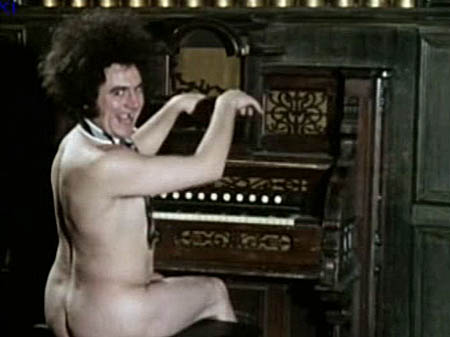
As a group, Monty Python produced 45 episodes of Monty Python’s Flying Circus for the BBC, three original feature films, a compilation film of re-shot sketches from their TV show, two extended original episodes produced for German television, several books and record albums crammed full of material unavailable in any other format, and toured as a live act (resulting in a concert film, for a total of five movies). No other comedy team can top that output. They hung up their Gumby boots in 1983, but well before that, the six members had begun concurrent solo careers which continue to this day (well, except for one — see below.) Graham Chapman, John Cleese, Terry Gilliam, Eric Idle, Terry Jones, and Michael Palin have produced some very creative and funny works of art — and some dreck.

Here’s the format for our little examinations: Only projects that the individual Pythons had a direct hand in creating will be considered. This means writing or co-writing, directing, producing, or any combination thereof. If we expanded our project to include instances where they simply took an acting job for a paycheck, the “worst” portion would be impossible to sort through, especially concerning John Cleese and Eric Idle. (Every non-superstar actor has to take roles to pay the bills from time to time, but it pains me to say that Idle and Cleese have been particularly non-discriminating and mercenary in this regard, popping up in some of the most notorious turkeys of the last twenty years.)

And unlike the solo Beatles, we are not limiting ourselves to one medium. The solo Pythons have written and/or directed feature films, created TV series, written children’s books, self-help books, novels, and scholarly history books, and produced Broadway musicals, to name just a few endeavors.

There will be Best Project and Worst Project, followed by Should Probably Avoid, and to end on a positive note, a Worth Checking Out. This format will be adhered to strictly, except for the times when it’s not. Continue reading

Leave a comment

Filed under Books, Film & TV, Pop Culture

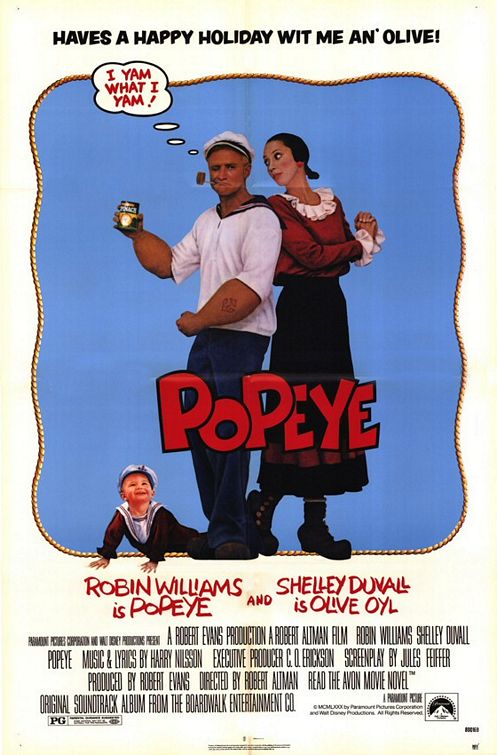
The Holy Bee Recommends, #9: Robert Altman’s Popeye (1980)

Perhaps it wouldn’t be such an odd idea nowadays, now that cartoons, comic books, and even comic strips are acceptable — even ideal — fodder for big live-action Hollywood films. In popeyefact, you can probably subtract $25 million from your opening weekend if your film isn’t based on some colorful funnybook creation.

But 1980 was a different world. Superman had been a success two years before, but that was more of an anamoly than the true beginning of the comic/movie phenomenon. And it made sense. Superman was a great character on which to base a film. But…Popeye?

A balding, muttering, one-eyed sailor with a seemingly stroke-induced speech impediment, a filthy, chewed-up corncob pipe jammed in the corner of his slack mouth at all times (even while asleep), freakishly swollen forearms and possibly rickets (or at least severe hip dysplasia)? This was leading man material? Someone evidently thought so… Continue reading

1 Comment

Filed under Film & TV, The Holy Bee Recommends

The Holy Bee Retires…Sort Of (The Top 20 Albums of 2012)

Timeliness has always been a watchword here at Holy Bee World HQ, so it may seem odd to post my Top 20 Albums of 2012 in March of 2013. Ordinarily an eagerly-anticipated feature of January, there has been a bit of a drift around here, and I have to ‘fess up to what’s causing it.

Looking back on 2012, I see that the most acclaimed albums are from the likes of the xx, Swans, Grizzly Bear, Dirty Projectors, Shonen Knife, Flying Lotus, Cloud Nothings, Ariel Pink’s Haunted Graffiti, Bat For Lashes, Chromatics, Beach House, Purity Ring…

…and I’ve decided they can all go die in a fire. To my ears, they all kinda sound like shit, and wash by in a clatter of forced artiness, or smug haziness, or often, downright tunelessness. Sometimes all three. I blame Radiohead. Fuck those guys and what they’ve wrought. Someone needs to tell that emperor he’s buck naked.

I kind of hate them.

I kind of hate them.

Yes, I’ve always been a proud classicist and defender of old-school dinosaur rock, but I felt I balanced that with an eagerness to explore other areas and a respect for those breaking new ground. But now, I can no longer pretend to be interested the newest and different-est. In fact, I may have been faking it for quite some time, because time spent trying to like the Mountain Goats was less time I got to spend listening to Led Zeppelin.

I realize that this is on me. I own this, it’s my failing. If you like the kind of music listed up there, I’m not judging your taste, I’m judging mine. You don’t have to write me to say “you couldn’t be more wrong about the xx.” I know I’m wrong. But my ears are now dead  to the sound of what is still frequently called “indie” music. Which is sad, because ever since I (and a lot of people my age) lost touch with the “mainstream” well over a decade ago, “indie” (which has, admittedly, lost any true meaning as a descriptor, but it’s handy) was the discerning music-lover’s haven. And now that has passed me by, too. It all leaves me cold. I guess there’s something to be said for the mainstream trending back toward roots music, but I can’t stomach Mumford & Sons either, so where does that leave me?

It leaves me as someone who no longer considers music a central facet of his existence, which is a difficult truth for me to face. I used to go hungry to be able to buy a CD. I’d have some sleepless Monday nights waiting to get Tuesday’s new releases. I have written more on music than any other subject, and had more conversations about it with more people than any other subject. But the flame has gone out. And it’s not an age thing. Several of my friends my age and a little older still have the passion. Great rock writers like Anthony Decurtis, Jim DeRogatis, Greg Kot, and many, many others are a decade or two older than me, and are still forward-thinking, ever on the prowl for the cutting edge. I think that’s fantastic…but they’ll have to carry on the mission without me. Continue reading

2 Comments

Filed under Life & Other Distractions, Music -- 2000s

Alexander Hamilton Meets the Dark Knight: The Holy Bee’s Adventures in D.C. and N.Y.C., Part 4

[Ed. Note — During the COVID-19 shelter-in-place quarantine in the spring of 2020, the Holy Bee had the opportunity to do a deep dig into his dusty archives. Lo and behold, I found the concluding segment of this long-forgotten blog series. It was still a very much a rough draft, and missing its photos and a conclusion, but a little work got it into presentable shape, though it’s shorter and patchier than my usual stuff. I am placing it in its correct position in the Holy Bee blog timeline.]

Part One

Part Two

Part Three

We had a few open hours before dinner, so we split into groups. MDG took the lion’s share to go see the Museum of Comic and Cartoon Art, Our Principal took a slightly smaller group who wanted to go shopping, and I — with my agenda of seeing historic Trinity Church and the New York Public Library — attracted only two: my loyal son, Cade, and his friend Adam. 

Trinity Church, 2:37 p.m. The rain continued as we made our way to Trinity Church, within easy walking distance of the 9/11 Memorial. Trinity Church has been a lower Manhattan landmark since the 1790s, when the Second Trinity Church towered 200 feet over the smaller buildings around it. (The First Trinity Church was a much humbler building, destroyed by the Great Fire of 1776.) It was the Episcopalian house of worship for notable New Yorkers like Alexander Hamilton, and George Washington during the first year of his presidency, when the U.S. capital was briefly New York City. Most of the Founders were newly Episcopalian — the post-Revolution, screw-the-English Americanized version of the Church of England (or Anglican Church), which was itself founded in a fit of pique by jolly old King Henry VIII when the Pope wouldn’t grant him an annulment from his first wife (who got off pretty lightly when you consider later wives).

100_0865

The building before us was the Third Trinity Church, completed in 1846 in Gothic Revival style after the Second was pulled down due to structural weakness. The compact Trinity Churchyard is home to a few notable burials, none more so than Alexander Hamilton.

The young Holy Bee first developed a passion for history in the third grade, thanks to a classroom set of World Book encyclopedias. When I finished my classwork, I would often peruse these volumes. It was the history stuff that always hooked me, particularly the Revolutionary War. At recess, I would gallop around, pretending to be Paul Revere, much to the amusement of my more traditional, four-square-playing peers. One of the more gripping stories I came across at this time was the Duel — when the sitting Vice-President Aaron Burr gunned down political rival and former Secretary of the Treasury Alexander Hamilton on July 11, 1804. Hamilton became a figure of fascination to me, even as I recognized his numerous character flaws. 

After lingering a day, Hamilton died a painful death and was put to rest here in the Trinity Churchyard. I led our little troupe to his grave site — an above-ground sarcophagus near the Rector Street fence. We did what you normally do when looking at the grave of someone well-known, but not known personally — stare for a moment, nod solemnly, maybe with a soft “mm-hm,” then move on.

100_0863

(Trivia note: Alexander Hamilton’s fifth son, William, is buried in my hometown of Sacramento. He was a mining engineer, came to California during the Gold Rush, and was one of the many victims of an 1850 outbreak of cholera.)

Wall Street, 2:56 p.m. We crossed Broadway and headed down Wall Street, so named because it once ran along a literal wall. The wall was actually a rampart, part of the fortifications of the original Dutch settlement of New Amsterdam and it represented the settlement’s northern boundary. The rampart was pulled down in 1699, but the road next to it remained. A hundred or so years later, a possibly-mythical buttonwood tree where the road met the East River is where a group of traders and speculators would gather to trade securities. From that beginning, Wall Street became the financial center of the country, if not the world. 

100_0877

Adam and Cade on a wet Wall Street, Trinity Church in the distance

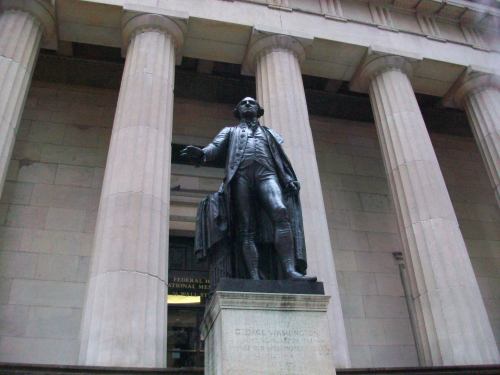
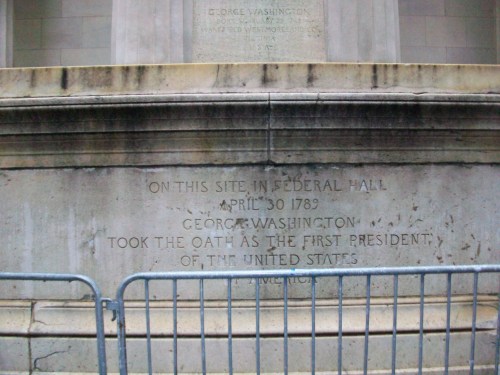
I was never all that interested in economics, and certainly have no interest in the stock market, so the attraction of Wall Street for me was seeing the place where George Washington took the oath of office to become the first President of the United States. Federal Hall, directly across the street from the New York Stock Exchange building, was originally New York’s City Hall. In 1789, it briefly became the seat of the new U.S. government after the ratification of the Constitution. Both the Senate and the House of Representatives had their first sessions here, and Washington was sworn in on its second-floor balcony. (The U.S. government moved to Philadelphia in 1790, then to the newly-constructed Washington, D.C. in 1800.)

The original Federal Hall was torn down in 1812, and replaced by a marble Greek Revival building that served as the Custom House for the Port of New York. It later became a depository for the U.S. Treasury. In 1939, it became a national memorial and museum. On the large staircase leading to the main entrance, there is an elevated pedestal with a bronze statue of George Washington, gazing stoically across Wall Street from roughly the same spot where he was sworn in as President.

IMG_20190416_131532

I never took a decent long distance shot of the Federal Hall National Memorial Building on that stormy day in 2011. This was taken on a much sunnier day on one of the Holy Bee’s later trips to NYC

220px-Federal_Hall,_N.Y._1789_ppmsca.15703

The original Federal Hall, 1789

100_0875100_0876

The rain was not letting up. The Occupy Wall Street protesters were nowhere to be seen, but there was definitely a teeming city of colorful tents in Zucotti Park, with the protesters zippered into their much dryer interiors. We ducked down into the nearest subway station, and headed uptown. 

New York Public Library, Main Branch, Fifth Avenue & 42nd St., 3:37 p.m. The ornate 1911 Beaux-Arts style building is now called the “Stephen A. Schwarzman Building” after a guy who gave them $100 million in the early 2000s. The least they could is name the building after him, right? The two famous marble lions, named Leo Astor and Leo Lenox after the library’s founders, flank either side of the main entrance stairway. (Supposedly the lions were re-named “Patience” and “Fortitude” during the Great Depression, but I don’t know if those names ever became official.) Want to check out a book? Too bad, the Main Branch hasn’t been a lending library since the 1970s. It’s for on-site reading and research only. Go to the nearby Mid-Manhattan branch for more traditional library services.
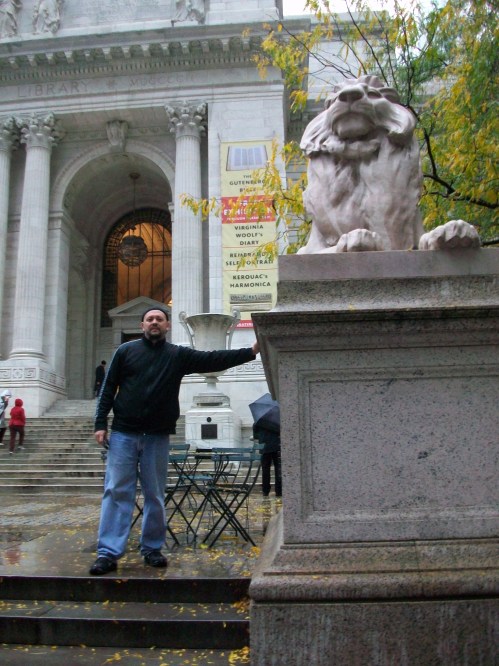
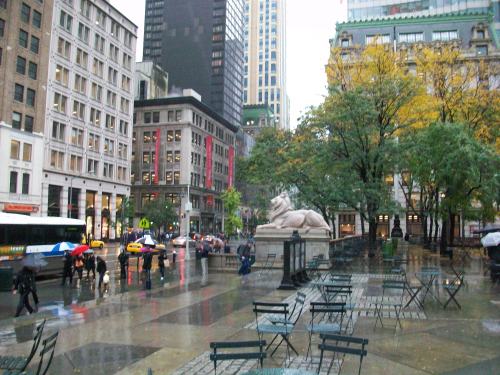
100_0882100_0886

Like a lot of people my age, the Main Branch of the New York Public Library will always be associated with Ghostbusters, which set its opening scenes in the Rose Main Reading Room (filmed early in the morning before the library opened) and its non-public stacks (filmed across the country at the L.A. Central Library). We wanted to get a peek at the iconic Reading Room. Unfortunately, photography was forbidden in most of the library’s interior spaces, so I had to surreptitiously fire off a few quick, unfocused shots of this very familiar (to Ghostbusters fans) location.

100_0889100_0893

No matter what movie it’s in, a library reading room will never be much more than a library reading room. We soaked it in for a few minutes, sneaked our blurry pics, and left. The real find of the day was in a first floor exhibition space called Gottesman Hall, which had numerous literature-related artifacts on display as part of the library’s centennial celebration. The “Celebrating 100 Years” exhibit featured things like Thomas Jefferson’s handwritten draft of the Declaration of Independence, Charles Dickens’ letter opener (made from the paw of his cat Bob, who had died of, one would hope, natural causes), Virginia Woolf’s walking stick (found floating in the river in which she drowned), Jack Kerouac’s notebooks, and other remarkable artifacts. We gawked at this stuff for the better part of an hour, and could have stayed longer, but we had a bit of a walk ahead of us. 

It was getting dark as we exited the library. Still raining, and the air was getting much chillier as the sun sank. Our route took us through Manhattan’s single-block “Diamond District” on 47th Street between Fifth and Sixth Avenues, where a day’s jewelry trade could exceed $400 million. As the city clocks struck five, a number of Hasidic Jews, clad in their rekels and their dark hats covered in clear plastic to protect them from the rain, hit the streets after closing up their businesses for the day.

Trattoria Trecolori, 254 W. 47th St., 5:27 p.m. We reunited with the main group at this small Italian restaurant in the heart of the Theater District. They had had a mostly-unsuccessful afternoon — the Museum of Comic and Cartoon Art had limited hours and was closed that day. (It would close permanently the following July.) They squished up nearby Bleecker Street and explored the shops of Greenwich Village.

The restaurant staff hustled us upstairs — away from real customers — where an Italian buffet had been laid out in a small banqueting area.

Imperial Theatre, 249 W. 45th St., 7:30 p.m. One of the more non-educational items on our super-crowded agenda was a Broadway show. The Imperial Theater was home for thirteen years to Les Miserables. Its current production, Billy Elliott: The Musical, probably won’t achieve that level of longevity, but it was well into its third year when we saw it.

hero-small1

The play was based on the 2000 film, about a boy from the mining country of northern England who longs to be a ballet dancer, but must overcome his working class family’s resistance to the idea. Set during the mining strike of 1984, the play’s language is not particularly…middle-school friendly. One f-bomb is probably okay, but by the middle of the second act, where everything is “fookin’” this and “fookin’” that, Our Principal had slouched noticeably lower in her seat. The play was entertaining in that superficial way typical of most Broadway musicals. The rain had stopped by the time the show was over, and the temperature had plunged. Teeth chattering, we hustled back to the subway station and out to our Holiday Inn in Queens.

DSC00597

Friday, October 28, 2011. Battery Park, 10:03 a.m. It was right around now that we realized we were not getting near those boats, at least not in a timely enough manner to get us to LaGuardia Airport for our flight.

100_0920

The waves frequently crested onto the walkway that morning. It was a challenge keeping our shoes dry

After a full day of rain yesterday, the morning dawned incredibly clear — and incredibly cold. It was just a few ticks above freezing when we emerged from the subway at Battery Park, full of hope that we would get out to see the Statue of Liberty. We got in line. A long line was expected.
DSC00607

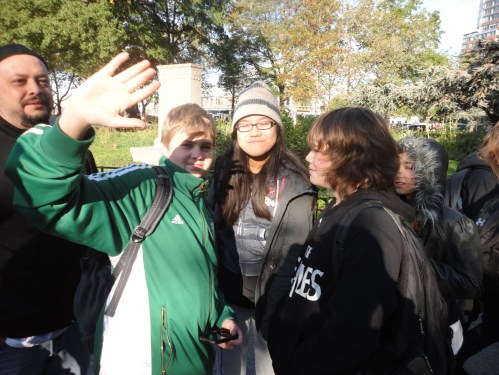
The Holy Bee, Adam, Lana, Cade, and Sandi during our aborted attempt to board a ferry to Liberty Island

DSC00610

But as we looked around, we started to realize that the line was particularly long, extending out of the docking area and into the park itself, winding along the park’s path, and spilling onto State St. As we shuffled along over the course of an hour, we started putting the picture together from fragments of overheard conversations around us.

DSC00614

The Nineteen, Battery Park, 10/28/11

DSC00624

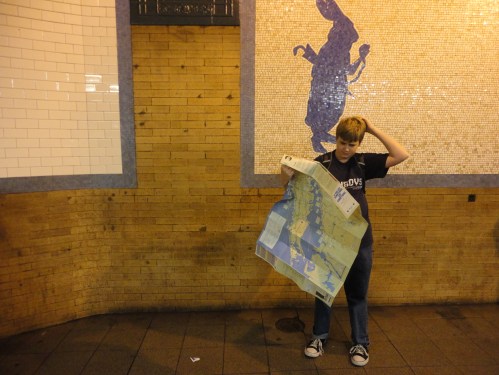
It turns out — entirely unbeknownst to us — we had chosen the exact day of the Statue’s original dedication and opening 125 years earlier. October 28, 1886. There were festivities and whatnot taking place out on Liberty Island. It would be hours before we even got near the ferries that were taking large swaths of humanity out there. We decided to bail, with no real idea of where to go or what to do for the four or so hours before we had to check in at the airport.
DSC00605

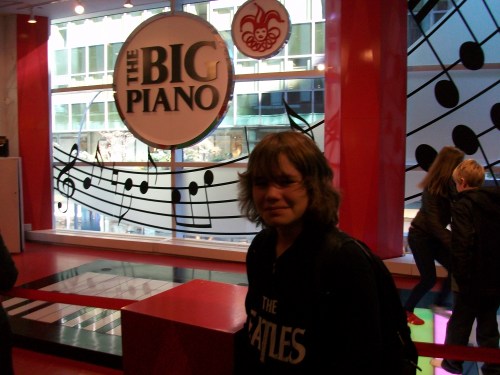
FAO Schwarz, 767 Fifth Avenue, 10:48 a.m. We ended up in another well-known movie location. This was the toy store where we saw Tom Hanks and Robert Loggia dance atop an over-sized piano keyboard set into the floor in 1988’s Big. Seeing the genuine article was somewhat underwhelming. Penny Marshall must have used a wide-angle lens or something. 

100_0940100_0939

The massive, multi-level store provided demonstrations of various toys, gadgets, and magic tricks, had lots of try-it-yourself hands-on displays, and a number of elaborate Lego sculptures. By the time we had all the fun there was to be had, it was lunchtime, so we grabbed a bunch of gastronomically dubious items from the various street vendors surrounding the Grand Army Plaza.

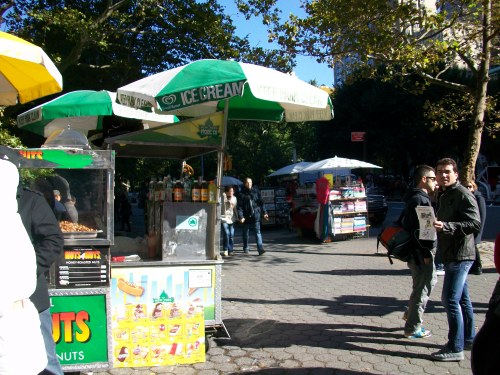
100_0938100_0928100_0927

Trump Tower, 725 Fifth Avenue, 12:31 p.m. With time left to kill, we began walking down Fifth Avenue in search of diversion. We found it at Trump Tower…or should I say, Wayne Enterprises?
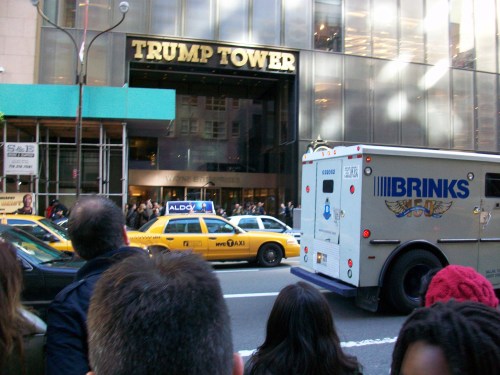
100_0955

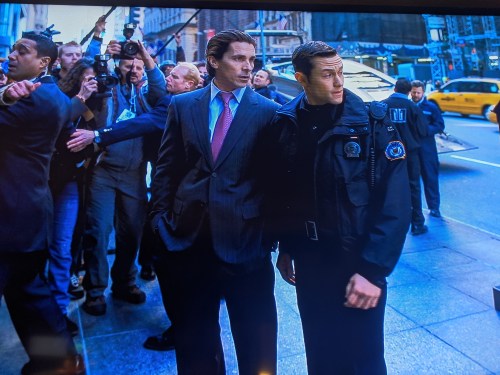
We spotted what appeared to be a flurry of microphones, and cameras snapping away at someone coming out of the building’s entrance. Those cameras were in turn surrounded by bigger cameras and more microphones, along with large lights and reflectors. We were puzzled for a moment. The person who came out of the front doors turned around and went back in, as the large light reflectors came down, and everyone shifted into milling-around mode. They were were obviously shooting a movie.
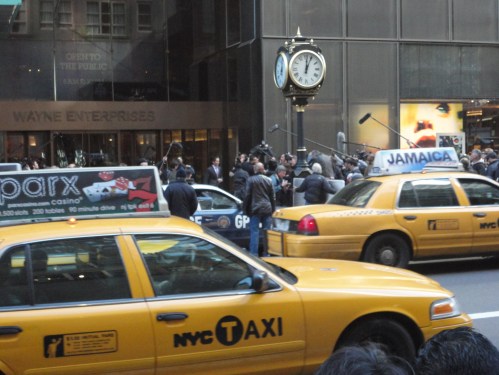
DSC00636

Our view from across Fifth Avenue. Christian Bale is in the suit at the center of the image

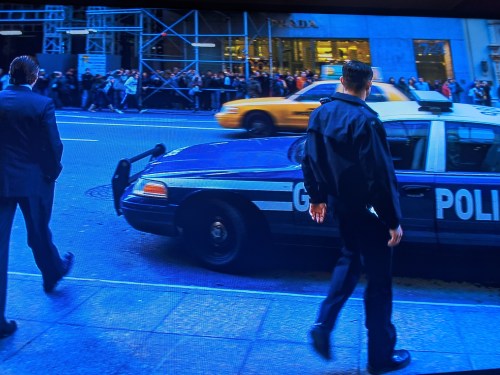
After a few minutes, everyone snapped back to full alert. The doors opened and we realized the person coming out was actor Christian Bale in a finely tailored suit. He was approached by Joseph Gordon Levitt in a police uniform. We all stared, open-mouthed, as we realized we were witnessing the filming of Christopher Nolan’s third entry in his Dark Knight trilogy. The sign above the door says “Wayne Enterprises.” A sign higher above the door — presumably out of camera range — reads “Trump Tower.” The blue police car at the curb is marked “GPD” — Gotham Police Department.

Bale came out and exchanged his lines with Levitt about three more times before the film crew started breaking things down, and we realized we now had to move quickly. The clear conditions of the morning were replaced by a slate-gray overcast, and the wind was starting to whip.

Later, all the kids agreed this had been the absolute highlight of the entire trip.

IMG_20200331_180727

The scene we watched being filmed

IMG_20200331_180817

IMG_20200331_180945

We are just to the right of the scaffolding, behind the first row of spectators. My back was against that store window

(The Dark Knight Rises hit theaters on July 20, 2012. The scene we saw being filmed on October 28, 2011 was Bruce Wayne being ousted as head of Wayne Enterprises and leaving his company building amid a media frenzy, and comes at the 1:03:24 mark.)

[Ed. Note — That’s where the original text ends. We left Manhattan and hustled back to get our luggage (those of us who still had luggage — see Part 1) from our hotel in Queens, then got to LaGuardia Ariport in time for a 3:45 flight.
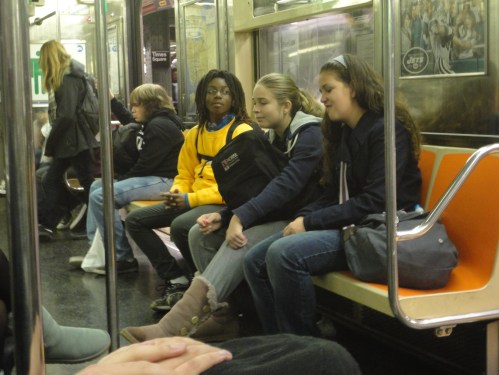
DSC00642

Second-to-last subway ride, back to the hotel. A little tired and subdued. It was almost over

At our layover in Dallas, I tried to recover my luggage, but Lost & Found was closed. My suitcase was probably only a few feet from where I stood forlornly looking at a locked door. We watched six innings of Game 7 of the tied-up 2011 World Series on the big airport TV screens — St. Louis eventually beat the Texas Rangers when we were somewhere over New Mexico. We arrived back in Sacramento a little after 11:00 p.m. 

As I was clearly hinting, the frigid conditions on our last day on the East Coast were a precursor to a massive storm that became known as the “2011 Halloween Nor’Easter” — 12 hours after we left, New York City was under a blanket of snow and two million people were without power.

My luggage arrived via Federal Express a few days later.
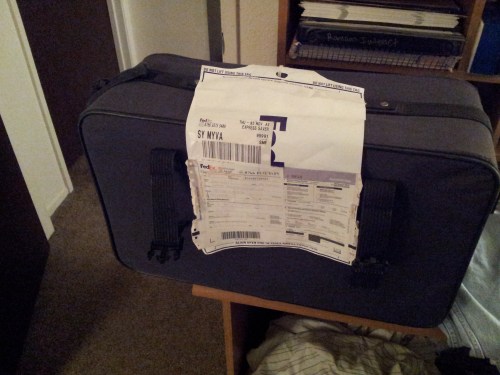
20120521_215121

Reunited and it feels so good

Over the next year (2012), I wrote up the events of the trip based on the notes I took at the time. I don’t know why I never finished part 4. I think I had planned on adding some more color and detail, historical background, funny remarks from the students, and certainly some kind of grand summation, but I kept putting it off until it fell between the cracks, other stuff came up, and this was forgotten about. The completist in me is glad to see this finally posted in its proper spot, unpolished as it may feel. Obviously, Hamilton the musical was still two years in the future, and Trump was still a game show host.

My school has grown and changed, and both MDG and Our Principal have moved on to other opportunities. I’m still there, but I doubt we’ll ever mount a field trip like this again — Washington, D.C. and New York City in five days with nineteen 8th graders! (Most of them now college seniors.) It makes me tired just re-reading it.]

2 Comments

Filed under Life & Other Distractions

Hot Pastrami with the Ghost of George Gobel: The Holy Bee’s Adventures in D.C. and N.Y.C., Part 3

When last we left the intrepid Holy Bee, less than two hours after arriving in the Big City, he and four of his students failed to make it off at the correct subway stop, and were barreling into parts unknown…

If I were alone, this moment would have produced a tingle of excitement. A challenge! But since I was nominally in charge of four eighth-graders who foolishly assumed I knew what I was doing, the moment produced nothing but a sort of grim, quiet panic. They were all relatively bright kids, but as far as navigating the perplexing N.Y.C. subway system, they were drooling idiots. (I found myself making a snap judgment of their intelligence to determine if they could be in any way helpful, as obviously my little miscue proved I was far from Mensa material myself when it came to urban public transportation.)

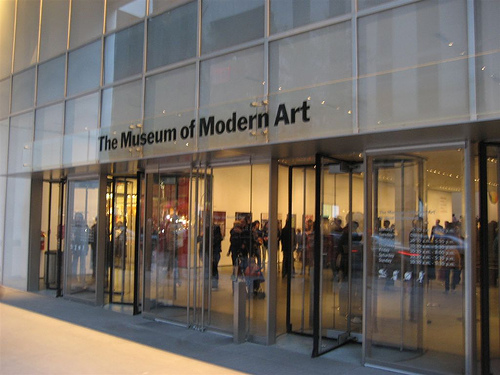
Luckily, the subway cars were copiously supplied with mounted and framed subway maps, so I pushed my way through to the nearest non-defaced one. Ah, a quick hop onto the Yellow Line at Queensboro Plaza should save our bacon nicely.  We could get off at Fifth Avenue and 59th Street, and hoof it six blocks south to the Museum of Modern Art. A doddle, as the Brits say.

Maybe the fact that my plan worked so flawlessly caused me to have a moment of giddy euphoria as we emerged from the subway station into midtown Manhattan just south of Central Park. My earlier glimpse of Metropolis at Penn Station was hurried and distracted. Now I drank it all in. It felt like a movie set, as if the whole thing were created as a massive special effect. I loved it immediately. But we had to hustle — the MoMA closed at 5:30 and it was already edging past three. We all broke into a jog, slipping and squeezing our way through pedestrian traffic. At least one of us pretended he was a Ghostbuster. We arrived at the MoMA a mere fifteen minutes behind the main group, who’d used the “correct” subway connections.

Continue reading

2 Comments

Filed under Life & Other Distractions

This Used To Be My Playground, Part 17: Nine Inch Fails — You Want To What Me Like A What??

#133. “Closer” – Nine Inch Nails

#134. “No Excuses” – Alice In Chains

#135. “The Day I Tried To Live” – Soundgarden
For some reason, the summer of 1994 was a heyday for particularly grim music. Saturating the air were the negative vibes of “industrial” bands like Nine Inch Nails and Ministry (their 1994 offering was entitled Filth Pig. Indeed.) All the grunge knock-offs and second-generation shoegaze aided and abetted the general ambiance of doom. Which was fine by me. It matched my state of mind. I was in the grips of post-breakup grief, and things like the NIN magnum opus The Downward Spiral (“Help me – I’ve broke apart my insides/Help me – I’ve got no soul to sell/Help me – the only thing that works for me/Help me get away from myselfMy whole existence is flawed…”) gave it a voice.

The gritty Alice In Chains EP Jar Of Flies was also a favorite at this time, thanks to the song that may have summed up my feelings better than anything else. I almost wore out the CD on this one, so it’s worth quoting at length:

It’s alright…There comes a time
Got no patience to search for peace of mind

Laying’ low…Want to take it slow
No more hiding or disguising truths I’ve sold

Everyday something hits me all so cold
Find me sittin’ by myself — no excuses that I know

It’s okay…Had a bad day
Hands are bruised from breaking rocks all day

Drained and blue …I bleed for you
You think it’s funny, well you’re drowning in it too

Everyday something hits me all so cold
Find me sittin’ by myself — no excuses that I know

Yeah, it’s fine…We’ll walk down the line
Leave our rain, a cold trade for warm sunshine

You my friend …I will defend
And if we change, well I love you anyway

Get the picture, skipper? Continue reading

1 Comment

Filed under Music -- 1990s, This Used To Be My Playground

The Best & Worst of the Solo Beatles, Part 4: Ringo Starr

Part 1: John Lennon

Part 2: Paul McCartney

Part 3: George Harrison

OK, this is the one I’ve been dreading. Most folks who lead normal lives are blissfully unaware that the former drummer for the Beatles has released sixteen solo albums. That is not a typo. But the experience of listening to all of them actually turned out not to be excruciating. Read on…

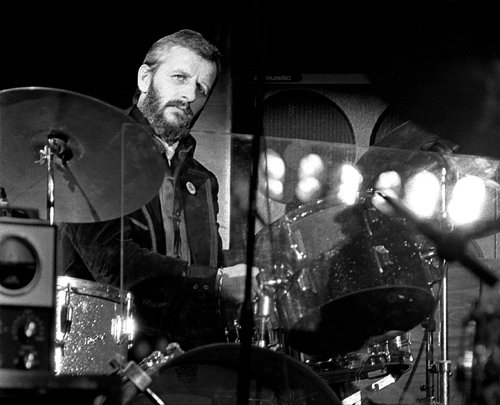
Starr may have been the Beatle who least matched his public persona, a persona created out of thin air by the early-’60s media (especially the American media, who initially had trouble telling them apart) and reinforced by his “Ringo” character in A Hard Day’s Night, Help!, and especially the ridiculous Beatles Saturday morning cartoon. He was the mascot, the goofy dimwit, condescended to and put upon by the others, but always childlike and cheery. Out of the spotlight, however, the real-life Richard Starkey could be just as cutting and sarcastic as Lennon, as moody as Harrison, and as savvy as McCartney.

He was the oldest Beatle, and the others have all reminisced about how much more cool and sophisticated Starr seemed before he signed on with them. In fact, “Richy” (his spelling) was considered something of a tough customer, rising up from the lowest of the Liverpool slums (a place called “The Dingle”) to become the powerhouse drummer for the hardest-rocking band on the local “beat” scene, Rory Storm & The Hurricanes. He drove a sporty car while his future bandmates still scrounged for bus fare, wore flashy jewelry (hence the stage name), and cultivated a cool bohemian beard as early as 1960.

The fact that the proto-Fab Three had coveted him and his drums for years should certainly say something about how his skills were regarded at that time, and the fact that the great Ringo Starr ditched his sweet gig with the Hurricanes and deigned to join these upstarts should say something about Starr’s own musical judgment. [ADDENDUM: I’ve recently (Nov. 2013) read the first volume of Mark Lewisohn’s exhaustive three-volume Beatles biography, and it shed a lot of light on this era. Evidently, the Hurricanes were stagnating — Ringo had already quit them once — and the Beatles, far from being “upstarts,” had been top of the heap in Liverpool for some time, and were clearly poised for bigger things.]

Maybe his role as the “runt” stemmed from the fact that he joined the band at the last moment before they skyrocketed in late ’62. Maybe it was the fact that he was three inches shorter than the others, or wasn’t quite as handsome (that nose, y’know.) What seems clear is that the dismissiveness people sometimes projected onto Ringo as a personality began to spill over to his skill as a drummer, and that’s just plain unfair. Continue reading

13 Comments

Filed under Music -- 1970s-80s, Music -- 1990s, Music -- 2000s

The Best & Worst of the Solo Beatles, Part 3: George Harrison

Part 1: John Lennon

Part 2: Paul McCartney

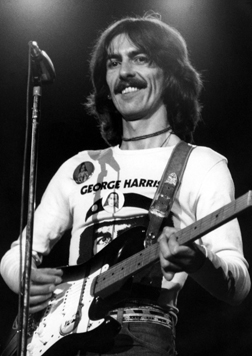
As a vocalist, he was nothing special. His voice was not as immediately powerful as Lennon’s nor as sweet as McCartney’s. In fact, it was kind of sub-par. Adenoidal and thickly accented, but I suppose he could carry a tune. As a guitarist, he was admittedly unable to improvise on the fly, definitely out of sync with his flashy Sixties peers, and not criminally underrated the way Ringo was as a drummer. (Relax, we’ll get to him in Part 4).  As a songwriter, he couldn’t hold a candle to the great rock poets like Dylan and Springsteen. Harrison’s talents in all these areas can best be described as “modest.”  One gets the impression that if there were no Beatles, Lennon and McCartney would have found another path and still be known to us in some capacity, but Harrison was in dire need of his Beatles background to launch his solo career.

But wait! Let’s examine all this again. Harrison’s voice was certainly distinctive and full of character (and blended perfectly with Lennon and McCartney’s to create that special Beatles alchemy, usually pinning down the tricky middle harmony). As a guitarist, it may not have been a bad thing to be out of step with his flashy Sixties peers. Some of those wanky, Vanilla Fudge-style blues-worshipers soloed like there was no tomorrow, often forgetting they were supposed to be playing a song.

Harrison did not go down the very well-trodden blues path, but played in a much more country & western-influenced rockabilly style, patterned after guys like Chet Atkins and Carl Perkins. His major concession to R&B was a healthy dose of Chuck Berry, which is the one thing he had in common with all other Sixties rock guitarists. (Hell, even the great Keith Richards spent most of the decade recycling Berry riffs, until he discovered open tuning in ’68.) Every Harrison solo was short, punchy, and served the song perfectly. Re-listen to some Beatles songs (“Can’t Buy Me Love” and their cover of the Larry Williams scorcher “Bad Boy” come to mind) with an ear on the solos, and you’ll see what I mean. As a songwriter, neither Lennon solo nor McCartney solo were on par with Dylan or Springsteen, either, and the best of Harrison’s solo material certainly equals the best of Lennon’s and McCartney’s. As far as being unable to improvise, who gives a good goddamn? The Beatles were never a jam band, anyway (thank God.)

And when, on a whim, he decided to join American R&B act Delaney & Bonnie on their British tour in 1969, he finally embraced the blues, but in his own way, rapidly developing an almost Hawaiian-sounding slide guitar technique that became the defining sound of his solo career. I still doubt there would have been a George Harrison music career without the Beatles, but luckily for everyone, there was a Beatles. And there’s some great stuff in the Harrisongs catalog…and also some turkeys. That’s why we’re here.

Anything else I have to say about Harrison, I said in my 2010 essay “The Quiet One.” In fact, I’ve probably already repeated myself somewhat, so let’s get on with our examination of the solo Harrison. Continue reading

20 Comments

Filed under Music -- 1970s-80s, Music -- 1990s

The British Invasion Soldier That Didn’t Make It: The 1960s EP (Part 3)

Click here for PART 1

Click here for PART 2

All right, wake up, I’m almost finished…

The Kinks — Kwyet Kinks. (Tracks: 1. “Wait Till The Summer Comes Along.” 2. “Such A Shame.” 3. “A Well-Respected Man.” 4. “Don’t You Fret.” Released: September 17, 1965).

In the late summer of 1965, Kinks lead singer and primary songwriter Ray Davies was heading for a nervous breakdown. Nursing an extremely tender psyche pretty much since the day he was born, he was just not cut out for dealing with pop stardom, early 1960s-style. In addition to the eternal cycle of live appearances, TV and radio spots, interviews with clueless journalists asking the same inane questions about hair length and how long the “rock & roll fad” would last, the bands had to squeeze in recording sessions when they could, and if they wrote their own material, the pressure was even greater. Not only did they have to keep up with a brutal release schedule (their record labels expected at least two full albums and three  hopefully smash-hit standalone singles per year — imagine!), they were pushed by their management to provide songs for lesser-known artists who were not songwriters. (See Part 1 and Billy J. Kramer and the Dakotas.)

After a string of early hits such as “You Really Got Me,” “All Day And All Of The Night,” “Tired Of Waiting For You,” and several others, the Kinks kracked. Led by Davies (and aided and abetted by his rowdy kid brother/worst enemy, 17-year-old lead guitarist Dave Davies), the group attempted to sabotage themselves with an epic string of boorish and unprofessional behavior. Cancelling concerts for no good reason, often storming off stage mid-set when they did deign to show up, telling powerful musician’s union reps to “fuck off,” and becoming the very first band to make a habit of trashing hotel rooms, The Kinks were punks a dozen years before there was any social or musical cachet associated with the term. It all culminated with a disastrous American tour, where their antics resulted in a blacklisting from American venues for the next four years.

Due to Davies’ disappointment and suspicion towards all things American, the Kinks gradually turned away from American-influenced R&B. He soon came up with his first satirical character sketch, and harbinger of the “new” Kinks sound, “A Well-Respected Man.” Poking vicious fun the conservative upper middle-class, the acoustic-textured song was a throwback to old British music hall and traditional pub sing-alongs. These older, very English pre-rock institutions began dominating the Kinks’ sonic palette, giving the band a fey, campy, whimsical style totally unique in the British music scene. The punks became dandies. Continue reading

Leave a comment

Filed under Music -- 1960s

The British Invasion Soldier That Didn’t Make It: The 1960s EP (Part 2)

Click here for PART 1

The Rolling Stones — Five By Five. (Tracks: 1. “If You Need Me.” 2. “Empty Heart.” 3. “2120 South Michigan Avenue.” 4. “Confessin’ The Blues.” 5. “Around And Around.” Released: August 14, 1964.)

This was not the Stones’ first trip to the EP well. That distinction goes to their self-titled disc released in January ’64. The Stones would not truly embrace songwriting until the following year, so that first The Rolling Stones EP featured the usual fare of Anglicized R&B covers from the sublime (Arthur Alexander’s “You Better Move On” is given a gorgeous acoustic treatment and one of Jagger’s best early vocals) to the typical (Chuck Berry’s “Bye Bye Johnny” is sloppily bashed out in a sped-up, amphetamine-drenched tangle similar to most British covers of the era, and both it and “Money (That’s What I Want)” strain the limits of the primitive mics and tape machines used back then), to the forgettable (the Coasters’ novelty hit “Poison Ivy” was once intended as the Stones’ second single — wiser heads prevailed.)

What makes Five By Five much more special than their first EP attempt is not just their growing musical prowess, which was audible with each release, but where it was recorded. At this time, British bands were content to record in British studios, whose limited technology and stodgy engineers simply couldn’t provide the muscle and bottom-end achieved in more forward-thinking American facilities. (How the Beatles wrung such sonic magic out of stuffy old Abbey Road Studios is detailed in engineer Geoff Emerick’s book Here, There, And Everywhere: My Life Recording The Beatles.) The Rolling Stones broke the ocean barrier, becoming one of the first British acts to utilize American studios almost exclusively through this early era.

And what a studio to start with! In the midst of their difficult first U.S. tour, the Stones took two days off to visit 2120 South Michigan Avenue in Chicago. This was the home studio of Chess Records. Two vital elements, represented by two legendary studios and their associated labels, blended to become what we know as modern rock: Sun Records in Memphis focused more on the white, country-influenced sound of rockabilly, while Chess Records provided the raw, hardcore African-American blues and R&B. I’m over-simplifying greatly, of course, but I think it captures the essence.

The Chess artists were the ones who most inspired and influenced the Rolling Stones: Muddy Waters (whose song “Rollin’ Stone” gave the band their name), Howlin’ Wolf, Willie Dixon, Bo Diddley, and Chuck Berry used Chess Studios to record the songs that made them deities. Over the course of June 10 and 11, 1964, the Rolling Stones put their mark on the place, recording sixteen songs — more than enough for an album. Alas, no one thought to take advantage of the opportunity for a full-length “Chess Album,” and we have to be content with this EP of Chess-recorded material. (The rest of the songs were spread out over their next two albums and two smash singles, “It’s All Over Now” and “Time Is On My Side.”).

The upstart band even met their heroes in the process: Bassist Bill Wyman remembers Muddy Waters helping them carry in their gear (Keith Richards insists Waters was also painting the studio ceiling at the time, a story everyone else present refutes), Willie Dixon attempted to peddle them some songs, and Chuck Berry poked his head in during the recording of “Down The Road Apiece” and complimented their “swinging” style, which was a little different than other British bands of the era due to the jazz-based drumming of Charlie Watts. Continue reading

1 Comment

Filed under Music -- 1960s