It is getting closer and closer to the debut of the official Institute of Idle Time podcast, featuring myself and my cohorts MDG and WH. All of you should know what a podcast is, but in case you don’t, click here.
I commute almost 100 miles a day round trip, and listening to podcasts makes the trip bearable, even enjoyable. Here are the ones that travel with me day in and day out. All of these can be downloaded free of charge (except where noted), most of them produce a new episode roughly every week, and none of them should be listened to if you have young children or elderly relatives in the car. In the words of Jordan Morris, these podcasts wallow in “salty talk.”
Never Not Funny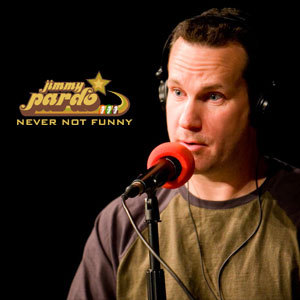
We’ll start with the award-winning, top-shelf, premium stuff, and the only podcast on this list that you have to pay for. $19.99 gets you about 25 weekly 90-minute episodes, plus a few special bonus episodes. It’s hosted by stand-up comedian Jimmy Pardo (former host of the Game Show Network’s Funny Money). The show, described as a “party conversation,” is basically a collection of personal anecdotes and pop culture commentary, a description which can be applied to almost all of the podcasts listed below.
Now wrapping up its fourth season, NNF has gone through several changes since its debut in April 2006. Initially, it was just going to be Pardo shooting the breeze with a rotating group of guests drawn from the L.A. comedy world, and centered primarily around those who work regularly at Hollywood’s Upright Citizens Brigade Theatre (a venue that supports alternative and underground comedy, in both sketch and stand-up forms.) Pardo has hosted a live talk-show at the UCB Theatre called Running Your Trap for some time, and initially the podcast was to be an internet version of that.
The first guest, Mike Schmidt (more on him later), became a “permanent guest,” essentially co-hosting the first season. The producer, Matt Belknap, was originally intended to have a very limited role, but this also changed. Belknap, not a comedian himself but kind of a comedy super-fan, founded the website and comedy record label A Special Thing. His role in the NNF conversation grew by leaps and bounds from the first few episodes on, and it is interesting to listen to his development over three years from what was essentially a straight man into a skilled comedic improviser in his own right. Other guests appeared every fourth episode.
At the end of the first season, Schmidt abruptly departed due to personal differences with Pardo. Neither man commented on specifics, but the careful listener could piece together a scenario where Pardo had grown tired of Schmidt’s quick temper and unpredictability, and needed a “break” from their friendship. [2010 Ed. Note: They have since reconciled, with Schmidt appearing as a guest on a sixth season episode.]
Beginning with the second season, guests joined Pardo and Belknap on every episode. Paul F. Tompkins, Patton Oswalt, Doug Benson, Graham Elwood, Rob Corddry, Maria Bamford, and even Mad Men’s Jon Hamm (a funny guy despite his dour TV character) have all been among the show’s guests, several of them multiple times. Now every fourth episode or so features Jimmy’s off-air best friend, Pat Francis, as the guest. Francis retired from stand-up comedy several years ago, but Pardo still insists he’s the funniest guy he knows, despite constantly haranguing him for being immature, or a “chimp.” Pardo admits that frequently he’s the only one amused by Francis’ antics, which include a loud Paul Stanley impression.
In the third season, the show began being videotaped. The videographer is Jimmy’s brother-in-law Andrew “AK-47” Koenig, son of Star Trek’s Walter Koenig, and former child actor. (Most people would know him as “Boner” from Growing Pains, a fact that was delicately tiptoed around until Koenig himself gave the go-ahead to let the cat out of the bag, which led to a flood of Boner-related jokes in nearly every episode from then on.) [2010 Ed. Note: The clinically depressed Koenig committed suicide in February 2010. The podcast took three weeks off, then returned with a compilation of Koenig’s most memorable moments before resuming normal shows. Pardo has been signing off every season seven episode with the words “AK-47, gone but not forgotten.”]
The show can be little L.A.-centric at times, but Pardo is a Midwesterner at heart, and unlike some of the younger comedians in the underground comedy scene who exist in a smug SoCal bubble, Pardo is a 20-year veteran road comic with all the skills that kind of experience provides. As a stand-up, Pardo insists that he has “no act,” and mostly relies on crowd work and improv. (His fast improvisational reflexes earned him the nickname “Shooter” early in his comedy career.) His comedic persona as an exasperated, impatient, borderline insult-comic carries over to the podcast, where he frequently berates guests, Belknap, and (especially) Koenig for slight transgressions of his arbitrary rules, and loudly wishes for the world to return to a simpler time, when people were “gentlemen” and wore “long pants and hard shoes” as opposed to cargo shorts and flip-flops. This earned him another nickname in the first season: “America’s Haircut Dad.”
Although other podcasts follow the same format, Pardo’s comedic chops and the amount of high-quality guests ensure that Never Not Funny remains the most consistently entertaining podcast out there.
SModcast
This was actually the first podcast I began listening to. I was on board from the first episode (entitled “Fisting Flipper”), which premiered in February of 2007.
No matter what you think of Kevin (“Silent Bob”) Smith as a filmmaker, if you’ve listened to his audio commentaries or watched any of his three “Evening with Kevin Smith” Q&A DVDs, there’s no denying his personal charm, and skill at being a raconteur. Frankly, at this point, I would rather listen to Smith talk than watch one of his films (or as Smith would say, “peep one of his flicks.”) So SModcast is ideal for me. It’s co-hosted by Smith’s long-time producer Scott Mosier (the “M” to Smith’s “S” in SModcast), whose deadpan baritone (he played “Snowball” in Clerks) is the perfect foil for Smith’s wild flights of verbal fancy. Smith, although a noted director with eight feature films to his credit, has never lost the perspective of the everyday person, the Regular Joe, who self-deprecatingly accepts the fact that his Hollywood life is the result of some witty writing, a lot of luck and good timing, but not necessarily filmmaking brilliance (and I say that as a fan.)
SModcast’s specialty is taking a topic, and stretching the discussion for that topic far beyond normal limits. A brief mention of light bulbs could turn into a twenty-minute spiel, with digressions and sub-digressions, and imaginary scenarios overlaid with a veneer ofSmith’s personal obsessions: scatology, genetalia, and homoeroticism. Not for every taste, but I find it pretty amusing.
Smith’s reminiscences of his lower-middle class upbringing in New Jersey in the late 80s (you can taste the hairspray and stone-washed denim in his descriptions), and his “behind the Hollywood curtain” Regular-Joe-makes-movies-and-meets-famous-people anecdotes tend to be far more entertaining than the role-playing improv scenarios he frequently concocts for himself and Mosier. These often lead to dead ends, although the Christmas episode where Smith plays an angel explaining the Virgin Birth to Mosier’s doubting-Joseph character is a classic. Also, the scenario where a fan (Smith) of Foreigner’s Lou Gramm (Mosier) accosts the hapless singer in a grocery store and chews him out for singing one of his own songs to himself as he shops is also pretty good. Smith also frequently displays the shortcomings of the New Jersey public education system by making egregious geographical and historical errors as he discusses things, although this tendency has decreased since they seemed to have started keeping Wikipedia open as they record the podcast.
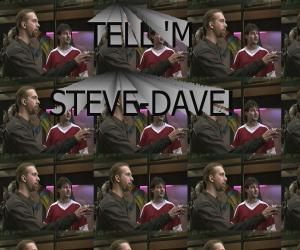
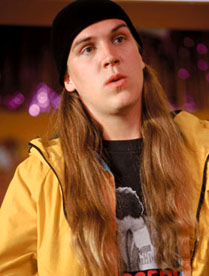
Whenever Mosier is unavailable to co-host, Smith’s old New Jersey friends Walt Flanagan and Bryan Johnston (familiar to Smith fans from their cameos in his films: “Tell him, Steve-Dave!”) often fill in, as does the notorious Jason (“Jay”) Mewes and fellow independent filmmaker Malcolm (Small Town, Gay Bar) Ingram. Smith’s astonishingly patient and tolerant wife Jennifer has also co-hosted, as has their nine-year-old daughter Harley Quinn, forcing Smith’s usual explicitness into PG territory. (There was still considerable talk of “doo doo” and “peepees.”)
Like most podcasts, it is home-recorded and has a low-tech, DIY ambience, frequently featuring Smith’s dachshund Shecky barking in the background, traffic sounds from outside the dining room window, and the recurring *click* of Smith’s cigarette lighter. [Feb. 2010 Ed. Note: In the wake of the relative box-office failure of his Zack and Miri Make A Porno, Smith stated that he tail-spun into a deep depression and sought solace in the sweet, sticky embrace of cannabis. Despite the pot-loving Jay and Silent Bob characters he created, Smith had heretofore been a “once or twice a year” smoker. The depression lifted by early 2009, but the hardcore waking-and-baking remained, and the Smodcast has suffered. They’ve become much more rambling, much less funny, and punctuated by Smith’s annoying new stoner giggle — you know the kind.]
The 40-Year-Old Boy

Schmidt, cast into exile by his NNF cohorts, spent over a year licking his wounds and then began a podcast of his own in early 2008. Schmidt pulls off the most difficult feat in podcasting: the one-man show. It is exceedingly tricky to not have anyone to bounce off of, to essentially talk non-stop and be amusing for over an hour on your own.
Schmidt may have the most brilliant improvisational mind (with the possible exception of “Shooter” Pardo) in podcasting. If there were any justice in the world, he would be a comedy superstar…but he is his own worst enemy. When you listen to him, you hear only the wit and charisma (and the poetic vulgarity.) But in the anecdotes he spins about his misspent life, he reveals himself to be destructively lazy, willfully immature (hence the title), and frighteningly combative. And when I say frightening, keep in mind Schmidt once tipped the scales at 500 pounds before gastric bypass surgery.
His non-comedy career escapades include working as an over-zealous bouncer, a night clerk at 7-11 who fell asleep on duty (allowing the place to be robbed), a deli employee who shaved a large chunk of his palm off in the meat slicer, and an armed bagman for a comically inept Lake Tahoe bookie. Raised in a tough-as-nails single mother Chicago household with four fellow delinquent brothers, Schmidt is always ready for a fight, and he has alienated or pissed off anyone who could have helped him further his career. Which is why he is now perpetually broke, “reduced” to emceeing a weekly burlesque show, working open mike nights at comedy clubs (instead of headlining, which he could be), and week after week, generating what may be the best comedy podcast on the net. He recounts tales of poor life choices and run-ins with a variety of perceived adversaries with barely a pause for breath, punctuated by his frequent refrain of “I’m not gonna lie to you folks.”
He is not entirely alone in creating The 40-Year-Old Boy. From the ninth episode on, his podcast has been produced by burlesque artist (and podcast host herself) Lili Von Schtupp, whose background gales of off-mike laughter have audibly improved Schmidt’s timing and confidence. Every episode, you think Schmidt’s well of stories must run dry eventually, but every episode he pulls another tale from his sordid past, or a recounting of a fresh incident from just that week. There is no reason for you to miss this podcast (unless you’re incredibly squeamish), but if you do, Schmidt frequently pops up as a guest on just about every other podcast out there. That’s because other people doing podcasts know that bringing him in as a guest essentially gives them the week off.
Uhh Yeah Dude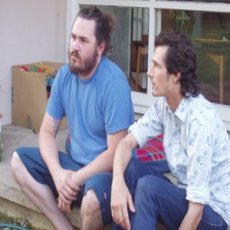
Subtitled “A Weekly Round-Up of America Through the Eyes of Two American Americans,” UYD is hosted by aspiring actor Seth Romatelli, and musician-and-son-of-famous-actor Jonathan Larroquette. The show’s format doesn’t look like much when described in writing, as much of it comes down to the personalities of the hosts, who must be heard to be truly appreciated. Romatelli, a veteran of dozens of commercials and movie bit-parts, is all coiled East Coast intensity, which is offset by the more laid-back, hippie-ish Larroquette. Both have hinted at wild, drug-fueled pasts, but are trying to live cleaner, semi-vegan lives these days.
In keeping with its late-night recording time, UYD focus on the darker, seedier side of things. They spin riffs on sordid news stories (usually originating from the state of Florida), bizarre psycho-sexual postings from Craigslist, detailed recaps of To Catch A Predator, and other unsavory topics, which they pick apart with gleeful enthusiasm and a mock sense of moral outrage. Seth is the more vocal of the two, often ramping up into a frenzied rant, while Jonathan dissolves into helpless giggles. Their unique verbal interplay blends hip-hop lingo, self-promotion and UYD sloganeering, and repetition of words and phrases in various inflections until they lose all meaning and become oddly hilarious, punctuated with frequent uses of “dawg” and “whatevs.”
Again, it doesn’t sound like much. But it works.
Jordan, Jesse, Go!
The sunnier flipside of Uhh Yeah Dude, Jordan, Jesse Go! features another pair of young Los Angelinos on the next-to-bottom rung of the show-biz ladder cracking wise on American culture. Jesse (“America’s Radio Sweetheart”) Thorn’s day job is hosting the public radio show The Sound of Young America, and Jordan (“Boy Detective”) Morris is an on-air correspondent for Fuel TV. Their original collaboration was a comedy radio show for UC Santa Cruz’s college station, and JJG! is an attempt to recreate and expand on that format for a larger, adult audience. In keeping with their radio roots, the show is more interactive than other podcasts, with listeners’ voicemails and phone calls playing an important role. Every episode usually sees Jesse and Jordan giving their listeners “action items,” special tasks to perform and then call the voicemail line with the results.
It is also more structured than the other podcasts, as most of JJG!’s content is based around several recurring segments. “Momentous Occasions” features listeners’ voicemails describing noteworthy events in their lives, preferably as they are happening, “Keep It Up or Hang It Up” is their off-kilter version of what’s hot/what’s not, “Judge John Hodgman” features comedian and writer Hodgman adjudicating a dispute between two listeners over the phone, and “Ask Juanita” has listeners getting advice from a sassy, middle-aged woman of color from Jesse’s night-school Spanish class. “Jordan Is Wrong” features callers correcting Morris on his incorrect assertations from previous episodes, and “Jordan Sings A Song” is exactly that. Many episodes feature guests (mostly comedians, like Mike Schmidt, but Jesse has a soft spot for underground rappers and DJs as well). Just as many episodes do not feature guests at all.
Like the hosts of UYD, Jesse and Jordan are in love with the sound of words and the vast possibilities of the English language, but their perpetual cheeriness provides a nice contrast with the creeped-out noir of Seth and Jonathan. [Feb. 2010 Ed. Note: This podcast has really taken off, and now it’s a rare episode indeed that doesn’t have a semi-celebrity guest.]
The Paul Goebel Show
Ostensibly a podcast discussing television, hosted by comedian and self-crowned “King of TV” Paul Goebel (also known as the “TV Geek” from Comedy Central’s defunct Beat The Geeks), this is really just another free-form “party conversation,” touching on all manner of pop cultural detritus. Each episode, Goebel introduces his co-host in an endearingly pre-pubescent way as his “best friend,” Jim Bruce. Bruce is a member of the sketch comedy group Trouser Shock, and the show often features other members of that troupe, such as Brian McNett and Tom Griffin.
Listening to all of these podcasts, one gets the feeling that the world of underground L.A. comedy is really kind of an extended family, where everyone knows everyone else. There is plenty of guest crossover between this and JJG! and NNF. As previously noted, Mike Schmidt is the most frequent common denominator.
Battleship Pretension
More earnest and less comedically-oriented than the other podcasts, this one features youngfilm school graduates Tyler Smith and David Bax talking about a different facet of the filmmaking or film-going experience every week. They are fairly witty, without ever being laugh-out-loud hilarious, extremely knowledgeable about film history, naïve as only recent college grads can be, and yes, at times, a little pretentious. They are very aware of this, and named their show accordingly. (They have mentioned that they’ve received e-mails complaining that their tastes are too mainstream, thereby making them not pretentious enough in some people’s eyes.)
With the demise of The Hollywood Saloon, this is probably the best film-based podcast available. Not surprisingly, Mike Schmidt has popped up as a guest here as well.
So check these out. Most are not asking for your money, just your attention.
[2010 Note: I should really write a Podcast Roundup Part 2 to talk about comedian Bill Burr’s “Monday Morning Podcast,” where Burr one-ups Mike Schmidt in the doing-it-alone category. Burr doesn’t even have an off-mike producer to giggle at his stuff. He simply barks it into a microphone in this thick Baaaahston accent, and it’s usually brilliant. The old “Don and Mike” radio show morphed into the “Mike O’Meara Show”after Don’s retirement, and then was canceled altogether when their home station changed to all-sports. It has found new life as a podcast starting in Dec. 2009. These two shows have pretty much replaced Paul Goebel (too many unamusing digressions into political talk) and Battleship Pretension (still great, just doesn’t bring the funny) in my regular rotation. I guess I just want my podcasts to be wall-to-wall laffs.]









 The third Twilight cover in as many months. Even most fans of the book agree the movie was dogshit, and the two dead-eyed leads couldn’t act hot if their hair was on fire. But the new EW can’t resist pretty, pretty people. (This month’s cover story featured the previously-unseen “Director’s Diaries.” What’s next? Garfield: The Lost Sketches? The secret Hannah Montana demos?)



 Holy Bee of Ephesus