Category Archives: Pop Culture

The Holy Bee’s 2015 Halloween Special: 24 Hours of Halloween (Part 2)

10:00 — 11:35: Halloween
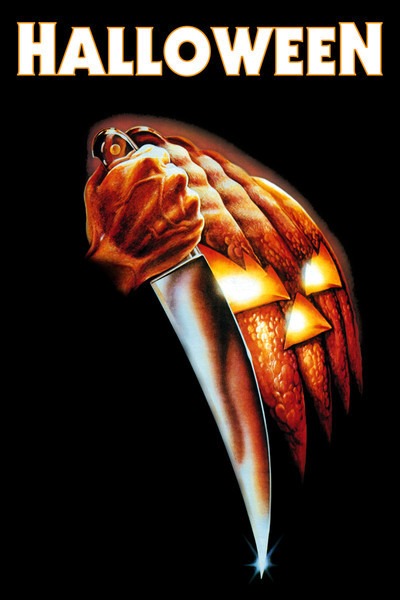
large_vjoOFOTBJcJvA1weJejlZ92LZD4The Holy Bee has already dedicated a “Halloween Special” post to his ill-advised, but ultimately successful, attempt to watch all eight original Halloween films in a row. I’m pretty sure we need only bother with the first one here, 1978’s Halloween, directed, co-written, and scored by John Carpenter. That three-note keyboard riff has become synonymous with slasher films, and almost as well known as the Jaws theme. Film historians have had a long-running debate about what constitutes a true “slasher” film, or what the first one was. Whether or not Halloween was the first slasher film, it certainly put all the tropes together in a stylish way, and more importantly, it was a pretty solid commercial success.

Success breeds imitators, and wherever Halloween’s place is in the origin of the genre, it opened the floodgates to the Golden Age of Slashers. Halloween’s superhuman, knife-wielding killer Michael Myers established a formula followed by at least two other slasher film series of the 1980s, beginning with Friday the 13th (1980) and its Jason Voorhees, and A Nightmare On Elm Street (1984) and its Freddy Krueger. There were also dozens of others of lesser repute, and those usually sprouted a franchise of their own since they were so damn inexpensive to produce.

halloween-michael-myers

Unlike its later knock-offs, Halloween is almost Hitchcockian, pretty much bloodless, and except for a few flashes of nudity, could probably play uncut on network television. Carpenter’s film succeeds on camera work and atmosphere, which cannot be said for the others, and cannot even be said for subsequent Halloween films, which were in the hands of lesser talents than Carpenter.

11:35 — 12:00: NewsRadio (Season 3, Episode 5: “Halloween”)

NewsRadio was one of the most underrated shows of the 90s, and was one of the of the last great three-camera, live-audience sitcoms. (And before anyone says anything about Big Bang Theory or something like that, remember I said “great”.) Its best moments were in the same league as Taxi or Cheers, although it lacked those shows’ richness. I suppose it was more comparable to Night Court when it was at its mid-run peak, if anyone remembers that. Almost a television version of a comic strip. The ensemble cast boasts two genuine comedy geniuses (Dave Foley and the late Phil Hartman), future Serious Actress (Maura Tierney) before she became a fixture on E.R., and two future nutcases (Andy Dick and Joe Rogan) before they went barking mad. 51lg6TV3jUL._SX940_
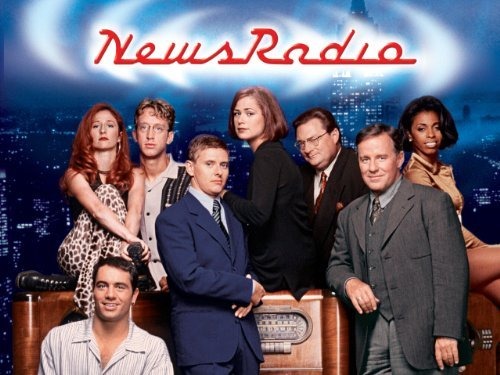
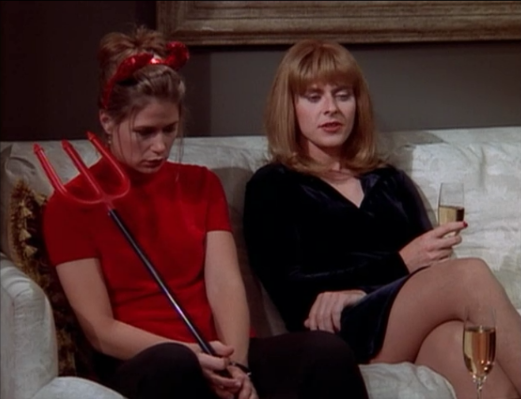
The show’s real treasure, though, was Stephen Root as the eccentric billionaire who owns the radio station, and in this episode refuses to invite the staff to his annual Halloween party. When asked why, he mentions that at his last Halloween party, the staff were, as he puts it, “too cool for school,” refusing to wear costumes and participate in the party games. He relents after they beg him to reconsider, leading to the show’s payoff — After frantically trying to think of a costume idea, in desperation Dave Foley asks to borrow Maura Tierney’s new cocktail dress, which leads to Foley revisiting his Kids In The Hall days and appearing in full drag…and looking quite fetching, actually. Tierney is in a  mysterious foul mood for the remainder of the episode. When Foley finally asks why she is sulking, she explodes “Because you look better in my dress than I do!”
tumblr_mbbrqrYISt1qi972uo1_540

12:00 — 1:25: The Monster Squad

A flop upon release, The Monster Squad (1987) has developed a dedicated cult following over the past couple of decades, despite the fact it was a pretty obvious attempt to recreate The Goonies, right down to the slightly older tough kid and the token fat kid (simply referred to throughout the film as “Fat Kid.”) However, The Monster Squad has its own charms, not least the inclusion of the full gamut of classic movie monsters.
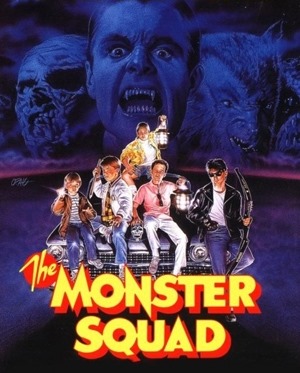
monster_squadThrough a series of convoluted circumstances, Count Dracula and cohorts are very real, very alive (or at least very undead), and wreaking havoc on a quiet 1980s suburban neighborhood. The only ones to take the threat seriously are Sean and Patrick, a pair of earnest, slightly nerdy middle schoolers who have a “monster club” in a treehouse right out of an Our Gang short. They are happy to be joined by the super cool older delinquent Rudy, though it’s for less than wholesome purposes. (The treehouse has an unobstructed view of Patrick’s older sister’s bedroom. And you know Rudy’s a delinquent because he wears shades and a leather jacket and chews a matchstick.) The club’s activities are usually restricted to drawing pictures and writing stories, but when people begin turning up dead, they piece together the clues, arm themselves with stakes and silver, and go into battle.

1412162321458020132

Despite, or because of, all its juvenile silliness (including its now-classic line from Fat Kid: “Wolfman’s got nards!” after he delivers a solid kick to the werewolf’s nether regions), there is a lot to enjoy here, including a fully committed performance by Duncan Regehr as Count Dracula, a poignant subplot about a Holocaust survivor, and a series of crowd-pleasing moments as it heads for its climax. My personal favorite is when the cynical, condescending non-believer Rudy unexpectedly steps up and blasts a stake through the heart of a hissing vampire to the open-mouthed amazement of everyone. (“What? I’m in the goddamn club, aren’t I?”) Continue reading
1 Comment

Filed under Film & TV, Pop Culture

The Holy Bee’s 2015 Halloween Special: 24 Hours of Halloween (Part 1)

Halloween falls on a Saturday this year. As far as the Holy Bee is concerned, every Halloween should be on a Saturday. (A dark, rainy Saturday, preferably. Not one of the sunlit 80-degree days that so often characterize late October here in the central valley of California. The last Halloween that combined Saturday and the requisite gloom was 1998, and it was mostly wasted by me working the afternoon shift down at the old movie theater. At least we were showing Bride of Chucky…)

Especially since I’ve had a grown-up, Monday through Friday type of job, Saturday Halloweens have retained their special cachet, and now another is upon us.

Halloween1

Given the choice between doing something and not doing something, the Holy Bee would tend to choose the latter course every time. I’ve often said to my sons (who share this philosophy) that our family crest should contain the Latin motto Utinam Non Magis (“I’d Rather Not”), along the lines of Bartleby the Scrivener. Combining a Saturday Halloween with nothing to do? Perfect. That’s when you dive into a Halloween-themed marathon on a local channel or deep cable. These are always a great idea, but they often come up short in terms of variety. How much variety can one put into a Halloween-themed marathon? Plenty.

Though I’m not quite Walter Mitty level, I do tend to daydream, usually when driving at high speeds, or when important people are talking to me about a topic I’m not interested in (which is most of them). So not long ago, I began thinking about how I would program a Halloween marathon on my very own TV station (“KHBE”).

Imagine yourself, Gentle Reader, as the inhabitant of a better world where51NyVCq3RyL KHBE actually exists, and is airing a “24 Hours of Halloween” marathon from midnight to midnight. You would get home from work around five-ish on Friday the 30th (maybe having slipped out a little early), toss your keys on the counter, flip through the mail, perhaps fix a snack, and then pop an Ambien and get right into bed and get some sleep! Set your alarm for 11:55 pm.

I hope you’ve stocked your larder and have the number of a good pizza delivery place, because you won’t be leaving the house any time soon. Cut through some of that post-Ambien grogginess with a quick Instant Pumpkin Spice Latte, and fire up your TV. What will you see? Not commercials, that’s for damn sure. The Holy Bee has scheduled this marathon tightly. No time for ads.

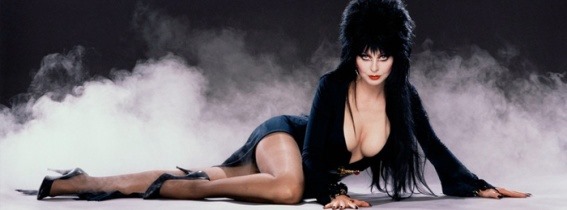
There will be a few minutes of downtime here and there to keep things starting 52 Coors Light Elvira Store Displayon the 0s and 5s. I have decreed that this time will be filled by everyone’s favorite wise-cracking horror hostess, Elvira, Mistress of the Dark. I don’t care if she’s now 64 — enough make-up, candlelight, and soft focus will transport her back to how she looked on that Coors Light cardboard standee (left) that greeted millions of 7-11 customers during any given October in the 1980s, and may have contributed to the onset of puberty for the younger ones. (Her self-titled 1988 movie did not make the cut for the marathon because I needed her for hosting duties, and did not want to make 24 Hours of Halloween top-heavy? overstuffed? with Elvira.)

662a2e96162905620397b19c9d249781_567x210 Continue reading

2 Comments

Filed under Film & TV, Pop Culture

“The All-New Holy Bee/Pointless Nostalgia Adventure Hour”: My Typical Saturday Morning in the Early 80s (Part 2)

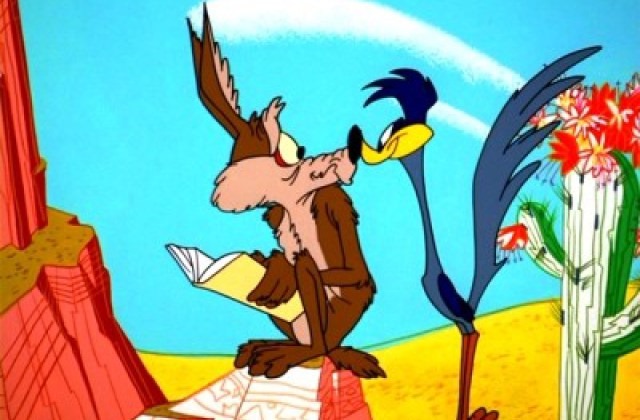
As The Bugs Bunny/Road Runner Show rolled on through the morning, the focus of the program switched to the Road Runner for the second half or final third, introduced by its own memorable theme — “Road Runner, the Coyote’s after you/Road Runner, if he catches you, you’re through…” Unfortunately, the quality of the Road Runner’s portion of the show was somewhat compromised…

wile e coyotes

You see, Warner Brothers continued to release theatrical shorts longer than the other studios, but they farmed out the actual work to smaller companies. DePatie-Freleng Enterprises (co-owned by former WB director Friz Freleng) made the shorts from 1964 to 1967, resulting in a much-altered animation style (not quite “limited,” but close). The WB/DFE partnership did some Road Runner films, but focused mostly on a series of Daffy Duck vs. Speedy Gonzalez shorts (the less said about which the better). Format Films handled the final batch of Road Runner shorts, which were even worse than the Daffy/Speedy stuff. These late-period embarrassments turned up again and again on The Bugs Bunny/Road Runner Show, but can’t hold a candle to the ones originally produced from ‘49 to ‘63, which also turned up on BB/RR. Even a six-year-old could tell the difference.

Sometimes during one of the Format Road Runner shorts (there were eleven of them, and at least two were shown every damn week), I would turn the dial back to ABC, and frequently encounter The Fonz and the Happy Days Gang, another entry in the trend of turning a prime-time family show into a Saturday morning kids’ cartoon. Before my time, there had already been Saturday morning versions of Star Trek, The Addams Family, Gilligan’s Island, The Brady Bunch, Emergency!, Lassie, My Favorite Martian, and possibly I Dream of Jeannie (the adaptation was pretty loose.)

Fonz_and_Happy_Days_Gang

The Fonz and the Happy Days Gang bridged that era with the 80s, which brought us animated versions of The Dukes of Hazzard, Laverne and Shirley, Mork and Mindy, Punky Brewster, ALF, and more Gilligan.

The premise for a lot of these shows was the same: take a few of the original TV cast, dump them into a crazy new setting, and add a few new “cartoon-only” characters, preferably some kind of cute mascot or talking animal. To wit: Fonz, Richie Cunningham, and Ralph Malph are caught in a malfunctioning time machine and bounce through history accompanied by a comic-relief dog named Mr. Cool and a “future girl” named Cupcake. (Second example: Laverne and Shirley are in the army and their drill sergeant is a pig named Squealy.)

Almost without exception, these spin-off cartoons managed to get most of the original cast to do the voices. I imagine Donny Most probably wasn’t too difficult to convince, but Ron Howard had already directed two TV movies, one feature film and was planning his second (Night Shift), and had left the actual prime-time version of Happy Days. Still, the work couldn’t have been too demanding. Howard could probably knock back a Scotch and polish off his lines for all 24 episodes in an afternoon, with one eye on the clock so he could get to the bank before it closed.

(Those 24 episodes were padded out for almost two years — first in the usual re-runs, then re-packaged with other shows, in true Saturday Morning style, as the rather desperate-sounding Mork & Mindy/Laverne & Shirley/Fonz Hour.)

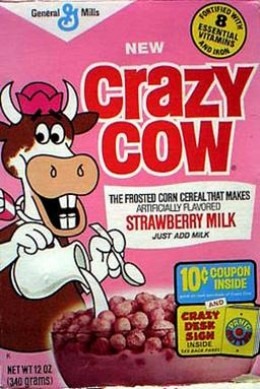
222_65_ucpAt some point during The Bugs Bunny/Road Runner Show, it would be time for breakfast. With a laborious lugging about of the kitchen stool, I assembled the disparate parts that would come together to form my perfect meal — a bowl of cereal. I took my cereal very seriously. Every other Saturday or Sunday afternoon, Mom would do the grocery shopping, and I would accompany her to make sure the cereal acquisition was handled by me personally. Mom had grocery shopping down to a science: her trip through the aisles took exactly sixty minutes. I had that amount of time to pick out my cereals for the next two weeks. I had to get one “healthy” cerealbox291 (Grape Nuts, Cheerios, Chex, etc.) to offset the effects of the two others I was allowed, which were always powerfully sugared. I liked the healthy ones just as well, because I would simply add my own sugar to taste, usually to the point it would leave a viscous sludge on the bottom of the bowl. Mom would often threaten that I would “get worms” if I continued to eat that much raw sugar, the horrific threat of which might be effective on less-savvy six-year-olds, but I waved it off like the old wives’ tale it was. (To this day, I am worm-free.)

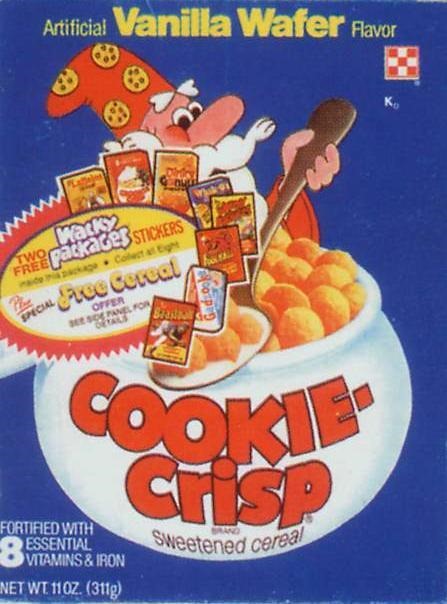
So I stood in the cereal aisle in the dead center of Woodland’s Nugget Market (the original!) for an hour, making my decisions. When Mom passed down that aisle, I knew I was at half-time. Would I go home with a product from Post, Kellogg’s, or General Mills? Would it be Pops? Loops? Pebbles? Jacks? I avoided the Smacks — the puffed wheat cereal looked like a bowl of dead locusts, and I didn’t care how cool Dig ‘Em the Frog dressed, I didn’t want a slimy amphibian on my cereal box. Something from the Crunch family, perhaps? The good Cap’n’s original version would tear the roof of your mouth vanilla-cookie-crisp-boxto hell, and leave a strange film, but Peanut Butter Crunch was smooth as silk. (I’ve often wondered if Cap’n Crunch’s eyebrows were floating above his eyes, or simply painted on his hat.) And speaking of unpleasant mouth feel, Grape Nuts was tantamount to eating a bowl of garden-path gravel, but it had a peculiar charm and its slightly-smaller box often graced our shelf. If I was feeling particularly jaunty, I would select Cookie Crisp, which many hand-wringing nutritionists felt was truly the end of civilization. I preferred the long-discontinued Vanilla Wafer Cookie Crisp (in the blue box).

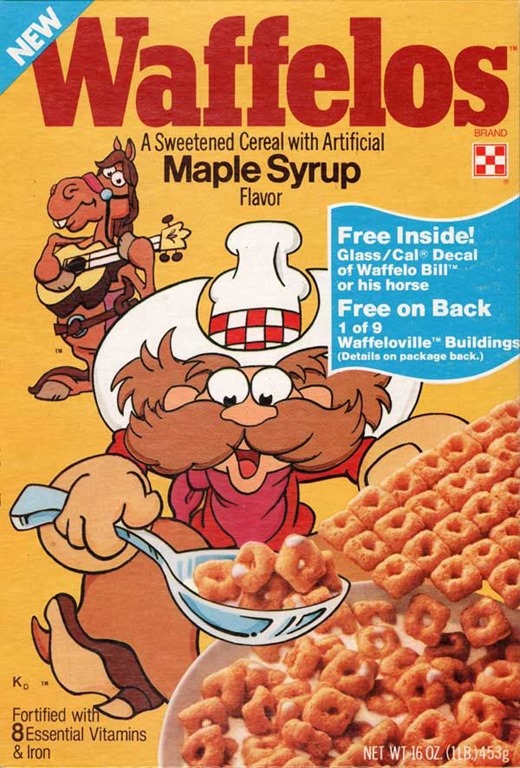
Around this time, at least one of the choices was almost automatic — Waffelos,waffelos my hands-down favorite cereal. They tasted exactly like waffles with maple syrup. They came in regular or blueberry, had a mustachioed cowboy mascot on the box, and best of all, my sister didn’t like them, so the whole box was mine! (If you go to the Mr. Breakfast website comment page — and who wouldn’t? — and read the comments for Waffelos, one of the first remarks you’ll see is “This stuff was like crack!”) The Waffelos cowboy rode off into the sunset before the 80s were half-over, and we’ll never see his like again. (Post introduced some bullshit called “Waffle Crisp” in 1996, but it is a pale imitation.)

Brimming bowl of cereal in (two) hand(s), I carefully baby-stepped my way back from the kitchen to the TV tray I had hopefully remembered to set up ahead of time… Continue reading

1 Comment

Filed under Film & TV, Pop Culture

Who Needs Friends When You Have “Super Friends”?: My Typical Saturday Morning in the Early 80s (Part 1)

It is about 7:45 on a Saturday morning, sometime late in 1980, or perhaps early in 1981…

We have gained a new president, lost a Beatle, and the whole country has just learned who shot J.R…

None of this matters to me, of course. I am six. The winter sun has begun to peek through the cracks in my Empire Strikes Back curtains. I am tucked under my Empire Strikes Back comforter. I hear the furnace kick on in the basement. I hear the back door in the kitchen open and close as my dad leaves for work. He runs an auto body shop, and his sole employee is himself, so six-day work weeks are a necessity. Mom works the graveyard shift as a police dispatcher, and arrives home not long before I wake up. She will remain sleeping until noon or so. My sister will also remain sleeping until noon or so, by virtue of the fact she is a fourteen-year-old girl.

The house is mine, and it is the best time of the week — it is Saturday Morning.

As warmth fills the house via the heating grates, I slip out of bed. I am clad solely in my briefs. I’ve always hated the sweaty, tangled mess of pajamas, twisting around my torso and riding up my shins. I usually only wear them on Christmas Eve, so I can appear decent in Christmas morning photos. There’s still enough chill in the air to raise goosebumps, so I make sure I wrap my security blanket tight around me, like a chrysalis or vampire’s cape. This blanket has been with me since the crib, and has seen better days. It is basic, thermal-style cloth (like long underwear) and was once vivid yellow, but has faded to a hue best described as “old buttermilk.” The satin edging it was manufactured with is not even a memory at this point. I already feel a little too old for such nonsense, but I confess it stays within reach for at least another few years.

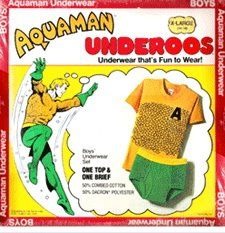
underoosIf I’m lucky, one of my three pairs of Underoos briefs would be among the laundered options in my top drawer. Not only did they come in bold superhero colors, they were much softer than my standard tighty-whiteys, mellowing their cotton with a little polyester. I barely considered Underoos underwear — they were a costume, and, on a warm day, perfectly acceptable as outerwear, at least as far as the yard.

SCN_0004

Scantily-clad and wrapped in my shawl, I creep downstairs. There is one possible obstacle on the landing between the two sets of stairs. Ninety percent of the time, our housecat Tom Kitty is an amenable, purring charmer, on the hunt for a lap to knead and a hand to lick. But every once in awhile, he would get in a “mood.” Sprawled on his side, tail twitching, pupils dilated to the max, he would park himself in some family pathway and challenge everyone to dare try and pass fifteen pounds of feline moodiness. Everyone else stepped over him with little consequence. I was his favorite victim. He would literally nod at me, raising his furry chin in a menacing “‘sup, bro?” gesture. I could either sprint past him and hope to outrun him (he would give chase), or try to cause a diversion, frequently by sacrificing my blanket — tossing it over his head would buy me a few seconds. The downside was that I would sooner or later have to retrieve the blanket, and also the fact that Tom had a long memory for slights. “Payback’s A Bitch” might as well have been embroidered on his collar.

SCN_0016 (2)

The old Zenith…

Happily, most of the time he either wasn’t on the landing, or was in an agreeable temper, so my journey to the couch and TV was unimpeded. The TV was a Zenith cabinet model, half home entertainment, half furniture, with its controls hidden on the right-hand side by a little louvered door, and fake drawers under the screen.  I pull the on-off knob. If I’m a little too early, it’s still showing “Farm Report,” but usually I’m right on time. I feather my couch nest with yet another blanket — a much bigger blue tartan number with fringed edges that lives under our end table. There is no remote. Channel changing must be done on the dial. (Just like my descent from the bedroom, this process can also be complicated by the presence of a moody feline.) If it’s warm enough, I might not bundle myself on the couch, but rather drape myself over a barrel-like hassock footstool that I’ve turned on its side, and rock back and forth like a patient in an experimental chiropractic treatment.

What draws me out of bed so early on a non-school day? The same lure that is reeling in millions of children across the country at this precise moment – Saturday-morning cartoons.

533900766_17af94f2e2_o

Long ago, cartoons were denizens of the cinema screen, and the major studios had massive animation departments creating the shorts that would run ahead of the feature films. Each studio had its stable of characters — MGM had Woody Woodpecker, Tom & Jerry, and Chilly-Willy, Paramount had Popeye, Casper the Friendly Ghost, Baby Huey, and Little Audrey, 20th Century-Fox  licensed stuff from Terrytoons (Mighty Mouse, Heckle & Jeckle), and the twin kings of cinematic animation, Disney and Warner Brothers, had the most iconic characters of all, of whose names I’m sure I need not remind you.

Television arrived for most households in the early 1950s, and immediately began cutting into the movie studios’ profits as more people got their entertainment at home. One by one, the studios shut down their animation departments as a cost-cutting measure. At the same time, animation was still pretty scarce on early television. Kids’ shows tended to be live-action (eg. Howdy Doody, or The Mickey Mouse Club.) What was a cartoon-loving kid to do?

Hanna_Barbera_Logo

Luckily, along came two former MGM animators — Joseph Hanna and William Barbera. Out of a job when MGM closed their animation department, they formed their own production house with the revolutionary idea of producing quick, low-cost animation directly for television. After a few false starts, Hanna-Barbera hit it big with The Huckleberry Hound Show in 1958, and pioneered theHuckhound use of “limited animation.” Limited animation uses less-detailed backgrounds, fewer “in-between” drawings between key frames, recycles many elements, and has a lot more “holds,” where characters don’t move at all. Huckleberry Hound and his ancillary characters and spin-offs (Yogi Bear, etc.) were originally developed as packages for weekday syndication on independent local stations, and usually aired sometime after the evening news and before prime-time. Hanna-Barbera’s rival, Jay Ward Productions, actually scored a network deal with ABC for Rocky & Bullwinkle in 1959. There was even a brief period when a flurry of animated shows were developed for prime-time evening viewing, culminating in six seasons of The Flintstones.

8896283_f260Then around 1960, it dawned on the networks and station owners that Saturday morning was a programming wasteland — the perfect place to air a block of kid-centric shows, and much more importantly, kid-centric advertising. The post-WWII economy reveled in conspicuous consumption, and for the first time, the average joe could afford to buy useless crap for his kids. All manner of snacks, candy, toys, and games were hawked to eager young eyeballs. But mostly cereal. Cereal commercials followed each other like a sugar-coated freight train hour after hour. Saturday Morning basically created the brightly-colored, pre-sweetened substance that us kids knew as “cereal,” a development which would certainly send old John Harvey Kellogg into quite a grave-spin. As we’ll see, the commercials were just as big a part of the Saturday Morning experience as the programs.

Depatie-freleng1970

And the programs were for the most part cartoons. Hanna-Barbera and Jay Ward blazed the trail, and other low-cost animation studios followed suit. DePatie-Freleng and Filmation were both churning out material by 1963. (Think Hanna-Barbera animation was low-rent? Compare it to the dirt-cheap house style of Filmation. I recall an old Calvin and Hobbes strip where Calvin’s dad lambasted the quality of the cartoons Calvin was watching. “They don’t move! They just stand there and blink!” — he was almost certainly watching a Filmation production.) The major movie studios probably believed their old animated shorts were fated to collect dust in the archives, and were delighted to squeeze a few more bucks out of them by selling them to TV at bargain basement prices. (Except Disney — Disney guarded its vaults like a she-bear, which is why you would see nary a feather on Donald’s ass on Saturday mornings.) The fad for prime-time animation died out (at least until The Simpsons), making those shows ripe for plundering. All in all, tons of animated material, new and old, was now available to fill hours of airtime at a much lower cost than live action. Pixie, Dixie, and Mr. Jinks were never going to demand a salary increase or a contract re-negotiation.

Filmation83

Animation in other time slots of the broadcast week dried up, giving Saturday Morning its special cachet. For much of the 70s, Saturday morning was about the only place you could see a decent amount of cartoons on TV. By the time I reached TV-viewing age, things had loosened up. Thanks to a greater number of independent channels on the dial, and the birth of cable, by 1980 there were after-school cartoons, before-school cartoons, and hell, for an hour or two there were even Sunday-morning cartoons. (There was some Dutch/Canadian monstrosity called Dr. Snuggles, and the Pink Panther always seemed to turn up on Sunday mornings on Channel 31.)

But all of that was bush league compared to the hold Saturday Morning held over the average pre-teen viewer. Something about the melange of old Warner Brothers animation, new “limited animation” works by H-B and Filmation, the bright, loud commercials, and the token attempts to educate between all of it held a special kind of magic. Continue reading

5 Comments

Filed under Film & TV, Pop Culture

The Best & Worst of the Solo Pythons, Part 3: Terry Jones

Terry_JonesI had originally intended to move through the solo Pythons in strict alphabetical order, just as they are listed in the credits of their TV episodes and movies (always reading “Monty Python’s [Insert Project Title] was conceived, written, and performed by…”), but I was bursting with so many things to say about TERRY JONES, I leap-frogged right to him.

A great ensemble means that no one member is more or less important than any other, but I really do feel that it’s Jones who makes Python Python. He was an early champion of the idea of moving the TV episodes along through a “stream of consciousness,” not allowing conventional sketch-show structure to dictate how the thirty minutes of TV comedy unfolded. This concept was greatly aided by the animations of Terry Gilliam (we’ll be getting to him next), and Jones and Gilliam can be credited with contributing the most to Monty Python’s Flying Circus’s unique look.

The look…that’s actually what first hooked me when I saw my first episode as a middle-schooler on “late night” PBS. Like absolutely nothing on American TV at the time…A surreal visual appeal that augmented and fed into all the absurdity. Much of it was due to how BBC programs shot things in those days — everything in the studio was done on videotape, and everything outside the studio was done on film.

And “outside the studio” could be anywhere. It was sometimes simply the residential west London streets just outside BBC Television Centre, but they frequently trotted off to the coolest-looking spots in the British Isles — windswept highlands and rugged coasts — to get 5313917369_600full_terry_jones_answer_5_xlargetheir filmed segments. Jones more than anyone favored and pushed for this policy. (It became a running inside joke among the Pythons that all of the sketches Jones wrote opened with “Slow pan across Yorkshire moor…mist swirls, music plays…a lone figure emerges…”) Filming these parts of each episode outside the confines of the studio was where Jones first began making his mark. He admitted to constantly pestering the credited director, Ian MacNaughton. “I was always saying, ‘Shouldn’t we put the camera over there, Ian?’” He also cops to backseat-driving the editing process, succeeding in getting the editors to put in a full workday on an episode, rather than the couple of hours they were used to. Getting a clock-watching BBC technical crew to listen to his dictates proves his reputation for being willful and tenacious (he credits it to his Welsh blood) was well-earned, and it’s why Python’s TV show looked far better than anyone else’s at the time.

Jones wrote most of his Python material in collaboration with Michael Palin, and their stuff tended to be longer, more conceptual, and more visual than the Cleese/Chapman sketches, which were more traditional and verbal. (It was the blend, of course, that made Python great.) In many ways, the raw, earthy Jones existed at the opposite end of the comedy spectrum from the coolly cerebral Cleese, which led to many spirited “discussions” at Python writing meetings. “I only threw a chair at John once,” Jones has said.

From a performance standpoint, Jones was the utility player. He was a great straight man when the situation called for it (“Nudge, Nudge”), and was often the put-upon Everyman, the straight-laced “city gent,” or his true specialty — the screeching, middle-aged ratbag housewife the Pythons called a “Pepperpot.” All of the Pythons played Pepperpots at one point or another, but Jones perfected them.

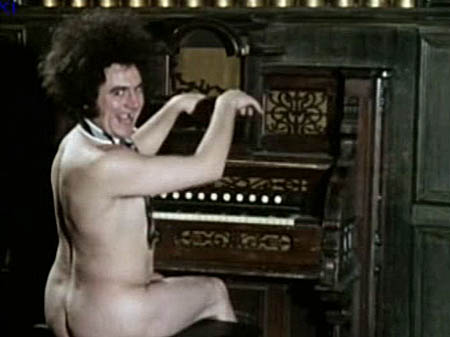
When the Pythons branched into film, it was only natural that the two “visual” Pythons, Jones and Gilliam, co-direct Monty Python and the Holy Grail. Gilliam found that trying to direct five mouthy, prickly, opinionated teammates full of their own ideas was more than his patience could bear, and the two subsequent Python films, The Life of Brian and The Meaning of Life were directed — quite happily — by Jones solo. And either through his own inclinations, or because the rest of the Pythons just thought it was funny, Jones managed to be nude on-camera a lot more than the others (including his iconic Nude Organist, which opened every third-season episode).

In all areas, Jones was absolutely essential to Monty Python as we know it. He was the glue, the heart. Yet he remains less well-known than all of the others, especially here in the U.S. (Sharing a name with a batshit-crazy fundamentalist preacher who made the news a few years back probably doesn’t help.) It all seemed so unfair that it caused me to create the very first Terry Jones fan website in 1996, on good ol’ GeoCities.

Film director. Historian. Children’s author. Opera librettist. Political journalist, even. Terry Jones, left to his own devices, covers a lot of ground. Continue reading

1 Comment

Filed under Books, Film & TV, Pop Culture

The Best & Worst of the Solo Pythons, Part 2: John Cleese

john_cleese-761027JOHN CLEESE was actually famous before Python, as a cast member for the very well-regarded series of comedy/satire programs starring David Frost in the mid-’60s. (5/6ths of the future Pythons wrote for Frost, but Cleese was the only on-camera personality among them.) His popularity was what caused the BBC to offer him his own show, which ultimately became Monty Python’s Flying Circus (with Cleese desiring to simply be part of the ensemble, refusing star billing, to the BBC’s confusion and disappointment.)

Then he was the first person to grow tired of Python, at least in its television incarnation, and did not participate in the final season of the show in 1974. Some members of the group were a little resentful, feeling that due to his fame and recognizability, he had the best chance of a solo career. They weren’t wrong.

Even the average non-Python fan in 2013 has a pretty good idea who John Cleese is.

Perhaps it’s his height. In Python sketches, the six-foot-four Cleese often played upper-class authority figures. Unlike Graham Chapman’s authority figures, though, Cleese’s were infused with a kind of cruel, maniacal glee that made them riveting and unsettling. Sometimes he played a very odd creation the Pythons referred to as “Mr. Praline,” always wearing a green plastic raincoat and complaining to a shopkeeper or civil servant (usually played by Michael Palin) in a clipped, nasal voice about his dead parrot or inability to purchase a fish license, always with an undercurrent of menace and suppressed rage. In both actual fact and in the audience’s mind, Cleese towered over the rest of the cast.

More likely, he’s known far and wide simply for his ubiquitousness. He’s everywhere. He has appeared in more films than the rest of the team combined (and deserves a special award for most supporting roles in terrible movies), has done hundreds of commercials for every conceivable product for the past four decades, has guest-starred in dozens of shows on British and American television (and had long-running recurring roles in several more), performed tons of voice work, and in general has been one of major faces of British comedy, streets ahead of his slightly less-recognizable Python teammates.

So let’s break down the fabulously successful solo career, shall we? Continue reading

1 Comment

Filed under Film & TV, Pop Culture

The Best & Worst of the Solo Pythons, Part 1: Graham Chapman

My website stats have proven conclusively that the most popular segment of this little blog has been “The Best & Worst of the Solo Beatles.” In the true spirit of sequels, I will now take the same basic premise and turn it into something that will likely prove somewhat less popular. Why not take on the solo careers of “The Beatles of Comedy”?

NYT2007090415181690C

Many collectives of funny folk have been referred to as “The Beatles of Comedy” — from the original Not Ready For Prime Time Players of Saturday Night Live to the cast of Seinfeld. But the group that has truly earned the title is the one that earned it from the Beatles themselves — Monty Python. They were shooting their very first episodes for the BBC in August of 1969, just as the last notes of Abbey Road were being committed to tape and the hassled, harried Apple board meetings were growing particularly hostile. George Harrison has said many times that he believes the impish Spirit of Genius vacated the dying rock band at this moment, and infused itself into the comedy troupe just being born.

As a group, Monty Python produced 45 episodes of Monty Python’s Flying Circus for the BBC, three original feature films, a compilation film of re-shot sketches from their TV show, two extended original episodes produced for German television, several books and record albums crammed full of material unavailable in any other format, and toured as a live act (resulting in a concert film, for a total of five movies). No other comedy team can top that output. They hung up their Gumby boots in 1983, but well before that, the six members had begun concurrent solo careers which continue to this day (well, except for one — see below.) Graham Chapman, John Cleese, Terry Gilliam, Eric Idle, Terry Jones, and Michael Palin have produced some very creative and funny works of art — and some dreck.

Here’s the format for our little examinations: Only projects that the individual Pythons had a direct hand in creating will be considered. This means writing or co-writing, directing, producing, or any combination thereof. If we expanded our project to include instances where they simply took an acting job for a paycheck, the “worst” portion would be impossible to sort through, especially concerning John Cleese and Eric Idle. (Every non-superstar actor has to take roles to pay the bills from time to time, but it pains me to say that Idle and Cleese have been particularly non-discriminating and mercenary in this regard, popping up in some of the most notorious turkeys of the last twenty years.)

And unlike the solo Beatles, we are not limiting ourselves to one medium. The solo Pythons have written and/or directed feature films, created TV series, written children’s books, self-help books, novels, and scholarly history books, and produced Broadway musicals, to name just a few endeavors.

There will be Best Project and Worst Project, followed by Should Probably Avoid, and to end on a positive note, a Worth Checking Out. This format will be adhered to strictly, except for the times when it’s not. Continue reading

Leave a comment

Filed under Books, Film & TV, Pop Culture

The Holy Bee Recommends, #8: Best Versions Of The 25 Best Christmas Songs (Part 2: 10 Through 1)

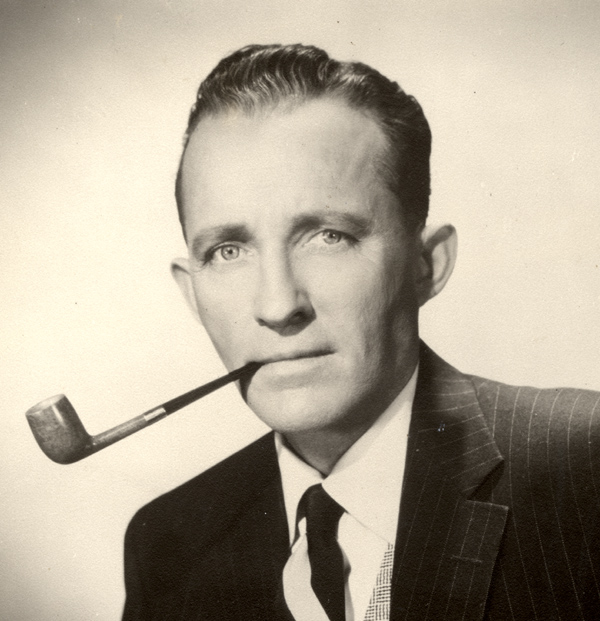
The King of Christmas Music, and my role model in everything except parenting: Bing “If You Hit ‘Em With A Bag Of Oranges It Doesn’t Leave A Mark” Crosby

#10. “Merry Christmas, Baby.” Possibly because of their gospel roots, R&B singers seem to love Christmas music, and there are several worthy compilation albums out there that bring together some of the best R&B takes on classic Christmas music. (Sadly, there are also compilations that bring together some of the worst, so buyer beware.) In addition to R&B renditions of the traditional carols, there’s also a huge array of original R&B  holiday songs, from Charles Brown’s heart-breaker “Please Come Home For Christmas” (also covered in a hit version by — yeeesh — The Eagles) to Louis Armstrong’s goofy “‘Zat You, Santa Claus?” But the grandaddy of them all is “Merry Christmas, Baby,” originally recorded in 1947 by Johnny Moore’s Three Blazers, and covered by everyone from Chuck Berry to Christina Aguilera. BEST VERSION: Otis Redding. Recorded at his peak with the powerhouse Stax-Volt house band, Redding schools them all. You can find another version on Elvis Presley’s second Christmas album, 1971’s Elvis Sings The Wonderful World of Christmas, which can’t hold a candle to his first. Elvis sounds tired and jaded, and probably has one eye on the gingerbread at this point, but it does contain a version of “Merry Christmas, Baby” that’s worth hearing. If you can get past the quasi-blues musical arrangement that probably sounded fine in ’71, but today sounds exactly like a Cialis commercial, you’ll be treated to a casual and funny version of the song, something that sounds like the band warming up in the studio prior to recording whatever they were supposed to recording. It also sounds like the band thought song was going to be faded out for its ending, but the take that made it onto the album goes way past that point, with Elvis (whose pharmaceutical assistance is quite audible) tossing out increasingly bizarre asides to the musicians, and attempting to scat between verses.

#9. “Christmas Must Be Tonight.” Apologies to Creedence Clearwater Revival, but there simply was no better (North) American band from 1968 to 1971 than The Band. Which I guess is a moot point here, as “Christmas Must Be Tonight” dates from their less-consistent later years. Originally intended to be a special, non-album single release for Christmas 1975, it was dumped at the last minute, and ultimately included on their patchwork final release, Islands, in 1977. Good thing, too, as the dire Islands needs a lift, and “Christmas Must Be Tonight” re-visits the strengths of the Band’s glory days — Rick Danko’s soulful vocals, Garth Hudson’s mystical organ, and a rural, rustic arrangement that hearkens back to an era (music writer Greil Marcus calls it the “old, weird America”) that none of the Band members could possibly be old enough to remember — half-history, half-fantasy, it all comes from chief songwriter Robbie Robertson’s fertile imagination. BEST VERSION: The Band. My research indicates Hall & Oates also took a stab at it, and there’s an iTunes-only version by Band heir-apparents My Morning Jacket that just came out a few weeks ago.

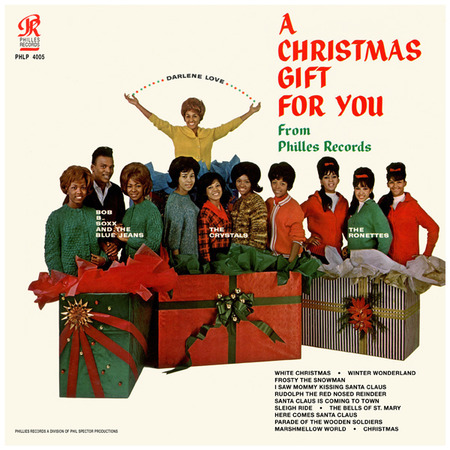
#8. “Christmas (Baby Please Come Home).” At this point, we should discuss the merits of Christmas albums. There’s always a few new ones each year, generally by flash-in-the-pan mediocrities (most often from competition TV shows) hurriedly shoved out as a cynical cash-grab to pad out their sales figures, which will soon go into steep decline when the American public, with its squirrel-monkey attention span, moves on to the next TV-endorsed mediocrity. When it gets right down to it, the best Christmas albums all came out between 1945 and 1965. I feel that way not because I’m necessarily the world’s biggest Andy Williams or Gene Autry fan, but because by comparison, the newer ones sound kind of vapid and overly slick. Working beyond this Golden Age, your best bet is compilations — collections of songs by various artists. And even during the Golden Age, one of the best Christmas albums was a compilation. Well, sort of. All of the various artists were on the same label (Philles Records), all of the songs were recorded at the same time for the same record, and the whole project had a single producer: Phil Spector, the label’s co-founder. The future convicted murderer gathered together his top four artists — The Ronettes, The Crystals, Darlene Love, and, uh…Bob B. Soxx & The Blue Jeans (how did that happen?), put together amped-up versions of some Christmas favorites featuring his big, booming Wall Of Sound production technique, and let loose this gleeful explosion of holiday bliss — on November 22, 1963. Understandably, it kind of fizzled at the time. But A Christmas Gift For You From Philles Records (later pressings of the record replaced “Philles Records” with “Phil Spector”) had staying power, and now it stands proudly atop the Christmas album heap. BEST VERSION: When that creepy cat lady Susan Boyle is deservedly long-forgotten, Darlene Love and her “Christmas (Baby Please Come Home)” will continue to have eternal life. (Two or three Christmases ago, Boyle was a household name, but just for a moment there, you thought to yourself, “Susan who?” didn’t you? See? It’s already happening. And what Christmas song did she do definitively, for all time? Exactly. Not a damn one.) Continue reading

Leave a comment

Filed under Pop Culture, The Holy Bee Recommends

The Holy Bee Recommends, #8: Best Versions Of The 25 Best Christmas Songs (Part 1: 25 Through 11)

All right, kids, pull your chair up next to the fire, make sure your hot cocoa has a liberal splash of peppermint schnapps, mute that horrid eunuch Michael Buble warbling away on whatever passes for a network Christmas special these days, and lend an ear to the Holy Bee’s Top 25 Christmas Songs — and the artists who did them best. And even though I say “25,” faithful readers know I always throw in extra.

First of all, let’s dispense with those 3 Perennial Chestnuts that are more jingles than songs: “Jingle Bells,” “We Wish You A Merry Christmas,” and “Deck The Halls.” A staple of grade-school recitals, these super-simple ditties that anyone can pick out on a piano after few minutes of fooling around barely qualify as “songs.” We can acknowledge that they’re a huge part of the fabric of Christmas and move on.

Second of all, while I cast a pretty jaundiced eye on religion, the music lover in me has a lot of fondness for some of the Jesus-oriented songs. Some would say that the sentiments expressed in the religious songs are the whole reason for Christmas to begin with, and to them I say feh. Solstice festivals at the end of the year had been a facet of civilization since time immemorial. Then the Christians came along and, with no scriptural nor any other kind of evidence, high-handedly plopped their savior’s birthday right on top of the year-end celebrations that predated their belief system by several millenia. They co-opted it because they knew people were already having a good time around that time of year, and they wanted a piece of the action for their golden boy. Well, I’m co-opting it right back, and I’m taking the term “Christmas” and several of the songs with me. Secular humanism for the win!

#25. “The Nutcracker Suite.” Not really a song per se, this is a sort of sampler of various musical pieces, hitting the highlights from a much longer work, Tchaikovsky’s ballet The Nutcracker. Originally a flop at its 1892 debut in St. Petersberg, Russia, the U.S. took the The Nutcracker to its collective bosom when it began regular Yuletide performances in the 1950s. BEST VERSION: The Brian Setzer Orchestra knocks the hell out if it with an arrangement that combines rock & roll energy with big-band swing.

#24. “A Holly Jolly Christmas.” Simple to the point of imbecility,

Burl Ives

this sounds like the ramblings of a friendly guy on the barstool next to you. “I dunno if there’ll be snow/Have a cup of cheer…” The singer sounds as if he’s had a few cups already. BEST VERSION: Burl Ives’ 1965 recording is the one most people are familiar with, having been written for the Rankin-Bass Rudolph The Red-Nosed Reindeer TV special which featured Ives as narrator/singer the year before. The TV version is slightly different, and the later recording became the definitive rendering.

#23. “Christmas Time Is Here.” The slow, sad-sounding theme to the 1965 TV special A Charlie Brown Christmas. It’s healthy to have a little melancholy injected into your year-end celebrations. You’re one year closer to the grave, after all! (Ho ho ho.) A Charlie Brown Christmas has become so firmly entrenched as a holiday tradition, some people even think of the jauntier “Linus & Lucy” theme (i.e., “The Catchy Peanuts Piano Music Everyone Knows”) as “Christmas music,” but I associate more with Halloween. The Great Pumpkin special opens with it, whereas it’s buried halfway through the Christmas special. Best Version: The original by the Vince Guaraldi Trio.

Continue reading

1 Comment

Filed under Pop Culture, The Holy Bee Recommends

The Holy Bee’s 2010 Halloween Special, Part II

Chez Holy Bee, on a Halloween night sometime in the early 1980’s…


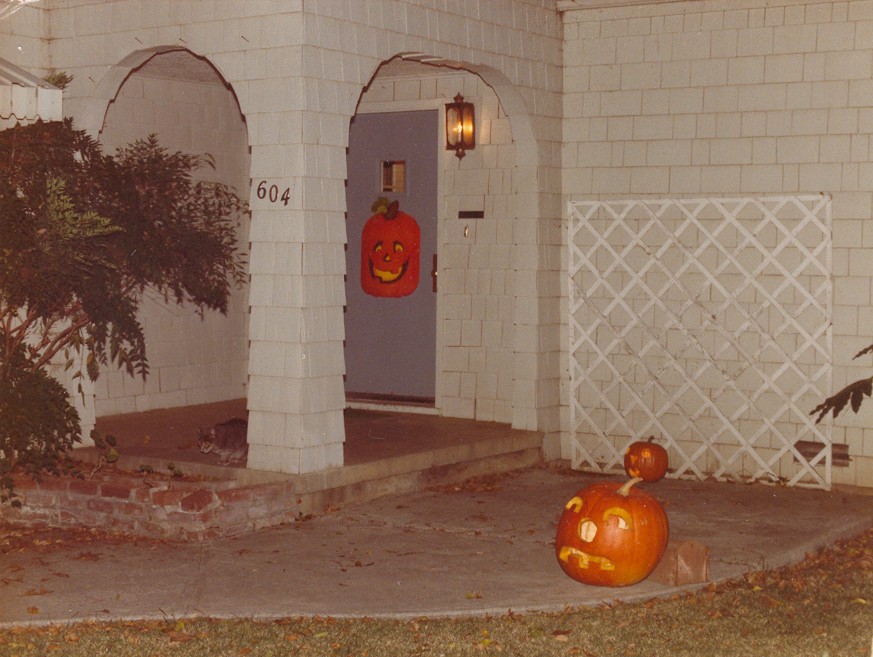
Funnily enough, I don’t remember any family trips to the pumpkin patch. I went regularly to our local patch as a school field trip in my early elementary years, but we only got to pick one to take back with us on the bus. I do remember a copious amount of pumpkins around the house each October, at least four of which went under the knife to become jack o’lanterns. They came from somewhere, but I was either not involved in getting them (pretty unthinkable) or this is a rare case of a holiday tradition of which I have no memory (equally unthinkable.) I don’t know.

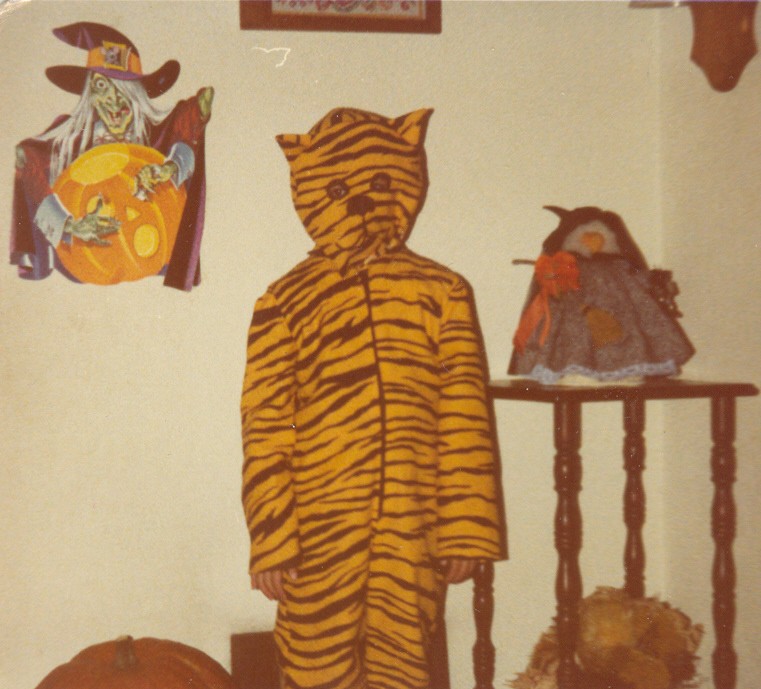
Flipping through one of my picture books sometime in 1980, I came across an illustration of a boy in a tiger suit. This, for some reason, went off like a rocket in my five-year-old skull. I decided then and there that the acquisition of, and proud wearing of, a tiger suit would be the focal point of my existence.


The cardboard witch cutout in the background was a mainstay of our Halloween decorations until at least 1990, along with the green skull in the Dracula pic below

The end result, hot off my mother’s sewing machine, was a minor disappointment — it was not the plush, upholstered, fuzzy theme-park-mascot-style suit from the illustration, but rather a limp, featureless thing made of the thinnest tiger-print cotton with a mask like a grain sack. My bare hands dangled from the sleeves instead of being concealed in paws, and my battered size 1 Keds gave away my humanness at the suit’s bottom. The disappointment lasted only a moment, however, for this was an honest-to-goodness tiger suit. I decided I was immensely pleased with it no matter what. (In retrospect, I’m kind of glad it wasn’t a deluxe tiger suit, as that might have spun me off into a life of being a “furry,” and I’d be off somewhere yiffing right now instead of entertaining and informing you good people.) The fact that the tiger suit was completed close to Halloween was a happy coincidence. My tiger-suit mania could have hit me in January just as easily as late September. Continue reading
Leave a comment

Filed under History, Life & Other Distractions, Pop Culture