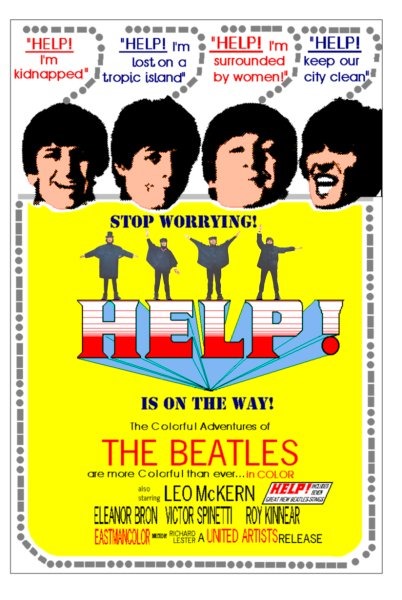
The original film poster
Help! was a movie, too, you know…
Nowadays, Help! mostly conjures up thoughts of the 1965 album, its driving, brilliant title single, and its Side Two (in the UK) monster classic “Yesterday.”
But Help! was a cinematic entity as well, and the accompanying album was (mostly) intended to be its soundtrack tie-in. Help! (the movie) has always gotten short shrift from Beatles historians, film critics, and even the Beatles themselves. Oh, no one says it’s bad — everyone acknowledges it’s a hell of a lot of fun to watch — but in most Beatles books it’s dismissively given about a page-and-a-half to two pages out of the band’s whole history. This for a project that the band spent almost four months producing, and four months in those hectic Beatlemania days might as well have been four years. (Even their self-made, self-indulgent psychedelic mess of a TV movie, 1967’s Magical Mystery Tour, gets more notice and affection these days.)
There was a time when popular singers, once they’d reached a certain point of fame, were expected to take the next step and become all-around “entertainers,” conquering other mediums, especially film and television. Guys like Bing Crosby, Frank Sinatra and Elvis Presley ended up with just as many films as albums, if not more. Following that mindset, Beatles manager Brian Epstein signed the band up for a three-picture deal with United Artists in late 1963. Their first film, A Hard Day’s Night (released July 1964) was microscopically budgeted and hastily shot with the belief that the Beatles were a temporary craze with an imminent expiration date. (UA could cancel the remaining two pictures if they chose.)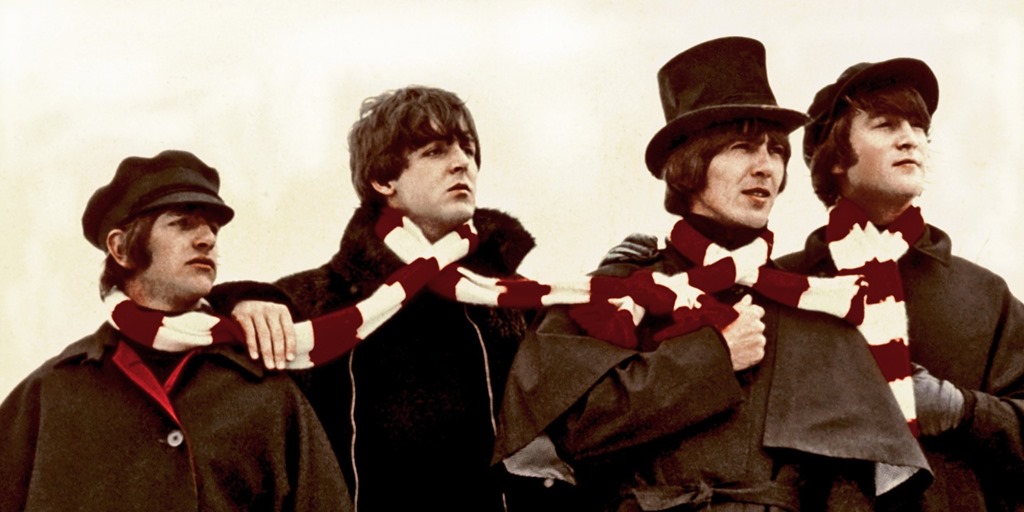
Help!, their second film under the UA contract, was released to British cinemas in July 1965 (a month later in the US). The British and American versions of the soundtrack (two very different animals, as we’ll see) were released a week apart in early August.
“There’s nothing in Help! to compare with…A Hard Day’s Night…This one, without sense or pattern is wham, wham, wham all the way…Some of it is surprising. Richard Lester, the director, has played some witty pranks with his camera. There are some fetching title and color gags, and a lot of amusing tricks achieved with old silent film techniques…The boys themselves are exuberant and uninhibited in their own genial way. They just become awfully redundant and—dare I say it?—dull.” (Original New York Times review by Bosley Crowther, 1965.)
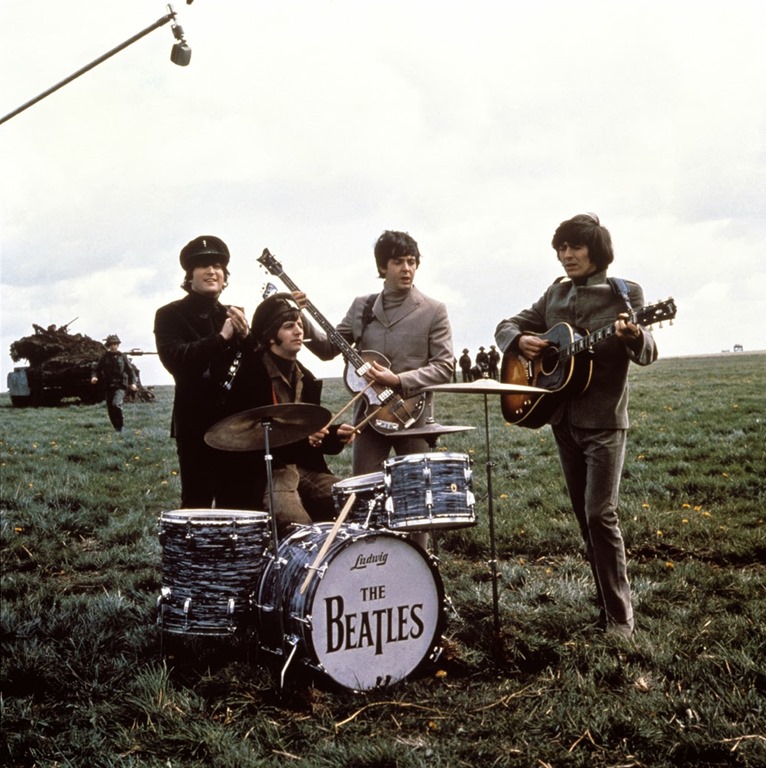
“The script…isn’t a complete failure, especially for fans of British comedies of the 1960s. There’s some really great funny business between the group…But overall, the story can’t hold a candle to the behind-the-scenes look from A Hard Day’s Night. The issue with Help! is its complete rejection of any realistic element – the moment you see the Beatles living in one large house, you know this is a cartoon world with no sense of reality…Help! turns the zaniness to 11 and it’s just too much to make for a good movie….It makes it pretty clear that while the Beatles were geniuses at music, acting was not their forte. The songs written for Help! are some of the group’s best…but the dated stuff in between make it hard to watch on a regular basis…” (Daniel S. Levine, film critic for The Celebrity Cafe, and evidently a hater of everything non-realistic.)
“I enjoyed filming it. I’m sort of satisfied, but not smug about it. It’ll do. There’s good photography in it. There’s some good actors in it — not us, because we don’t act, we just do what we can.” (John Lennon, damning it with faint praise around the time of its release).
“Looking back on it, Help! isn’t such a bad film. It’s more of a fun romp, but I think that A Hard Day’s Night is the better of the two…we’d really tried to get involved and learn the script for A Hard Day’s Night, [but] by the time Help! came along we were taking it as a bit of a joke. I’m not sure anyone ever knew the script, I think we used to learn it on the way to the set.” (Paul McCartney.) 
Yes, Help! will always suffer in comparison to A Hard Day’s Night, a film-buff favorite. That first film was cinema-verite style look at a fictionalized “two days in the life of” the world’s greatest pop group. Its gritty, black & white cinematography, documentary-style handheld camera work, jittery editing, and energetic performances from the Beatles still in their first flush of mega-stardom make A Hard Day’s Night a bona fide cinema classic. (The music is pretty good, too.)
The lion’s share of credit goes to director Richard Lester, but accolades are also deserved by screenwriter Alun Owen, like the Beatles a native of Liverpool, who traveled with the band on their November 1963 mini-tour of Ireland, and incorporated their personalities and witticisms into his Oscar-nominated script. Also contributing to its success were Beatles’ recording producer George Martin, who composed the orchestral score, and film producer Walter Shenson of United Artists, who stayed hands-off and allowed Lester, Owen, Martin, and the Beatles to create something that wasn’t just “another shitty pop movie” (Lennon’s words) like the kind Presley was cranking out in bulk at the time. Mere days after the Beatles stood on Ed Sullivan’s stage making their iconic US TV debut, they were in front of Lester’s cameras to get the film in the can before their next round of touring…
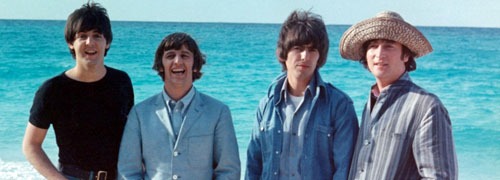
SIDE NOTE: The Beatles’ schedule in their first three years or so of worldwide fame was almost inhumanly grueling, as a glance at Mark Lewisohn’s Complete Beatles Chronicles will tell you. Consider this: the last day of filming on A Hard Day’s Night was April 24. On the 25th, they were in rehearsals for their ITV TV special Around The Beatles. On the 26th, they played at the New Musical Express Poll-Winners concert. The 27 and 28th was more rehearsing and then taping Around The Beatles. The 29th and 30th were concerts up in Scotland. May 1st saw them back in London recording an appearance for the BBC. And so on…


 “If I was ‘the quiet one,’ the others must have been really noisy.” – G.H.
 audition recordings


 Holy Bee of Ephesus