Category Archives: Film & TV

The Holy Bee’s 36 Hours of Christmas (Part 1)

At the end of last year’s “24 Hours of Halloween” — a marathon of spooky movies and TV shows curated by me for my imaginary TV station (“KHBE”) — I remarked jokingly that “48 Hours of Christmas” would follow. The joke turned quite serious when I realized I was short a Christmas entry this year. So the project is on!

andy-color-dancers

The first thing that struck me was that actually watching a 48 hour marathon would stretch the limits of human endurance, unless a very different kind of Christmas “snow” was involved. Thirty-six hours is just about do-able, and I’ll be offering suggestions as to when to catch some shut-eye. Also, have some food on hand. In fact, go ahead and have some turkey. That whole thing about tryptophan making you sleepy is just as big a bullshit myth as sugar causing hyperactivity (so quit making excuses for your poorly-behaved children.)

Part of what made the original “24 Hours of Halloween” marathon work was that my notional cable station would run the programs commercial-free, and start everything promptly on the 0s and 5s. Any one-to-four-minute downtime between shows would be filled by quips and double-entendres from everyone’s favorite horror hostess, Elvira, Mistress of the Dark. Since no equivalent pop-culture icon could fill her dress in a Christmas capacity, I decided to go ahead and pack those tiny spaces with commercials — but only vintage, holiday-themed commercials from the late 70s to the early 90s.

You want Hershey’s Kisses ringing like bells? You got it. (This one still pops up on real TV from time to time.)

You want Ronald McDonald ice-skating? You got it.

You want Joe College, in that horrid cable-knit sweater, home for winter break and waking up the whole damn house by brewing a pot of Folger’s? You got it.

And more Budweiser clydesdales than you can shake a peppermint stick at.

If there’s any other awkwardly-timed space to be filled, KHBE will just show footage of a Yule log for a few moments, maybe with some tasteful snippets of Mannheim Steamroller in the background.

(You’ll notice there’s not a lot of Disney stuff here, and that’s because Disney never really “did” Christmas very much, or all that well. I think they see Christmas as a competing brand of magical happiness. Maybe I’ll throw in that Chip ‘n’ Dale short where they hide from Donald Duck in the Christmas tree in the place of a few vintage commercials.)

The “36 Hours of Christmas” marathon will run from noon on December 22nd to midnight on the 23rd, so you can get a good night’s sleep and be up (bright-eyed and bushy-tailed) on Christmas Eve morning, and are able to stop being a lazy shut-in, and handle all of your family obligations. For those bound and determined to continue being a lazy shut-in, and/or those whose families are annoying fundamentalists or obnoxious Trump voters who can’t stop making quasi-racist remarks over the figgy pudding, the marathon will re-run in its entirety through the 24th and 25th. You’re welcome.

img_20161212_094301

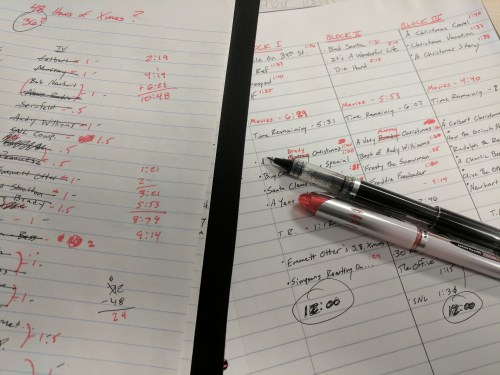
These marathons don’t just organize themselves

OK, the clock is striking twelve, you’ve cashed in some vacation hours from work, you’ve dumped a splash of peppermint schnapps into your hot cocoa (yes it’s noon, but no one will judge you), and you find KHBE down in the 800s of deep cable…what do we start with?

Santa Claus Is Comin’ To Town

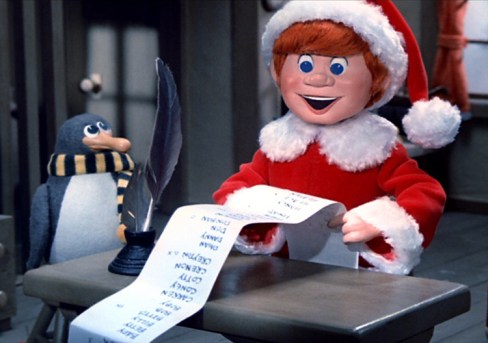
What better way to kick things off than with a bunch of creepy, plastic talking dolls? Over the past five decades, the Rankin/Bass production company has become practically synonymous with “kids’ TV Christmas specials,” and their stop-motion “Animagic” aesthetic (a song every few minutes, polyester snow, jerky, spastic movements and lifelessly staring eyes for the characters) is as beloved by some as a favorite ugly sweater.

santa.88

Another reason we start the marathon here, besides the general ubiquitousness of Rankin/Bass at yuletide, is that it’s an origin story. 1970’s Santa Claus Is Comin’ To Town, based on the 1934 song by the wonderfully-named songwriting team of Coots & Gillespie, explains how an orphan child, who was left on a doorstop with the nametag “Claus” around his neck, was taken in and raised by a family of toy-making elves (the Kringles), and grew up to be the familiar figure of Santa. He had to work his way up to delivering on a global scale. He started by bringing happiness to the gloomy children of Sombertown, although his methods may raise an eyebrow or two. During the song “If You Sit On My Lap Today (Be Prepared To Pay),” a beardless young Kris Kringle (voiced by well-known degenerate letch Mickey Rooney) demands a kiss from every child before he will give them their present. No wonder Burgermeister Meisterburger wanted to kick his ass out of town and back over the Mountain of Whispering Winds. Continue reading

2 Comments

Filed under Film & TV, Pop Culture

The Holy Bee Recommends, #13: “Sinatra: The Chairman” (and to a lesser extent, “Frank: The Voice”) by James Kaplan

“Frank Sinatra saved my life once. I was jumped by a bunch of guys in a parking lot. They were beating me with blackjacks. Sinatra said, ‘Okay, boys, that’s enough…'”                                                                                  –Shecky Greene

I have never been a huge fan of Frank Sinatra, but I certainly can’t deny he was one of the foremost musical artists of the 20th century. (I’m not a fan of ballet or musical theater either, but would never deny the skill and talent required to do them well.) I’ve tried to get into Sinatra, but for all the praise heaped on him for his “phenomenal phrasing” and his way of “living the emotion of a lyric,” my rock-raised ears can’t get around the fact that everything he’s done now sounds dated and hokey. It’s grandfather music. Or nowadays, great-grandfather music. It’s polite. Which makes it all the more wonder that it comes from perhaps one of the most impolite human beings that ever existed. Sinatra may have hated rock — and he did, with all the passion his passionate nature could muster — but in personality and demeanor, he was first rock star, maybe even the first punk (although to someone of Sinatra’s generation, “punk” was a grievous insult.)

The post-1954 Frank Sinatra as depicted by James Kaplan (and many others) is, more often than not, a generally unpleasant person. Thoughtless, hyper-sensitive, and supremely self-centered at the best of times, he often melted down into rages that were literally toddler-like: screaming, throwing things, breaking things, hitting people — because he didn’t get his way on some minor matter. When asked why those close to him tolerated it, they usually said something about his formidable charm and bottomless generosity when his mood was lighter…and of course that talent, and “that voice.” But for a reader like myself who isn’t a particular fan of “that voice,” his behavior is inexcusable. His story, however, is fascinating…

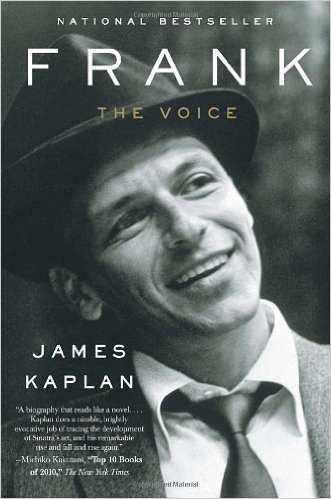
Sinatra: The Chairman is the just-published second of a two-volume biography by Kaplan, but the first, Frank: The Voice (2010), feels like nothing more than an extended prologue, chronicling the singer’s early years in Hoboken (as an indulged only child of a lower-middle class family, not the tough street gangster he claimed to be), his rise to fame as a skinny, bow-tied “crooner” singing with the big bands in the 1940s, and finally his temporary plunge into semi-obscurity. (Peter Guralnick’s two-volume Elvis Presley biography has the opposite issue; the first volume, Last Train To Memphis, is riveting, and the second, Careless Love, feels like a perfunctory denouement.)

Kaplan’s first volume lingers for its entire final third on those wilderness years of 1950-53 — dumped by Columbia Records and MGM, Sinatra limped through hosting a short-lived, low-rated variety show on CBS, sang to half-filled halls, and clung to fame primarily through his rocky marriage to rising star Ava Gardner. Frank: The Voice ends in early 1954 on a note of triumph — it’s Oscar night and Sinatra has just won Best Supporting Actor for From Here To Eternity (he had begged for the role when no one wanted to hire him.) The ink has just dried on his contract with Capitol Records, where his newly-matured voice and partnership with a number of gifted arrangers (Nelson Riddle foremost among them) put him at the forefront of American popular music.

This is where Sinatra: The Chairman begins, and rewards the reader for making the slog through Frank: The Voice. This is where we get the Sinatra we want to hear about — the Mafia ties, the brawls, the womanizing, the Rat Pack, the iconic Capitol albums, the dabbling in Kennedy-era politics…Kaplan does not disappoint. When I call the first volume a slog, that’s not a knock on Kaplan’s writing. In both books it’s wonderful, almost novelistic prose. What I mean is Sinatra’s early years, personally and professionally, are his least interesting. 1954 and beyond is where the real meat is.

Kaplan weaves Sinatra’s story in and out of a larger cultural picture. Like the first volume, a generous portion of Sinatra: The Chairman focuses on a few key years, in this case, 1960 to 1963, when Sinatra parked himself at an exciting and somewhat dangerous intersection of entertainment, organized crime (he was friends with Chicago mob boss Sam Giancana), and politics (he lobbied hard for JFK in the 1960 presidential campaign, and even partied with the Massachusetts senator several times early on, before Kennedy wisely began distancing himself.) Kaplan explains and intercuts all of these meticulously-researched threads without ever losing momentum, with a keen eye for the details he knows we want, and never becoming salacious or losing his academic tone. As we move through the 1960s, Kaplan also begins intercutting Sinatra’s story with the rise of the Beatles (by implication declaring them the other great musical phenomenon of the 20th century), and the rapidly-changing face of popular music in that decade. The sands once again shift beneath Sinatra’s feet as he ages out of any real relevance everywhere but Vegas showrooms and the cocktail parties of old Palm Springs millionaires. (Admittedly, it’s pretty cool that the marquees in Vegas would simply say “HE’S HERE” with no further information needed.)

Biographies sometimes find it difficult to strike a balance between telling the story of a life, and examining the work that life produced. They often either dwell on their subject’s psyche, or read like a chronological resume of projects. Kaplan does an excellent job interspersing Sinatra’s films and recordings into the overall picture, giving a good impression of what clicked and what didn’t, both with the artist himself (Sinatra did not care much for “Strangers In The Night,” and absolutely hated “My Way”), and with the public that paid for the results. Continue reading

1 Comment

Filed under Books, Film & TV, Music -- 1950s & Before, Music -- 1960s, Pop Culture, The Holy Bee Recommends

The Holy Bee’s 2015 Halloween Special: 24 Hours of Halloween (Part 2)

10:00 — 11:35: Halloween

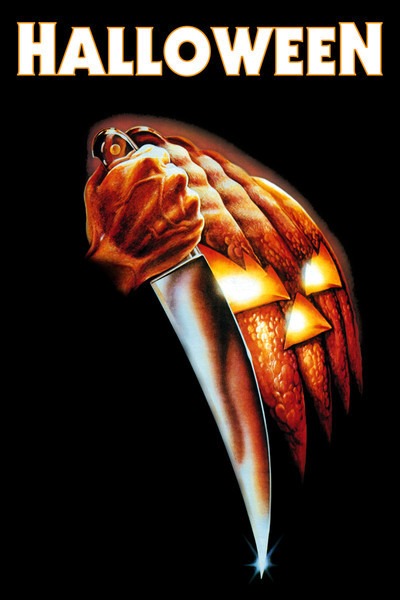
large_vjoOFOTBJcJvA1weJejlZ92LZD4The Holy Bee has already dedicated a “Halloween Special” post to his ill-advised, but ultimately successful, attempt to watch all eight original Halloween films in a row. I’m pretty sure we need only bother with the first one here, 1978’s Halloween, directed, co-written, and scored by John Carpenter. That three-note keyboard riff has become synonymous with slasher films, and almost as well known as the Jaws theme. Film historians have had a long-running debate about what constitutes a true “slasher” film, or what the first one was. Whether or not Halloween was the first slasher film, it certainly put all the tropes together in a stylish way, and more importantly, it was a pretty solid commercial success.

Success breeds imitators, and wherever Halloween’s place is in the origin of the genre, it opened the floodgates to the Golden Age of Slashers. Halloween’s superhuman, knife-wielding killer Michael Myers established a formula followed by at least two other slasher film series of the 1980s, beginning with Friday the 13th (1980) and its Jason Voorhees, and A Nightmare On Elm Street (1984) and its Freddy Krueger. There were also dozens of others of lesser repute, and those usually sprouted a franchise of their own since they were so damn inexpensive to produce.

halloween-michael-myers

Unlike its later knock-offs, Halloween is almost Hitchcockian, pretty much bloodless, and except for a few flashes of nudity, could probably play uncut on network television. Carpenter’s film succeeds on camera work and atmosphere, which cannot be said for the others, and cannot even be said for subsequent Halloween films, which were in the hands of lesser talents than Carpenter.

11:35 — 12:00: NewsRadio (Season 3, Episode 5: “Halloween”)

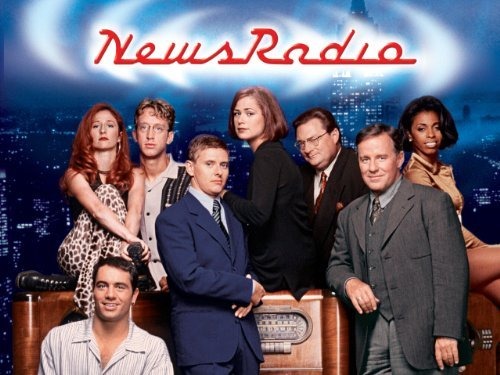
NewsRadio was one of the most underrated shows of the 90s, and was one of the of the last great three-camera, live-audience sitcoms. (And before anyone says anything about Big Bang Theory or something like that, remember I said “great”.) Its best moments were in the same league as Taxi or Cheers, although it lacked those shows’ richness. I suppose it was more comparable to Night Court when it was at its mid-run peak, if anyone remembers that. Almost a television version of a comic strip. The ensemble cast boasts two genuine comedy geniuses (Dave Foley and the late Phil Hartman), future Serious Actress (Maura Tierney) before she became a fixture on E.R., and two future nutcases (Andy Dick and Joe Rogan) before they went barking mad. 51lg6TV3jUL._SX940_

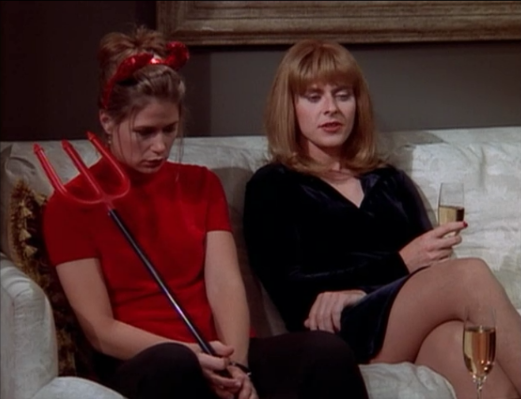
The show’s real treasure, though, was Stephen Root as the eccentric billionaire who owns the radio station, and in this episode refuses to invite the staff to his annual Halloween party. When asked why, he mentions that at his last Halloween party, the staff were, as he puts it, “too cool for school,” refusing to wear costumes and participate in the party games. He relents after they beg him to reconsider, leading to the show’s payoff — After frantically trying to think of a costume idea, in desperation Dave Foley asks to borrow Maura Tierney’s new cocktail dress, which leads to Foley revisiting his Kids In The Hall days and appearing in full drag…and looking quite fetching, actually. Tierney is in a  mysterious foul mood for the remainder of the episode. When Foley finally asks why she is sulking, she explodes “Because you look better in my dress than I do!”

tumblr_mbbrqrYISt1qi972uo1_540

12:00 — 1:25: The Monster Squad

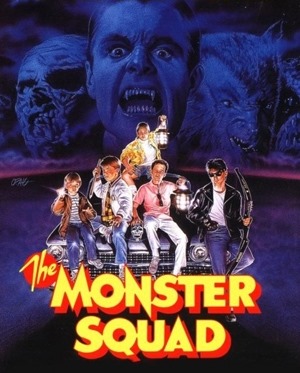
A flop upon release, The Monster Squad (1987) has developed a dedicated cult following over the past couple of decades, despite the fact it was a pretty obvious attempt to recreate The Goonies, right down to the slightly older tough kid and the token fat kid (simply referred to throughout the film as “Fat Kid.”) However, The Monster Squad has its own charms, not least the inclusion of the full gamut of classic movie monsters.

monster_squadThrough a series of convoluted circumstances, Count Dracula and cohorts are very real, very alive (or at least very undead), and wreaking havoc on a quiet 1980s suburban neighborhood. The only ones to take the threat seriously are Sean and Patrick, a pair of earnest, slightly nerdy middle schoolers who have a “monster club” in a treehouse right out of an Our Gang short. They are happy to be joined by the super cool older delinquent Rudy, though it’s for less than wholesome purposes. (The treehouse has an unobstructed view of Patrick’s older sister’s bedroom. And you know Rudy’s a delinquent because he wears shades and a leather jacket and chews a matchstick.) The club’s activities are usually restricted to drawing pictures and writing stories, but when people begin turning up dead, they piece together the clues, arm themselves with stakes and silver, and go into battle.

1412162321458020132

Despite, or because of, all its juvenile silliness (including its now-classic line from Fat Kid: “Wolfman’s got nards!” after he delivers a solid kick to the werewolf’s nether regions), there is a lot to enjoy here, including a fully committed performance by Duncan Regehr as Count Dracula, a poignant subplot about a Holocaust survivor, and a series of crowd-pleasing moments as it heads for its climax. My personal favorite is when the cynical, condescending non-believer Rudy unexpectedly steps up and blasts a stake through the heart of a hissing vampire to the open-mouthed amazement of everyone. (“What? I’m in the goddamn club, aren’t I?”) Continue reading

1 Comment

Filed under Film & TV, Pop Culture

The Holy Bee’s 2015 Halloween Special: 24 Hours of Halloween (Part 1)

Halloween falls on a Saturday this year. As far as the Holy Bee is concerned, every Halloween should be on a Saturday. (A dark, rainy Saturday, preferably. Not one of the sunlit 80-degree days that so often characterize late October here in the central valley of California. The last Halloween that combined Saturday and the requisite gloom was 1998, and it was mostly wasted by me working the afternoon shift down at the old movie theater. At least we were showing Bride of Chucky…)

Especially since I’ve had a grown-up, Monday through Friday type of job, Saturday Halloweens have retained their special cachet, and now another is upon us.

Halloween1

Given the choice between doing something and not doing something, the Holy Bee would tend to choose the latter course every time. I’ve often said to my sons (who share this philosophy) that our family crest should contain the Latin motto Utinam Non Magis (“I’d Rather Not”), along the lines of Bartleby the Scrivener. Combining a Saturday Halloween with nothing to do? Perfect. That’s when you dive into a Halloween-themed marathon on a local channel or deep cable. These are always a great idea, but they often come up short in terms of variety. How much variety can one put into a Halloween-themed marathon? Plenty.

Though I’m not quite Walter Mitty level, I do tend to daydream, usually when driving at high speeds, or when important people are talking to me about a topic I’m not interested in (which is most of them). So not long ago, I began thinking about how I would program a Halloween marathon on my very own TV station (“KHBE”).

Imagine yourself, Gentle Reader, as the inhabitant of a better world where51NyVCq3RyL KHBE actually exists, and is airing a “24 Hours of Halloween” marathon from midnight to midnight. You would get home from work around five-ish on Friday the 30th (maybe having slipped out a little early), toss your keys on the counter, flip through the mail, perhaps fix a snack, and then pop an Ambien and get right into bed and get some sleep! Set your alarm for 11:55 pm.

I hope you’ve stocked your larder and have the number of a good pizza delivery place, because you won’t be leaving the house any time soon. Cut through some of that post-Ambien grogginess with a quick Instant Pumpkin Spice Latte, and fire up your TV. What will you see? Not commercials, that’s for damn sure. The Holy Bee has scheduled this marathon tightly. No time for ads.

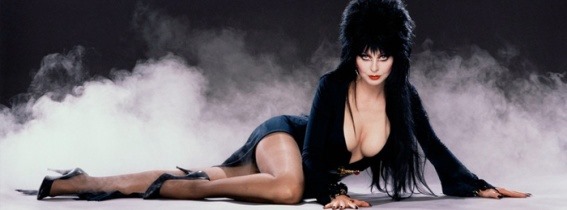
There will be a few minutes of downtime here and there to keep things starting 52 Coors Light Elvira Store Displayon the 0s and 5s. I have decreed that this time will be filled by everyone’s favorite wise-cracking horror hostess, Elvira, Mistress of the Dark. I don’t care if she’s now 64 — enough make-up, candlelight, and soft focus will transport her back to how she looked on that Coors Light cardboard standee (left) that greeted millions of 7-11 customers during any given October in the 1980s, and may have contributed to the onset of puberty for the younger ones. (Her self-titled 1988 movie did not make the cut for the marathon because I needed her for hosting duties, and did not want to make 24 Hours of Halloween top-heavy? overstuffed? with Elvira.)

662a2e96162905620397b19c9d249781_567x210 Continue reading

2 Comments

Filed under Film & TV, Pop Culture

“The All-New Holy Bee/Pointless Nostalgia Adventure Hour”: My Typical Saturday Morning in the Early 80s (Part 2)

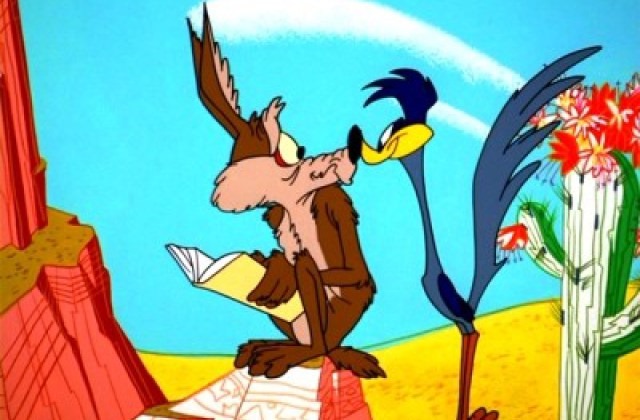
As The Bugs Bunny/Road Runner Show rolled on through the morning, the focus of the program switched to the Road Runner for the second half or final third, introduced by its own memorable theme — “Road Runner, the Coyote’s after you/Road Runner, if he catches you, you’re through…” Unfortunately, the quality of the Road Runner’s portion of the show was somewhat compromised…

wile e coyotes

You see, Warner Brothers continued to release theatrical shorts longer than the other studios, but they farmed out the actual work to smaller companies. DePatie-Freleng Enterprises (co-owned by former WB director Friz Freleng) made the shorts from 1964 to 1967, resulting in a much-altered animation style (not quite “limited,” but close). The WB/DFE partnership did some Road Runner films, but focused mostly on a series of Daffy Duck vs. Speedy Gonzalez shorts (the less said about which the better). Format Films handled the final batch of Road Runner shorts, which were even worse than the Daffy/Speedy stuff. These late-period embarrassments turned up again and again on The Bugs Bunny/Road Runner Show, but can’t hold a candle to the ones originally produced from ‘49 to ‘63, which also turned up on BB/RR. Even a six-year-old could tell the difference.

Sometimes during one of the Format Road Runner shorts (there were eleven of them, and at least two were shown every damn week), I would turn the dial back to ABC, and frequently encounter The Fonz and the Happy Days Gang, another entry in the trend of turning a prime-time family show into a Saturday morning kids’ cartoon. Before my time, there had already been Saturday morning versions of Star Trek, The Addams Family, Gilligan’s Island, The Brady Bunch, Emergency!, Lassie, My Favorite Martian, and possibly I Dream of Jeannie (the adaptation was pretty loose.)

Fonz_and_Happy_Days_Gang

The Fonz and the Happy Days Gang bridged that era with the 80s, which brought us animated versions of The Dukes of Hazzard, Laverne and Shirley, Mork and Mindy, Punky Brewster, ALF, and more Gilligan.

The premise for a lot of these shows was the same: take a few of the original TV cast, dump them into a crazy new setting, and add a few new “cartoon-only” characters, preferably some kind of cute mascot or talking animal. To wit: Fonz, Richie Cunningham, and Ralph Malph are caught in a malfunctioning time machine and bounce through history accompanied by a comic-relief dog named Mr. Cool and a “future girl” named Cupcake. (Second example: Laverne and Shirley are in the army and their drill sergeant is a pig named Squealy.)

Almost without exception, these spin-off cartoons managed to get most of the original cast to do the voices. I imagine Donny Most probably wasn’t too difficult to convince, but Ron Howard had already directed two TV movies, one feature film and was planning his second (Night Shift), and had left the actual prime-time version of Happy Days. Still, the work couldn’t have been too demanding. Howard could probably knock back a Scotch and polish off his lines for all 24 episodes in an afternoon, with one eye on the clock so he could get to the bank before it closed.

(Those 24 episodes were padded out for almost two years — first in the usual re-runs, then re-packaged with other shows, in true Saturday Morning style, as the rather desperate-sounding Mork & Mindy/Laverne & Shirley/Fonz Hour.)

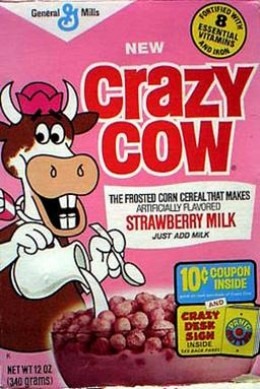
222_65_ucpAt some point during The Bugs Bunny/Road Runner Show, it would be time for breakfast. With a laborious lugging about of the kitchen stool, I assembled the disparate parts that would come together to form my perfect meal — a bowl of cereal. I took my cereal very seriously. Every other Saturday or Sunday afternoon, Mom would do the grocery shopping, and I would accompany her to make sure the cereal acquisition was handled by me personally. Mom had grocery shopping down to a science: her trip through the aisles took exactly sixty minutes. I had that amount of time to pick out my cereals for the next two weeks. I had to get one “healthy” cerealbox291 (Grape Nuts, Cheerios, Chex, etc.) to offset the effects of the two others I was allowed, which were always powerfully sugared. I liked the healthy ones just as well, because I would simply add my own sugar to taste, usually to the point it would leave a viscous sludge on the bottom of the bowl. Mom would often threaten that I would “get worms” if I continued to eat that much raw sugar, the horrific threat of which might be effective on less-savvy six-year-olds, but I waved it off like the old wives’ tale it was. (To this day, I am worm-free.)

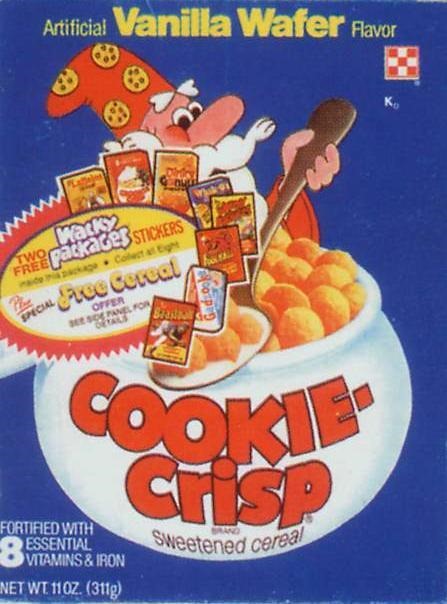
So I stood in the cereal aisle in the dead center of Woodland’s Nugget Market (the original!) for an hour, making my decisions. When Mom passed down that aisle, I knew I was at half-time. Would I go home with a product from Post, Kellogg’s, or General Mills? Would it be Pops? Loops? Pebbles? Jacks? I avoided the Smacks — the puffed wheat cereal looked like a bowl of dead locusts, and I didn’t care how cool Dig ‘Em the Frog dressed, I didn’t want a slimy amphibian on my cereal box. Something from the Crunch family, perhaps? The good Cap’n’s original version would tear the roof of your mouth vanilla-cookie-crisp-boxto hell, and leave a strange film, but Peanut Butter Crunch was smooth as silk. (I’ve often wondered if Cap’n Crunch’s eyebrows were floating above his eyes, or simply painted on his hat.) And speaking of unpleasant mouth feel, Grape Nuts was tantamount to eating a bowl of garden-path gravel, but it had a peculiar charm and its slightly-smaller box often graced our shelf. If I was feeling particularly jaunty, I would select Cookie Crisp, which many hand-wringing nutritionists felt was truly the end of civilization. I preferred the long-discontinued Vanilla Wafer Cookie Crisp (in the blue box).

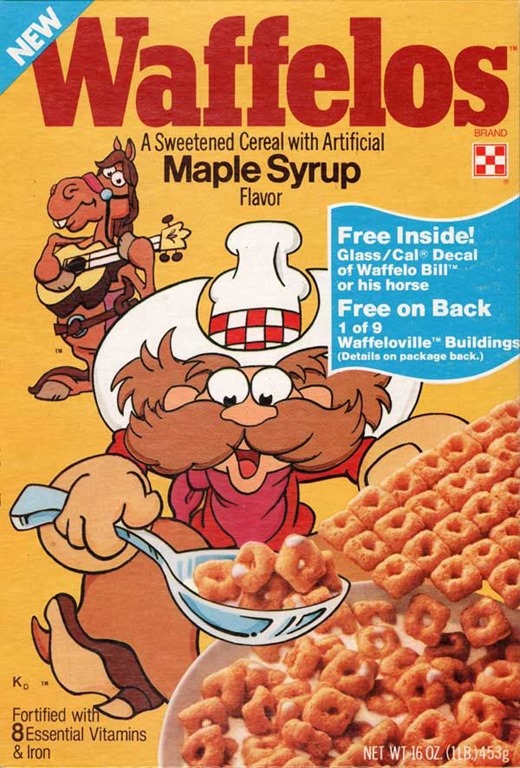
Around this time, at least one of the choices was almost automatic — Waffelos,waffelos my hands-down favorite cereal. They tasted exactly like waffles with maple syrup. They came in regular or blueberry, had a mustachioed cowboy mascot on the box, and best of all, my sister didn’t like them, so the whole box was mine! (If you go to the Mr. Breakfast website comment page — and who wouldn’t? — and read the comments for Waffelos, one of the first remarks you’ll see is “This stuff was like crack!”) The Waffelos cowboy rode off into the sunset before the 80s were half-over, and we’ll never see his like again. (Post introduced some bullshit called “Waffle Crisp” in 1996, but it is a pale imitation.)

Brimming bowl of cereal in (two) hand(s), I carefully baby-stepped my way back from the kitchen to the TV tray I had hopefully remembered to set up ahead of time… Continue reading

1 Comment

Filed under Film & TV, Pop Culture

Who Needs Friends When You Have “Super Friends”?: My Typical Saturday Morning in the Early 80s (Part 1)

It is about 7:45 on a Saturday morning, sometime late in 1980, or perhaps early in 1981…

We have gained a new president, lost a Beatle, and the whole country has just learned who shot J.R…

None of this matters to me, of course. I am six. The winter sun has begun to peek through the cracks in my Empire Strikes Back curtains. I am tucked under my Empire Strikes Back comforter. I hear the furnace kick on in the basement. I hear the back door in the kitchen open and close as my dad leaves for work. He runs an auto body shop, and his sole employee is himself, so six-day work weeks are a necessity. Mom works the graveyard shift as a police dispatcher, and arrives home not long before I wake up. She will remain sleeping until noon or so. My sister will also remain sleeping until noon or so, by virtue of the fact she is a fourteen-year-old girl.

The house is mine, and it is the best time of the week — it is Saturday Morning.

As warmth fills the house via the heating grates, I slip out of bed. I am clad solely in my briefs. I’ve always hated the sweaty, tangled mess of pajamas, twisting around my torso and riding up my shins. I usually only wear them on Christmas Eve, so I can appear decent in Christmas morning photos. There’s still enough chill in the air to raise goosebumps, so I make sure I wrap my security blanket tight around me, like a chrysalis or vampire’s cape. This blanket has been with me since the crib, and has seen better days. It is basic, thermal-style cloth (like long underwear) and was once vivid yellow, but has faded to a hue best described as “old buttermilk.” The satin edging it was manufactured with is not even a memory at this point. I already feel a little too old for such nonsense, but I confess it stays within reach for at least another few years.

underoosIf I’m lucky, one of my three pairs of Underoos briefs would be among the laundered options in my top drawer. Not only did they come in bold superhero colors, they were much softer than my standard tighty-whiteys, mellowing their cotton with a little polyester. I barely considered Underoos underwear — they were a costume, and, on a warm day, perfectly acceptable as outerwear, at least as far as the yard.

SCN_0004

Scantily-clad and wrapped in my shawl, I creep downstairs. There is one possible obstacle on the landing between the two sets of stairs. Ninety percent of the time, our housecat Tom Kitty is an amenable, purring charmer, on the hunt for a lap to knead and a hand to lick. But every once in awhile, he would get in a “mood.” Sprawled on his side, tail twitching, pupils dilated to the max, he would park himself in some family pathway and challenge everyone to dare try and pass fifteen pounds of feline moodiness. Everyone else stepped over him with little consequence. I was his favorite victim. He would literally nod at me, raising his furry chin in a menacing “‘sup, bro?” gesture. I could either sprint past him and hope to outrun him (he would give chase), or try to cause a diversion, frequently by sacrificing my blanket — tossing it over his head would buy me a few seconds. The downside was that I would sooner or later have to retrieve the blanket, and also the fact that Tom had a long memory for slights. “Payback’s A Bitch” might as well have been embroidered on his collar.

SCN_0016 (2)

The old Zenith…

Happily, most of the time he either wasn’t on the landing, or was in an agreeable temper, so my journey to the couch and TV was unimpeded. The TV was a Zenith cabinet model, half home entertainment, half furniture, with its controls hidden on the right-hand side by a little louvered door, and fake drawers under the screen.  I pull the on-off knob. If I’m a little too early, it’s still showing “Farm Report,” but usually I’m right on time. I feather my couch nest with yet another blanket — a much bigger blue tartan number with fringed edges that lives under our end table. There is no remote. Channel changing must be done on the dial. (Just like my descent from the bedroom, this process can also be complicated by the presence of a moody feline.) If it’s warm enough, I might not bundle myself on the couch, but rather drape myself over a barrel-like hassock footstool that I’ve turned on its side, and rock back and forth like a patient in an experimental chiropractic treatment.

What draws me out of bed so early on a non-school day? The same lure that is reeling in millions of children across the country at this precise moment – Saturday-morning cartoons.

533900766_17af94f2e2_o

Long ago, cartoons were denizens of the cinema screen, and the major studios had massive animation departments creating the shorts that would run ahead of the feature films. Each studio had its stable of characters — MGM had Woody Woodpecker, Tom & Jerry, and Chilly-Willy, Paramount had Popeye, Casper the Friendly Ghost, Baby Huey, and Little Audrey, 20th Century-Fox  licensed stuff from Terrytoons (Mighty Mouse, Heckle & Jeckle), and the twin kings of cinematic animation, Disney and Warner Brothers, had the most iconic characters of all, of whose names I’m sure I need not remind you.

Television arrived for most households in the early 1950s, and immediately began cutting into the movie studios’ profits as more people got their entertainment at home. One by one, the studios shut down their animation departments as a cost-cutting measure. At the same time, animation was still pretty scarce on early television. Kids’ shows tended to be live-action (eg. Howdy Doody, or The Mickey Mouse Club.) What was a cartoon-loving kid to do?

Hanna_Barbera_Logo

Luckily, along came two former MGM animators — Joseph Hanna and William Barbera. Out of a job when MGM closed their animation department, they formed their own production house with the revolutionary idea of producing quick, low-cost animation directly for television. After a few false starts, Hanna-Barbera hit it big with The Huckleberry Hound Show in 1958, and pioneered theHuckhound use of “limited animation.” Limited animation uses less-detailed backgrounds, fewer “in-between” drawings between key frames, recycles many elements, and has a lot more “holds,” where characters don’t move at all. Huckleberry Hound and his ancillary characters and spin-offs (Yogi Bear, etc.) were originally developed as packages for weekday syndication on independent local stations, and usually aired sometime after the evening news and before prime-time. Hanna-Barbera’s rival, Jay Ward Productions, actually scored a network deal with ABC for Rocky & Bullwinkle in 1959. There was even a brief period when a flurry of animated shows were developed for prime-time evening viewing, culminating in six seasons of The Flintstones.

8896283_f260Then around 1960, it dawned on the networks and station owners that Saturday morning was a programming wasteland — the perfect place to air a block of kid-centric shows, and much more importantly, kid-centric advertising. The post-WWII economy reveled in conspicuous consumption, and for the first time, the average joe could afford to buy useless crap for his kids. All manner of snacks, candy, toys, and games were hawked to eager young eyeballs. But mostly cereal. Cereal commercials followed each other like a sugar-coated freight train hour after hour. Saturday Morning basically created the brightly-colored, pre-sweetened substance that us kids knew as “cereal,” a development which would certainly send old John Harvey Kellogg into quite a grave-spin. As we’ll see, the commercials were just as big a part of the Saturday Morning experience as the programs.

Depatie-freleng1970

And the programs were for the most part cartoons. Hanna-Barbera and Jay Ward blazed the trail, and other low-cost animation studios followed suit. DePatie-Freleng and Filmation were both churning out material by 1963. (Think Hanna-Barbera animation was low-rent? Compare it to the dirt-cheap house style of Filmation. I recall an old Calvin and Hobbes strip where Calvin’s dad lambasted the quality of the cartoons Calvin was watching. “They don’t move! They just stand there and blink!” — he was almost certainly watching a Filmation production.) The major movie studios probably believed their old animated shorts were fated to collect dust in the archives, and were delighted to squeeze a few more bucks out of them by selling them to TV at bargain basement prices. (Except Disney — Disney guarded its vaults like a she-bear, which is why you would see nary a feather on Donald’s ass on Saturday mornings.) The fad for prime-time animation died out (at least until The Simpsons), making those shows ripe for plundering. All in all, tons of animated material, new and old, was now available to fill hours of airtime at a much lower cost than live action. Pixie, Dixie, and Mr. Jinks were never going to demand a salary increase or a contract re-negotiation.

Filmation83

Animation in other time slots of the broadcast week dried up, giving Saturday Morning its special cachet. For much of the 70s, Saturday morning was about the only place you could see a decent amount of cartoons on TV. By the time I reached TV-viewing age, things had loosened up. Thanks to a greater number of independent channels on the dial, and the birth of cable, by 1980 there were after-school cartoons, before-school cartoons, and hell, for an hour or two there were even Sunday-morning cartoons. (There was some Dutch/Canadian monstrosity called Dr. Snuggles, and the Pink Panther always seemed to turn up on Sunday mornings on Channel 31.)

But all of that was bush league compared to the hold Saturday Morning held over the average pre-teen viewer. Something about the melange of old Warner Brothers animation, new “limited animation” works by H-B and Filmation, the bright, loud commercials, and the token attempts to educate between all of it held a special kind of magic. Continue reading

5 Comments

Filed under Film & TV, Pop Culture

Just Another Shi**y Pop Movie?: The Beatles’ “HELP!” Turns 50 (Part 3)

HELP_logo

Realizing John’s songwriting pen had struck gold, the Beatles raced to Abbey Road on the evening of April 13, 1965 (after spending a long day filming, then doing a lengthy radio interview from a car in the studio parking lot — I’m telling you, their calendars were packed) and emerged with not only a massive hit single, but also the film’s official title.

“Help!” the song is arguably one of the all-time greatest Beatles singles. Its gutsy lead vocal from John, and innovative backing vocals from Paul and George (the lyrics in the backing vocals at times actually precede the lead vocals — a minor but notable twist to the formula), backed by the powerful, Ritchie Havens-like pounding of John’s acoustic rhythm guitar (a Framus 12-string), Ringo’s flawless drumming, and the jangling, descending lead guitar lines of George (played on a Gretsch Tennessean) that almost single-handedly launched everyone from the Byrds to R.E.M, combine to create something that was probably much, much better than a song called “Eight Arms To Hold You” would have been. That name was gratefully relegated to the scrap heap.

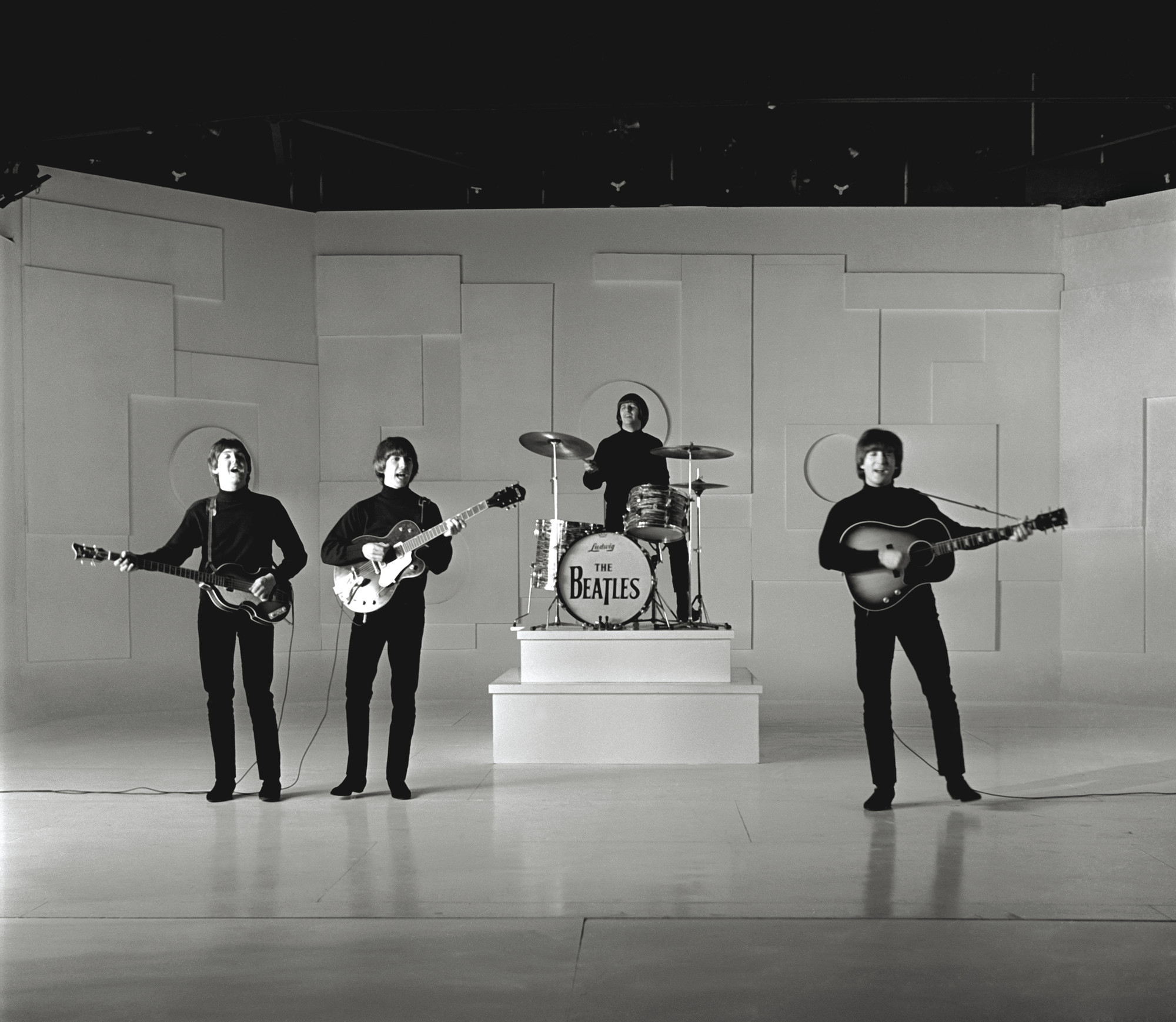
The opening title sequence where the band performs the song was filmed on April 22.
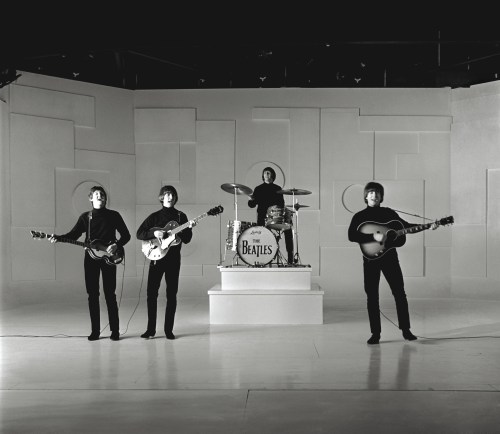
The title sequence

The title sequence, Twickenham Studios, April 22, 1965. Lennon’s 12-string acoustic heard on the actual song is replaced by a Gibson 6-string here, but the Framus can be seen in the “You’ve Got To Hide Your Love Away” sequence later in the film.
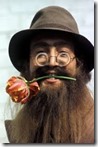
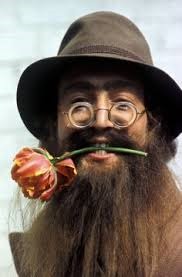
lennonThere is an eerie, odd moment when the Beatles are in the departure lounge of Heathrow Airport (filmed at Twickenham on April 27) fleeing to the Bahamas in disguise. John’s disguise — big beard and round, wire-rimmed glasses — is exactly how he would look four years later — check the cover of 1969’s Abbey Road.

SIDE NOTE: Is Help! racist? Some modern internet reviews display a very laudable 21st-century concern that the film’s treatment of Eastern religion is, shall we say, not the most enlightened. George Harrison’s most recent biographer, Graeme Thomson, sniffs haughtily that “Help! is their least soulful, least committed project, in which alternative spirituality is mockingly played for the broadest of laughs.” Thomson may be overstating the case somewhat (and the remark was a sufficient enough irritant to the Holy Bee to inspire these blog posts.) The unnamed cult in the film does not seem to be a jibe at Hinduism, Krishnaism, or any other form of real religious worship. What they actually seem to be based on is the Thuggee, a bloodthirsty group of thieves and murderers that once terrorized the Indian subcontinent. If that’s Thomson’s idea of “alternative spirituality,” then he certainly has more issues than the film.
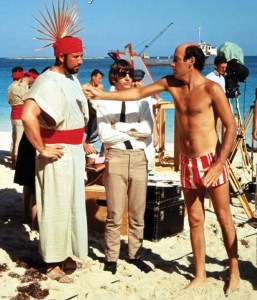
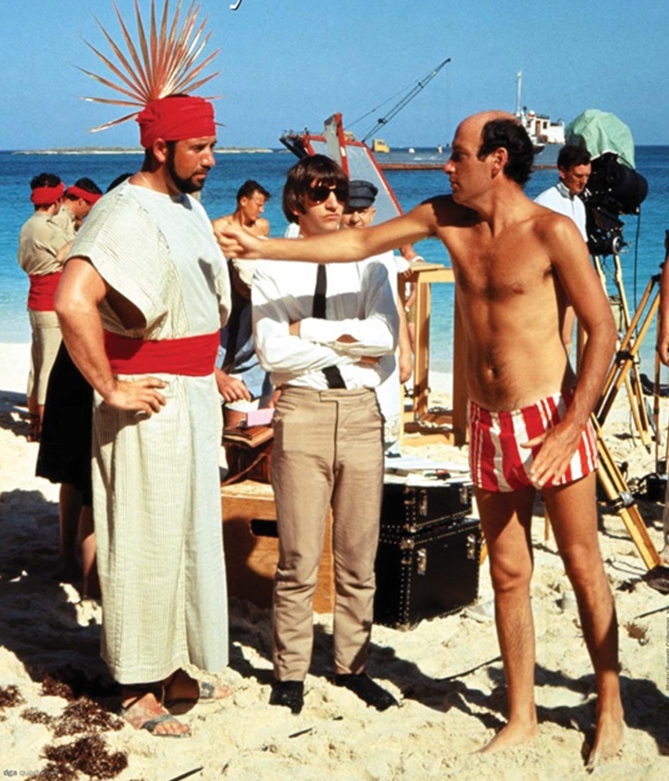
Lester directing Ringo and an

Lester directing Ringo and an “Indian” extra. It looks like Ringo has a 21st-century cell phone in his front pocket, but it’s a pack of cigs.

The Thuggee were also the villains in Indiana Jones and the Temple of Doom, which has had its own accusations of presenting institutionalized colonial racism as if it were acceptable. The Thuggee were definitely devotees of Kali, but unlike the demon goddess demanding blood sacrifice depicted here and in Temple of Doom, Kali is a loved and accepted (if not always benevolent) member of the pantheon of Hindu gods. In this case, I suppose both films are guilty of fostering a misapprehension.  However, this is Help!, the goofy, written-in-ten-days musical romp that’s a half-century old. Anyone expecting documentary-style accuracy on actual Hindu religious rites should look elsewhere.

And not that any religion is treated with reverence in the Help! universe. “They have to paint me red before they chop me,” Ringo patiently explains at one point. “It’s a different religion from ours. [Long pause]…I think.”

Some also decry the fact that all of the “Indians” are played by lily-white English actors. That, of course, is part of the overall joke, and the English are the butts of it. Despite their Empire being long gone, the English are so childishly pleased with themselves and their way of life that they suspect that everyone, deep down, is really just like them. (As Clang is growling instructions to the henchmen in Hindi, Bhuta looks on helplessly. “I don’t speak the language,” he admits to no one in particular. “Latin, yes, but this Eastern babble…” he concludes with a resigned shrug, like a good British public-school boy.)

In general, the film is just a mild culture clash, with the working-class Scouser/Cockney attitudes toward the “mystic East” tending more toward tolerant befuddlement or innocent cluelessness. If you’re really looking for something to be offended about, I suppose you could find it in Help!, but you’d need to put forth the effort. Keep in mind, Harrison’s and the Beatles’ sincere interest in Indian religion inspired by their work on the film did lead directly to a more educated and informed view in subsequent years.

beatles-help-image1

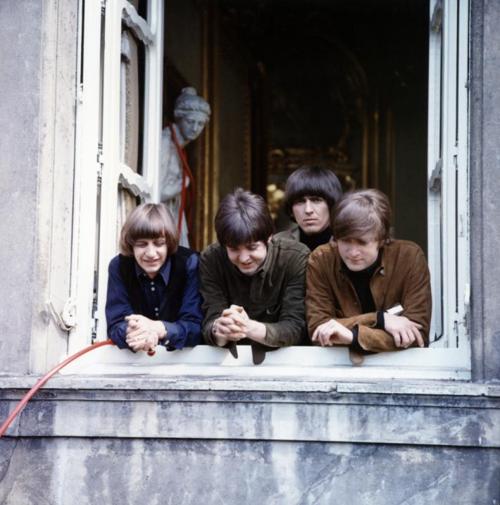
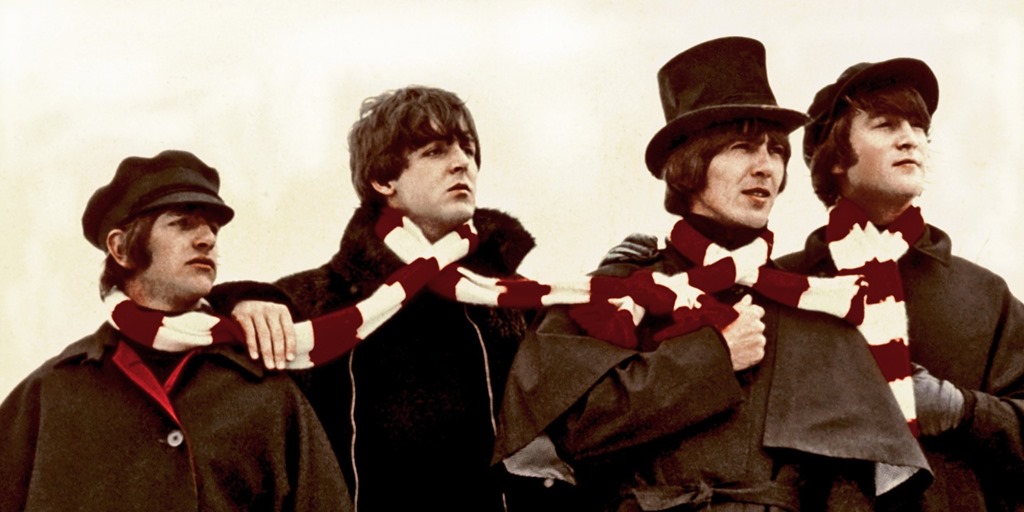
At some point in late April or May, the band dug out their heavy Austrian ski outfits to be photographed for the promotional materials, including the movie poster and album cover. Photographer Robert Freeman’s original intention was to have them spell out H-E-L-P with their arms in semaphore. That formation looked awkward and didn’t photograph well, so, in Freeman’s words, “we decided to improvise and ended up with the best graphic positioning of the arms.” They roughly spell out “NUJV” or “NVUJ”, depending on which version of the picture you’re looking at.

I had naturally assumed the “semaphore” photos were shot on location in Austria, but soon remembered that was almost a month before the title had been conceived. (Add to that fact that no version of the semaphore photos with an actual Austrian background can be found — they’re always superimposed onto other things: record sleeves, posters, books, etc., which indicates a later studio shoot against a blank backing. There is a brief arms-extended shot in the “Ticket To Ride” sequence that may have sparked the idea.) The official still photographer on the set of Help! was not Freeman, but Emilio Lari.
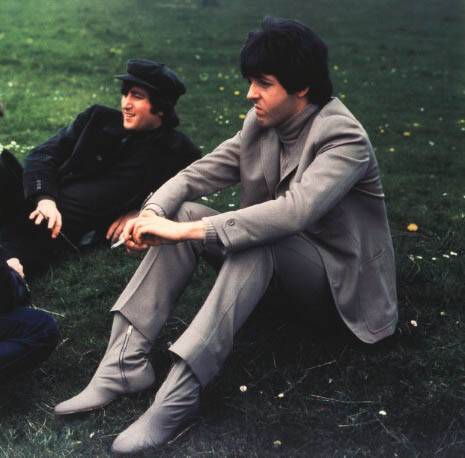
jpgrass

Smoke break on Salisbury Plain. I would love to own McCartney’s outfit, but doubt I could pull it off.

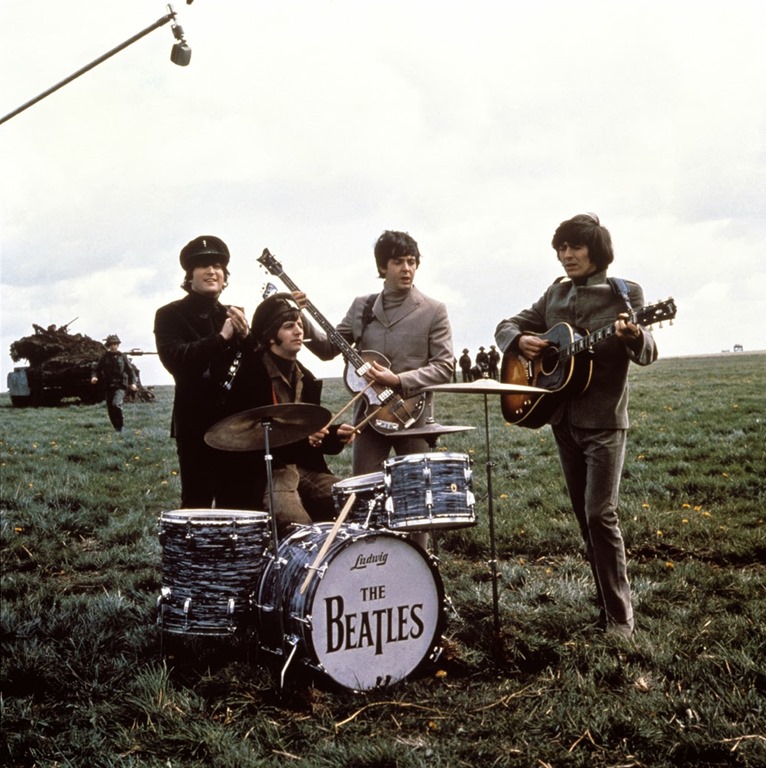
The first three days of May were spent creating a visually striking sequence on the windswept Salisbury Plain with a noticably freezing, shivering band playing “I Need You” and “The Night Before.” (In the film, this was an presented as an unorthodox outdoor recording session, so that the Beatles — a national treasure — could be protected from all the nefarious forces out to do them harm by a ring of armored tanks while cutting their latest record.)
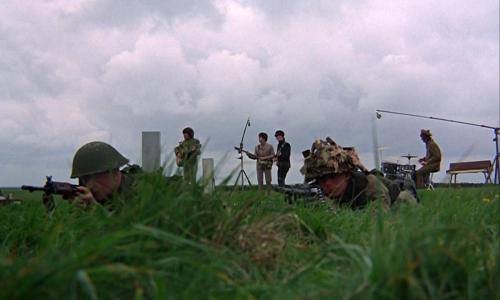
0027b927

The last few days of the shoot were spent at Cliveden House, a 19th century mansion in the Berkshire countryside, whose large, paneled rooms were a believable stand-in for the interiors of Buckingham Palace.
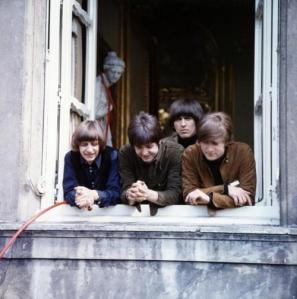
At Cliveden House

At Cliveden House

Practically as soon as “cut” was called on their last scene on May 11, the Beatles hit the recording studio again (in fact, they had begun the night before.) This time they turned their attention to the second half of the Help! album, the material that would not be in the film. Through May and June, the Beatles bounced between the Twickenham recording studio, doing post-sync sound work on the final cut of Help!, and their regular recording studio on Abbey Road, laying down “Dizzy Miss Lizzy,” “Bad Boy,” “I’m Down,” “I’ve Just Seen A Face,” “It’s Only Love,” “Act Naturally,” and “Yesterday.” The Vox Continental organ replaced the Hohner Pianet as the keyboard flavor-of-the-week during these sessions. (The Hammond organ, mellotron, and Moog were all waiting in the wings…)

They also recorded the appropriately-titled “Wait,” which would end up on Rubber Soul later in ‘65. “If You’ve Got Trouble” and “That Means A Lot” were shit-canned, until both were resurrected for the outtake-based Anthology project in the 1990s.
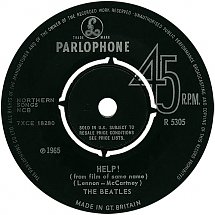
help british singleOn June 20, they steeled themselves for another round of touring the world, playing the usual 30-minute inaudible shows into a maelstrom of hysterical screams. On July 23, the “Help!” single was released (backed by “I’m Down”) to whet the public’s appetite for the upcoming film and album.

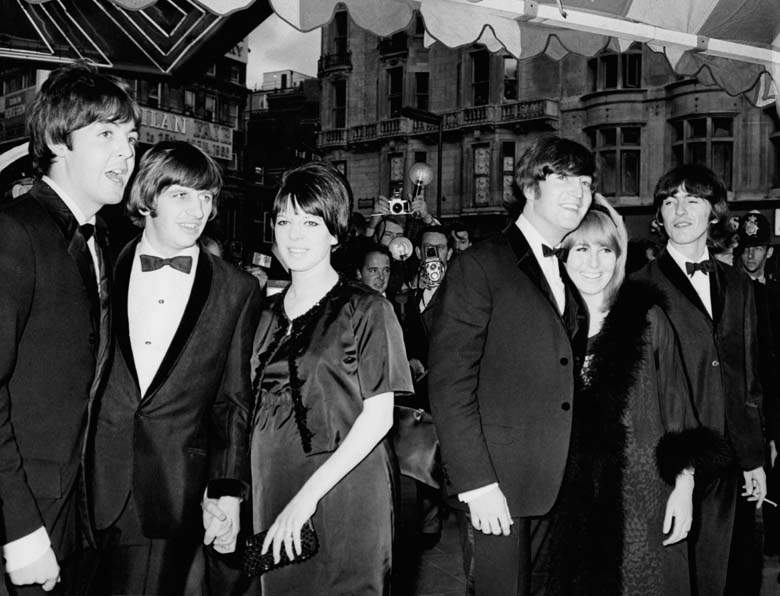
Help! received a Royal Premiere at the London Pavilion in Piccadilly Circus on July 29, 1965, the same day it hit cinemas throughout Britain. The band was on a break between the European and American legs of their tour, and were able to put on their tuxes and attend. It was a box-office hit, although critics, as we’ve seen, were noticeably more lukewarm compared to the raves they gave A Hard Day’s Night.
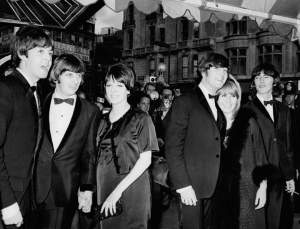
Beatles & Beatle wives at the Help! premiere

Beatles & Beatle wives at the Help! premiere

The British and American soundtrack albums were two very different entities, following the pattern established by the A Hard Day’s Night soundtrack. In the UK, both A Hard Day’s Night and Help! were released as proper Beatles albums, with two full sides of original music. The first side featured songs from the film, and the second side featured additional “album-only” songs. The only deviation from standard Beatles recording policy on the British soundtracks was the inclusion of singles, which ordinarily would not be included on a UK album. However, it was considered a commercially smart move to boost movie ticket sales by 1) having the title song of the movie released as a single at the same time as the movie/album, and 2) having the movie/album feature an already-released hit single (“Can’t Buy Me Love” in the case of A Hard Day’s Night, “Ticket To Ride” for Help!).

On the American versions, only the seven songs heard in each film were included on the A Hard Day’s Night and Help! records, spread over both sides and interspersed with sections of the orchestral scores by George Martin and Ken Thorne, respectively. Kind of a rip-off, really, to be paying full album price for what was essentially a half-album of Beatles songs. In fact, the American Help! was packaged as a “deluxe” album with a gatefold sleeve, and priced $1 higher than a standard album when it hit shelves on August 13, 1965.

George Martin was not invited back to provide the score for Help!. Martin later complained that Letser “fancied himself a musician,” and constantly second-guessed Martin’s scoring choices in an undiplomatic and overbearing manner, leading to some bitter arguments. Lester’s choice of composer Ken Thorne to score the film is not without interest, however unwelcome his presence on a supposed Beatles album might be. His score for Help! consists mostly of orchestral and Indian re-workings of the Beatles songs “A Hard Day’s Night,” “From Me To You,” and “You Can’t Do That,” along with a few snippets of classical pieces, and, naturally, the “James Bond Theme.” Continue reading

3 Comments

Filed under Film & TV, Music -- 1960s

Just Another Shi**y Pop Movie?: The Beatles’ “HELP!” Turns 50 (Part 2)

Help! had no shortage of good actors, although the Beatles would not count themselves among them…

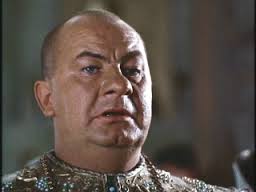
Leo McKern as Clang

Leo McKern as Clang

High Priest Clang was played by Leo McKern, a character actor with a distinctive round face and bulbous nose who already had a long theatrical and film career going back to the 1940s (including an appearance in Lester’s Running Jumping & Standing Still Film). Help! launched him to a higher level, and he went on to give notable performances in A Man For All Seasons, Ryan’s Daughter, and The Blue Lagoon. He is probably most remembered by British viewers (and the American PBS audience) as the barrister Horace Rumpole in the BBC TV series Rumpole Of The Bailey, which ran off and on from 1975 through 1992.

Eleanor Bron as Ahme

Eleanor Bron as Ahme

High Priestess Ahme was played by Eleanor Bron in her film debut. The young actress with a strikingly unconventional look was already well-known for being the first female performer in a Cambridge University Footlights revue (the previously all-male theatrical club was also the launching pad for David Frost, Peter Cook, future Pythons John Cleese, Graham Chapman, and Eric Idle, and later, Douglas Adams, Hugh Laurie, Stephen Fry, Emma Thompson, and on and on…) She made a name for herself in the emerging world of modern British satire. With fellow Footlight John Fortune, she created a male/female comedy duo act for Peter Cook’s Establishment nightclub (similar to the sort of thing Mike Nichols and Elaine May were doing in the US around the same time). She also was a performer on David Frost’s Not So Much A Programme, More A Way Of Life (1964-65). After Help!, she continued performing in film, television, stage, and radio, and authored several books.

A lot of sources say her name inspired the title of the 1966 Beatles song “Eleanor Rigby,” but this may not be so. real Eleanor Rigby has a grave in the St. Peter’s Parish Church cemetery in Liverpool. (Paul swears that he had never seen this grave, so it is probably just a remarkable coincidence.)

John Bluthal as Bhuta

John Bluthal as Bhuta

Bhuta, Clang’s long-suffering sidekick, was played by John Bluthal, who had worked with Richard Lester for many years (he was the car thief in A Hard Day’s Night), and would go on to do so for many years more. Modern audiences might recognize him as the blind street musician who owns the chimpanzee (“min-key”) in Return of the Pink Panther, or Professor Pacoli in the opening sequence of The Fifth Element.

Roy Kinnear as Algernon

Roy Kinnear as Algernon

Dr. Foot’s assistant, Algernon, was played by Roy Kinnear. (“He’s an idiot,” says Foot of Algernon. “A degree in woodworking. I ask you.”) Like Bluthal, the rotund Kinnear was a member of Lester’s “stock company,” appearing in most of his films. And like Bron, he was a veteran of Britain’s satire boom of the early Sixties, appearing in David Frost’s That Was The Week That Was in 1962-63. (Frost seemingly came up with a different satirical comedy show for every TV season.) Kinnear’s performance is quite possibly the comedic highlight of Help!. The Behm/Wood screenplay has no shortage of lines that aren’t particularly funny to read, but become funny in performance. Kinnear is a genius in this area. Some examples:

“I’m better with animals than plugs and transistors, Daddy being the local master of the hounds. That’s where I get it from, my love of animals. They trust me. [Long pause, then wistfully] I should have been in vivisection.”

“[To Ringo] You’re a drummer, eh? I’m no mean hand at the ol’ sticks-man stuff myself, you know,” [Then randomly slaps the back of an office chair for several seconds with his hands.]

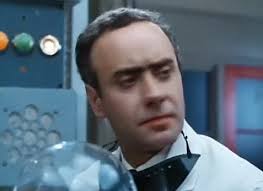
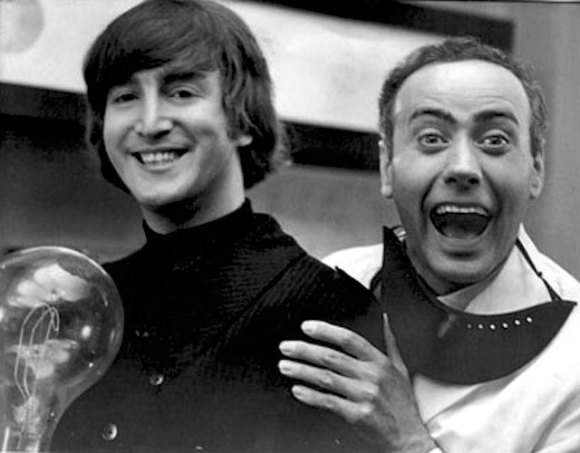
Victor Spinetti as Dr. Foot

Victor Spinetti as Dr. Foot

Everyone loves, or should love, Roy Kinnear. Most people know him as Veruca Salt’s father in 1971’s Willy Wonka And The Chocolate Factory. He never did much work in the US, but his British filmography is pretty impressive.

The mad scientist, Dr. Foot, was played by Victor Spinetti. Spinetti, described by Wikipedia as a “raconteur,” was a Welsh-born actor who did most of his work writing, directing, and acting on the theater stage (while still managing to appear in over 30 films). He appeared in a major role in A Hard Day’s Night (as the neurotic TV director), and the Beatles loved him so much they insisted he be in their second film. After Help!, he continued his association with the band, appearing on their fan-club Christmas recordings, adapting Lennon’s book of nonsense stories and verse, In His Own Write, into a stage play, and making an appearance in Magical Mystery Tour. Paul McCartney described him as “the man who makes clouds disappear,” and George Harrison told him “you’ve got to be in all our films…if you’re not in them, my mum won’t come and see them — because she fancies you.” (Mrs. Harrison was shit out of luck — like Graham Chapman, Spinetti was openly and flamboyantly gay in an era when that sort of thing was kept hidden, or, in theatrical circles, at least very discreet.)john-lennon-victor-spinetti_01

Patrick Cargill as Superintendent Gluck

Patrick Cargill as Superintendent Gluck

Another “flamboyant” British theatrical eccentric, Patrick Cargill, played Superintendent Gluck of Scotland Yard. Cargill was a fixture of British stage and television for decades, although his two popular TV shows, Father, Dear Father and The Many Wives of Patrick didn’t get much play Stateside. One of Cargill’s great moments in the film, in addition to his obsession with the word “famous,” is his insistence that he is a great mimic (“James Cagney” he proudly cites among his repertoire), followed by his attempt to do an Liverpudlian impression of Ringo over the phone. “Hullo, this is the famous Ringo speaking, gear-fab, what can I do for you as it were, gear-fab?” (“Not a bit like Cagney,” George remarks acidly.)

The Beatles began the Help! project in John Lennon’s home music room, him and Paul crafting to order the songs that would be heard in the film. They had been playing a winter residency at the historic Hammersmith Odeon theater in London from December 1964 through January 1965. In the chilly afternoons before the performances, Paul would drive out to Lennon’s country home in Weybridge and hammer out the soundtrack for the movie they knew they would be filming in a month or so. (Cynthia Lennon related in her memoir that if deadlines were particularly tight, Lennon and McCartney would collaborate over the phone.)

“We made a game of it. John and I wrote [each of] the songs within two or three hours — our ‘time allotted.’ It hardly ever took much longer than that.” (Paul McCartney.) If a song didn’t at least start to come together in the time allotted, they figured it wasn’t worth the effort and moved on.

After their winter holidays, and well-stocked with several Lennon-McCartney compositions written expressly for the film (and two Harrison songs to boot), the band arrived at EMI Studios on Abbey Road on February 15, 1965. They recorded the basic tracks for “Ticket To Ride,” “Another Girl,” and “I Need You.” Those three songs were completed the following day, along with a song that was not destined to end up the the film, “Yes It Is.”

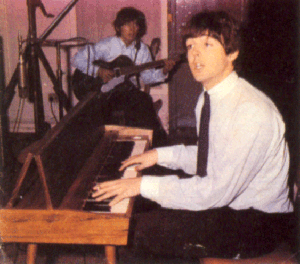
hohner pianet

McCartney plays the Pianet on “Tell Me What You See”

On February 17, “The Night Before” was recorded, along with another non-film song “You Like Me Too Much,” both heavily featuring the Hohner Pianet electric piano, which they saw one of their opening acts use at a May ’64 concert at the Prince of Wales theater. They were smitten with the instrument, and perhaps over-enthusiastically vowed to order two for their next recording session. The Pianet didn’t show up until the Help! sessions, and it was only one of them. Like a lot of the band’s new musical “toys,” the Pianet was briefly obsessed over, then virtually abandoned. (Harrison’s just-purchased volume-control guitar pedal, which was all over the previous day’s “I Need You” and “Yes It Is,” met a similar fate after the Help! sessions.)

On February 18, “You’ve Got To Hide Your Love Away” was begun and completed, along with the non-film song “Tell Me What You See” and an unreleased Lennon-McCartney song with Ringo on lead vocals, “If You’ve Got Trouble” (which was so awful, the Beatles gave up on it almost immediately, managing only a single take — though they did do a few overdubs and gave it a rough mix, just in case.)

February 19 saw the recording of “You’re Going To Lose That Girl.” The final tweaking, overdubbing, and mixing of the soundtrack songs occurred on February 20, along with an attempt at another song destined for the reject pile, “That Means A Lot.”  Continue reading

2 Comments

Filed under Film & TV, Music -- 1960s

Just Another Shi**y Pop Movie?: The Beatles’ “HELP!” Turns 50 (Part 1)

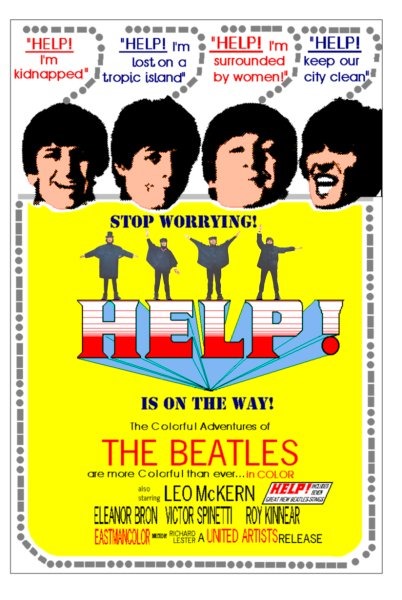
film2

The original film poster

Help! was a movie, too, you know…

Nowadays, Help! mostly conjures up thoughts of the 1965 album, its driving, brilliant title single, and its Side Two (in the UK) monster classic “Yesterday.”

But Help! was a cinematic entity as well, and the accompanying album was (mostly) intended to be its soundtrack tie-in. Help! (the movie) has always gotten short shrift from Beatles historians, film critics, and even the Beatles themselves. Oh, no one says it’s bad — everyone acknowledges it’s a hell of a lot of fun to watch — but in most Beatles books it’s dismissively given about a page-and-a-half to two pages out of the band’s whole history. This for a project that the band spent almost four months producing, and four months in those hectic Beatlemania days might as well have been four years. (Even their self-made, self-indulgent psychedelic mess of a TV movie, 1967’s Magical Mystery Tour, gets more notice and affection these days.)

There was a time when popular singers, once they’d reached a certain point of  fame, were expected to take the next step and become all-around “entertainers,” conquering other mediums, especially film and television. Guys like Bing Crosby, Frank Sinatra and Elvis Presley ended up with just as many films as albums, if not more. Following that mindset, Beatles manager Brian Epstein signed the band up for a three-picture deal with United Artists in late 1963. Their first film, A Hard Day’s Night (released July 1964) was microscopically budgeted and hastily shot with the belief that the Beatles were a temporary craze with an imminent expiration date. (UA could cancel the remaining two pictures if they chose.)o-THE-BEATLES-facebook

Help!, their second film under the UA contract, was released to British cinemas in July 1965 (a month later in the US). The British and American versions of the soundtrack (two very different animals, as we’ll see) were released a week apart in early August.

“There’s nothing in Help! to compare with…A Hard Day’s Night…This one, without sense or pattern is wham, wham, wham all the way…Some of it is surprising. Richard Lester, the director, has played some witty pranks with his camera. There are some fetching title and color gags, and a lot of amusing tricks achieved with old silent film techniques…The boys themselves are exuberant and uninhibited in their own genial way. They just become awfully redundant and—dare I say it?—dull.” (Original New York Times review by Bosley Crowther, 1965.)

Help!

“The script…isn’t a complete failure, especially for fans of British comedies of the 1960s. There’s some really great funny business between the group…But overall, the story can’t hold a candle to the behind-the-scenes look from A Hard Day’s Night. The issue with Help! is its complete rejection of any realistic element – the moment you see the Beatles living in one large house, you know this is a cartoon world with no sense of reality…Help! turns the zaniness to 11 and it’s just too much to make for a good movie….It makes it pretty clear that while the Beatles were geniuses at music, acting was not their forte. The songs written for Help! are some of the group’s best…but the dated stuff in between make it hard to watch on a regular basis…” (Daniel S. Levine, film critic for The Celebrity Cafe, and evidently a hater of everything non-realistic.)

“I enjoyed filming it. I’m sort of satisfied, but not smug about it. It’ll do. There’s good photography in it. There’s some good actors in it — not us, because we don’t act, we just do what we can.” (John Lennon, damning it with faint praise around the time of its release).

“Looking back on it, Help! isn’t such a bad film. It’s more of a fun romp, but I think that A Hard Day’s Night is the better of the two…we’d really tried to get involved and learn the script for A Hard Day’s Night, [but] by the time Help! came along we were taking it as a bit of a joke. I’m not sure anyone ever knew the script, I think we used to learn it on the way to the set.” (Paul McCartney.) 3834949

Yes, Help! will always suffer in comparison to A Hard Day’s Night, a film-buff favorite. That first film was cinema-verite style look at a fictionalized “two days in the life of” the world’s greatest pop group. Its gritty, black & white cinematography, documentary-style handheld camera work, jittery editing, and energetic performances from the Beatles still in their first flush of mega-stardom make A Hard Day’s Night a bona fide cinema classic. (The music is pretty good, too.)

The lion’s share of credit goes to director Richard Lester, but accolades are also deserved by screenwriter Alun Owen, like the Beatles a native of Liverpool, who traveled with the band on their November 1963 mini-tour of Ireland, and incorporated their personalities and witticisms into his Oscar-nominated script. Also contributing to its success were Beatles’ recording producer George Martin, who composed the orchestral score, and film producer Walter Shenson of United Artists, who stayed hands-off and allowed Lester, Owen, Martin, and the Beatles to create something that wasn’t just “another shitty pop movie” (Lennon’s words) like the kind Presley was cranking out in bulk at the time. Mere days after the Beatles stood on Ed Sullivan’s stage making their iconic US TV debut, they were in front of Lester’s cameras to get the film in the can before their next round of touring…

Beatles-help-0513-banner

SIDE NOTE: The Beatles’ schedule in their first three years or so of worldwide fame was almost inhumanly grueling, as a glance at Mark Lewisohn’s Complete Beatles Chronicles will tell you. Consider this: the last day of filming on A Hard Day’s Night was April 24. On the 25th, they were in rehearsals for their ITV TV special Around The Beatles. On the 26th, they played at the New Musical Express Poll-Winners concert. The 27 and 28th was more rehearsing and then taping Around The Beatles. The 29th and 30th were concerts up in Scotland. May 1st saw them back in London recording an appearance for the BBC. And so on…

Continue reading

Leave a comment

Filed under Film & TV, Music -- 1960s

The Holy Bee Recommends, #12: “Smokey And The Bandit”

I’ve already written a few pieces on life in my college apartment awhile back, and every once in awhile, something comes along that takes me right back to those days. The other night, I came across a certain flick while channel-flipping…

Every college apartment has those one or two movies that are almost nightly viewing…the Big Lebowskis, the Monty Python & The Holy Grails…where the dialogue, gestures, even facial expressions become a treasure trove of inside jokes and the secret language of roommates. For me and my college roommates, it was 1977’s Smokey And The Bandit. We had a VHS copy with warbly sound and a discolored rainbow effect down one side of the screen, but it did its duty, night after night. Individual lines of dialogue that made no sense outside of the immediate context of the film came out of our mouths to the exclusion of actual conversation:

“Lemme have a Diablo sammich and a Dr. Pepper and make it fast I’m in a goddamn hurry!”

“Hold up on that car wash, gentlemen.”

“What we gonna do, kidnap the pope or somethin’?” (Proper response: “How’d ya guess?”)

“If they’d-a cremated that sumbitch, I’d be kicking that Mr. Bandit’s ass around the moon by now…”

“What-I-owe?” (while pointing at someone with both the index finger and pinkie extended.)

“I’m gonna barbecue yo’ ass in MOLASSES!!”

“Honey hush.”

“Thank you, nice lady.”

Each of those lines, and many, many others, meant something to us in Apartment-speak. (Respectively, “I’m hungry,” “stop what you’re doing,” “what’s your plan/idea?” “this traffic jam sucks,” “how much do I owe you?” “I’m very upset with you,” “oh my goodness,” and, uh, “thank you, nice lady.”) Again, there were many others. I almost considered compiling a glossary for this piece.

The film’s story is a simple premise — for reasons that don’t seem to extendSmokeyBanditposter beyond their own twisted amusement and taste for sub-par beer, millionaire Texans Big Enos Burdette and his adult-but-diminutive son Little Enos Burdette travel through the South offering truck drivers (“gearjammers”) exorbitant amounts of cash to haul Coors beer outside of its legal distribution zone. In the 1970s, Coors was available only west of the Mississippi, and people who couldn’t get it became obsessed with it, despite the fact it is very, very shitty beer. (I’d like to see a movie where someone has to haul a truckload of White Castle sliders to California.) They make the offer to “truck-driving legend” Bo “Bandit” Darville. (“Looks like a legend and an out-of-work bum look a lot alike, Daddy” Little Enos observes.) According to the terms of the wager, Bandit must travel to Texarkana, Texas, acquire his cargo, and return to Atlanta in 28 hours. He eagerly accepts, enlisting his pal Cledus “Snowman” Snow to actually drive the truck, while he speeds around in a flashy Pontiac Trans-Am as a “blocker,” drawing the attention of any law enforcement in the vicinity away from the truck and its illicit load. Along the way, he picks up Carrie, a runaway bride. Add to this mix a dogged, vengeful Texas sheriff who fanatically tails him far beyond his jurisdiction. Revving engines, squealing tires, high-speed chases, and crashed police cars ensue as the characters exchange witticisms via CB radio.

Veteran stunt coordinator & driver Hal Needham made his directorial debut with this film, and he never bettered it (not even with his 1986 BMX epic Rad). The project was originally meant to be a low-budget B-movie targeted to rural drive-ins, capitalizing on the CB radio fad and truck-driver worship sweeping the country in the mid-1970s. (You can start singing “Convoy” to yourself now. And the term “smokey” was CB slang for a state policeman, due to their Smokey the Bear-style park ranger hats.) It would feature country singer and part-time actor Jerry Reed as the titular Bandit…until Reed’s friend, Gator co-star, and bona fide celebrity Burt Reynolds expressed an interest in starring. Universal Studios thought that was a great idea. The budget was duly inflated, Reed got bumped to the sidekick role, and it was released as a main feature in theaters across the country, to critical indifference and massive popular success. The only film to make more money that year was Star Wars. Continue reading

1 Comment

Filed under Film & TV, The Holy Bee Recommends