Category Archives: Film & TV

Act Naturally: The Films of the Solo Beatles (Part 6)

“To my mind I’ve already proved I can act. The trouble was that I used to approach acting like a rock ‘n’ roller. I was getting parts simply because of who I was. Geezers would say what a great idea it was to have a Beatle in their movie. And the fact that I wanted to act, that I felt I could act, wasn’t really the issue. But no one is going to offer Ringo Starr a top role these days just because I used to be one of the Beatles. I’ve got to be able to do the job…Maybe Caveman is the dawn of a new era for me.”

— Ringo Starr, 1980

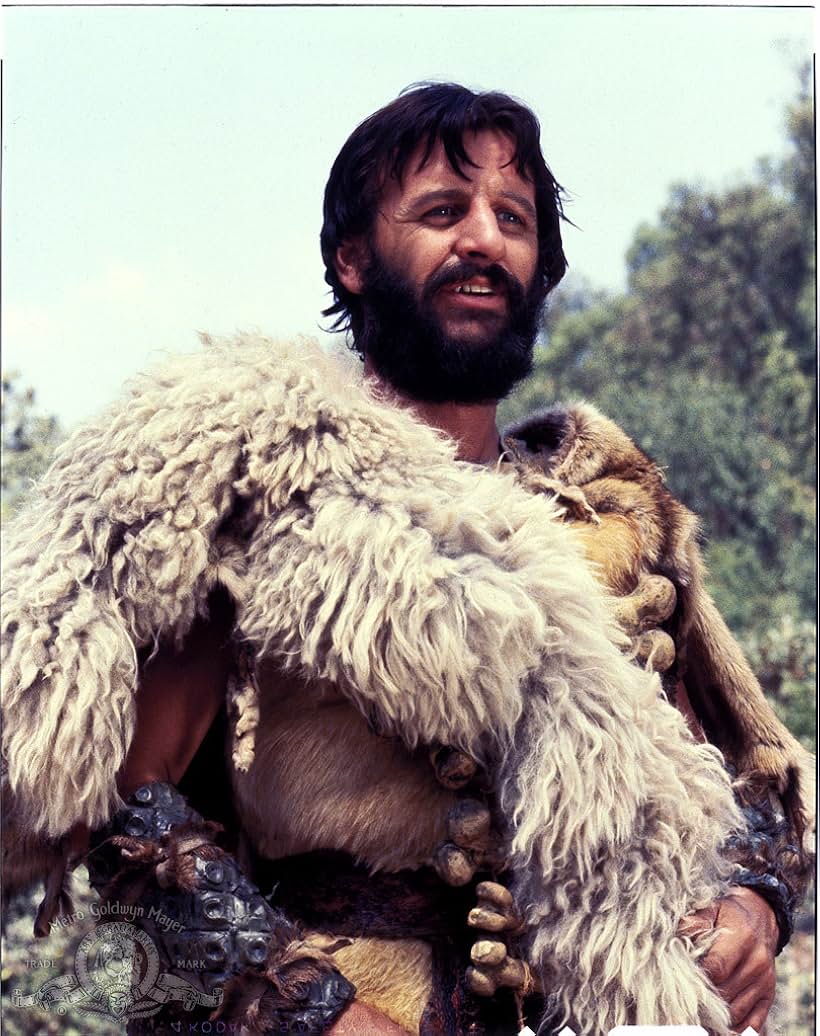
Caveman — the movie that Ringo hoped would finally launch his career as a…well, maybe not “Serious Actor,” but at least someone capable of playing a leading role — would be the feature directing debut of Carl Gottlieb. It was intended to be an homage to B-grade humans-coexisting-with-dinosaurs schlock like One Million Years B.C. and When Dinosaurs Ruled the Earth, and to the silent slapstick of Chaplin and Keaton (who had both done comic “caveman” routines). The concept was not without promise, and Gottlieb had an impressive resume. Ringo had good reason to be hopeful.

Carl Gottlieb

Carl Gottlieb got his start in the 1964 iteration of the San Francisco improv troupe The Committee, along with guys like Howard Hesseman and Peter Bonerz. They transferred to L.A. later in the 60s, and Gottlieb moved on to TV writing before the decade was out. He scored an Emmy for writing for the controversial Smothers Brothers Comedy Hour in 1969. In addition to penning scripts for The Bob Newhart Show, All in the Family, and The Odd Couple as the ‘70s commenced, he also maintained a minor presence in the acting world, most notably in the small but dryly funny role as anesthesiologist Capt. “Ugly John” Black in Robert Altman’s 1970 feature film version of MASH. 

Lightning really struck for Gottlieb in 1974 when his friend Steven Spielberg (it helps to know the right people) hired him to do a quick polish on Peter Benchley’s screenplay for Jaws. Benchley, adapting his own novel, had created a screenplay that was serviceable but not great. The characters lacked dimension and the tone was humorless and relentlessly dark. What was intended to be a one-week job blossomed into Gottlieb traveling to the Martha’s Vineyard location for the duration of the production and doing an entire re-write in close collaboration with Spielberg while shooting was underway. (He also appeared in the film as Meadows the newspaper editor.) Gottlieb’s version was a huge improvement, with likeable characters and a subtle touch of humor. Jaws went on to be the first true summer blockbuster in 1975. 

Another feather in Gottlieb’s Jaws cap was his publication that same year of The Jaws Log, a book chronicling the film’s difficult production from a first-hand perspective. It became a behind-the-scenes classic in its own right among film buffs (a copy has graced the Holy Bee’s shelf since childhood), and has been updated and re-published multiple times.

Everyone’s heard the Hollywood cliche quote — “…but what I really want to do is direct.” Gottlieb was no exception, and got his chance when Steve Martin tapped him to direct his short film The Absent-Minded Waiter in 1977, which was nominated for an Academy Award. This led to him co-writing Martin’s first starring feature The Jerk (1979).

Around 1977 or ‘78, a movie producer named Lawrence Turman (The Graduate) was inspired by seeing comedian Buddy Hackett play a caveman in a Tonight Show sketch. “As a kid, I loved the film One Million B.C. [the 1940 version with Victor Mature], and the thought of doing a picture like that, using the same wardrobe and the same language, but played for laughs, seemed like a great idea.”

Turman and his producing partner David Foster hired Gottlieb and Rudy De Luca (fellow TV writer and frequent Mel Brooks collaborator) to do a screenplay based on this idea. Trusting Gottlieb’s comedy instincts, the producers decided to have him direct as well. Although they felt Gottlieb was on solid ground humor-wise, they hedged their bets when it came to the rookie director’s handling of visual effects. They brought in stop-motion guru Jim Danforth, who had done the effects on Caveman’s inspiration One Million Years B.C. and similar films, to direct all the sequences with the dinosaurs. He would be credited as a co-director with Gottlieb. 

“When we wrote the movie, it required a clever but small person, not someone with an imposing stature,” said Gottlieb. “We wrote it without an actor in mind, and then, when the screenplay was finished, we were looking at Dudley Moore or Ringo…Those were the choices. Dudley was unavailable and we went with Ringo because we met with him and found out he was interested in doing it…I told him this was not like anything he’s done before. It didn’t depend on his being a Beatle or a famous person — it’s actually an odd, funny little acting part.”

Filming began in February 1980 in Sierra de Organos National Park outside of Durango, Mexico. Joining Ringo in the cast were Dennis Quaid, Shelley Long (two years before Cheers), football legend John Matuszak, former Bond girl Barbara Bach (The Spy Who Loved Me), and veteran comic actors Avery Schreiber and Jack Gilford (if you don’t know their names, you know their faces).

Ringo, Avery Schreiber, and John Matuszak on location

Armed federales surrounded the location each day to protect the production from pillaging by the local bandits — and to make sure the visiting Americans had no narcotics, meaning the cocaine-loving Ringo had to do without, so he doubled down on his alcohol intake. He brought along his friend Keith Allison to be his “minder,” making sure he made it on set each morning in relatively decent shape after long nights in Mexican cantinas.

About two-thirds of the way through production, word came through from the Director’s Guild that Jim Danforth would not be allowed a co-director’s credit for directing the dinosaur sequences. He walked off the project. Gottlieb would receive sole credit as director. Danforth declined any onscreen credit, so visual effects are credited to his partner David Allen (who would later go on to do some great stuff for George Lucas’s effects company Industrial Light & Magic). 
The bulk of the location work was done at Sierra de Organos, followed by a week in Puerto Vallarta, and concluding with soundstage work at Churubusco Studios in Mexico City. As production proceeded, Ringo and castmate Barbara Bach found themselves in a developing relationship. After rehearsing a comedic “seduction” sequence with each other the night before the scene was shot, Ringo lingered in Bach’s hotel room after everyone else had left, and the couple showed up the next morning hand-in-hand. Bach was unawed by Ringo’s storied past. “I was never that much of a Beatles fan, which made it easier,” Bach said. “I just treated him like everyone else.”

Despite the credit dust-up with Danforth and a few queasy mornings with hungover cast members, shooting went smoothly and was all over within six weeks. Everyone had gotten along famously and went home satisfied with the results. 

CAVEMAN

Released: April 17, 1981

Director: Carl Gottlieb

Producers: Lawrence Turman, David Foster

Screenwriters: Carl Gottlieb, Rudy De Luca

Studio: United Artists

Cast: Ringo Starr, Barbara Bach, Dennis Quaid, Shelley Long, John Matuszak, Avery Schrieber, Jack Gilford, Evan Kim, Ed Greenberg, Cork Hubbert, Mark King, Carl Lumbly

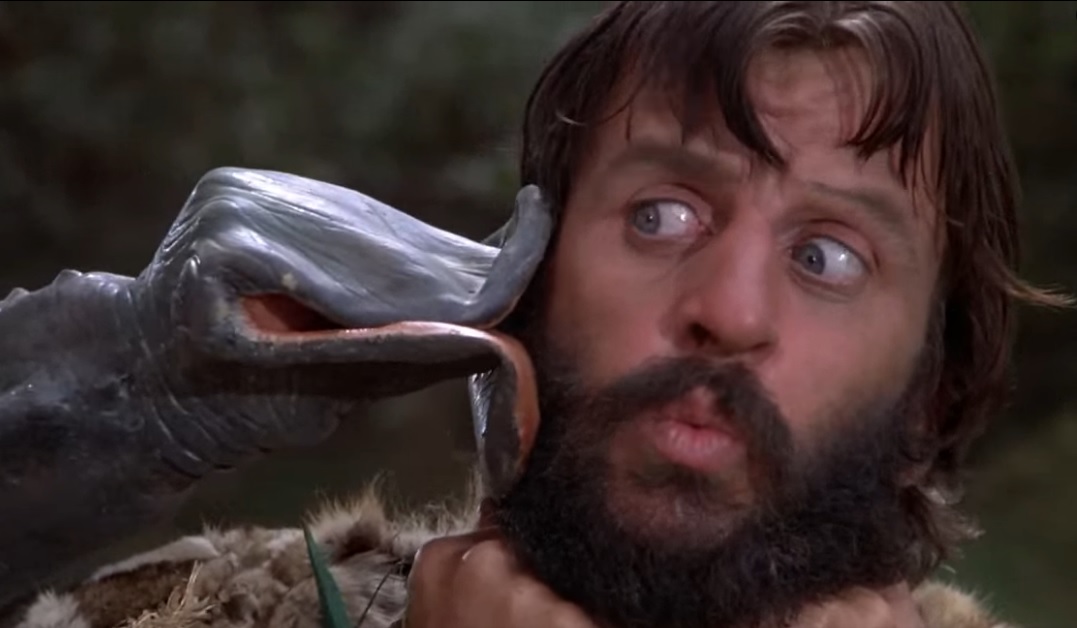
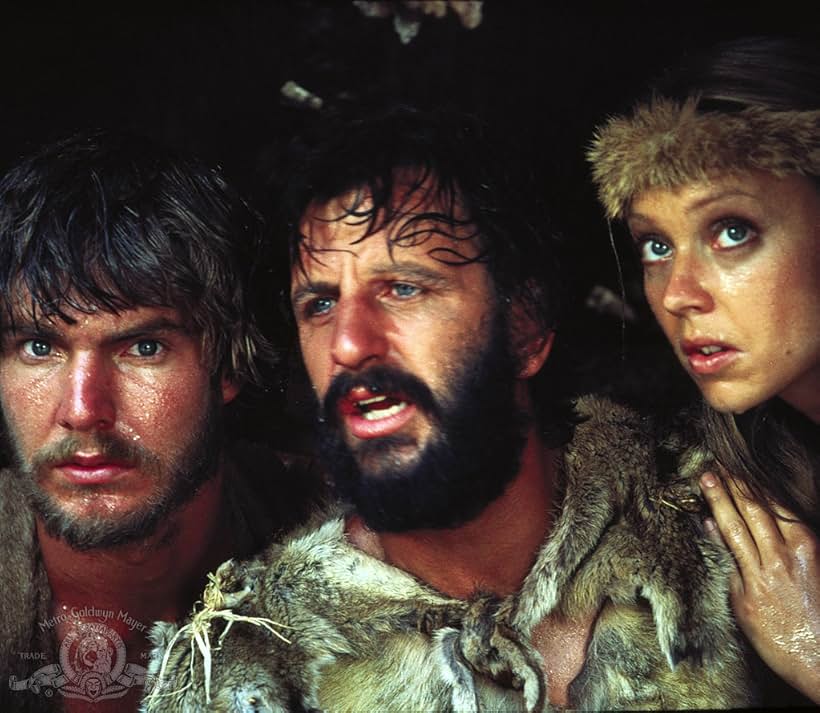
Caveman tells the story of Atouk (Ringo), a meek and put-upon prehistoric cave dweller in the year “one zillion B.C.” The leader of his tribe is Tonda (John Matuszak), a bullying alpha male who forces his food-gathering expedition to abandon slow-witted Lar (Dennis Quaid) when he is injured in a dinosaur attack triggered by Atouk. Tonda also has a beautiful mate Lana (Barbara Bach), with whom Atouk is secretly in love. Atouk is already on the outs with the tribe for bungling the expedition, and finds himself cast out entirely when he is caught attempting to “seduce” Lana (after drugging her with sleep-inducing berries, which is pretty creepy).

Out in the wilderness, Atouk is reunited with Lar, and the two begin gathering other outcasts together into a “misfit” tribe, beginning with Tala (Shelley Long) and her blind father Gog (Jack Gilford), and eventually including a dwarf, a gay couple, and Nook (Evan Kim), who happens to speak perfect modern English. (The rest of the misfits find him totally incomprehensible.) The misfit tribe’s discoveries include standing erect, music, fire, and cooking. They also create weapons and armor, allowing them to strike up a rivalry with Atouk’s original tribe. There are multiple encounters with Danforth-designed dinosaurs, and a run-in with the Abominable Snowman before the whole thing ends up with Tonda vanquished and Atouk being acknowledged as leader of the combined tribes. Atouk ends up choosing Tala over the shallow Lana, and “they lived happily ever after” as the onscreen words tell us. 

Whether or not it was Gottlieb’s intent, what he ended up with is essentially a stoner comedy. The broad, basic humor is the textbook definition of “sophomoric” and perhaps very appealing to someone watching this glazed-over high at two in the morning. The film is reaching for a kind of sweet silliness, but too often comes off as just really, really dumb. It’s almost as though Gottlieb and De Luca secretly passed off their screenwriting duties to a group of fifth-grade boys. Falling into something (water or ideally something grosser), or simply falling over, is considered the pinnacle of comedy. Cartoon sound effects are employed to an extreme degree. Fart jokes and poop jokes abound.

The one element that seems to work well is that the dialogue consists of about fifteen nonsense words in “cavespeak,” so most of the acting is done through grunts, pantomime, and facial expressions…and the performers are clearly having a great time working that way. Dialogue was always Ringo’s Achilles’ heel, and now he could eschew his flat Liverpool monotone and rely on his natural physicality and expressive eyes. Shelley Long also came off very well and is kind of adorable, not yet associated with her uptight Diane Chambers character. In fact, the only one who seems a little stiff and hesitant is Barbara Bach. The animated dinosaurs are actually pretty charming, and for the most part steal the show. 

When all is said and done, Caveman is a harmless little film that feels interminably long at barely 90 minutes. Despite Lawrence Turman’s moment of inspiration, perhaps “comedic cavemen” is a concept best left to Buddy Hackett sketches and Charlie Chaplin shorts.
The reviews were surprisingly kind. The New York Times called it “nicely whimsical,” and the Village Voice went so far as to use the term “enchanting.” Newsday went with “infantile, but also playful and appealingly good-natured.” The Washington Post was a little more realistic: “Priceless it ain’t, but if the kids are determined to enjoy it, the brain damage should be minimal.” Ringo was also singled out for praise, with many comparing his performance favorably with his Beatles films. It generated a mediocre $16 million at the box office, but the budget was only $6.5 million.

So what happened? No one seems to know. Despite the good reviews for his performance, and despite the fact that, all things considered, Caveman was far from a disaster, Ringo was never offered another major film role again.

Carl Gottlieb went on to direct two sequences in the 1987 cult anthology film Amazon Women on the Moon. Each of his sequences perfectly encapsulates the two Gottlieb directing styles — “Pethouse Video” was obvious and crass, and “Son of the Invisible Man” was subtle and clever. (He wrote neither.) He hasn’t directed since, nor has he written anything of note since the ‘80s.

Ten days after Caveman’s release, Ringo and Barbara Bach were married at Marylebone Town Hall in London. Now happily (if blearily) hitched, he was still barely keeping his head above water career-wise. No movie producers were calling him. His most recent solo album, Stop and Smell the Roses (October 1981) sold about six copies and is now widely regarded as one of the worst of all Beatle solo albums. He was dropped by yet another record label. His heavy drinking continued unabated, and his new spouse joined in. “Every couple of months she’d try and straighten us out,” Ringo said. “But then we’d fall right back in the trap.”  

His next — and to date, final — movie role was handed to him by an old friend: Paul McCartney. He was to play a drummer in Paul’s band. Not too much of a stretch.

Continue reading

Leave a comment

Filed under Film & TV

Act Naturally: The Films of the Solo Beatles (Part 5)

“Ringo liked films, but I think he just liked being in a Hollywood movie sort of world…he didn’t stop to say, ‘Hang on, I’m Ringo Starr. I have to choose carefully.’ He just did [the films] because they were good fun. Having a little laugh, you know? You get doomed for that, forever. People remember them.”

–Ray Connolly, That’ll Be The Day screenwriter

Franz Liszt

Ringo had a fairly successful follow-up album to 1973’s smash hit Ringo with 1974’s Goodnight Vienna. It reached a respectable #8 on the Billboard album chart, and its accompanying single “No No Song” got to #3 on the singles chart. But he couldn’t resist the allure of hanging out and having a little laugh on a film set.

It’s been so long since I left this website series hanging, I had to re-watch Lisztomania. The things I do…

The term “Lisztomania” was coined by German writer Heinrich Heine to describe the effect composer and pianist Franz Liszt (1811-1886) had on an audience — mostly an audience of women. They would leap to their feet, scream, and sometimes faint. Liszt would rile them up, pounding out aggressive arpeggios, tossing his sweat-soaked hair, and distributing tokens such as scarves and gloves into the ecstatic crowd. It was the exact same effect that would crop up over a hundred years later in response to Elvis Presely and the Beatles. 

Franz Liszt was the first rock star. 

Director Ken Russell spun that single idea into a film that was as tedious as it was tawdry, its incoherence masquerading as “surrealism.”

But that’s Ken Russell for you.

“Lisztomania” cartoon by Adolf Brennglas, 1842

Franz Liszt was born in Hungary (thanks to some later border shifts, the town of his birth is now in Austria) and was considered a child prodigy. He studied under Antonio Salieri (yes, the Amadeus guy) and was said to have impressed both Beethoven and Schubert when he made his performing debut in Vienna at age 11. He subsequently lived for many years in Paris, composing, performing, and tutoring. He became personal friends (or sometimes “frenemies”) with fellow composers Felix Mendelssohn, Robert Schumann, Frederic Chopin, and most notably, Richard Wagner.

Comtesse Marie d’Agoult

As he grew to adulthood, his chiseled features and flowing locks earned him many female admirers, but his reputation as a rabid womanizer was probably a little exaggerated. He was something of a serial monogamist, engaging in safe, long-term affairs with titled women in arranged marriages to indifferent (read: probably homosexual) husbands. One of these relationships, with Comtesse Marie d’Agoult, produced three children in the 1830s — daughter Blandine, son Daniel, and daughter Cosima, who later married composers Hans von Bulow and Richard Wagner in quick succession.

The “Lisztomania” period made up only a small portion of Liszt’s remarkable life. For seven years (1841-1848), he barnstormed the concert halls of Europe as a traveling virtuoso, selling sex appeal as much as music. He then quit performing to focus on composition, publishing the first of his Hungarian Rhapsodies and Liebesträume (“Dreams of Love”) in the early 1850s. He became the court conductor and choirmaster in the city of Weimar, Germany, a very settled-down and respectable position.

Princess Carolyne zu Sayn-Wittgenstein

Liszt finally decided to marry for the first time to Princess Carolyne zu Sayn-Wittgenstein — who was, as usual, already married to someone else. He and Princess Carolyne spent over a decade trying to get her marriage annulled, to no avail. Even a sympathetic audience with Pope Pius IX in 1860 did not yield positive results in the end.

Pius IX (1792-1878) is known to history as the longest-serving pontiff. His leadership of the Catholic Church spanned 32 years, from 1846 to his death in 1878. He was initially a progressive supporter of church reform, but radical events such as the Revolutions of 1848 turned him more conservative. He orchestrated the literal kidnapping of a Jewish boy on the basis that he had been secretly baptized by a servant. Edgardo Mortara lived under “papal protection” until adulthood, despite the desperate pleas of his parents. The story brought waves of outrage, and contributed to Pius IX’s loss of the Papal States (a region of central Italy which the Pope had ruled directly as a sovereign monarch since 756).

Pope Pius IX

Liszt and the princess gave up their attempts at matrimony. Liszt decided to become a monk, joining the Third Order of Saint Francis. He received a tonsure, and became Abbe Liszt. He still composed on a small piano in his monastery quarters. After almost a decade of cloistered life, Liszt returned to the wider world and bounced between Rome, Weimar, and Budapest, teaching master classes in piano. He never fully recovered from a fall down a staircase in 1881, and died five years later at the age of 74.

All of this is thrown into a cinematic blender by Ken Russell, along with celestial rocket ships, Nazis, vampires, superhero costumes, Nietzsche references, rayguns, and a ten-foot penis. (Not for nothing was one of Russell’s biographies titled Phallic Frenzy: Ken Russell and His Films.) “My film isn’t biography,” said Russell in the understatement of the year. “It comes from the things I feel when I listen to the music of Wagner and Liszt and when I think about their lives.” 

Ken Russell was an authentic English eccentric. Born in 1927, his childhood ambition was to be a ballet dancer. Rather than sell shoes in his emotionally abusive father’s shop, Russell opted for disastrous stints in the Royal Naval College and the British Merchant Navy. When he washed out of the latter, he reluctantly returned to the parental home. One day his mother and a friend came home early and discovered a teenaged Russell frolicking around the house in the nude to Stravinsky’s Rites of Spring. There were embarrassed faces all around, and an ultimatum — sell shoes or join the RAF. It was an easy choice.

After being discharged from the RAF in 1948, Russell decided to make his childhood dreams come true. He was actually accepted into the International Ballet School in South Kensington, mostly because he was one of the few male applicants. It didn’t take long for Russell to discover the flaw in his dream — he was a terrible ballet dancer. The Institute patiently kept him on for four years before they finally, and no doubt with a certain degree of exasperation, asked him to leave.

Young Ken Russell

After making ends meet as a freelance photographer and a bit player in touring musical comedies, Russell was hired by the BBC to work in their documentary department based on a few independent short films he had made. One of his early assignments was a documentary on the composer Sergei Prokofiev.

The BBC had a very strict policy regarding documentaries. No actors, no “dramatic re-enactments.” It was to be only narration played over authentic photos, talking-head interviews with experts in the field, and, if available, archival footage. The iconoclastic Russell kicked against this policy from the get-go, and went ahead and inserted brief bits recreated by actors — hands on a keyboard, a reflection in a pond, that sort of thing. Despite admonishment from the BBC suits, he took it even further with his next composer biography on Edward Elgar. This was the beginning of a leitmotif in Russell’s career — a series of biographical films on composers. From relatively staid documentary works for BBC arts shows like Omnibus and Monitor in the 1960s to the twisted, overbaked cinematic explosions of the 1970s, Russell always returned to presenting the lives of composers.

Russell made his big cinematic breakthrough with an acclaimed adaptation of D.H. Lawrence’s Women in Love in 1969. Conventional compared to his later works, Women in Love still broke boundaries, featuring the first full frontal male nudity in a mainstream film. The naked wrestling match between Alan Bates and Oliver Reed certainly got the film a lot of attention…and repeat viewing. His next two composer biographies, The Music Lovers (1971) about Tchaikovsky, and Mahler (1974) reflected Russell’s increasing self-indulgence and reliance on surrealism. “More interested in impressionistic history than literal truths,” is how Russell biographer Joseph Lanza generously put it. 

Russell’s flamboyant, overblown style was already familiar enough to be parodied by Monty Python in 1972.

To be fair, Russell always did meticulous research and did throw in small nuggets of historical accuracy as long as they were suitably weird. For example, Princess Carolyne really did smoke cigars and really did write a 24-volume work entitled The Inward Reasons for the Church’s Outward Weaknesses as depicted in Lisztomania.

Mahler was the first of a proposed six-film series on composers to be written and directed by Russell and produced by David Puttnam’s company Goodtimes Enterprises. It was to be followed by a film about Franz Liszt, for which Russell initially envisioned Mick Jagger as the star.

Roger Daltrey

Before he jumped into the Liszt biopic, Russell decided he wanted to adapt the Who’s “rock opera” Tommy. The work was first released by the Who as a concept album in 1969, and performed by them as a three-piece band in opera halls as well as the usual rock venues across Europe and America. Classical music purist Russell was no fan of rock, but hearing the London Symphony Orchestra perform the Tommy material in true classical style in 1972 piqued his interest. He got in touch with Who guitarist/songwriter Pete Townshend, and the two hit it off and agreed to collaborate. It seemed only natural to cast Who lead singer Roger Daltrey as the title character. Tommy (1975) was a critical and box-office success, although I suspect the Who’s music and appearances by Elton John, Tina Turner, and Eric Clapton were more of a draw than Russell’s typical high-camp hallucinatory style.

At some point during the production of Tommy, Russell made a mental switch from Jagger to Daltrey for the role of Franz Liszt, and announced him as the lead in what was now called Lisztomania a month after Tommy had wrapped. Russell felt that Lisztomania would be a true companion piece to Tommy, exploring similar themes.

Continue reading
Leave a comment

Filed under Film & TV, Pop Culture

Act Naturally: The Films of the Solo Beatles (Part 4)

Prologue: Ringo As Director?

The Beatles’ many-faceted multimedia company, Apple Corps, continued in spite of the split between its four creators. Like all the ex-Beatles, Paul was contractually tied to Apple Records (via Capitol) through the end of 1975, but otherwise wanted nothing to do with the business that had driven such a wedge between himself and the other three. John, George, and Ringo continued to use Apple as a creative playground for the next few years.

Since the Beatles’ break-up, Apple Films had managed to release two George Harrison-produced documentaries: his own concert film, The Concert for Bangladesh, and an exploration of the music of Ravi Shankar, Raga. Apple Films had been nominally under the supervision of Denis O’Dell (also producer of The Magic Christian, see Part 2) since 1968, and it’s only natural that the movie-minded Ringo gravitated to this subsidiary of the company. O’Dell had one foot out the door by 1971, and Ringo pretty much took over, using the Apple Films office as his personal headquarters and clubhouse. Joined by the ever-present Keith Moon and Harry Nilsson, the Apple Films office on St. James Street often served as the starting point for a long night of carousing around the nightclubs of London. 

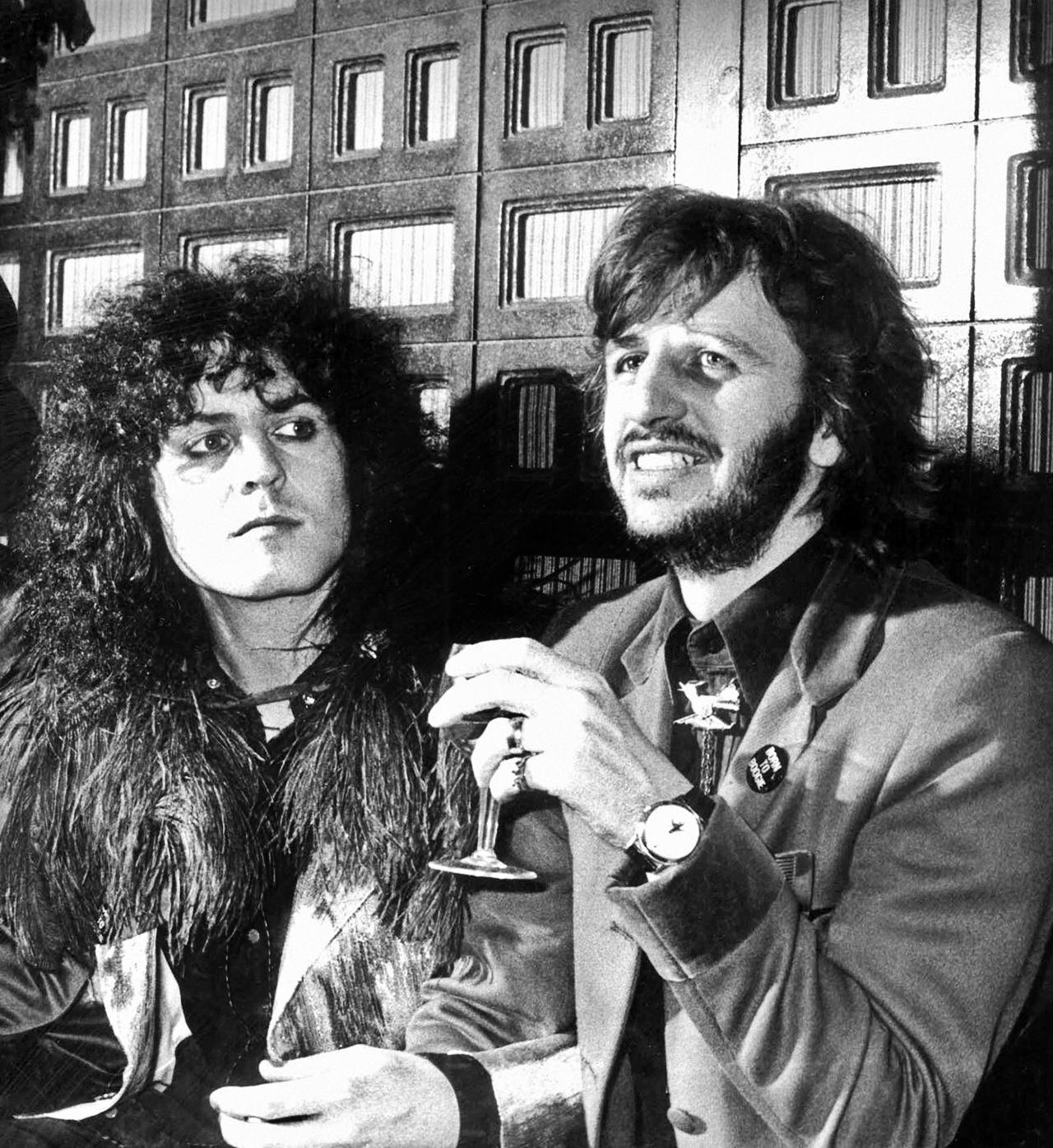
Sometime in the second half of ‘71, Ringo made the acquaintance of Marc Bolan, frontman of the band T. Rex. Their single “Get It On” had burned up the U.K. charts that summer, and their classic album Electric Warrior — often credited as the first “glam rock” album — was about to drop. They were riding a crest of huge popularity in Britain (described in the music press at the time as “T. Rextasy”).

“I don’t know how he got in there,” says Ringo, whose memories of that era are understandably fuzzy. Ringo was charmed by the elfin, enigmatic songwriter and he was quickly included in the hard-partying drummer’s social circle. (The title and lyrics of Ringo’s 1972 single “Back Off Boogaloo” were inspired by Bolan’s cheery space-hippie nonsense sayings.)

When T. Rex played two shows to a combined 20,000 Rextatic fans at one of Britain’s largest venues, Wembley Arena (then known as “Empire Pool”), on March 18, 1972, Ringo decided to hire a film crew to capture the event for posterity. He eagerly clambered down into the photographer’s pit at the front of the stage and began calling the shots, even occasionally operating a film camera himself. The additional footage in the DVD release of the resuting film Born To Boogie shows that Ringo captured plenty of useable footage for a traditional concert film — but, alas, he had other ideas.

Ringo switched hats from documentarian to surrealist. “My theory about filming concerts is you can’t capture the atmosphere that was in the hall,” he explained. “So I needed to do more.” He and Bolan concocted a couple of fantasy sequences to make the film more of a visual experience. The scenes were both heavily inspired by the Beatles’ own hot mess of a 1967 TV movie Magical Mystery Tour. One, set on the runway at Denham Aerodrome, seemed pretty improvised — Bolan goofing around in a red convertible, joined by a Ringo in a mouse suit and an angry little person in a Dracula cape who proceeds to eat various parts of the convertible. The other sequence showed evidence of more planning — a fancy tea party turned carnivorous hamburger cookout, complete with a tuxedoed waiter, violinists, and nuns. Bolan as the Mad Hatter treats us to gentle acoustic versions of “Jeepster” and “Get It On” (neither of which work in this format), along with two other songs. This particular sequence was filmed around the lakes of John Lennon’s massive estate, Tittenhurst Park. (John had moved to the U.S. the previous August, and Ringo was designated as the property’s caretaker, until he bought it outright in 1973. Tittenhurst Park was also the setting for the last Beatles photo session in 1969 and John’s “Imagine” video in 1971.)

The fantasy sequences were exactly as wretched as you would expect, and show why surrealism shouldn’t be left in the hands of self-indulgent, drug-addled musicians. It’s always the same old sub-Fellini shit, featuring a lot of nuns, little people, and undercranking

A non-concert segment that works slightly better is a jam session on a set heavily dressed with stuffed circus animals, giant toothbrushes, and tons of reflective foil paper filmed in Tittenhurst Park’s Ascot Studios. Joining T. Rex for renditions of Little Richard’s “Tutti Frutti” and their own “Children of the Revolution” are Elton John on piano, and Ringo on a second set of drums when he’s not randomly wandering in and out of shots in a clown costume and make-up. (The glimpses of the camera crew indicate they are also in full circus gear.)

Intercut among of all this dated, cringe-worthy hogwash is about forty minutes of decent T. Rex concert footage. In spite of the film’s issues, Ringo does demonstrate a natural feel for both photography and editing, and had he stuck with directing as a sideline, probably could have produced some truly quality work.

Apple Films premiered the 61-minute Born To Boogie in December 1972, with a wider release the following spring. “We made the film strictly for a teenage audience who demand youthful excitement at the cinema,” Bolan said. “I think the film does that — no more, no less.” The film came and went with little notice.

Bolan was killed in a London car crash five years later. 

Ringo never returned to the director’s chair.

Computer programming was incredibly primitive in 1962. Room-filling computers running off of paper punch cards took hours to perform functions that a modern smart phone can do in a nanosecond. Security First National Bank in Van Nuys, California was an early adopter of computer tech — the first bank in the country to use magnetic coding on checks. A lot of the grunt work was done on the overnight shift by three massive computers ran by thirty-two sorters and operators. The whole team was supervised by a twenty-one-year-old Brooklyn-born high school dropout (he lied on his application), who also happened to be a musical prodigy. Existing on almost no sleep, he spent his daytime hours writing songs he hoped to have published. 

His name was Harry Nilsson.

The problem, if you can call it that, was that everyone who heard him perform his songs loved his voice, and felt he should become a recording artist in his own right. He was cautiously amenable to this, but was terrified of performing in front of an audience. So his music career continued in fits and starts — he sold several songs to big-time producers, sang songs (his own and others) on demo recordings, and released a few independent singles of his own (usually under a pseudonym). Some of these early recordings were compiled into a low-key debut album on a budget label in 1966, and on the back of that, RCA signed him up.

Nilsson, 1967

His second album and first for RCA, 1967’s Pandemonium Shadow Show (credited simply to his mononym “Nilsson”), showed off his soulful voice, his original songwriting skills in a variety of genres (this was by no means a traditional “rock” album — Nilsson usually defied categorization), and his ability to give unique twists to songs by other artists, including the Beatles’ “You Can’t Do That.” The album became a critical favorite, and although it never sold in massive numbers, it was heard and admired by people who mattered. The Beatles themselves became huge fans. It was rumored he was paid $40,000 by the Monkees for one of his songs (“Cuddly Toy”). All without ever performing a live set.

When he heard the Monkees’ version of “Cuddly Toy” being played continually on the radio in the fall of 1967, he finally quit Security First National Bank.

Nilsson briefly met all the Beatles on a trip to England in 1968 while they were recording “The White Album,” and they promised to keep in touch.

He finally got the commercial success to go with his critical respect with the theme song to Midnight Cowboy, Fred Neil’s “Everybody’s Talkin’,” in 1969. That same year, Three Dog Night took one of Nilsson’s originals, “One (Is The Loneliest Number),” to the Top 5. 

When Nilsson teamed up with well-respected producer Richard Perry to record his seventh album in 1971, Perry said the best engineer to work with to get the sound they were after was Robin Geoffrey Cable of Trident Studios in London. Nilsson was only too happy to make an extended stay in his “favorite city.” It was at this point he entered the bleary orbit of Ringo and Keith Moon (and sometimes Marc Bolan and Monty Python’s Graham Chapman), where it was brandy for breakfast, cocaine for dinner, sunglasses indoors at night, and the good times never stopped. 

Ringo, Nilsson, & Moon

The resulting album, Nilsson Schmilsson, was his most commercially successful, yielding the epic #1 ballad “Without You” (a cover of Apple Records’ own discovery, Badfinger), the thumping rocker “Jump Into The Fire,” and the breezy novelty song “Coconut.” 

When it came time to record a follow-up in the spring of ‘72 (Son of Schmilsson), a return to London and Trident Studios was an obvious choice. Ringo played on several tracks (credited as “Richie Snare”). The partying became more decadent, the partiers became more pale, bloated, and dissipated, and the album was not as successful as its predecessor. By then, Nilsson had separated from his wife and impulsively bought an apartment in London. For the next six years, he would divide his time equally between L.A. and Flat 12, 9 Curzon Square, Mayfair. 

“Ringo and I spent a thousand hours laughing,” recalled Nilsson. At some point during their brandy-soaked bull sessions, Ringo mentioned an idea for a movie that had been rattling around his head for awhile. It would be a horror-rock-comedy about a reluctant vampire who would rather be a musician. The vampire’s name? Count Downe! That was the sole joke so far. Would Nilsson like to star in it? Nilsson assumed Ringo was spitballing based on the album cover of Son of Schmilsson, where Nilsson posed as Dracula. As it turns out, Ringo hadn’t even seen the cover of his best pal’s album that he had so recently played on. Starting from this speck of an idea, Nilsson agreed to participate and Ringo decided to produce the project through Apple Films, putting up $800,000 out of his own pocket. 

Your screenwriter

The first thing they had to do was put together a script, and neither Ringo nor Nilsson had the tools, time, or desire to engage in the drudgery of screenwriting. So they found someone who came cheap — Jennifer Jayne. A mid-level actress of 1950s-60s British cinema and television, Jayne was trying to break free of her unfulfilling acting career to become a screenwriter under the pseudonym “Jay Fairbank”. Via circumstances I have yet to uncover, Jennifer Jayne was commissioned by Apple Films to quickly bash out a script based on Ringo’s one-sentence idea. The result bore all the hallmarks of hasty assembly by an amateur scribe. For something purported to be a “horror comedy,” there were neither scares nor laughs to be found. Not a-one. Ringo went ahead anyway. “We had this script, Drac [sic] takes the cure, marries the girl and goes off into the sunlight – and it was the only movie we wanted to make,” he said. Once the script — such as it was — was submitted, he got down to work.

“I went through everything,” said hands-on producer Ringo. “Casting, meetings with the actors, electricians, the lot. I wanted to make the film in England because it’s easier to learn at home.” Nilsson would play the leading role of Count Downe. “We had Harry’s teeth fixed, which his mother was always grateful for,” noted Ringo. Ringo cast himself as Merlin the Magician, and Suzanna Leigh would be the leading lady. Esteemed British character actors of that era were widely known to be 1) workaholics, and 2) desirous to fill their bank accounts so they could take artistically-fulfilling but lower-paying stage roles. Lots of them would take any film part, no matter how silly or demeaning, if the money was right and the schedule was brief. Two of them — Dennis Price and Freddie Jones — accepted the roles in the film. (In a stroke of luck, Price died shortly after completing his part, so he never had to live with the results.)

Another Freddie, Freddie Francis, was brought on board as director. Francis was an Oscar-winning (Sons and Lovers) cinematographer trying to make the transition to directing his own films. He was mostly stuck with the low-budget horror of Hammer Studios, and worked quickly and inexpensively.

Freddie Francis, probably while working on something much better

Cameras began rolling on location in London in August of 1972. The first thing shot was Count Downe’s big performance sequence, done over two nights on the Surrey Docks. The backing band consisted of Keith Moon on drums, Peter Frampton on guitar, Klaus Voormann on bass, and Jim Price and Bobby Keys (fresh off recording the Stones’ Exile On Main St.) on brass. On the second night of filming, Moon was due on stage in Brussels with The Who, so Led Zeppelin’s John Bonham subbed in. “[The band] was costing me just union rate, only about 30 quid a day,” said Ringo. “But it was costing £1000 for booze! It was such a headache. Everyone shouts at you. I didn’t know that if you didn’t get your crew home and in bed by midnight, you couldn’t work them the next day. I’m a musician. If we start working and it starts to cook, we’ll keep it rolling for three days if necessary.” Further location shooting took place at Wykehurst Place (standing in for the exterior of Dracula’s castle) and Sussex Place in Regent’s Park (“Merlin’s house”). Presumably, there was plenty of soundstage work in a studio as well, but I couldn’t track down which one. 

Filming wrapped in late October. Although Ringo gamely threw himself into the pre-production chores, now that the “new project” buzz had worn off, post-production seemed like a hassle and a bummer. A review of the finished footage revealed that it would require an enormous effort to get it even close to releasable shape.

No release or distribution plan had been devised by Apple Films. Ringo was due on the set of his next film project pretty much immediately, and everyone involved walked away and left Count Downe on the shelf for the time being…

Continue reading

1 Comment

Filed under Film & TV

Act Naturally: The Films of the Solo Beatles (Part 3)

Imagine if a musician chose the discordant throwaway “Only A Northern Song” as the pinnacle of the Beatles’ output, and used it as a template for the entire sonic palette of their own work for years. You’d probably get a musician very similar to Frank Zappa. (In reality, Zappa’s approach was a combination of his affinity for ‘50s R&B combined with modernist composers like Edgard Varese, but the results were more or less the same.)  

Frank Zappa

I never much liked Frank Zappa. I suppose there’s a twisted appeal to listening to someone using immense talent for the purposes of coming off as a second-rate novelty act, but I don’t get it. His general approach, at least on his rock albums with his backing band, the Mothers of Invention, is to combine heavy-handed social satire with an incredibly sophomoric sense of humor. (His work in modern classical and jazz is beyond my scope to comment on.) The best parody/pastiche comes from having an affection for the original material, and Zappa always came off as contemptuous of ‘60s rock. In fact, “arrogant contempt” seems to be his default mode for most things, and that’s one of the reasons his humor falls flat.

Admittedly, Zappa’s arrangements were tight. The musicians he assembled could always hold down a solid groove, and his guitar playing was often incendiary, but the material was undercut by the jokey vocals, dumb spoken-word monologues, sub-Spike Jones sound effects, and inane lyrics that veered between juvenile sex jokes, scatology, and pretensions of cultural relevance. Many of the “tracks” on his albums are useless little fragments. If you want to sit through twenty-six seconds of whispering and backwards tapes titled “Hot Poop,” more power to you. I’ll pass. (Yes, I know in this context “poop” means “gossip,” but don’t tell me the writer of “Don’t Eat the Yellow Snow” wasn’t aware of the double meaning.)

The magic of the Beatles is their timelessness. Rob Sheffield explored this quality in his book Dreaming the Beatles (highly recommended), pointing out that for a long time, the Beatles themselves failed to grasp the immensity of their continuing appeal. Before their deaths, both Lennon and Harrison were frequently puzzled and annoyed that people refused to let the whole Beatles thing go. They waved it off as nostalgia. Well, you can’t be nostalgic for an era you never witnessed, and I’d wager millions of current hardcore Beatles fanatics were born after 1970. By now, Paul seems to get this. (Bless his heart, but peace-and-love-peace-and-love Ringo still seems to be pitching his endless stream of new albums and tours to a rapidly dying-off Boomer audience.) Frank Zappa is the opposite. He is so firmly of his time it’s as if he were preserved in amber. For years, Zappa remained locked in a greasy, confrontational “1968,” flying his increasingly pointless freak flag, and trying desperately to shock the “squares.” And when he finally updated his style, he decided to poke fun at disco and Valley girls, true Statements for the Ages. 

Zappa and his legion of fans would probably say I’m missing the point. And maybe I am. And if someone gave me the choice between listening to Zappa or the Grateful Dead for an afternoon, give me Zappa every time. At least I wouldn’t be falling asleep listening to an alleged “song” featuring Jerry Garcia elaborately playing scales for 25 minutes.

The kicker to all this? The Beatles loved Frank Zappa. 

Paul was overheard on the Sgt. Pepper session tapes proudly saying “This is our Freak Out!” (a reference to Zappa’s 1966 debut album). One of the handful of times John played live during his solo years is when he joined Zappa onstage at the Fillmore East in June of 1971. And Ringo took a role in Zappa’s 1971 film 200 Motels.

200 MOTELS

Released: October 29, 1971 (L.A.), November 10, 1971 (N.Y.)

Director: Frank Zappa, Tony Palmer

Producer: Herb Cohen, Jerry D. Good

Screenwriter: Frank Zappa, Tony Palmer

Studio: United Artists

Cast: Theodore Bikel, The Mothers (Mark Volman, Howard Kaylan, Aynsley Dunbar, George Duke, Ian Underwood, Martin Lickert, Jim Pons), Ringo Starr, Jimmy Carl Black, Don Preston, “Motorhead” Sherwood, Janet Neville-Ferguson, Lucy Offerall, Pamela Des Barres, Ruth Underwood, Keith Moon, Dick Barber, Judy Gridley

Zappa had always dabbled in filmmaking. His short film, Burnt Weeny Sandwich, was aired on KQED in San Francisco in 1969, and he was constantly tinkering with his multi-media Uncle Meat project (the film portion of which would never be officially completed). His idea for 200 Motels — how life on the road as a touring band could drive you crazy — stemmed from the Mothers of Inventions’ very first tour in 1966. The vaunted Zappa originality would lie not in the premise (which was pretty trite even back then), but in the execution. He pieced together a score in bits and pieces over three years, and arranged to have it performed at UCLA’s Pauley Pavilion.

As an orchestral piece, 200 Motels had its debut performance on May 15, 1970, conducted by Zubin Mehta. The 96-piece Los Angeles Philharmonic Orchestra joined forces with Zappa’s nine-piece rock band in an acoustical and technical trainwreck. But the audacity was admired. The initial idea was to expand 200 Motels into a TV special for Dutch television. When Zappa brought in British director Tony Palmer to consult, Palmer demonstrated his pioneering video-to-35mm film transfer system which he’d used on his film of Cream’s farewell concert in 1968. Zappa decided to turn the project to a feature film, knowing that by using video he could shoot and edit quickly, and keep costs down. 

Tony Palmer

In November 1970, Zappa was about to leave on a European tour with an all-new Mothers band (the “of Invention” was mostly dropped, and they now featured former Turtles Mark Volman and Howard Kaylan on vocals). Just before his departure, he met with United Artists chief David Picker to arrange a film deal for 200 Motels. Based on thirty minutes of music, a ten-page treatment, and a few photos, United Artists agreed to fund the film in exchange for rights to the soundtrack album. Shepperton Studios just outside London was booked for early 1971. The European tour ended on December 17, and Zappa headed to England to get started on the project. Shepperton turned out to be unavailable due to Roman Polanski’s Macbeth running over schedule, so the production hastily shifted to another British studio, Pinewood. 

Ringo Starr was at that time in the depths of Beatles Break-Up misery. On December 31, 1970 Paul officially sued the other three Beatles to dissolve the band’s business partnership, a regrettable but necessary move. No one wants to go through a lawsuit, but Paul — correctly — did not want his finances managed by the criminal sleazebag (Allen Klein) the other three had naively hitched their wagons to, and he wanted out. Sometime just before or just after the lawsuit was filed, the phone rang at Round Hill, Ringo’s Highgate mansion. “A call came from the Apple office that Frank Zappa had this idea, and he wanted to present it to me,” recalled Ringo. “So, I invited Frank to my house. He laid this huge score out and said ‘I’ve got an idea to make this movie, and here’s the score.’ I said, ‘Why are you showing me the score? I can’t read music. But because of that I will do the movie.’” [That’s the quote, but I’m still not sure because of what.]

Jimmy Carl Black, Theodore Bikel, and Pamela Des Barres

Tony Palmer agreed to co-direct, utilizing his video-to-film technique. Much of 200 Motels would be performance pieces by the Mothers and the Royal Philharmonic Orchestra. The narrative segments would feature the Mothers (none of whom could really act, so they just improvised around Zappa’s written outlines), former Mothers, real-life groupies playing onscreen groupies, Ringo, and Who drummer Keith Moon (who, as we’ll see, pops up almost every time Ringo appears before a camera in anything). The lone professional hired for the project was veteran character actor Theodore Bikel.

Mothers bassist Jeff Simmons quit just before filming (or rather, taping) started, and an infuriated Zappa said he would give the part to the next person who walked in the room. The lucky winner was Ringo’s driver, Martin Lickert, who actually knew how to play bass guitar. Problem solved. (A weird story circulated that Zappa brought in Wilfrid Brambell — Paul’s “clean” grandfather from A Hard Day’s Night — put him in a long-haired wig and gave him a bass to hold. The near-elderly Brambell was completely bewildered and didn’t last long in the part.) Turtles bassist Jim Pons was also on hand, though his role was murky. (Both he and Lickert were officially credited as Mothers on the soundtrack album, and both did stints on tour with Zappa later in ’71.)

After six days’ rehearsal with the band and orchestra, shooting occurred from January 28 through February 5, 1971 on two Pinewood sound stages. Zappa directed the performers and played with the band, Elgar Howarth conducted the orchestra, and Palmer directed the four video cameras from a control center in an off-set truck. The music would be performed and recorded live on set, rather than the normal procedure of pre-taping and synching the soundtrack in post-production. Three of the orchestra members wanted nothing to do with the material, and quit after the first day’s rehearsal (maybe they shared a taxi home with Wilfred Brambell). The brief shots of the mostly middle-aged Royal Philharmonic members seen in the final film show them either as very uncomfortable, or as slightly bored-looking professionals getting through a gig they were booked for.

Although I used the term “narrative segments” in an earlier paragraph, there is no narrative as such. The whole thing takes place on a crappy, cardboard-looking set on an obvious sound stage (deliberately built to look like a crappy, cardboard-looking set on an obvious sound stage) representing “Centerville, USA” — a hellish limbo where the Mothers are stuck while on tour. There are some vague themes — the band waiting to get paid by the dictatorial Zappa, getting hassled by rednecks at the local diner, and an overall fixation on genetalia and groupies (both Zappa obsessions). But, really, no sense is to be made from any of it. 

“Within the conceptual framework of this filmic event, nothing really matters,” says Rance Muhammitz. “It is entirely possible for several subjective realities to co-exist. It is possible that all things are a deception of the senses.”

“Right on, Rance,” agrees (former) band member Don Preston. “The functioning of our senses has been spiritually impaired and chemically corrupted by the fake artificial food coloring.”

That bit of dialogue comes in the first eight minutes, and serves as an attempt to excuse the ninety interminable minutes that follow.

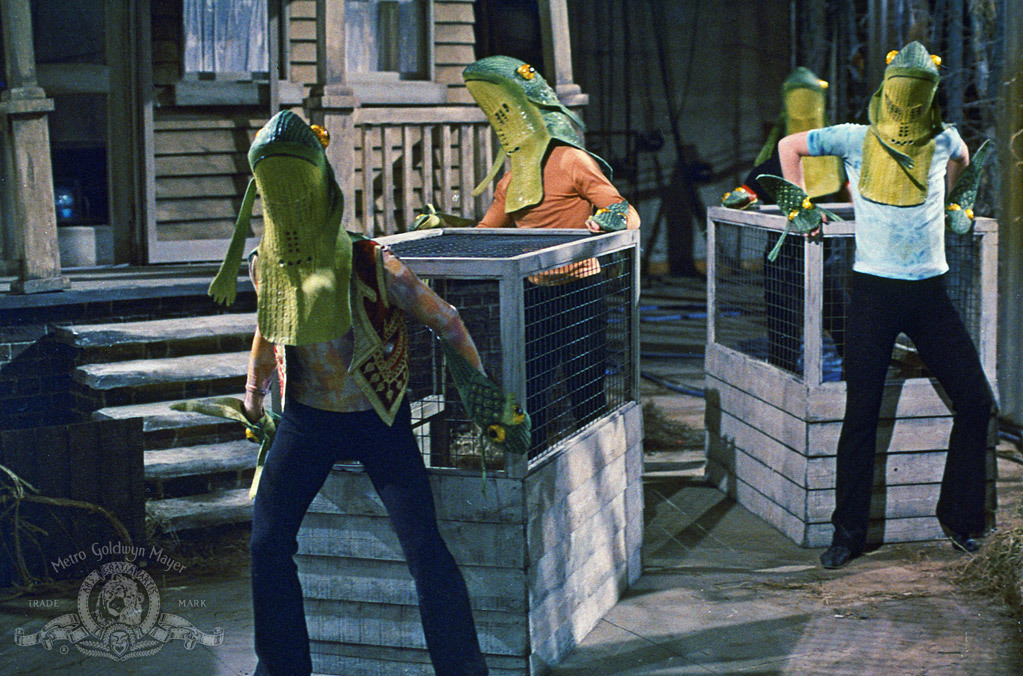
Here’s what we’re treated to: A KKK meeting with all the members singing a song called “Penis Dimension.” Keith Moon in drag as “the Hot Nun” trying to be a groupie. An incredibly overlong animated sequence created solely to lambast departed bassist Jeff Simmons. The band members randomly wrestling someone in a vacuum cleaner costume. Fish/lizard people wandering around. Another “nun” in a suit made of cardboard boxes. Dance routines that challenge the definition of both “dance” and “routine.” Did I mention all the stuff about groupies? (Janet Neville-Ferguson performs a number called “Half A Dozen Provocative Squats” — topless, of course — and Pamela Des Barres has a small part as a “rock journalist” in a leather Nazi SS uniform. Zappa always treated symbolism as a sledgehammer.) The whole thing is very meta, with participants addressing the audience and the mostly off-camera Zappa, making inside jokes about other bands and musicians, and commenting on the film’s strangeness.

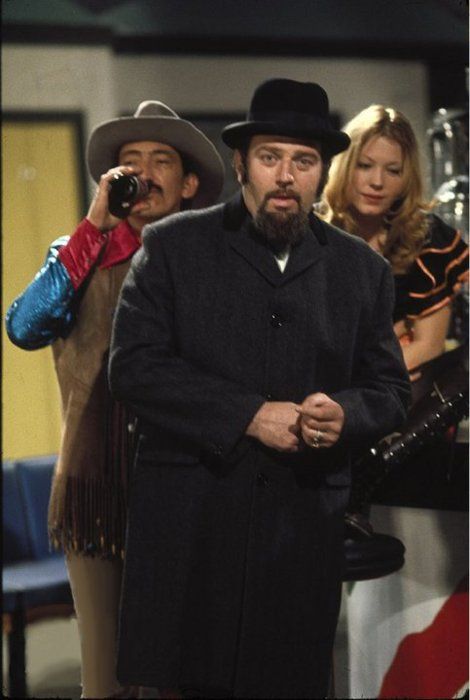
As stated, the Mothers played themselves. They were joined by several members of the original Mothers line-up, who had all been unceremoniously fired by Zappa back in 1969. No hard feelings, I guess. Original drummer Jimmy Carl Black gives the best “performance” in the film, both as his straightforward, laconic self and as the “Lonesome Cowboy Burt” character. Theodore Bikel as “Rance Muhammitz” serves as a kind of master of ceremonies through the whole thing, but 200 Motels resists all attempts at structure. 

Zappa is only briefly glimpsed on screen during some of the performance sequences. Standing in for him in the other portions of the film is Ringo, playing “Larry the Dwarf,” who is in turn playing “Frank Zappa.” Ringo as “Larry/Frank” (“a very tall dwarf”) sports a Zappa wig and a big Zappa mustache. He pops up from time to time to be interviewed by Rance Muhammitz, or deliver some rambling monologues. Although anyone who’s read candid interviews with any of the Beatles knows their language can be as blunt and colorful as anyone else’s, it is a bit off-putting hearing our beloved Ringo talk explicitly about “fucking” and “scoring pussy.” But remember, he’s playing Frank Zappa. As in The Magic Christian, there is not much to be said regarding Ringo’s performance from a technical standpoint. Once again, he’s basically playing himself — dressed as Zappa. His well-known Liverpool accent is firmly in place. Zappa biographer Barry Miles reported that Ringo was suffering a heavy cold through the brief shoot, and read all of his lines off of cue cards. When Ringo wasn’t playing the role, his place was taken by a stuffed dummy with Zappa’s distinctive features drawn on it. The difference was negligible.

The musical portions are a migraine-inducing dumpster fire of zooms, frenetic edits, flashing lights, and jarring close-ups. The whole production, even the non-musical scenes, are completely slathered in cheesy video effects — solarization, double- and triple-exposures, and false colors. In the words of the Den of Geek website, the video effects are “overbearing, unrelenting, and incomprehensible.” The use of video instead of film as a shooting medium did the production no favors, except for maybe saving a few bucks at the time. The combination of shooting on video, low-tech effects, and the junky sets makes the whole thing look like the world’s most catastrophic 1970s PBS kids’ show. In 21st-century parlance, Zappa and company would say all of these are “features not bugs,” and the film’s look was absolutely intended. But it doesn’t make it any more watchable knowing Zappa wanted it that way.

A couple of typical shots from 200 Motels

Or did he?

Continue reading

2 Comments

Filed under Film & TV

Act Naturally: The Films of the Solo Beatles (Part 2)

Terry Southern

In post-WWII France, an unlikely friendship developed between two American students studying at the Sorbonne on the G.I. Bill — one a sad-eyed Texan with a taste for the darkly absurd, the other a voluble New York dilettante who fancied himself a poet. The Sorbonne had no set schedule of classes, just the requirement to defend your thesis, and attendance-optional lectures from the likes of Sartre, Camus, and Cocteau. That left the two young men plenty of free time to linger in Parisian coffee shops, cinemas, and jazz clubs.

Terry Southern and Mason Hoffenberg were the original platonic ideal of the insufferably pretentious hipster — shamelessly appropriating jazz lingo (“dig this, man”), and passing sneering judgment on the bourgeois and “square” while actually doing or producing very little themselves. Southern finally broke free of this mold and became a writer of some repute (and became self-aware enough to satirize his own hipsterism in several of his stories). Hoffenberg, however, went on to do next to nothing, except a shitload of heroin. He managed to latch on the entourages of various rock stars in the ‘60s and ‘70s as a kind of amusing junkie mascot. I challenge you to find anyone with a Wikipedia entry who has done less to earn it. 

Mason Hoffenberg

By the mid-1950s, Southern was scratching out a living in Geneva, Switzerland as a writer of increasingly surreal short stories, while Hoffenberg remained in Paris, writing erotic fiction under a pseudonym for the notorious Olympia Press. Some of Southern’s writing also skirted the boundaries of what was then considered acceptable, such as his unpublished (and pretty much unpublishable) story about a beautiful, naive college student named Candy Christian who, according to Southern, is “compassion incarnate…so filled with universal love that she gave herself fully and joyfully…to a demented hunchback.” Southern circulated the grotesque sex tale among his associates. He fleshed it out a bit at Hoffenberg’s suggestion, and it eventually captured the attention of Maurice Girodias, head of Olympia Press, who thought it might be a suitable product for what was then still called the “dirty book” market. It became a collaboration between Southern and Hoffenberg, who would exchange character details and plot points via mail. Even those generously disposed towards Hoffenberg have to admit that the original correspondence (which has been preserved) shows that he contributed very little that made its way into the finished work, and that it was mostly Southern’s prose that ended up being published by Olympia Press. (In the final version, it seems Hoffenberg contributed one character arc and the novel’s ludicrous last few pages — a “climax” not used in the film version.)

Candy, original Olympia Press edition

Candy was published in 1958 under the name “Maxwell Kenton,” and was promptly banned in both the U.S. and France. The flimsy plot is a series of encounters between the titular (heh heh) Candy, who is encouraged by her respected philosophy professor go out and “give her love” freely, and a collection of degenerate authority figures bent on exploiting her attempts to do just that, including (but not limited to) that same professor (of course), her own uncle (who happens to be her father’s identical twin for an extra layer of perversity), and several doctors and therapists, including masturbation proponent Dr. Krankeit (Hoffenberg’s contribution.) The self-contained hunchback story that started the whole thing is now Chapter 10, and it’s the stand-out sequence of a tiresomely repetitive series of seductions/rapes, in both the extremity of its twistedness, and in that the psychotic hunchback does not desire Candy physically (at first), but merely wants to rob her. 

Putnam hardcover, 1964

Candy was finally published legitimately in the U.S. under Southern’s and Hoffenberg’s real names by Putnam in 1964. Southern had long since moved on with his life and career by then, and by his own admission, Candy was a one-joke premise that went on too long. Having read the thing myself (it’s a $3.99 Kindle if you look for it under the Kenton name), I couldn’t agree more. Candy is an incredibly tedious read. (As for it being a send-up of Volatire’s Candide? Probably hogwash. It seems someone decided on that interpretation after the fact, and Southern and Hoffenberg simply went along with it to give their project a whiff of intellectualism. “Yes, of course, it’s a send-up of Candide.”)

Then someone decided to turn it into a movie.

Maverick United Artists director/producer Frank Perry (David and Lisa) thought the book’s notoriety and popularity (it somehow reached number one on the bestseller list in America without anyone admitting to having bought a copy) gave it great potential as a film, even as it was making its way through lawsuit hell over various copyright and intellectual property issues between the authors, Olympia, and Putnam. (You can read about all that legal stuff in excruciating detail in Nile Southern’s The Candy Men.) How would the blatantly pornographic novel be translated into something that was showable on a pre-ratings, mid-’60s cinema screen? Well, that was a problem for the screenwriter.

Perry thought the logical solution was to hire Terry Southern himself (by then hot off co-scripting Dr. Strangelove) to write the screenplay, and he got through three drafts fueled by scotch and amphetamines before the U.A. deal fell through. The copyright nightmare was unresolved, and Southern’s script was still far too outrageous.

Christian Marquand

Enter Christian Marquand. A French actor (And God Created Woman, The Flight of the Phoenix) and close friend of Marlon Brando (Brando named his ill-fated son after him), Marquand came sniffing around the property as a vehicle for him to fulfill his directorial ambitions. As soon as the legal situation was resolved in early 1967, Marquand pounced. His celebrity contacts would attract the necessary financial backing. Brando would certainly be in it, and Marquand said he had both Richard Burton and Peter Sellers on board. On that basis, a Libyan-born financier and studio owner named Robert Haggiag agreed to produce.

The Candy movie got the green light. Southern’s too-explicit script was dumped in favor of a tamer version by Buck Henry. Henry, co-creator of TV’s spy spoof Get Smart, was, like Southern, on a pretty hot screenwriting streak, having just finished writing The Graduate. Henry used the basic premise of the book and some of the characters, then tossed the rest with Marquand’s blessing. “We’re going to throw the book away, and dig in,” said Marquand proudly, eager to put his own auteur stamp on the material.

While Candy was in pre-production, the Beatles released Sgt. Pepper’s Lonely Hearts Club Band, which featured none other than Terry Southern among the crowd on its iconic cover.

Peter Sellers dropped out of the project in favor of an instantly-dated hippie flick, I Love You, Alice B. Toklas (if he had ever actually agreed to be in Candy to begin with), but Richard Burton dutifully made an appearance, and Brando’s presence was a given. A gaggle of other celebrities who thought it might be fun to goof around in an adaptation of one of the decade’s most notorious books eagerly signed on to play the story’s ensemble of grotesques. Everyone converged on the sound stages of Haggiag’s Dear Studios in Rome in December of 1967 for what was sure to be a wild time.

Joining them was Ringo Starr.

Ringo as Emmanuel

Ringo had fulfilled his Beatle duties for the year. Sgt. Pepper had been a triumph that summer. Their plotless, psychedelic 50-minute TV movie Magical Mystery Tour was in the can after a September/October shoot, ready for a poorly-received Boxing Day premiere. Their new single, “Hello Goodbye,” had been released on November 24 (it shot to #1 and stayed there for seven weeks), and the Magical Mystery Tour soundtrack would hit British shops on December 8. Ringo’s last official band work before jetting off to Rome was to shoot a promo film for “Hello Goodbye,” featuring the Beatles performing the song in their Sgt. Pepper uniforms, on November 10, and taping their annual Christmas message for their fan club on November 28.

CANDY

Released: December 17, 1968 (U.S.)

Director: Christian Marquand

Producer: Robert Haggiag

Screenwriter: Buck Henry, based on a novel by Terry Southern and Mason Hoffenberg

Studio: ABC Pictures, Corona Cinematografica, Dear Films, Selmur Productions, distributed by Cinerama Releasing Corp.

Cast: Ewa Aulin, John Astin, James Coburn, Marlon Brando, Richard Burton, Charles Aznavour, Elsa Martinelli, Walter Matthau, Ringo Starr, John Huston, Anita Pallenberg, Sugar Ray Robinson, Enrico Maria Salerno, Umberto Orsini, Joey Forman, Fabian Dean, Buck Henry

No one seems to remember how a role in Candy came to Ringo in the first place. It may have been through his friendship with Peter Sellers. Ringo recalled in an on-set interview that an unnamed “they” offered him the role of Emmanuel the gardener. “They didn’t offer me a choice [of parts]. They only asked me to play the lust-mad Mexican gardener.” Ringo seems to have taken the part to have a bit of a break from the Beatles (even with no touring, ‘67 was a busy year), it fit his schedule, and because someone simply asked him to be in it. Like almost everyone else on the planet, he had read the book. “I thought, ‘You’re joking. How can they make that into a film?’ ‘Randy’ isn’t the word for it. [Making the film] was the mind-blowing experience of my life. I was filming with Marlon Brando, Richard Burton…wow!” He then added he would really preferred to have played the hunchback.

Ewa Aulin and Ringo in Rome, December 1967

Ringo arrived in Rome on December 3, 1967. His chestnut hair was given a hasty black dye job, and it was decided that the mustache and soul patch he had been sporting all year suited the character quite well. He was in front of the cameras beginning December 7. He filmed for just over a week, wrapping his part on the 16th, and returning to London on the 17th. Some of his co-stars, like James Coburn, remember the Candy shoot — nostalgically — as an undisciplined, freewheeling parade of bad behavior very suited to the era and the material. Although he already had a reputation as something of a party animal, no one recalls Ringo participating in the bacchanalia of sex and drugs that permeated the shoot. He spent most of his after-hours time hanging out with Richard Burton and Elizabeth Taylor on their yacht. Long after Ringo had finished his part, the production moved to New York and California for location shooting, and finally wrapped in April of 1968.

Ewa Aulin

Amid all the celebrities on display, who would be the film’s anchor? Who would play Candy? Haggiag and Marquand chose Ewa Aulin of Sweden. A petite, wide-eyed, pouty-lipped blonde, Aulin certainly had the “sex kitten” look, but her grasp of English was tenuous at best. Southern was disappointed. He felt Candy should be an all-American apple pie Midwesterner. But he knew the film adaptation was beyond his control, and Marquand wanted Candy to have a more “universal” quality. Aulin was Miss Teen Sweden of 1965, and Miss Teen International of 1966. Naturally, she attracted the attention of a bevy of slightly shady European film producers, and had appeared in a couple of low-budget Italian films which put her on Haggiag’s radar. 

According to some sources, Aulin had the same effect on her co-stars as Candy had on the characters they played. She was hit on constantly, and one actor’s groping “attention” — let’s just call him “Harlon Frando” — shocked even the other cast members, who were not exactly models of restraint. (Glad to report that Ringo by all accounts was a perfect gentleman, and Aulin later spoke of him fondly.)

Buck Henry

The actors all seem as if they had just glanced at the script for the first time right before the cameras rolled (this may indeed have literally been the case in a few instances). Not that it was much of a script anyway. Buck Henry’s considerable gifts have deserted him here. (“I wish I had written a better script,” Henry frankly admits in one of his last interviews before his death in 2020.) The dialogue is clunky and not particularly funny. It is supposed to be a comedy, but it mistakes eccentricity for humor. Admittedly, the eccentricity can be fun to watch in a few sequences, but there’s no earthly reason for the official cut of Candy to run just over two hours. 

Continue reading

Leave a comment

Filed under Film & TV

From the Archives, 2008 — The Holy Bee’s Top 5 Monster Movies

The Films of the Solo Beatles series will continue in March (hopefully). January turned out to be an unexpectedly busy month, so watching those films, taking notes, researching their production and other minutia, and then writing it all up in a breezy 5000+ words just wasn’t in the cards. 

The following article originally appeared in the Idle Times zine, Issue #1 (Fall 2008). Please note that some strident opinions have softened or changed entirely over the last decade-and-a-half, and there are some turns of phrase I would not have chosen at a later point in my writing “career.”

“There were giants in the earth in those days, and also afterward…” — Genesis 6:4

“Everybody said there was no honed iron hard enough to pierce him through, no time-proofed blade that could cut his brutal blood-caked claw…” — Beowulf, l.983-89

Human beings are by nature vulnerable. We have no thick hide, no tusks (unfortunately — wouldn’t that be cool?), nor any natural camouflage. We’re just six-foot tubes of delicious pink meat. All we have to protect ourselves is our comparatively turbo-charged brains — which is a double-edged sword. We have the mental ability to dominate the natural world, but also the ability to scare ourselves by imagining the most unnatural horrors.

When primitive humans huddled around the fire, they told tales of what lurked beyond the sheltering ring of light. Shaggy or scaly things, with sharp claws and dripping fangs. Waiting for a dim-witted or simply unlucky Cro-Magnon to wander just far enough into the darkness…

The best monster movies tap into this primal fear that’s been hard-wired into our psyches. So, what truly defines a “monster movie”? First of all, it doesn’t necessarily have to be a “horror” movie (although it helps), it just needs to make us humans feel very, very defenseless. Monsters should be an external threat. None of this “the-worst-monster-is-inside-us” psychological bullshit. So Hannibal Lecter, Joan Crawford, and their ilk are out. (Sorry, Mommie Dearest fans.) Monsters are also a very corporeal threat. Scary as they can be, ghosts are not monsters. Not even if they can wreak havoc in the physical world. No poltergeists, demons that make you do unspeakable things with a crucifix, or Freddy Krugers. The jury’s still out on whatever the hell Jason Voorhees and Michael Myers are. They are certainly physical, but their inability to be permanently killed suggests ghosts or “undead” as opposed to human. But it’s a moot point because 1) their movies are really shitty (except for the first Halloween), and 2) I am officially declaring the “Unkillable Slasher” film to be its own separate genre, and you can read all about it in the Things That Suck ‘zine. But not here.

So to sum up, a monster should be able to eat you, stomp on you, or at the very least, carry you off

#5 — The Undead

THE BRIDE OF FRANKENSTEIN (1935)*

The performance by Boris Karloff as Frankenstein’s Monster was a double triumph. It combined a simple sensitivity with the ever-present threat of hulking brutality. The make-up designed by Jack Pierce is positively iconic. No modern audience can think of the Monster without picturing the lank black hair over a squared-off skull, the green-tinted skin, the neck bolts — all from the imagination of Pierce. (Why green make-up? It photographed as the perfect shade of corpse-like gray on black-and-white film. Gray make-up would look too white. Some color stills were released to the press, and the Monster has been imagined as green ever since.)

Bride of Frankenstein ranks slightly above the 1931 original in most people’s opinion because it incorporates a lush score (like many early talkies, the original had no music), its eerily beautiful set design, and visionary director James Whale’s imagery and highly theatrical humor. For those of you who dig subtext, watch for all the religious themes and iconography, and the homosexual undercurrents. Ernest Thesiger as Dr. Pretorious might as well be credited as the first openly gay leading character in film history. (No, he doesn’t come right out and say it — this was 1935, after all. But some of his cleverly insinuating dialogue and the entire physicality of his performance left no one in any doubt, even in 1935.)

When it comes right down to it, as dated as they sometimes seem, all monster movies owe a tip of the hat to the classic Universal Studios monsters of the 1930s and ‘40s. Human-sized, awash in pathos, these creatures did not ask to be what they are — but if you cross them they will fuck you up.

#4 — The Hubris of Man

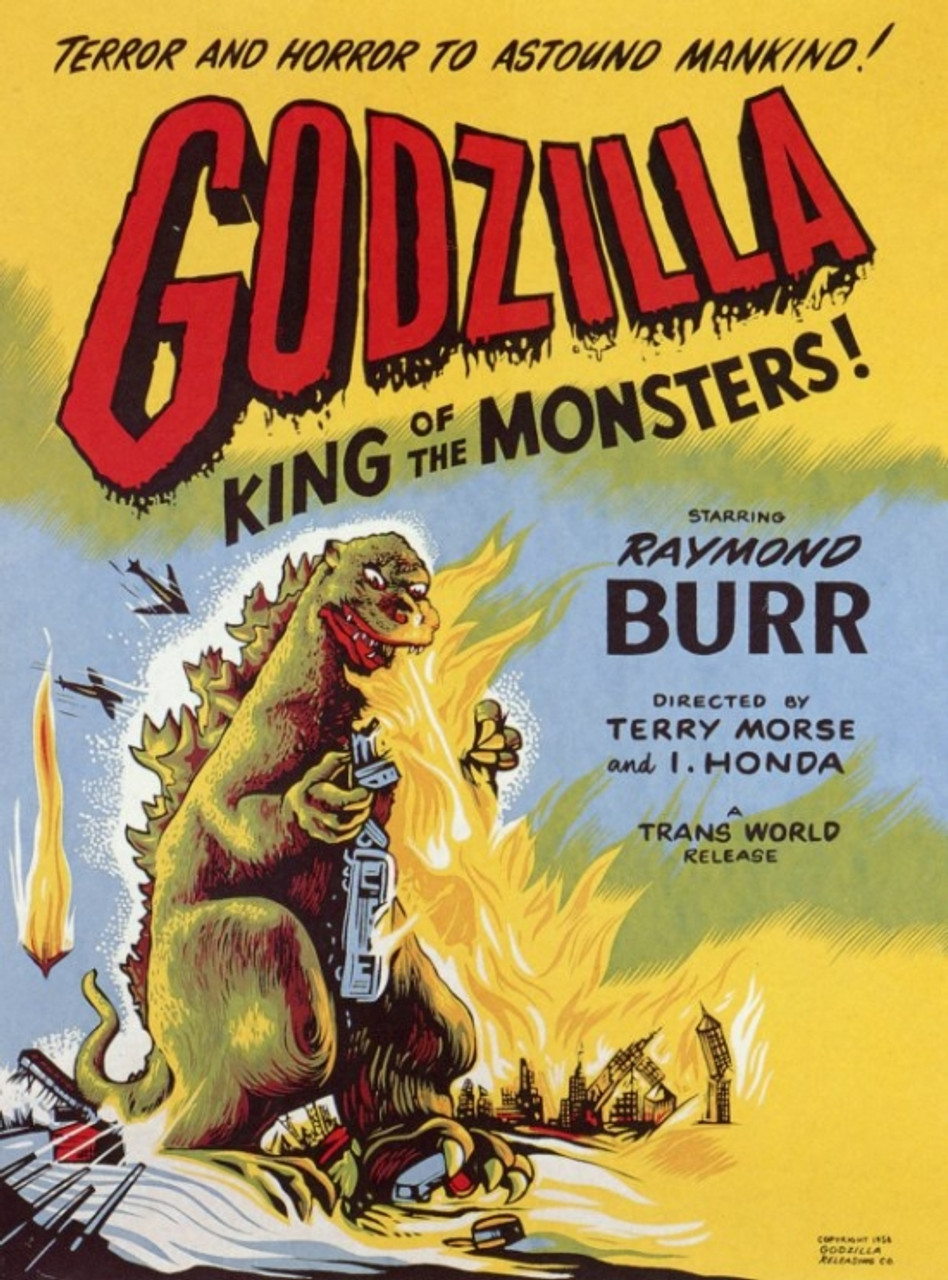
GODZILLA, KING OF THE MONSTERS (1956)

Saturday night/Sunday morning. 3 AM. Can’t sleep. Sandwiched between infomercials and increasingly desperate Girls Gone Wild ads, one can usually find an old monster movie. Count yourself lucky if it’s Godzilla, King of the Monsters. (Count yourself cursed if it’s the 1998 travesty of a remake.) GKOM is the U.S. version of the 1954 Japanese original Gojira, about nuclear fallout that brings to life an enormous mutant dinosaur. The film was Americanized by toning down the bitter recriminations over Hiroshima, and adding footage of Raymond Burr as an American reporter (“Steve Martin ”) in Japan. He interacts with the Japanese cast through the use of body doubles and clever editing, and the process is surprisingly well done.

Despite the editor’s scissors’ careful elimination of too many references to a certain country using a certain weapon on a certain other country, make no mistake, Godzilla is clearly an atomic-powered monster. And he’s not the friendly nuclear dino of later sequels, defending the Home Islands against other mutant threats. No, in ‘56 he’s pissed. He rages, stomps, sinks ships, and burns thousands of innocents to a crisp with his radioactive halitosis. The lesson here is that there are Some Things In Which Man Is Not Meant To Meddle, and splitting the atom may just be one of them. Godzilla’s first appearance is quite late into the film, setting a pattern that all good monster movies of the future follow. Show little glimpses, show some damage and casualties, build up the tension before the big reveal. There’s no way to avoid the fact that the “big reveal” here reveals a guy in a rather cheap-looking rubber lizard suit, but if your powers of disbelief-suspension are strong enough, you’ll go along with it.

Collector’s Note: After decades of unavailability, the 1954 original can finally be obtained as a bonus disc included with the 2006 GKOM DVD. At the risk of angering purisits, it’s no better than the U.S. re-cut. It’s about 15 minutes longer, and most of that is emotional discussions about atomic energy. 

#3 — The Thing From “Out There”

ALIEN (1979)

“In space, no one can hear you scream,” ran one of the greatest taglines in cinema history. We’re talking primal fear, remember, and fear of the dark is one of our most basic. It’s why those cavemen huddled close to that fire. It’s why the majority of children sleep with the soft glow of a favorite cartoon character glimmering in a nearby outlet. It’s why me, a grown-ass man, will pop on my bedroom TV after a particularly vivid nightmare. Why do we fear the dark? BECAUSE WE CAN’T FUCKING SEE ANYTHING IN IT. It doesn’t get any more basic than that. Who knows what’s lurking where we can’t see. Escaped circus animals, psychotic dismemberment aficionados off their meds, and…monsters. There’s always that possibility. We know there’s “no such thing,” but that assuredness slips just a tad in the dark, doesn’t it? And what is outer space but airless, silent, eternal dark? Midnight that goes on to infinity. And our confident daytime knowledge that there’s no such thing as monsters isn’t worth a bronzed turd, because we don’t know what such things could be…out there

Maybe aliens are gentle, elf-like beings with glowing fingertips and hearts, and big, expressive anime eyes. Or maybe aliens are slavering, nine-foot insectoid beasts with a double set of jaws and a taste for human flesh, not to mention the ability to move at blinding speeds and lay their eggs in live human hosts by ramming an ovipositor down their throats, which “hatch” several days later in Technicolor glory right as the human host is sitting down for a nice meal after recovering from the earlier (very traumatic) ovipositor incident. 

Guess which one this movie’s about?

Continue reading

1 Comment

Filed under Film & TV, Pop Culture

Act Naturally: The Films of the Solo Beatles (Part 1)

Prologue: A Hard Day’s Night, Help!, and Ringo the Actor

When I was a super young Beatles fan in the early ‘80s (age 7-10 or so), there wasn’t much beyond the music itself and a couple of books out there to feed my fandom. So when PBS decided to show the 1982 documentary The Compleat Beatles a few years after it came out, I made sure I was rolling VHS tape on it. In subsequent years, I literally wore out the tape watching and re-watching it. It ended with a brief summary on the activities of each individual Beatle after the break-up. Here’s Ringo’s:

That always puzzled me. “An acting career in Hollywood?” I went to the movies a lot as a kid, and I’d never seen any movie starring Ringo Starr. This statement was also echoed in the handful of Beatles books I had collected. Everyone agreed without contradiction that Ringo became an actor in the 1970s.

As it turns out, this is a bit of an overstatement. Ringo’s acting career never amounted to much, and the film work he did was pretty well removed from anything that can be described as “Hollywood.” 

But thinking about all this recently did get me interested in exploring the work of the solo Beatles on film, one element of their careers that I never delved into all that much.

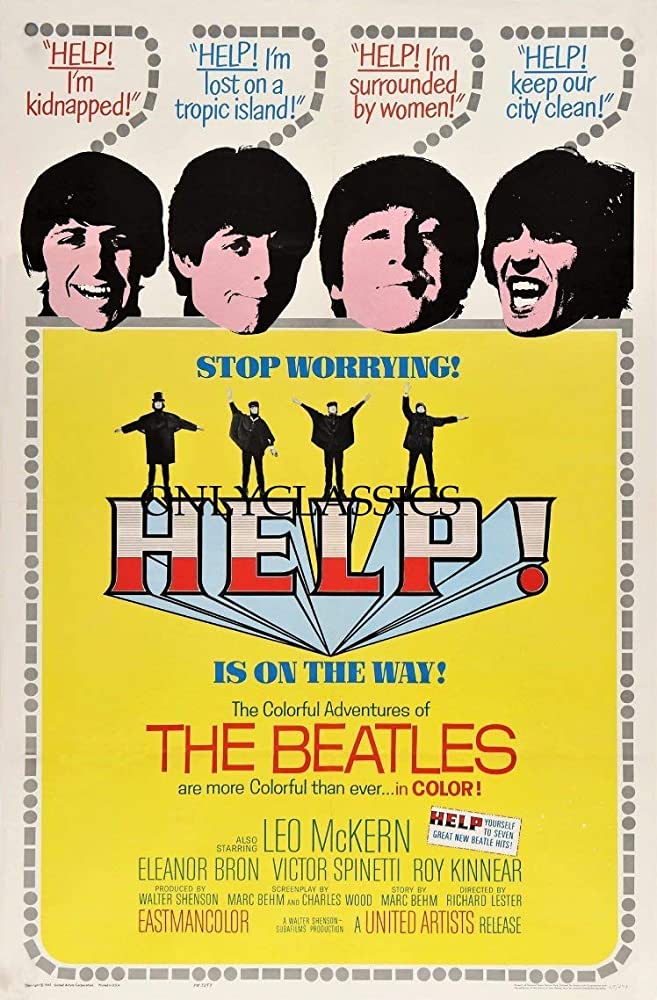
Collectively, the Beatles were movie stars by the middle of 1964.

There was once a time (the mid-20th century) when a popular singer could reach such a level of universal fame that they would be elevated past being a mere “singer,” to become an “entertainer.” They would be expected to not only sing and continue to sell records by the bushel, but also act in films, and appear on television (frequently poking good-natured fun at themselves in comedy sketches and the like). Bing Crosby, Frank Sinatra, Elvis Presley, and several others made the cross-over. It was all just homogenous “show business” at a certain point. By the early 1960s, even bands like the Beatles were expected — almost required — to follow the established path. Of course, it was bands like the Beatles and their contemporaries who put an end to this kind of thing by creating the world of modern rock and rebelling against old-school showbiz traditions. But in their early years, they really felt they had no choice but to play along. In October 1963 (when they had been famous in Britain for less than a year and hadn’t broken in the US at all), Beatles manager Brian Epstein signed them to a three-picture deal with United Artists.

It didn’t matter that none of the Beatles expressed an iota of interest in acting, because United Artists didn’t have an iota of interest in the Beatles as actors. They wanted the lucrative rights to the soundtrack album, which they hoped to cash in on before the Beatles fad died (as everyone was certain it would, any week now). Someone could have filmed the Beatles reading the phone book against a blank wall, and as long as some songs were interspersed in there, UA would be happy. Luckily, that’s not what happened.

What happened was they ended up making a really good movie. 

While contract negotiations were underway, United Artists producer Walter Shenson had a lunch with Richard Lester, who had just directed the Mouse That Roared sequel (The Mouse on the Moon) for Shenson and UA. When Shenson mentioned he would likely be handling an upcoming Beatles film, Lester eagerly asked if he could direct it. Shenson thought it was a wonderful idea.

Lester — described by singer/writer/eccentric George Melly as “an amiable space creature, very thin, with a great domed bald head, tiny childlike features and large kind eyes” — was born in Philadelphia, but had been working in television in the UK since the early 1950s, and had a couple of feature films under his belt by late 1963. He was 31 years old when he took on the Beatles’ first film, very youthful by today’s standards, but in the world of early ‘60s pop music, where both artists and fans were in their teens or not much past, he was an “adult.” A sophisticated lover of classical music who was a decent hand on the piano, no less. But unlike a lot of other “adults,” he did not necessarily look down on pop music, and the Beatles were on his radar pretty early. And when the Beatles heard Lester had been tapped to direct their movie, they approved wholeheartedly. They knew Lester had directed The Running Jumping & Standing Still Film, a surreal short featuring their comedy idols, Goon Show stars Spike Milligan and Peter Sellers. 

Richard Lester

Lester brought in Liverpool playwright Alun Owen to craft a script. (As a writer, Owen was so closely associated with Liverpool that Epstein reached out to him about the possibility of writing a Beatles script even before the UA deal was conceived, and likely pointed Lester in his direction.) Owen traveled with the band during their two-day trip to Ireland (November 7-8, 1963), and was able to distill their personalities and transcribe some of their witty remarks into his Oscar-nominated screenplay, which was an exaggerated “day in the life of the Beatles.” Aware that the group had no experience as professional actors, Owen made sure that no Beatle had more than one line at a time. Lester had a tight schedule (six weeks in March and early April 1964) and a modest (but by no means tiny) budget, so he used the limitations to his advantage, presenting the band in a gritty, black-and-white, semi-documentary style.

When A Hard Day’s Night hit cinemas in the summer of ‘64, the established film critics found themselves astonished that they actually enjoyed a movie about a bunch of pop musicians. Their positive reviews carried almost a puzzled air. Could this be possible? Lester’s film was fast-paced, inventive, and a great example of deadpan British humor. All of the Beatles acquitted themselves quite well, but one member was always singled out by the critics for individual praise — Ringo Starr. Ringo had a lengthy solo sequence two-thirds of the way through the film. Feeling put-upon by his bandmates, he ditches rehearsals to go on a lonely ramble along the Thames. He projects an air of melancholy and vulnerability, and the viewers’ hearts go right out to him. (His secret to “acting” this scene? He had been partying all night the night before, never went to bed, and was sleepy and hungover as the cameras rolled early in the morning.)

Although all the Beatles were natural performers — they just exuded charisma — everyone decided that Ringo was the one who had the potential to be a true actor. So he became the central figure (not exactly “star”) of the Beatles’ next film, 1965’s Help! Lester was once again at the helm, and engineered a complete departure from the Hard Day’s Night style — this time he went with glorious Pop Art color, and a pretty silly “story” (originally concocted as a Peter Sellers vehicle) about a cursed ring on Ringo’s finger. It was essentially a live-action cartoon, and the critics weren’t quite as effusive as they were for A Hard Day’s Night. But the music was as good as ever, spoofing the globe-trotting James Bond series was fun, and once again Ringo was noted for the special quality he brought to the screen. The band even paid tribute to the budding Brando in their midst by recording a cover of Buck Owens’ “Act Naturally” with Ringo singing lead. They enjoyed a good working relationship with Lester, and considered him a friend.

There was one more film left on their United Artists contract, and if they followed the pattern of 1964 and 1965, then they would produce a film (and accompanying soundtrack album) for a summer 1966 release. 

It did not come to pass.

A Talent For Loving and Up Against It

In the 1500s, an Aztec curse is placed on a Spanish conquistador…he and all of his descendants until the end of time will be consumed by insatiable lust from the moment of their first carnal encounter. Flash forward three centuries…Mexico, 1871. A prosperous ranch owner (and victim of the curse) is trying to marry off his virginal daughter before the curse “ruins” her. A series of competitions between two young ranch hands will determine which one has enough physical stamina to meet her needs and keep her honorably faithful in the bonds of matrimony…

This is the plot of A Talent For Loving or, The Great Cowboy Race, a 1961 novel by Richard Condon (famous at the time as the author of The Manchurian Candidate). It was an interesting attempt to combine a post-modern Western tale with an irreverent sex farce. In an odd move, Brian Epstein secured the film rights, envisioning this as a potential vehicle for the Beatles.

At what point “Beatles” and “Old West comedy about nymphomania” blended together in Brian Epstein’s mind is unclear (or maybe it was someone else’s suggestion), but it seems that the Beatles were big western fans, and evidently they had been bitten by the acting bug. They wanted to play actual characters instead of “the Beatles.” A screenplay written by Condon and his wife Evelyn was completed by March 1965 (literally while Help! was shooting), and it was hoped they could film in September. “No reason why Liverpool lads shouldn’t be out there [in the West],” said Condon confidently, “complete with accents, lariats, and six-shooters.” Walter Shenson was brought into the picture that summer, confirming this was to be the Beatles’ third UA release. But the film went into re-write hell — it seems it was more difficult than anticipated to incorporate four Liverpudlians into a western set in Mexico. The September shooting window came and went, because no one was happy with the script. By December, the project was dead. Times were changing fast, the Beatles were growing artistically by leaps and bounds, and they had soured on the idea of “playing cowboys” in a comedy. They also had genuine concerns about recording an appropriate soundtrack (19th-century Mexican balladry was not their forte). If they had to do another movie, they wanted something modern and cutting-edge. Epstein and Shenson went back to script hunting, still hoping to get a Beatles film into theaters sometime in 1966.

Any time the Beatles’ possible participation in a western comes up in discussion on a website, it is universally accompanied by one or more of these cowboy-themed images from a September 1964 photo shoot at the end of their summer tour of the US

[A Talent For Loving was eventually made in 1969, with Shenson still producing. It starred Richard Widmark (playing a middle-aged Civil War vet), Cesar Romero (playing the ranch owner), and Topol (playing a Mexican generalissimo with as much subtlety as the Frito Bandito). Obviously, none of these parts were suitable for the Beatles. I can only speculate that the two cowboys in competition for the rancher’s daughter would have become four cowboys, the four cowboys would also be British immigrants, and the parts would be much more fleshed out and important than the two hunky empty hats in the released version. Good ol’ Ringo probably would have been the victor.] 

It soon became apparent that there would be no 1966 Beatles movie, but a contract was a contract, and there was always 1967. In late ‘66, Walter Shenson commissioned writer Owen Holder to craft a script that would meet the “modern, cutting-edge” requirement. Holder came up with Shades of a Personality, the story of a young man (Holder envisioned Lennon in the lead role) with three separate personalities, to be embodied by the other three Beatles. (Classic rock fans will recognize this as very similar to the Who’s 1973 concept album Quadrophenia.)

Holder’s script was met with little enthusiasm from the group. They really did not want to do another “Beatles” movie at this point. So desperate were they to not appear in front of the cameras that they tried to give United Artists an independently-produced animated film that had their likenesses (but not their actual voices) and a few new songs. Yellow Submarine was distributed by UA in 1968, but it did not fulfill their contract.

Joe Orton

Hoping to entice them with edgiest of cutting-edge, Brian Epstein gave the Holder screenplay to Joe Orton for a re-write. Orton was the “bad boy” of British theater at that time. Plays like Loot and What the Butler Saw caused a sensation due to their explicitness and dark-humored nihilism. Orton began working on the Beatles project in January of 1967. He injected the material with a healthy dose of sadomasochism, polyamory, and gay subtext. He submitted the revised script — now called Up Against It — to the Beatles’ management. After several months with no word, the script was simply returned to him without comment. Free to entertain other options on the script, Orton was due to attend a meeting with producer Oscar Lowenstein and director Richard Lester on August 9, 1967. His body was discovered that day in his London flat, having been bluedgeoned to death by his boyfriend Kenneth Halliwell (whose body was nearby — he committed suicide by overdose). Eighteen days later, Brian Epstein died of an accidental overdose. (Paul McCartney admitted in 1997 that the Beatles had been frightened off the Orton project by the homosexual themes in the script.)

Less than two months after the death of their manager, the very first solo Beatle film would be released. 

Here’s my format for discussing the films of the solo Beatles:

No TV movies, no concert films, no documentaries, no popping up as themselves in a cameo. These are narrative films released in cinemas in which they play a character. (I fudged it a little on Give My Regards to Broad Street in which Paul McCartney plays a “fictional” rock star that, based on all observable evidence, is pretty much “Paul McCartney.”) I will watch each film in its entirety at least once, most of them for the first time in many years, and a few of them for the first time ever. Release dates will generally be for the British release, unless otherwise noted.

Continue reading

2 Comments

Filed under Film & TV

“A Christmas Story Christmas” Story

I’m always suspicious of people who claim to have no holiday traditions, although mine tend more towards “personal holiday observances, usually based around specific dates, that no one else really participates in.” I wrote about a bunch of them in some of my very first entries on this website, spreading them over three 2008 entries at a total length that would barely be half of a single 2020s-era entry. Obviously, much has changed since then. I’ve grown more long-winded in my website pieces, and more lax in observing many of my old traditions. However, the following five remain pretty iron-clad.

1. No Christmas music until after Thanksgiving. But as soon as the dishes are cleared away, I consider it open season for “Good King Wenceslas.” The Christmas Spotify playlist is usually on the car stereo driving home from Thanksgiving dinner.

2. Christmas lights on the house no later than the Sunday after Thanksgiving (weather permitting). This is often something I really have to force myself to do, tearing myself away from my fireside end of the sofa, my book, and the muted football game on TV to clamber around on a rickety ladder and almost plummet to a paralyzing injury at intervals that come closer together as the years roll on.

3. Christmas tree acquired and decorated on whatever weekend is closest to December 10. Any sooner and it dries up no matter how carefully I check the water level, any later and why bother? 

4. Making a shepherd’s pie at some point in December (usually between the 20th and 23rd).

5. Having a bunch of Christmas-themed stuff on the TV. Cheesy variety specials, Christmas episodes of sitcoms, classic movies, you name it.

I say “having it on” instead of “watching,” because it’s usually just atmospheric background to my reading, computer gaming, or puttering around the house. I am a world-class putterer, and lately I’ve taken to doing it with my half-moon reading glasses perched on the end of my nose. Jesus, I’m old. Am I really the same person who used to go to Primus concerts with dyed blue-black hair (Manic Panic!) and army surplus pants tucked into shin-high black boots? I did scrupulously avoid the mosh pit, so I guess I was always kind of soft. But at least I was young and soft. (That didn’t sound quite right, but I’m leaving it in.)

One of the movies in the holiday rotation is A Christmas Story. Little regarded upon its initial theatrical release in November 1983, it has since become a holiday television staple in households across the country. So popular were its frequent airings on cable stations that Turner Broadcasting began showing it marathon-style — “24 Hours of A Christmas Story” — in 1997. For the last 25 years, starting at 8pm Christmas Eve and concluding at 8pm on Christmas Day, you could tune in and get your fill of Ralphie and his Red Ryder BB gun (with a compass in the stock and “this thing which tells time.”) You’d be joining roughly fifty million others.

Like Christmas music, the viewing of Christmas material on TV is strictly forbidden until after Thanksgiving. But this year, I violated tradition by watching A Christmas Story way outside of its normally-accepted viewing slot because I wanted to watch its brand-new sequel, A Christmas Story Christmas, the day it dropped on HBO Max. Watching a new sequel without a re-watch of the original is a violation of the Holy Bee Code.

As the consistently high annual ratings for the marathon have proven, the Christmas Story phenomenon is a powerful thing, and it’s woven firmly into the fabric of American culture. Even if you haven’t seen the film, it might feel like you have — it’s the story of nine-year-old Ralphie and his quest to get a BB gun for Christmas, while also dealing with his perpetually hassled mom and intimidating dad (only ever referred to as “the Old Man”), along with various other childhood dramas. You’ve probably heard about the notorious “fra-gee-lay” leg lamp, the tongue frozen to the flagpole, and the oft-repeated “you’ll shoot your eye out” catchphrase. 

Full disclosure — I am not any kind of die-hard Christmas Story fanatic. It’s just tossed in with all the other holiday viewing for me. If it hasn’t been a part of a family tradition for years, this mild little period-piece comedy may actually be kind of a hard sell for new viewers who will undoubtedly wonder what all the fuss is about. But I did grow up with A Christmas Story, and I did get a warm tingle when I heard they were making a proper sequel. (And it just dawned on me that my Subscribe button is emblazoned with “I triple-dog dare you.” Maybe I am a die-hard fan.)

Wait, a “proper” sequel? Were there improper sequels? Yes, actually. Three of them, and they all failed for their own reasons, but mainly due to the issue that A Christmas Story Christmas intends to correct. 

Never much liked the original poster, which failed to capture the true tone of the film — it made it look far too “wacky” and/or “zany,” the kind of movie where you’re just waiting for someone to get hit in the nuts and go cross-eyed.

The Christmas Story juggernaut started with Jean Shepherd (“Shep” to his legion of fans), a fixture of New York late-night talk radio from 1955 to 1977. Shep built a dedicated following by spinning lengthy first-person yarns about his alter ego, “Ralphie,” Ralphie’s family (“the Parkers”), and his experiences growing up in America’s heartland in a bygone era. You can get a taste of Shepherd’s engaging vocal style from his narration of A Christmas Story, portraying the unseen-but-constantly-heard adult Ralphie. 

Although he insisted the tales were pure fiction and not autobiographical, elements of Shepherd’s real life always crept in. He really did have friends named Flick and Schwartz and a kid brother named Randy, he did go to Warren G. Harding Elementary School, and the name of his actual hometown — Hammond, Indiana (just across the state line from Chicago) — isn’t too far off from the fictional Midwestern town, “Hohman, Indiana,” that he created for his stories. He made the character of Ralphie a few years younger than himself to better align Ralphie’s childhood and adolescence with the Depression and the war years.

Jean Shepherd

What really blew people’s minds was that Shepherd told these stories off the top of the head. He prided himself on never relying on pre-written scripts, and could extemporize, ad-lib, spin off into side stories, and then tie it all up in a neat conclusion right as his closing music began to play. As his popularity grew, he began speaking tours of college campuses where audiences could verify this skill with their own eyes. 

Someone finally asked Shep to put some of his favorites down in writing, and one of the first stories published was the one that provided the framework for A Christmas Story. “Duel in the Snow or, Red Ryder Nails the Cleveland Street Kid” appeared in Playboy magazine in 1964. (Playboy also sent him as a correspondent to tour with the Beatles for a few days later that year. A middle-aged jazz snob by then, Shep never warmed to their music, but admitted they were great fun to hang out with.)

Enough stories appeared in Playboy over the next two years to compile into a book. The result, In God We Trust, All Others Pay Cash, was published in 1966. Often described as a “story collection” or “anthology,” Shep always proudly referred to it as a novel. Despite this claim, it is pretty episodic, with the self-contained stories appearing as reminiscences between adult Ralphie and Flick during Ralphie’s return visit to his hometown. Only “Duel in the Snow” is Christmas-themed, and the other stories bounce around chronologically, with Ralphie depicted as anywhere from seven to fourteen, depending on the chapter. 

Two sequels, Wanda Hickey’s Night of Golden Memories and Other Disasters (1971) and A Fistful of Fig Newtons (1981) continue the mixed bag of stories about (a mostly older) Ralphie. 

Shepherd’s radio monologue about Flick getting his tongue frozen to a flagpole (a story that never made it into print) turned aspiring young filmmaker Bob Clark into a lifelong Shepherd fan. The eventual Christmas Story director contacted Shep as early as 1970-71 about making a film based on his stories, but it was a long road to production. They got as far as writing a screenplay, but no studio was interested. 

The first attempt to tell a Ralphie Parker tale that made it to a screen was the TV movie The Phantom of the Open Hearth, which aired on December 23, 1976 as part of the PBS anthology series Visions. Shep wrote the script, and established a formula: a main throughline based on a key story from one of his books (in this case, the title story of Wanda Hickey), supplemented by secondary plot threads drawn from other stories (the leg lamp story from In God We Trust is first seen onscreen here) and from various unpublished monologues, all tied together by his voiceover narration.

James Broderick, the first Old Man

The Phantom of the Open Hearth led to two (or three, kind of) more PBS adaptations, and they’re just this side of watchable if you can handle dingy, PBS-level production values, a much slower pace, and a few glaring differences from our beloved Christmas Story. The PBS Ralphie (re-cast each time) is depicted as an athletic, self-assured high school junior — a far cry from the awkward, needy, bespectacled little kid we’re used to. Flick comes off as a potentially dangerous criminal thug. Craggy character actor James Broderick (known for the ABC drama Family from the same era) is no Darren McGavin, but makes a pretty decent Old Man. (Just like no one is going to surpass Anthony Hopkins as Hannibal Lecter, you have to hand it to Brian Cox, who was the first actor to play the character — and did a good job — in the 1986 movie Manhunter.) Barbara Bolton as Mrs. Parker is the only lead actor to appear in all three, but she doesn’t exude a lot of personality, and only reminds the viewer of how much spark Melinda Dillon brought to the role. And, like most 1970s productions set in a previous era, no one would commit to period-accurate haircuts, so everyone kept their bushy ‘70s hair. (Another example: any given episode of M*A*S*H.) (The Phantom of the Open Hearth was re-cast and re-shot as a possible pilot for an ABC series in 1978, but it was never shown.)

Broderick and a way-too-studly Matt Dillon

Another PBS anthology series, American Playhouse, aired the second Shepherd adaptation. The Great American Fourth of July and Other Disasters hit TV screens on March 16, 1982, based around more In God We Trust stories. James Broderick returns as the Old Man (it was one of his final roles, he died later that year), and the characterization of Ralphie as “cool teen” reaches its zenith — he is played by none other than Matt Dillon. Like its predecessor, The Great American Fourth of July is acceptable, but nothing great. I was particularly disappointed that one of my favorite Shepherd stories, “The Endless Streetcar Ride Into the Night and the Tinfoil Noose” (about Ralphie on a blind date), was staged and shot in such a clunky and cumbersome way that it drained the story of its slow-building tension and brilliant comedic payoff. 

Katherine Kahmi as Josephine Cosnowski.

The Star-Crossed Romance of Josephine Cosnowski was based mainly on Wanda Hickey material, and it aired on American Playhouse on February 11, 1985, after A Christmas Story had been ignored in theaters, but just before its big rediscovery as a TV treasure. Romance is a notch below the first two in terms of budget, humor, and performances. Despite the presence of a few vintage cars and kitchen appliances, all attempts to give it a period feel have been abandoned. The object of Ralphie’s affection looks more like Brenda Walsh from 90210 than anyone who would have breathed 1940s air. The usually reliable George Coe is a low-key, somewhat placid Old Man, with none of the bluster the part requires. (Coe is known to a later generation as the voice of Woodhouse on Archer.)

Bob Clark

Nobody ever went broke underestimating the taste of the American public, someone once said (it evidently wasn’t H.L. Mencken), and sure enough, Bob Clark’s Porky’s was a box office smash in 1982, giving Clark the clout to make whatever he wanted as his next project. He chose the Christmas-themed script he wrote with Shepherd many years earlier. Clark, who got his start in low-budget exploitation and slasher flicks, will likely never be in the Pantheon of Great Directors. He usually painted in the broadest strokes possible, and had a tendency to aim low in his comedy. But A Christmas Story has a subtlety that most of his other films lack. He was a potentially solid director (his pre-Porky’s Sherlock Holmes pastiche Murder By Decree was quite good) who had the misfortune to have directed mostly terrible films: The powerfully stupid Porky’s and its even worse sequel, feeble comedies like Rhinestone and Loose Cannons, whatever the hell Turk 182! was supposed to be, and the absolutely execrable Baby Geniuses, which played at the theater where I once worked and inspired more walk-outs than any other movie I can name. And those are just his movies people may have heard of. But not everyone can be Stanley Kubrick (luckily for Shelley Duvall), and Clark, by all accounts a genuinely nice man, had a personal warmth comes through in A Christmas Story’s informative commentary on the DVD. The kids in the cast loved him (unlike The Goonies’ cast, who were always a little afraid of grumpy old Richard Donner), and he clearly poured his heart into A Christmas Story. I was very sad to hear of his tragic death in a head-on collision on the Pacific Coast Highway back in 2007.

The film was shot from January to March of 1983, mostly in and around Toronto. The department store scenes were done at the actual Higbee’s in Cleveland. Another Cleveland location was the Parker house, located at 3159 West 11th Street. The interior scenes were shot on a Toronto soundstage, so the Cleveland location was for exterior shots only. It was purchased in 2004 by a California entrepreneur (who specialized in the production of replica leg lamps) and restored to resemble the house — inside and out — as it appeared in the film. Adjoining houses were converted into museum and gift shop space. (As of this writing, the whole complex is up for sale.)

A Christmas Story’s studio, MGM, did not seem to have much confidence in the final result. They put it into theaters in mid-November with little promotion, and it was mostly gone from screens by Christmas week itself. It wasn’t the box-office dud that legend later described it as, but its success was modest at best. It picked up a little traction when it showed on HBO and was released on VHS in 1985. Then came the turning point — a near-broke MGM sold most of its film library to Ted Turner in 1986, and A Christmas Story began its run on Turner-owned stations that holiday season. That’s when my family first watched it. It already felt like tradition by the following year. But don’t call it nostalgic. Both Clark and Shepherd insisted the film does not fit that description. “It’s not nostalgia. It’s an odd combination of reality and spoof and satire,” said Clark. Maybe that’s why newcomers to the movie are sometimes a little put off.

Continue reading

Leave a comment

Filed under Film & TV

Apple Scraps: The Odds & Ends of “Get Back”

Will I ever write a one-part Holy Bee entry again? This one was intended to be a one-shot. A throwaway, even. Just some random observations and lots of images. But my usual over-writing and lack of editing discipline caused it to bloat up, as if it had eaten fistfuls of instant mashed potato flakes right out of the box (don’t do that). To quote Abraham Lincoln, “As the preacher said, ‘I could write shorter sermons, but once I get started I get too lazy to stop.’”

I toyed with idea of dividing it into two entries.

But no! It’s staying a one-parter because it’s a stupidly indulgent entry, and just not worth spreading over two monthly installments. Word count-wise, I managed to keep it on par with a typical entry here, but all these pictures…your scrolling wheel may wear out before you get to the end. Read with caution.

Anyway, on with it…

Get Back, Peter Jackson’s landmark three-part series on the filming & recording sessions that ultimately produced the Beatles’ Let It Be album and documentary, has been out for almost a year now. It has inspired websites and podcasts to do recaps, reviews, and “deep dive” analyses of the development of the songs, and especially the interpersonal relationships and late-period band dynamics that give this project such dramatic heft. And everything from George Harrison’s color-coordinated outfits to the copious amounts of toast the band consumed (the toast rack seemed to be an essential piece of studio equipment) has been remarked upon many times.

I will try to avoid the most talked-about and analyzed stuff because I’m almost a year too late to that party. Mostly, I want to look at the little things that I noticed, or wondered about. 

I mean, really inconsequential things. This is going to get ridiculous.

It’s all about clutter in the background or quick cutaways, and little bits of dialogue that didn’t get heavily mentioned, or mentioned at all, in the hundreds of other reviews and recaps. My observations are really lopsided towards Part 1, just because there was so much being introduced. Part 3 is almost non-existent here because there wasn’t much new to notice, a big part of it was taken up with the rooftop concert to which I have little to add, and frankly, I was getting a bit burned out by my “micro-watching” of this whole thing.

I will assume the reader is familiar with the overall story of the “Get Back” sessions, or has watched the documentary already, so let’s jump right in.

Part 1 – 12:42 — Does the Hare Krishna (identified as Shyamasunder Das) randomly hanging out on the Twickenham set really keep his few worldly possessions in a tartan handbag from Freddy, a high-end Paris gift shop?

Also, why exactly is he there? Clearly it’s at George’s invitation. After an initial meeting the previous month, George, whose interest in Eastern religion and philosophy was passionate, agreed to help the small religious group set up a London temple. Upon Paul’s arrival for the session, he and John dismissively refer to Shyamasunder with a few lines of dialogue from A Hard Day’s Night (“Who’s that little old man?”). Although a tacit supporter of the Krishnas (he let several stay on his property later that year), John finally makes the offhand remark, “It’s a bit daft him being up there, isn’t it?” Daft or not, a couple of Hare Krishnas come and go through the first few days of the Twickenham sessions.

1 – 13:12 — Sticker Time! (1): The Bassman sticker makes its first appearance. The sticker was originally included with the Fender Bassman amplifier that was part of a sweet deal made with Fender the previous summer. The company would send along instruments and amps they thought the Beatles would like, and also fulfill their requests — all for free, in the hopes of getting some promotion or endorsements, or even just having the Beatles be seen using the equipment. At some point Paul peeled off the sticker and applied it to his Hofner “violin” bass, where it stayed through the rooftop concert.

1 – 14:15 — Sticker Time! (2): Both Ringo’s rack tom-tom and his floor tom-tom sport a “Drum City” sticker. Drum City was located at 114 Shaftesbury Avenue in London, and naturally enough, it’s where Ringo got all of his drums starting in 1963. At that time, he acquired his signature Ludwig set with the black oyster pearl finish. Drum City owner Ivor Arbiter designed the world-famous “Beatles” logo to go on the bass drum head for an additional £5 “artwork fee.” Ringo’s most recent Ludwig kit from Drum City was acquired in September of 1968, and for the first time broke away from the black oyster pearl, going with a natural maple finish. 

1 – 15:28 — John’s propensity for wordplay twists the title of his section of “I’ve Got A Feeling” from “Everybody Had A Hard Year” to “Everybody Had A Hard-On.” Paul adds to it “…except me and my monkey,” referring to the White Album song. John’s delighted smile when Paul nails the punchline is one of my favorite moments. (And the Beatles were nothing if not self-referential. They knew their own history very well and were fond of reminiscing, at least at that point.)

1 – 17:42 — Assistant roadie Kevin Harrington distributes orange drinks. Too thin and translucent to be orange juice, not fizzy enough to be mimosas or proper orange soda, this must be one of those weird British drinks that they seem to enjoy as flat and tepid as possible. My guess is it’s “orange squash” of the type made by British brand Robinsons. (It may also have been spiked with a little vodka. Although not heard in Jackson’s film, on the original Twickenham audio tapes recorded by the film crew, it’s right at this time George says something about a “screwdriver.” Most people who’ve heard this take it literally as George talking about a tool to adjust his guitar(?), but I prefer to think George is referring to a little mid-morning eye-opener*.)

1 – 18:44 — Paul seems to have taken up cigar-smoking, probably under the influence of director Michael Lindsay-Hogg, who was seen puffing on one in the opening few minutes, and perhaps brought a box to share. Paul’s cigar habit did not seem to last beyond the “Get Back” sessions, and even by the time they switched over to their Apple studio, he was mostly back to cigarettes (with one or two exceptions). 

1 – 19:28 — George waves off a tray of sandwiches, presumably ham and/or roast beef, saying “we don’t eat these.” He’s either facetiously referring to himself with the royal “we,” having been a vegetarian for a while at this point, or referring to himself along with John and Yoko, who stick to a Japanese macrobiotic diet. George does graciously offer a sandwich to Paul, who is still a few years away from going veggie himself, before they’re whisked away by one of the army of people who are hanging around off to the side of the action. 

1 – 19:33 — A cutaway to the supplement/dessert for the sandwiches, now their only snack option: a tray full of, in John’s words, “dry buns” and what appear to be currant or chocolate chip scones. There’s something chocolate-covered, and something cream-filled, but…the Twickenham commissary whiffed it on this one. The tray rests on the drum riser incongruously next to a copy of the Robert Johnson album King of the Delta Blues Singers, a compilation released in 1961, and a major influence on the early British R&B scene. Eventually, the snack of choice for the sessions ends up as toast. So. Much. Toast.

1 – 21:18 — Lindsay-Hogg rather tastelessly jokes that Paul should get a wide-brimmed hat and grow payot (the ringlet sideburns) to go with his black beard, implying that he looks like a Hasidic Jew. “That way we could do [the show] in Israel!” Paul is quite clearly not amused. (Many have remarked on Lindsay-Hogg’s talent for putting his foot in his mouth and not realizing it at all. I know I’m in the minority, but I actually grew kind of fond of Lindsay-Hogg and his upper-class twittery.)

1 – 23:45 — George cracks open the new issue (#66) of The Beatles (Monthly) Book. This was the official fan magazine of the group, established in August of 1963 by publisher Sean O’Mahoney. The Beatles Book issues are now hugely valuable to researchers, as they contain tons of exclusive features, essays, and interviews unavailable anywhere else, written as events were actually happening, before fading memories and the patina of legend hampered secondary historical sources. Issue #66 (January 1969) contained a look back at how the Beatles spent all their New Year’s Days going back to 1962, an account of George’s visit to the U.S. the previous fall written by roadie Mal Evans (who had gone with him), and other bits and pieces. (#77 — December 1969 — was the final original issue, although it has been periodically revived.)  

1 – 29:55 — George’s seemingly random remark — “The Animals reunited” — is true. The British R&B band’s original incarnation ended in December of 1966, but they reunited for a single charity show in their hometown of Newcastle a few weeks before the “Get Back” sessions. 

1 – 37:05 — The arrival of the Lowrey Heritage DSO-1 organ. George was very much inspired by The Band at this time, which had a Lowrey-heavy sound, so it may have been trucked in at his suggestion. However, the Beatles were no stranger to the Lowrey — it was the organ on “Lucy In The Sky With Diamonds” (set up to sound like a celeste).

1 – 48:10 — For the first time, the idea of adding a fifth instrumentalist to the line-up is mentioned. Since the idea was to have no overdubs on these songs, an extra pair of hands, especially on keyboards, would fill out the sound. (Session pianist Nicky Hopkins, who had played on “Revolution,” is suggested.)

1 – 50:56 — John and Paul take each other’s musical critiques quite well. Paul repeatedly calls the chord changes in “Don’t Let Me Down” “corny” (in this context meaning “clichéd”), and says that the lyrics “aren’t that good.” John simply nods and agrees that the song needs more work. (John bristles more at George’s criticisms, however, but George is blunter, calling the song “shit” at one point.) 

1 – 51:11 — As they continue to work out the arrangement of “Don’t Let Me Down,” they are adding some misguided call-and-response backing vocals. One thing I’ve noticed when listening to Beatles outtakes and works in progress is that they always seem tempted to over-complicate, and add frills and filigrees as they work their way through the song. They explore every option. Once it’s out of their system and they’re confident in the basic arrangement, they strip all that away and the final released version is perfect.

1 – 1:13:41 — The first appearance of the Fender VI six-string bass. Like the Bassman amplifier, it was “gifted” to the Beatles by Fender as part of a marketing push. It was first seen when George Harrison wielded it during the “Hey Jude” promo film (although he didn’t play it on the actual recording).

When the “Get Back” sessions rolled around, the band found themselves in a conundrum. Paul was both the Beatles’ bass guitarist and main pianist. In an ordinary recording session, this was no problem. He would just play one on the basic track and overdub the other later. But their current project had a “no overdubs” rule, and a couple of McCartney’s new songs were heavily piano-based. What to do? Enter the Fender VI. With its six strings, it felt familiar and comfortable to a traditional guitarist like John or George, and could produce some nice, rounded bass tones, especially when played through the Bassman amp. So during Paul’s “piano” songs (“Let It Be” and “The Long And Winding Road” specifically), John strapped on the Fender VI. (He’s not the steadiest of bassists, and later jokingly laments he was only given “two notes” on “Let It Be.”)

1 – 1:17:32 — It didn’t take long to realize the band simply did not have enough new material for the “Get Back” project. They had already dredged up one of John’s pre-Beatles teenage compositions (“One After 909”) to good effect, but they were still scrambling. Then they remembered John’s very pretty “Across The Universe” from an early ‘68 session. The song had sort of fallen through the cracks, and was given away to be included on a charity compilation album for the World Wildlife Fund. Then the charity album itself sort of fell through the cracks as well. “Across The Universe” was ripe for rediscovering…but no one could remember quite how it went. The only copy of the song they had was an acetate demo disc. Someone arranged to have a small portable record player delivered to Twickenham so they could play the disc and re-learn the song. If you’re the Beatles, simply ask for something — anything — and odds are it will be delivered on a silver platter in a matter of hours, or less. (The charity album eventually came out in December 1969, adapting a line from Lennon’s song as its title — No One’s Gonna Change Our World.)

“Across The Universe” made its debut here, in December 1969. It was also included on the Let It Be album six months later

1 – 1:22:08 — In January of 1969, there were really only three television channels in England. BBC1, BBC2, and whatever your regional independent “ITV” station was. (In the London area this was Thames Television beginning in 1968.) So viewing options were limited. Chatter on Beatles studio outtakes reveal that, if they’d had the previous night off, that night’s television programs were a favorite topic of conversation, since they were dedicated telly-watchers and odds were they’d all watched the same thing. George came in at the start of this day’s rehearsal with a new song about human ego, “I Me Mine,” inspired by a pair of shows he’d watched. As he described one of them in detail — an episode of the sci-fi anthology series Out Of The Unknown — it started to dawn on me that this was the exact same plot as the 1992 mega-turkey Freejack, starring Emilio Estevez and the Beatles’ friend Mick Jagger. (Both the episode and Freejack were based on the 1959 novel Immortality, Inc. by Robert Sheckley.) Yes, I saw Freejack in the theater back in the day.

NOTE: Unlike John, who had a bad case of writer’s block during these sessions, George had been quite prolific, at a rate of almost a song a day. Much has been made of John and Paul’s dismissal of George’s songs at this point, but he had been creating deliberately delicate, down-tempo, contemplative numbers that — by his own admission — were completely unsuitable for the type of live show they were attempting.

1 – 1:25:46 — John’s writer’s block is addressed in a kidding-but-not-kidding exchange between him and Paul as they test microphones. (John: “When I’m up against the wall, Paul, you’ll find I’m at my best.” Paul: “I wish you’d come up with the goods.” John: “Look, I think I’ve got Sunday off.”)

Continue reading

Leave a comment

Filed under Film & TV, Music -- 1960s

Stars of Bedlam: The Rise & Fall of the Marx Brothers (Part 11)

Chico on his endless tour, 1946

The Sidewalk, it was called, and then a little later, Diamonds in the Sidewalk. It was a treatment written by Ben Hecht as a project for Harpo. Like many, Hecht saw potential in Harpo as a solo star, a silent clown in the mold of Charlie Chaplin. Of course, by 1946, Chaplin was speaking on film, and Harpo was nearing sixty years old, so it may have been a little late to jump into this kind of thing. 

Ben Hecht

Ben Hecht was a veteran screenwriter who had befriended the Marx Brothers in their early Hollywood days, and made many uncredited contributions to their scripts at both Paramount and MGM. In the years leading up to World War II, he was also an incredibly fervent Jewish activist to the point of radicalism, supporting the Zionist movement and even armed resistance to the British occupation of Palestine. In these endeavors, he had the moral and financial support of Harpo, with whom he had grown close. After the war, when his attention returned to his day job, Hecht took an original story outline from Harpo, and began putting together a scenario to showcase Harpo’s talents.  

The last of the Marx Brothers’ offspring was Melinda Marx, born to Groucho and Kay on August 14, 1946, when A Night in Casablanca was still doing good business in theaters. Since its release, Groucho had earned a living with magazine articles, paid endorsements, and radio guest spots. One film offer came his way, and he jumped on it. It would be his first solo movie role, co-starring with Carmen Miranda in Copacabana. 

Copacbana, 1947

After A Night in Casablanca, Harpo returned to retirement. Or semi-retirement. Every so often, he would accept an offer to perform, usually on behalf of a charity or fund-raiser for a good cause. (Sometimes the cause was helping Chico.) “Dad performed only when he had the urge,” Harpo’s son Bill said. “He’d work his ass off for a day or an evening. At the end of it, he’d say ‘I feel better. I had to get out in front of people again.’” A far cry from the terrified, non-singing Nightingale who wet himself at his stage debut in 1908.

Chico, Gummo, & Harpo, early 1950s

During the war years, the ever-restless Zeppo had gradually extricated himself from his own agency. He made Gummo and his brother-in-law Alan Miller full partners in 1945, but rarely came into the “Marx, Miller, and Marx” office anymore. After a lucrative side hustle raising thoroughbred horses with business partner Barbara Stanwyck, he established a machine tooling company called Marman Products. At its height, Marman employed several hundred workers, and raked in money from a fat defense contract. The clamps that held the atomic bombs in place in the B-29s until they were dropped over Hiroshima and Nagasaki were manufactured by Zeppo’s firm. Between business profits and winning more than losing at high-stakes gambling, it was a poorly-kept secret that Zeppo was actually a wealthier man than his famous siblings.

The end of the Marx, Miller, and Marx agency came in 1947 when Zeppo sold off his controlling interest to MCA. Gummo continued to be his brothers’ personal agent and manager when called upon.

Chico & Mary Dee

Chico was finally feeling his age. He walked with a distinct stoop, was often short of breath, and needed a nap in his dressing room between performances. He still delighted in pointing out a sign backstage at the Roxy Theater in New York that read “Any Girl Found On Chico Marx’s Floor Will Immediately Be Fired,” but that may have been an historical curio by 1947. In other areas, he showed no signs of slowing down. He traveled in the company of his new companion, Mary Di Vithas, known as “Mary Dee,” whom everyone agreed bore a striking resemblance to ex-wife Betty. In March of 1947, he suffered a heart attack in Las Vegas, and was sidelined for a while, but his raging gambling addiction needed to be fed, so he was soon back on the road*. He and his band performed in Germany and England later in 1947, and then toured Australia in the spring of 1948. He returned returned to Europe for a grueling five-month tour in 1949, including a four-week residency at the London Palladium as a double act with Harpo. (Harpo prepared for the gig by going to the U.K. early and doing solo shows in Leeds and Glasgow.)

John Guedel, who helped make Groucho a very rich man

Bob Hope was hosting a star-studded, one-shot radio special sponsored by Walgreens drugstore in April of 1947. The show began to run long, and guest star Groucho was getting irritated and impatient waiting for his cue. When it finally came, he ignored the script and began a long and hilarious improvisation with Hope. Listening backstage was John Guedel, producer of Art Linkletter’s game show People Are Funny (and inventor of the concept of a “re-run.”) He was struck by Groucho’s skill at ad-libbing, and realized that Groucho’s failures in radio were due primarily to sticking to the rather corny scripts that dominated radio variety in those days. Guedel approached Groucho about hosting his own radio game show, one where he could improvise freely. Groucho was dubious, but agreed to look at whatever proposal Guedel came up with. 

Guedel concocted a game show where the game itself — a fairly straightforward quiz — was secondary to Groucho’s personality and interaction with the guests. He called it You Bet Your Life, and offered to go fifty-fifty with Groucho in ownership of the format. Groucho still had his doubts. “I don’t know if I can do the glad-hand bit and be sincere,” he told Guedel. He told others hosting a quiz show was “like slumming.” Still, he accepted Guedel’s offer and preparations were made, including a test recording to shop around to sponsors. Gummo handled all the financial arrangements.

Groucho’s first solo film, Copacabana, was released in May of 1947. “Solo” in the sense of without his brothers, he still had to contend with the hyperactive presence of Carmen Miranda, the Brazilian singer famous for wearing fruit on her head. Groucho played her shady agent in his usual style. He still sported a fake mustache, only instead of a swipe of greasepaint, it was a proper paste-on job. Copacabana was a fairly solid musical comedy that was more of a showcase for Miranda, and got decent reviews at the time, but it was far from a classic. “The only reason I took the job is because it was the only one offered to me,” said Groucho. “Except for making a Marx Brothers picture, something I have no more desire for or interest in.” United Artists saw potential in Marx-Miranda as a comedy team for future films, but Groucho demurred. Movies were clearly not going to be a major part of his career going forward, so it’s a good thing the You Bet Your Life deal had come along. 

In the meantime, Ben Hecht’s treatment for Harpo, Diamonds in the Sidewalk, was crawling its way towards becoming a reality. Hecht, who was very in demand, wrote a rough screenplay, then opted out of further participation. Subsequent rounds of the of screenplay went through a rogue’s gallety of writers, with two (Frank Tashlin and Mac Benoff) ending up with the credit. Early on, Chico was added to the story in a supporting role. By the time You Bet Your Life was about to hit airwaves, Groucho had grudgingly agreed to a small cameo appearance. Adding the other Brothers was at the insistence of producer Lester Cowan. “It was never designed as a Marx Brothers film,” insisted director David Miller. Nevertheless, before the project even left the early screenplay phase, all three brothers were on board. 

Early days of You Bet Your Life, ABC, Fall 1947

You Bet Your Life premiered on the smallest of the three radio networks, ABC, on October 27, 1947 to the smallest of audiences (it was ranked 96th in the weekly ratings). But they tinkered with the format, added the “secret word” that could gain contestants bonus cash, and hired a straight-laced announcer named George Fenneman that Groucho could play off of like a “male Margaret Dumont.”

Radio shows could now be pre-taped, so each episode of You Bet Your Life, which sometimes rambled on for almost ninety minutes in the studio, could be edited down to a tight 24 minutes containing only the best bits. Although Guedel’s initial interest in Groucho had been due to his ad-libbing skills, You Bet Your Life could be said to be semi-improvised at best. The contestants were pre-interviewed extensively, and Groucho was given an array of witty remarks by his writers based on the contestants’ responses and personalities. (Of course, he could always choose to go rogue as the tape rolled, which he often did.)

Groucho humbly accepted most of the much-younger Guedel’s suggestions and advice. “All your shows have been successful,” he told Guedel. “I’ve lost every sponsor I’ve ever had.” Groucho drew one line in the sand — he refused to put on the old frock coat and greasepaint mustache for the studio audience. “That character is dead,” he insisted. Instead, he grew a real mustache (later augmented with a thin, subtle toupee that hardly seemed worth the effort of putting on).

You Bet Your Life’s listening audience grew slowly but steadily. When their contract with ABC expired in 1949, Marx and Guedel were offered a small fortune to jump to CBS, where the show entered the top ten.

The Marx Brothers, 1948

Diamonds in the Sidewalk was re-titled Love Happy, and Mary Pickford, the former silent film star and one of the founders of United Artists, joined Lester Cowan as producer. Groucho’s cameo appearance had grown into a full supporting part in the most recent draft of the script. His old greasepaint mustache character was indeed gone, replaced by the much more normal-looking character of Sam Grunion, private eye. Grunion was intended to be a framing device, appearing only at the beginning and end of the picture as he talked to the camera, introducing and wrapping up the Harpo storyline.

The main story features Harpo as a loveable tramp who provides stolen food to a poor, struggling song-and-dance troupe (featuring Chico as “Professor Faustino”). Little does he know that one of the cans of sardines he pilfers contains a stash of smuggled diamonds, and the smugglers want them back.

Sam Grunion, Private Eye

Love Happy started shooting in August of 1948 with David Miller at the helm, and Harpo with the bulk of the screen time. Harpo soon found he did not get along with the abrasive Cowan, which led to a tense atmosphere on set. Cowan ran the production on a shoestring, and had to completely shut it down at least once due to lack of funds. Cowan’s solution was to re-tool the chase sequence at the end to be set among the city rooftops, and literally sold the billboards seen in the background to companies for in-movie advertising. 

As if to atone for “slumming” on a quiz show, Groucho was also working on something on a somewhat higher artistic plane. He put the finishing touches on the play he had been writing, off and on, with Norman Krasna for several years, and declared it ready for production. The problem was, no one who read it liked it all that much. Time For Elizabeth lacked Groucho’s trademark bite. It was a mild-mannered domestic comedy about a man who takes an early retirement to Florida, only to find retirement doesn’t agree with him. The leading role was intended to be played by Groucho himself, but his commitment to You Bet Your Life ruled out that option. Groucho and Krasna put up their own money, and Krasna would direct. Otto Kruger was cast in the lead, and Time For Elizabeth opened at the Fulton Theater on Broadway on September 27, 1948. It managed eight performances before closing in the face of reviews that ranged from dismissive to scathing. 

The cast of “It’s Only Money,” as it was called in 1948

Groucho did not have time to brood over the play’s failure. In addition to recording his quiz show, he filmed his scenes for Love Happy, and as soon as those were done, headed over to RKO Studios through the end of the year to co-star in a comedy with Jane Russell and Frank Sinatra called It’s Only Money. RKO had just been purchased by Howard Hughes, and once completed, It’s Only Money gathered dust on the shelf while Hughes spent the next few years reorganizing the company in his usual obsessive but disordered manner.

One of the only times in Love Happy when Groucho is onscreen with another Brother

Over at General Service Studio, the unpleasant experience of filming Love Happy finally came to an end for Harpo and Chico in January 1949, with two days of reshoots in February. The film sat in limbo while Lester Cowan scraped together enough funds to complete post-production work. He decided Groucho should appear throughout the film, so bits and pieces of the Sam Grunion framing device were cut out and edited into random places throughout the story. Groucho also provides narration due to the film’s total lack of coherence at times.

Love Happy went into extremely limited release in October 1949, then it was pulled by United Artists for more editing. It received its nationwide release on March 3, 1950. Unlike A Night in Casablanca, it was not a late-period success. Audiences ignored it and critics panned it. Neither Harpo nor Groucho mentioned it in their memoirs. Everyone wanted to forget its existence. Executive producer Mary Pickford did forget its existence. (When asked about the film years later, her response was “Love what?”) By coincidence or not, it was the last film she ever produced. The only thing that could be said for it was that Marilyn Monroe appeared as one of Grunion’s prospective clients at the end of the movie. It was her third film. She had two lines.

Groucho & Marilyn

Is Love Happy a true Marx Brothers movie? I vote No. It was conceived and planned by Harpo and Hecht as a solo turn for Harpo. It was only billed as “the Marx Brothers” because Cowan broke the contractual agreement that forbade him from doing so. Chico is tacked on. Groucho is a tack-on to a tack-on. Groucho isn’t even really “Groucho” anymore, although his old caricature is used in the film’s publicity material.

And all three Marx Brothers never share a single scene together. I will die on the hill of there being only twelve Marx Brothers movies. But…it’s listed in all the Marx Brothers movie books alongside the others. So I’ll express my disdain for it by calling it even less watchable than Room Service.

Continue reading

5 Comments

Filed under Film & TV, History