
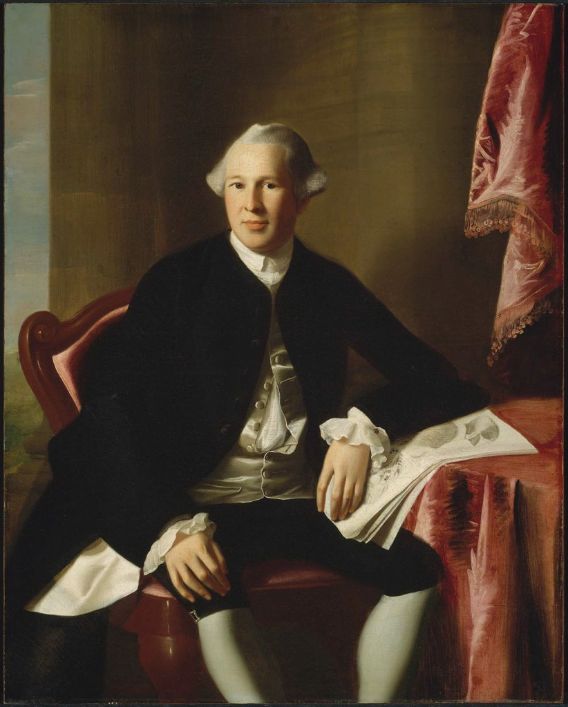
The tea went overboard into Boston Harbor in December of 1773…
The British responded with the Coercive Acts which, among other things, closed down the port of Boston, and drastically rewrote Massachusetts’ colonial charter, putting the misbehaving colony under direct royal control. Town meetings and colonial assemblies were for the most part banned.
Massachusetts and the other colonies decided to send delegates to a meeting in Philadelphia to decide how to handle this. This was the (First) Continental Congress.
In early September 1774, it seemed like Dr. Joseph Warren was the last of the anti-royalist resistance activists left in Boston. Most of his compatriots were either serving in the extralegal Massachusetts Provinical Congress, for secrecy and their own safety moving between Salem and Concord, or on their way to the big meeting in Philly. (The anti-royalist faction of colonists had been commonly referred to as “Whigs,” but a new label was starting to emerge: “patriots.”)
But Dr. Warren had work to do. In between tending to patients, he was writing. And writing. And more writing. Crafting a document that would “signal the transformation of the resistance movement into a rebellion.”
Conventions for the purpose of resisting or undermining the Coercive Acts (known in America as the “Intolerable Acts”) were being held throughout Massachusetts on a county-by-county basis. Boston’s county was Suffolk, and Dr. Warren was the Suffolk County convention chairman. And he had quite a statement to make.
On September 9, the convention met in a large private home in Milton, ten miles south of Boston. Warren read aloud what came to be known as the Suffolk Resolves. Each resolve received a boisterous cheer as it was read, and all of them were unanimously approved.
Warren’s resolves stated that the people of Boston and Suffolk County would boycott all British goods, pay no heed to any of the Intolerable Acts, demand the replacement of any government official appointed under the Intolerable Acts, support the Provincial Congress in operating free from any royal authority, and — this really got people’s attention — increase the size and strength of their colonial militia to fight if needed on behalf of these resolves.
Collectively, the resolves were a step-and-a-half further than anyone had gone before in an open forum. This was a group of colonists flatly rejecting acts of Parliament and expressing a willingness to defend this stance with lethal force. The other colonies needed to know about them as soon as possible. It was imperative that a copy be dispatched to the Continental Congress.
Dr. Warren handed off the Suffolk Resolves to his friend and trusted courier, who sped off towards Philadelphia…
The patriot movement in New England to re-establish colonial rights never had a true leader. There was no one demagogue or figurehead. It was a widespread social and political movement, guided by the will of the people. But the British government was desperate to blame it all on some kind of small cabal, just a handful of wily agitators stirring up trouble. The names they came back to again and again by the early 1770s were Samuel Adams and John Hancock.
But that duo was really a triumvirate. The efforts of Adams and Hancock to organize (not really “lead”) resistance to British oppression may not have succeeded without the contributions of their associate and confidante, Dr. Joseph Warren.
Born in 1741 to a respectable Roxford farming family that had been settled in Massachusetts for generations, the bright young Warren was sent off to Harvard in the late summer of 1755. (Sadly, his father, with whom he was close, died a few weeks later, after falling off a ladder while picking apples.) After graduation and a year of teaching at his old Latin school, he decided on a career in medicine. There was no such thing as a medical school in the American colonies, so Warren returned to Harvard to get a Master of Arts in medicine.
After gaining his post-graduate degree, Warren next had to serve a year-long apprenticeship under an established physician. He was lucky to be taken on by Dr. James Lloyd, one of Boston’s most respected medical practicioners. Under the tutelage of Lloyd (who had spent several years working with the best medical minds in London), Warren learned the most cutting-edge practices, in contrast to the primitive and outdated treatments used by many colonial doctors. He also was introduced to the higher levels of Boston society. Lloyd was quite wealthy, had a well-appointed house and gardens on Queen Street, and entertained lavishly. “Living under Lloyd’s roof, Warren had to comport himself as an extension of his mentor’s household,” wrote Warren biographer Christian Di Spigna. “Ensconced in an opulent lifestyle, he learned proper etiquette and how to entertain, acquiring his own taste for luxury in the process…Lloyd transformed Warren from an educated farm boy into a skilled and respected town physician.”
Warren opened his own general practice in 1763, treating everything from broken bones to STDs. He was also one of the few doctors at the time to offer up-to-date obstetric care. (Rather than leaving such things in the hands of God and midwives.) He was an early proponent of vaccination, and was crediting with staving off what could have been a disastrous outbreak of smallpox in the first year of his practice. He mixed with all levels of society, and could speak like both a “working-class farmer and a gentleman scholar.” The practice was a success thanks to Warren’s charm, intelligence, and what we now call good bedside manner.
Warren believed that a doctor should also be a responsible civic leader, so when the Stamp Act crisis hit in 1765, Dr. Warren plunged into the world of Boston politics. In addition to running his medical office (on south Hanover Street from 1770 on), he wrote provocative essays, made friends with John Hancock, Samuel Adams, and John Adams (who were also all his patients at one time or another), and discovered he had a talent for public speaking. Before his thirtieth birthday, he was considered one of Boston’s leading citizens and a major voice protecting colonial rights. Like Hancock, though, he maintained social connections on both sides of the divide (Dr. Lloyd was staunch Tory conservative) until that was no longer feasible.
He was there on frigid King Street in the aftermath of the Massacre, treating the wounded on site, and later performing the autopsies on the five who were killed.
He had married in 1764, and his firstborn came well short of nine months after the wedding day. (Despite 18th century folks having the reputation of being straitlaced, a teenaged pregnant bride was perhaps even more common then than it is now.) His wife, Betsy, died at age 26 in 1773, leaving him with four children under ten. After a brief but respectable amount of time, he began attracting the attention of several single women. After all he was only 31, easy on the eyes, made a good living, and was a well-known and well-liked figure around town. Although he kept it on the down-low, he was widely believed to be courting Mercy Scollay by the summer of 1774. Scollay was the daughter of a prominent town selectman and known to be a woman of “great energy and depth of character.”
Back for just a moment to 1630…
The town of Boston began at Bendell’s Cove. This small inlet on the southeast side of Shawmut Peninsula is where in September of that year John Winthrop established one of the primary necessities of a new trading colony — a dock. The Town Dock quickly became the heart of Boston commerce. Vendors converged in the area, hawking fish, butter, eggs, and poultry.
The marketplace around the Town Dock expanded over the next century, and really became something of a dirty, disorganized mess. Hardly the image of a pure, shining “city upon a hill” that Winthrop envisioned. The town fathers decided to step in and provide a little supervision. In the early 1730s, they constructed a public market building, and merchants were expected to rent a stall and keep things tidy. This was met by heavy resistance. Many vendors felt a centralized location would lead to increased price competition and unwanted regulations.
As we’ve seen, colonial Bostonians did nothing by halves. It wasn’t long before a mob of unruly merchants literally hacked the public market building to pieces, effectively de-regulating Boston’s commerce for the time being.
Enter filthy rich Peter Faneuil, described in the opening sentence of his Wikipedia article as “slave trader and philanthropist” (??), who offered to personally pay for a sturdier new brick market building…if Boston wanted it. Property-owning male citizens would have to vote on it. There were some suspicions about Faneuil’s motives. Why was he doing this? What was in it for him? Faneuil agreed to throw in a second-floor assembly hall (because Bostonians loved their assemblies) to assuage the doubters. The final vote was 367 to 360, so not exactly a landslide of approval. But construction began, funded substantially by the sale of enslaved persons. (Slavery eventually fell from favor in most of the northern colonies, New England particularly, but they weren’t there yet.)
#11 Faneuil Hall was opened in 1742 as the centerpiece of commercial Boston in what was now called “Dock Square.” The assembly hall’s first public function was Peter Faneuil’s funeral the following year. Yes, the hall burned to its brick walls in 1761, but that was to be expected. The restored Faneuil Hall was usable within two years, and completed by 1768.
There was some limited attic space, and this became the headquarters of the Ancient and Honorable Artillery Company of Massachusetts, founded many years before by our beleaguered friend Robert Keayne from the previous entry. The market was only partly successful in the colonial era, but the assembly hall was an immediate hit, and this is what Faneuil Hall is primarily known for. It has been referred to as “the Cradle of Liberty.” Town meetings were held there after every new British outrage in the 1760s, usually led by the era’s most captivating speaker, Samuel Adams. It was where a stunned populace gathered the morning after the Boston Massacre. It was the meeting place for Boston’s Committee of Correspondence, one of the earliest attempts to unite all the American colonies in resistance to British violations.
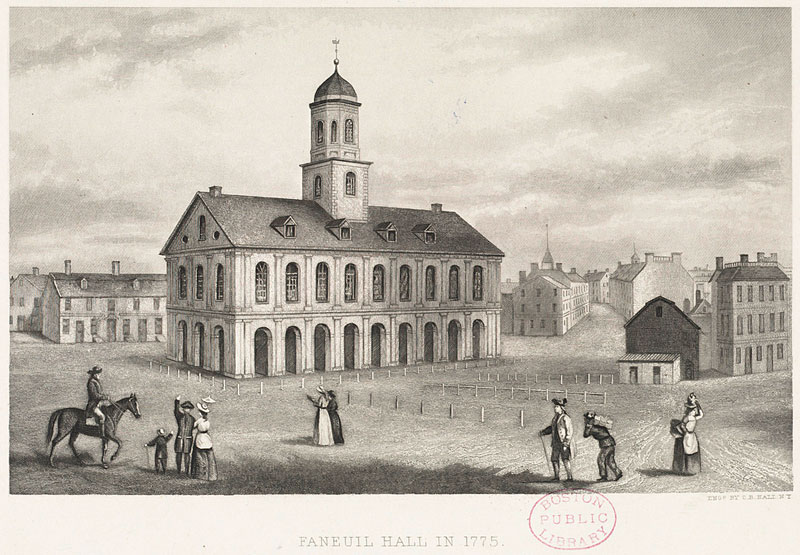
By the time revolution broke out in 1775, the British Army was using it as a barracks, a storehouse for arms and ammunition, and even as a space to stage theatrical plays for the entertainment of the soldiers. (This was especially galling to some of the more Puritan-minded Bostonians who still believed live theater to be sinful.)
After the war, Faneuil Hall returned to its original use. The market floor was now bustling in the post-independence era, illustrious orators brought large crowds to the upstairs hall, and by the early 1800s Faneuil Hall was deemed too small for its original purposes. Boston’s favorite architect, Charles Bulfinch, supervised the process of doubling the building’s width, and adding one-and-a-half stories to its height in 1806.
And it was still not quite enough.
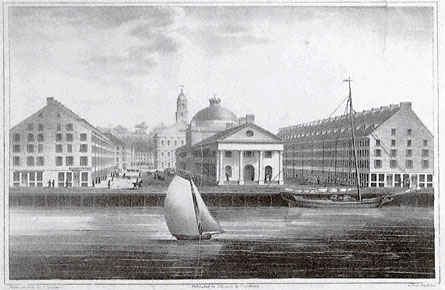
Boston was incorporated as a city in 1822. Most of the city’s shipping was to be found on the big commercial piers to the southeast of downtown, leaving the old Town Dock — where it all started — as a “receptacle for dead cats and other rubbish, its watercraft consisting of a pair of scows moored for the sale of oysters.” The dank waters of the harbor came right up to Faneuil Hall’s doorstep, and looking east from one of his offices on the Hall’s second floor, Boston mayor Josiah Quincy III gazed out on “a tangle of wharves and temporary wooden shacks.” The smell assaulted his nostrils. He decided to do something about it. The city bought out the wharves and shacks, or seized them through eminent domain, and began filling everything in. The shoreline moved eastward.
On the newly reclaimed land adjacent to the hall rose three long market buildings. The north and south buildings, funded by private investors, were made of brick, but the showpiece center building was granite with a large central rotunda and was paid for by the city. All of the original Faneuil Hall’s merchants were relocated to this new “Faneuil Hall Market” (or more commonly “Quincy Market,” against Josiah Quincy’s wishes), which opened in 1826. The hall then went through the first of several major renovations over the next two centuries.
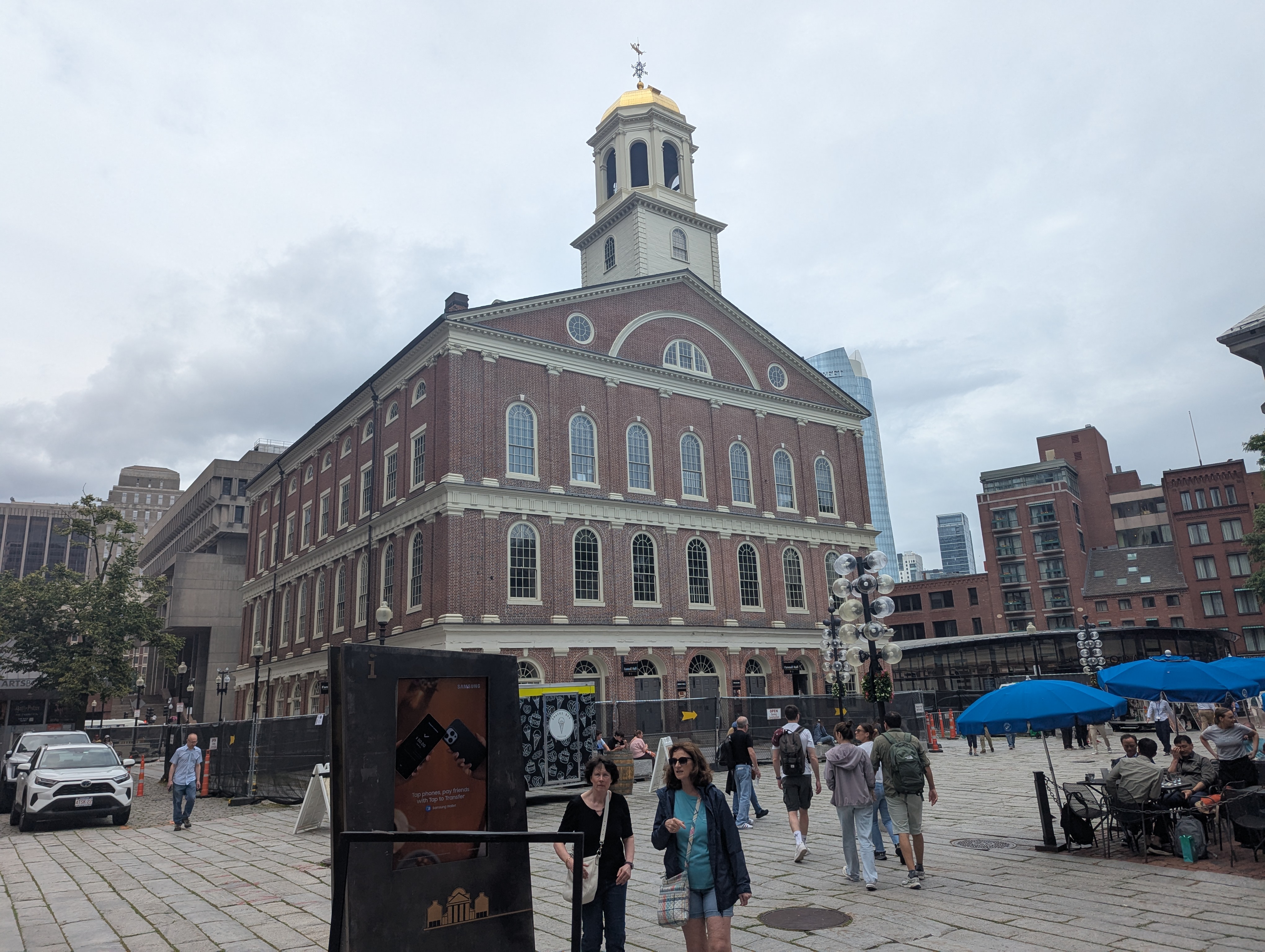
An 1880 bronze statue of Samuel Adams, arms crossed in defiance, was placed in Dock Square to the west of Faneuil Hall. Dock Square itself became a traffic circle with the advent of motorized transport. By the end of the 20th century, the area was overshadowed by Boston’s cluster of high rise buildings, the traffic circle was eliminated as the citys streets modernized, and nowadays, Dock Square is pretty much gone. It’s sometimes used to describe the area around a small pedestrian plaza on the western side of the Hall, nowhere near any dock.
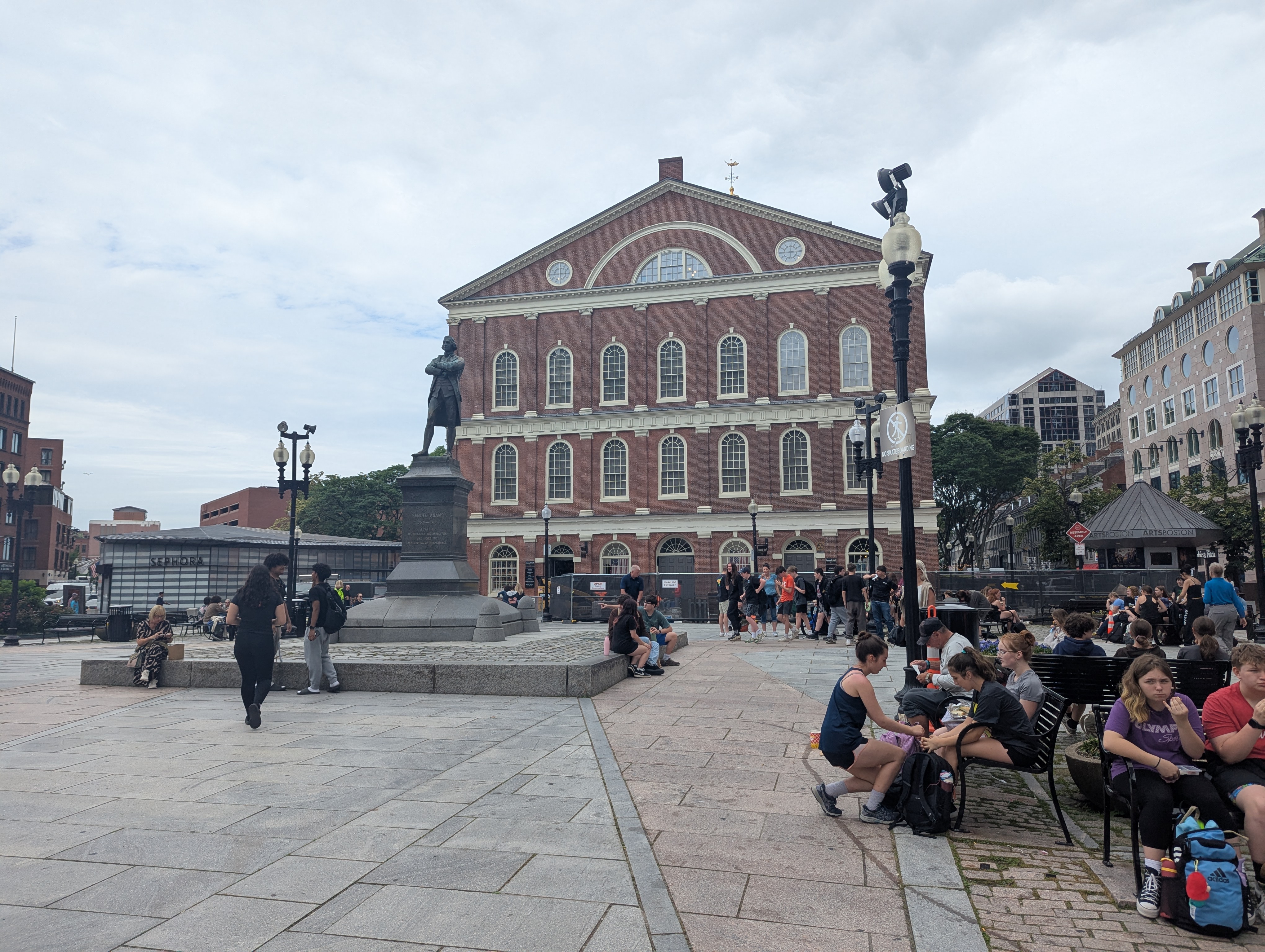
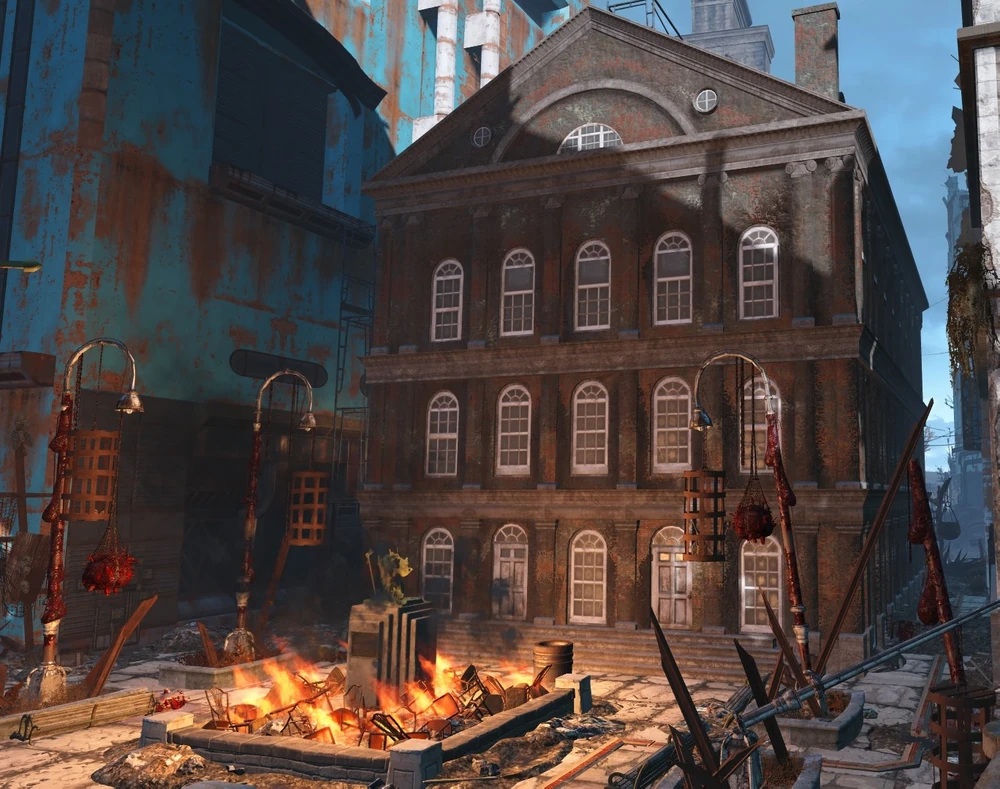
This was the area we entered looking for lunch. The shoreline was now even further to the east, and out of sight. Although it faces the busy thoroughfare of Commercial Street and boasts the aforementioned statue and plaza, the western side is technically the back of Faneuil Hall. The front, with its tall white cupola, faces east towards Quincy Market. I had a brief flashback of standing on the hall’s roof next to the distinctive grasshopper weathervane from back when I played Fallout 4. (I was strongly tempted to replay Fallout 4 after learning so much about Boston geography, which would go against my ironclad rule of never replaying lengthy open-world RPGs. Life’s too short. I inevitably fall into the same patterns and make the same highly moral decisions as my first playthrough. I could never call Dogmeat a “dumb butt,” even though the dialogue options give me the opportunity to do so. )
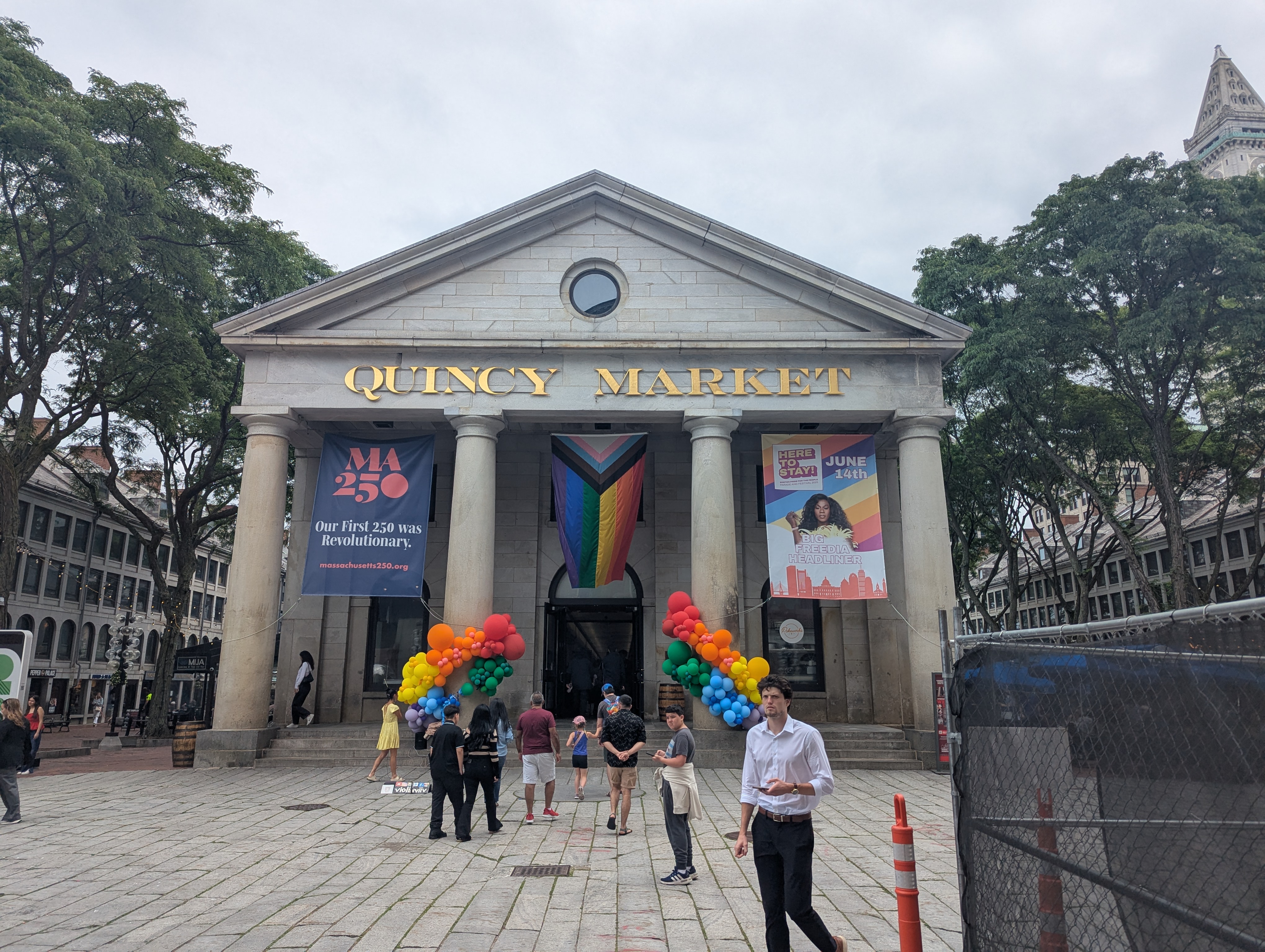
I gazed up at the stubborn bronze chin of the Samuel Adams statue as Shannon consulted the Yelp! app and fulfilled her designated role as “food finder.” We decided our first Boston lunch should be clam chowder. Luckily, there seemed to be a pretty good option merely yards away. We set off for the center building of the market complex. Entering Quincy Market, we observed that it was essentially a massive shopping mall of the type known as a “festival marketplace” — local or regional businesses instead of national chains, plenty of mid-mall kiosks and wagons, and large open common areas, often featuring street performers or musicians. There was a string quartet playing under the rotunda on the day we visited.
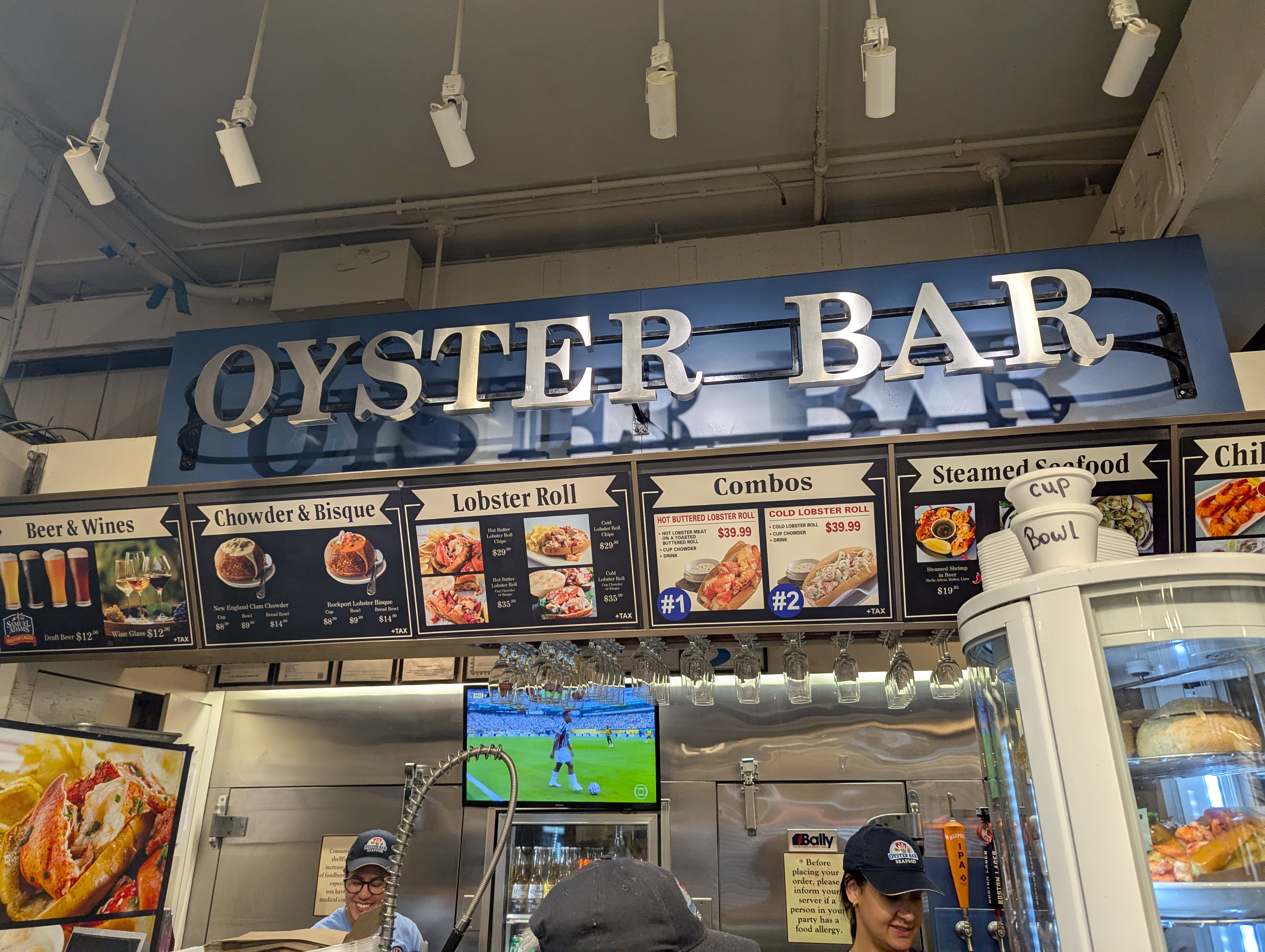
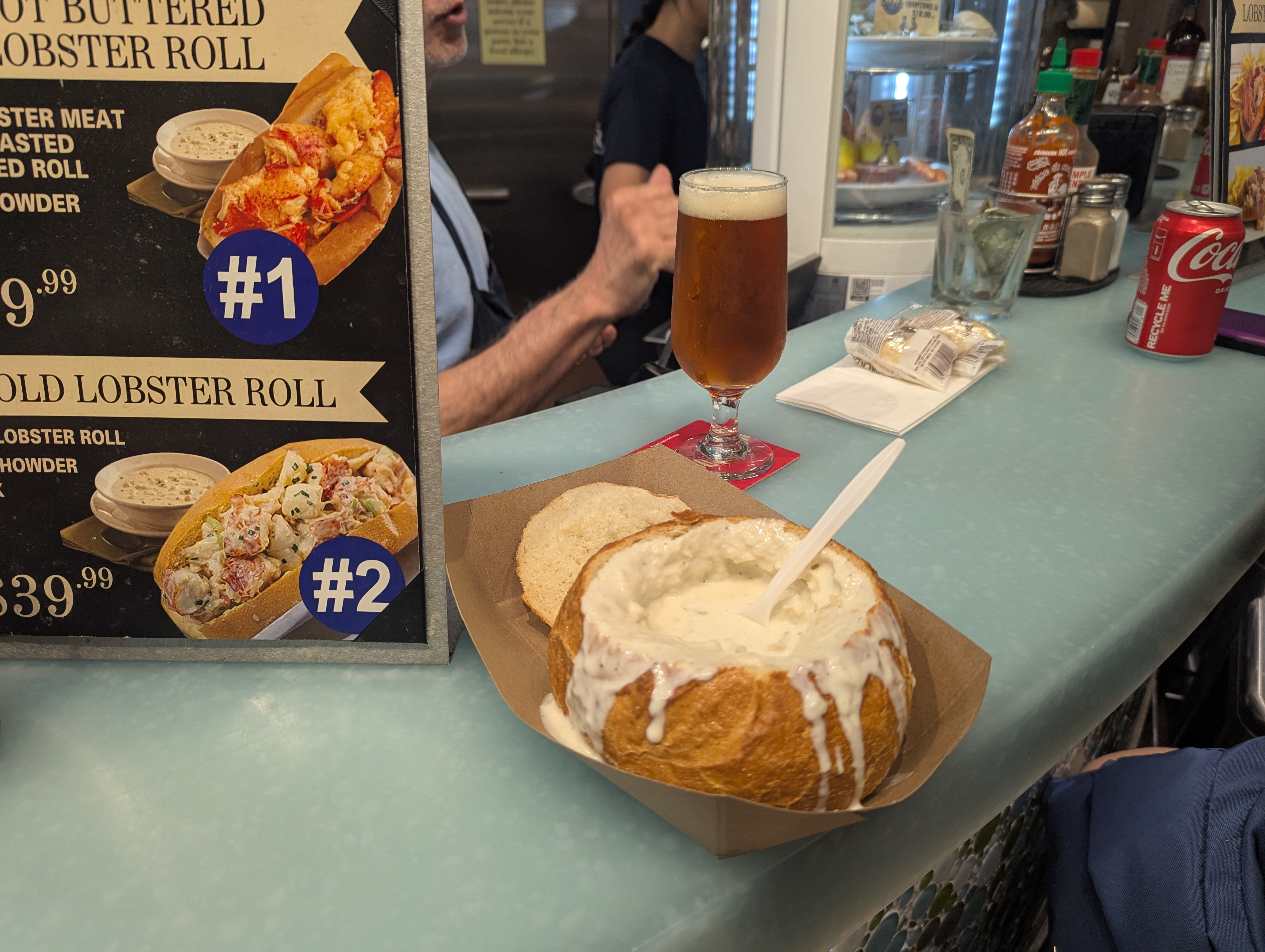
We soon reached the Oyster Bar in the market’s food colonnade. Several reviewers had pronounced it the best chowder in Boston, and even though I had nothing to compare it to (having been in Boston less than 24 hours), the claim seemed reasonable. The Oyster Bar is not a sit-down joint — you’re expected to get your food and skedaddle, hopefully finding seating elsewhere. There were only eight stools right up against the service counter. We lucked out and got there just as two people were leaving. The chowder was washed down with the first of many Sam Adams Boston Lagers (on the trip, not at the Oyster Bar).
As we returned to the Freedom Trail, we passed through the ground floor of the original Faneuil Hall, and in keeping with Faneuil’s original wishes it is still a marketplace. Only now instead of all manner of fish, meat, and farm-fresh produce, shoppers can procure Bostom-themed souvenirs or any number of hand-crafted items made by local artisans.
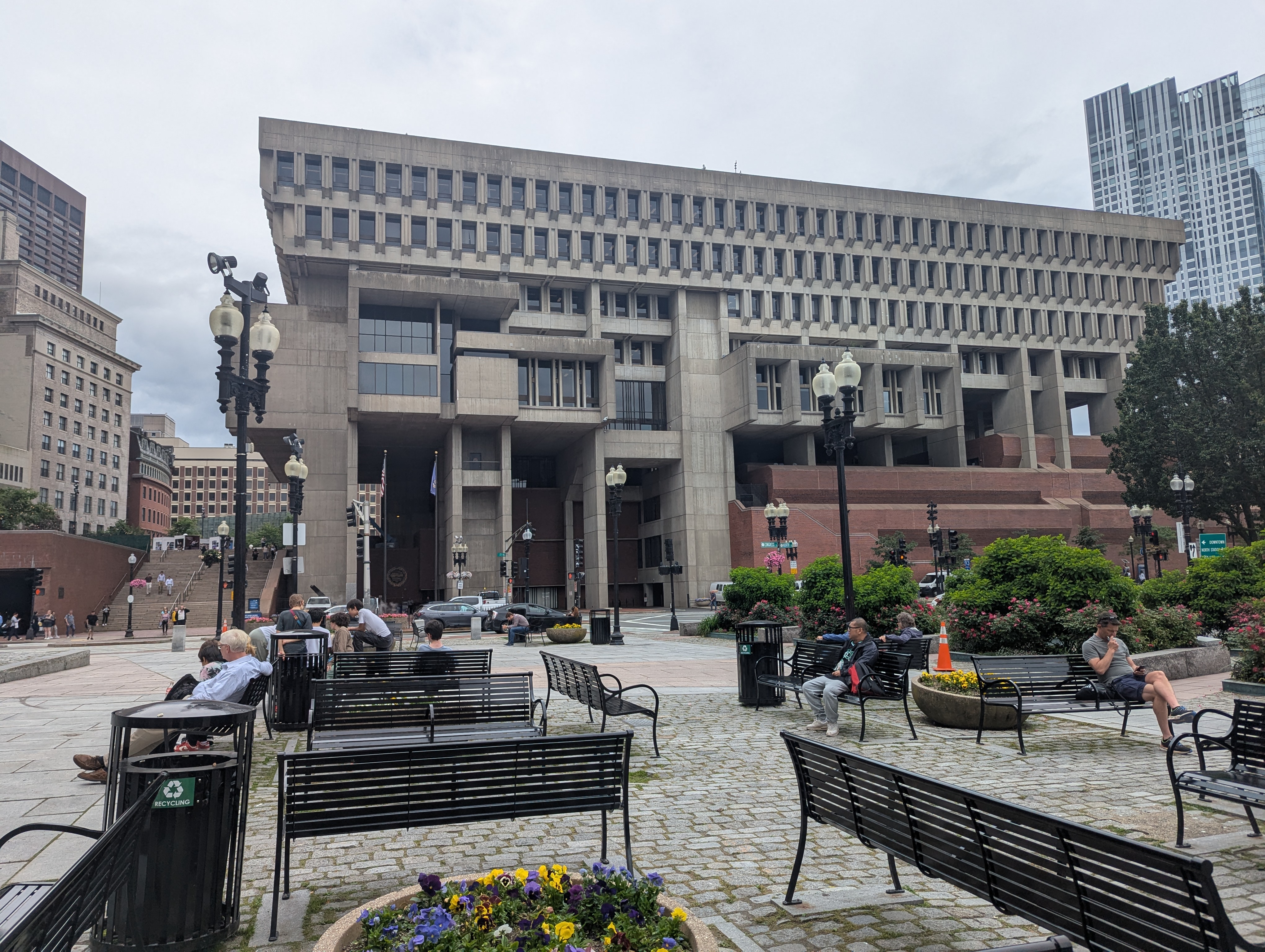
We didn’t linger long, and exited out the west door. I looked over the much-reduced Dock Square across Commercial Street at the incredibly ugly brutalist Boston City Hall. I wondered what had been there before this monstrosity was constructed, since every square foot of this part of Boston was connected to some important person or event in history. I researched it later and was not disappointed.
Boston City Hall is part of an area known as Government Center, also home to the John F. Kennedy Federal Building. The city hall and federal offices are separated by the 8-acre red brick City Hall Plaza. Seedy old Scollay Square (named after Mercy Scollay’s brother William, an early real estate tycoon), Brattle Street, the last remnant of Cornhill, and the southern portion of Hanover Street were all demolished in the early 1960s to bring Government Center into fruition. All historically notable, but fallen on hard times. Thousands of low-income residents and recent immigrants were booted for the $40 million federally-funded project which was completed in 1969.
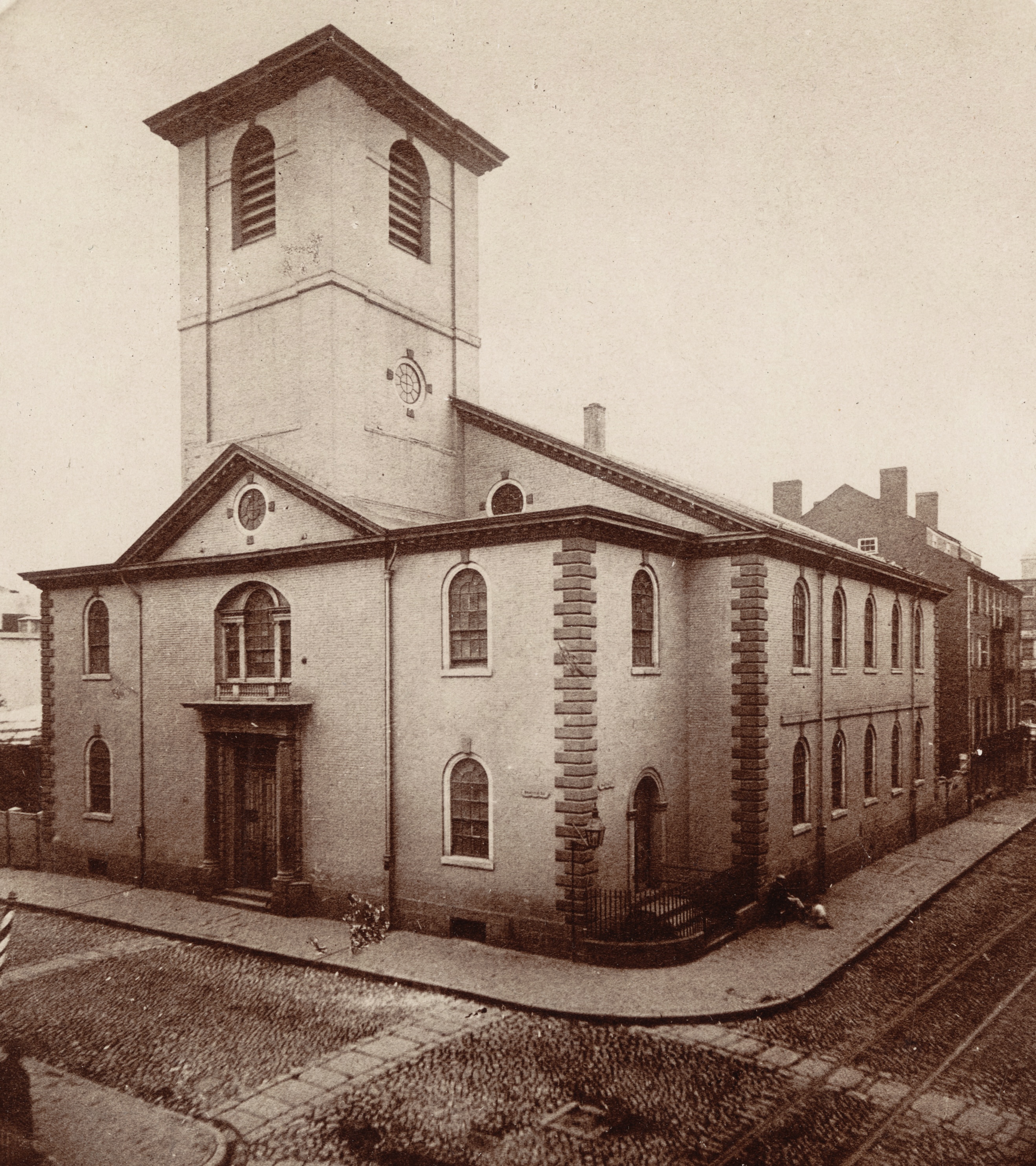
Already long gone was the Brattle Street Church. We’ve discussed Boston’s First Church (“Old Brick”), and Third Church (“Old South Meeting House”) in previous entries, and we’ll touch on the Second Church soon. What did all three of those venerable Congregational meeting houses have in common? It’s the fact that none of their pews were graced by the leaders of the nascent revolutionary movement. It was Boston’s fourth Congregational house of worship, the Brattle Street Church, that was the church of choice for Samuel Adams, John Hancock, John Adams, Joseph Warren (who had the pew closest to the side door so he could slip out in case of a medical emrgency), and many others of a revolutionary bent. They likely made their selection because this fourth congregation’s manifesto indicated they would not be as rigid and dogmatic as the other three. The ideas of the church’s primary founder, Thomas Brattle*, aligned more with the laidback old Anglican Church, rather than the fire-and-brimstone Calvinism that was a legacy of Boston’s Puritan roots.
The original 1698 wooden structure was replaced by a brick one in 1772, thanks largely to the “thousands of pounds” donated by the deep-pocketed John Hancock. (Samuel Adams later joined the Old South Meeting House in 1789. It is speculated that the Brattle Street Church had become the church of Boston’s wealthy elite, and Adams wanted to preserve his “man of the people” commoner image.) After a century of use, most of it as a Unitarian church after Congregationalism faded, the Brattle Street Church was demolished in 1872.
Also getting about a century of use was the American House Hotel, built in 1835 a block to the north of Brattle Street on Hanover Street. The American House was razed in 1935 for a parking lot, which in turn was covered over by the bricks and concrete of City Hall Plaza.
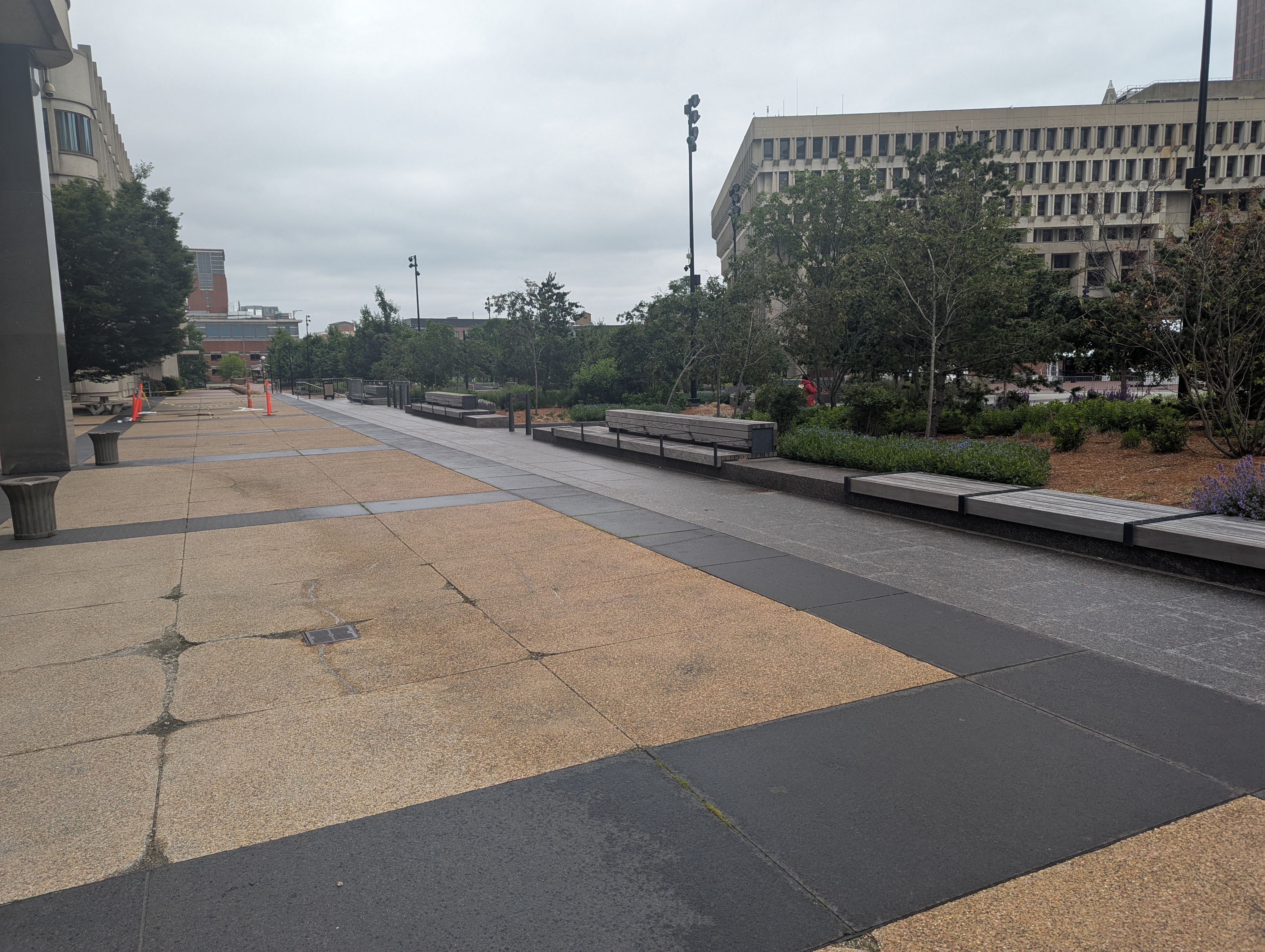
What was on the site before the American House Hotel, you ask? Nothing less than the home and medical office of one Dr. Joseph Warren. Now standing in its place is a row of decorative trees running parallel to the Kennedy federal building.
The friend and trusted courier to whom Dr. Warren gave the Suffolk Resolves on that early September afternoon for speedy dispatch to the Continental Congress was Paul Revere. The Continental Congress officially endorsed the Suffolk Resolves on September 17, 1774 (“one of the happiest days of my life,” wrote delegate John Adams at the time), and to the wonderment of many, used them as a template for its own set of resolves when the Congress adjourned in October. All thirteen colonies (well, twelve — Georgia sent no delegates) seemed prepared to go as far as the people of Boston would go. Things were looking dire for the relationship between the American colonies and the mother country. A second Continental Congress was scheduled for the following spring if the situation did not improve.
In 1752, the United Kingdom and her American colonies switched from the Julian calendar to the Gregorian calender. The most noticeable effect was shifting everything forward eleven days. Modern Americans know George Washington’s birthday as February 22, but the man himself always celebrated on February 11.
On the old calendar, Paul Revere was born on December 21, 1734. On the new one, he was born on the first day of 1735.
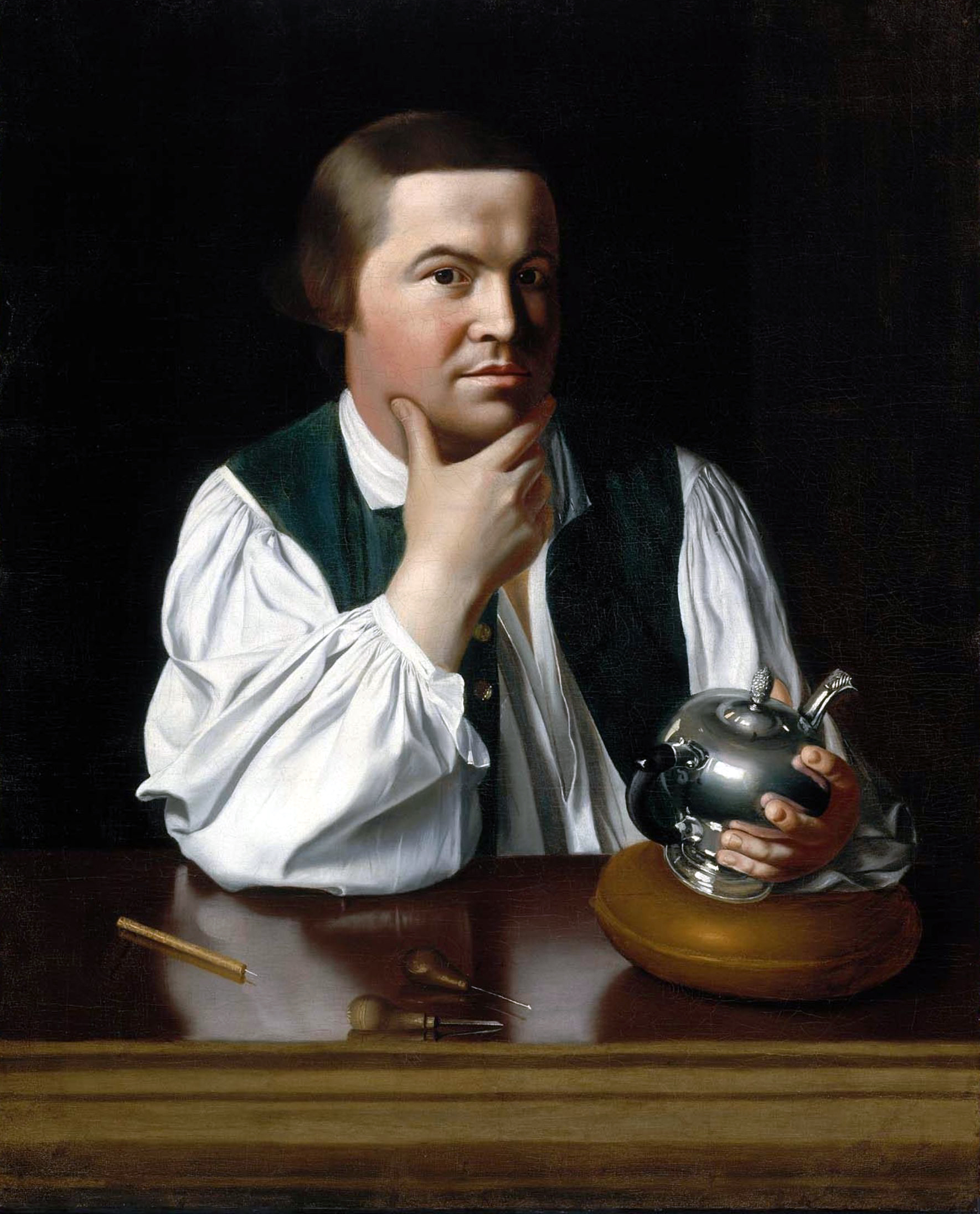
He was born in Boston, the son of a French Huguenot immigrant named Apollos Rivoire. Apollos arrived in Boston at age 13, speaking no English. It took a decade and a half, but by 1730, the senior Revere had anglicized his name to the version we’re now familiar with (because the “bumpkins pronounce it easier,” his son noted dryly), mastered his new language, married Boston native Deborah Hitchborn, and opened a silversmith workshop. Young Paul completed his schooling at thirteen, which was the standard age for those not advancing to university. Although industrious and bright, he was not Harvard material. He strapped on a leather apron and apprenticed under his father, learning the silversmithing and engraving trades. He made no effort to embrace his French Huguenot heritage, and always considered himself a salt-of-the-earth, hard-nosed, pragmatic Yankee. When his father died when Paul was nineteen, he was skilled enough take over the family business. (Surruptitiously at first — he couldn’t legally own a business until he was 21, so his mother fronted for him.) For many decades, Paul Revere’s shop could be found on Fish Street at the head of Clark’s Wharf on the waterfront in Boston’s North End. (Now the intersection of Fleet Street and Commercial Street.)
As a member of the artisan class, a man who worked with his hands and had no higher education, certain levels of society would always be closed off to him. But as the owner of a successful business, and the matrelineal offspring of an old Boston family (the Hitchborns were quite well-regarded), he could at least aspire to a certain level of respectability. “Class barriers [in colonial America] were real, but not insurmountable,” wrote Revere biograper Joel J. Miller. “By excelling in one’s craft and rising in the esteem of his neighbors, a man had a shot at going from the lower sort to the middle sort, and maybe even to the upper sort.” He married Sarah Orne in 1757, and immediately began producing offspring. He met Joseph Warren — before he was a doctor — at a Masonic lodge meeting in 1761, and the two became good friends. (Both Revere and Warren were very dedicated Freemasons.)
His business ebbed and flowed with the volatile New England economy, but for the most part he kept it in the black. Working with both silver and gold, he took orders for the creation of punchbowls, coffeepots, cutlery, snuffboxes, tankards, and jewelry. He offered repair and engraving services, and even tried his hand at what passed for dentistry in the mid-1700s. He also expanded into an interesting sideline — engraving illustrated copper plates for the purposes of printing, usually some form of political cartoon. Unlike Warren and many other Bostonians, the Stamp Act and its subsequent riots did not immediately turn Revere into a political animal. He stood on the sidelines for awhile, mostly concerned with his work and growing family. But it wasn’t long before he was drawn into the orbit of the anti-royalists. The instigators of the first Stamp Act riot, the Loyal Nine (as described in Part 1), were all artisans well known to him. He was close friends with hardcore Whig Joseph Warren. He grew increasingly sympathetic to all the anti-British propaganda he was engraving. A natural joiner, by 1767 or so Paul Revere was considered an active member of the Sons of Liberty.
In 1770, three important events in Revere’s life occurred. He created the propaganda engraving of the Boston Massacre that made the incident famous throughout the colonies and in Britain. He had his portrait painted by the famed artist John Singleton Copely (see above). (Sitting for a portrait was something normally reserved for the upper classes, but Copley owed Revere for some custom gilded picture frames.) And he bought the house at 19 North Square that Shannon and I now approached after leaving the Dock Square area and entering the North End.
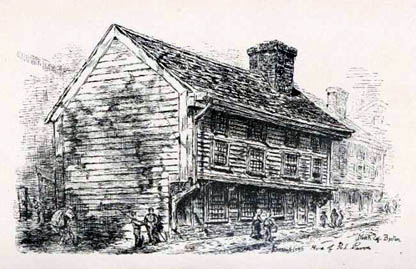
#12. The Paul Revere House was already almost a century old when he bought it. The site was originally the parsonage (minister’s residence) for the ministers of Boston’s Second Church, whch was right across from it. From 1664 to 1741, its ministers were all members of the Mather family — Cotton Mather, his son Increase, and Increase’s son Samuel. The Second Church was established in the North End in 1649 to keep up with Boston’s booming population, and its meeting place was called “Old North Meeting House.” (Don’t confuse it with the “Old North Church,” also connected to Revere’s legacy, and the next stop on the Freedom Trail.)
Wouldn’t you know it, the meeting house and the parsonage were destroyed by fire in 1676. A “new” Old North Meeting House was quickly built, but the parsonage site wasn’t built on until 1680. The parsonage had since moved elsewhere, and this new construction became a private home. By 1770, it had undergone a thorough renovation, was spacious enough for Revere’s ever expanding family, and was a two-minute walk from his shop on Fish Street.
It is claimed that nearly ninety percent of the Paul Revere House is original to the 1700s, and it contains several pieces of authentic period furniture that may have belonged to the family. Revere only lived here for a decade, but it was the decade that made him famous. He rented the property out in 1780, then sold it off in 1800.
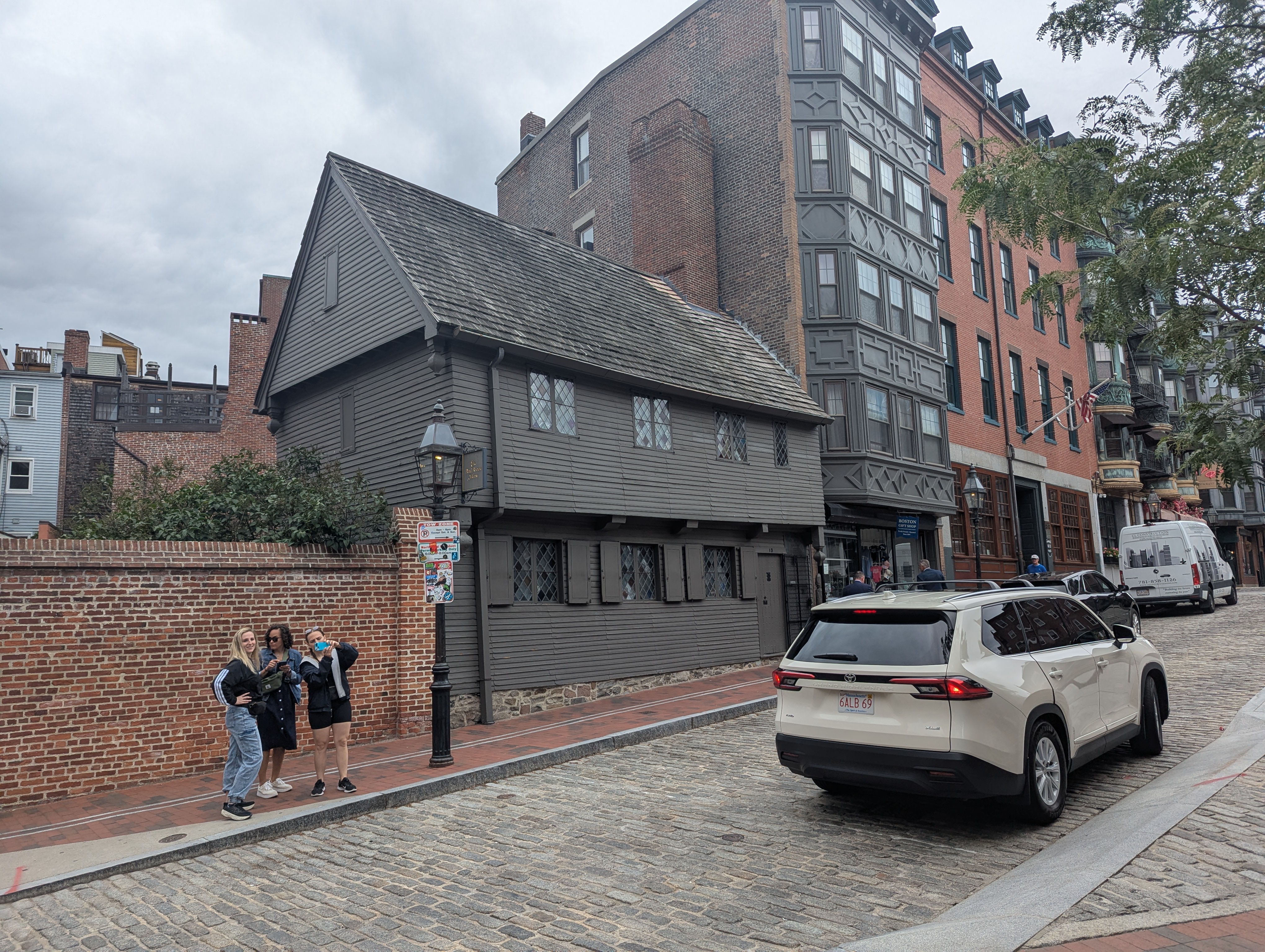
The Paul Revere House is also considered the oldest surviving house in central Boston. So it’s got that going for it, which is nice. We decided not to pay the fee to see the interior, but rested a moment on North Square itself, the former site of the Old North Meeting House. The Old North Meeting House was pulled down by the British Army during the Seige of Boston in January 1776 for use as firewood and never replaced. The congregation moved to a new building on Hanover Street. The modern North Square is considered the heart of the North End’s vibrant Italian community. I still had a stomach full of chowder, but I hungrily eyed the at least four Italian eateries in my direct line of sight.
As we lingered in the square, I had to listen to some elderly, half-soused dimwit of a tour guide in a powdered wig and knee breeches tell a group of tourists that John Hancock was the “actual first President of the United States” because he was president of the Second Continental Congress. If I were the confrontational type, I would have raised my voice above his yammering to point out that 1) Hancock had no executive authority (his position is better described as “chairman”), and 2) there was no “United States” to be president of! The nation did not exist at the time of the Second Continental Congress. We were “united” only in the sense that the colonies-turned-states pledged to cooperate with each other to achieve independence. That’s how the term was used and understood in the Declaration. “United States of America” as the name of our commonwealth was not official until the ratification of the Articles of Confederation in 1781. And even at that point, we were only a loose confederation of autonomous states, like the European Union, with no chief executive to speak of until 1789, when the Articles were dumped in favor of the superior U.S. Constitution (which, let’s be honest, has its own set of issues). The tour group should get their money back.
But I only sighed and said everything in the paragraph above, pretty much verbatim, through clenched teeth to Shannon. She listened patiently and gently patted my arm. We moved on.
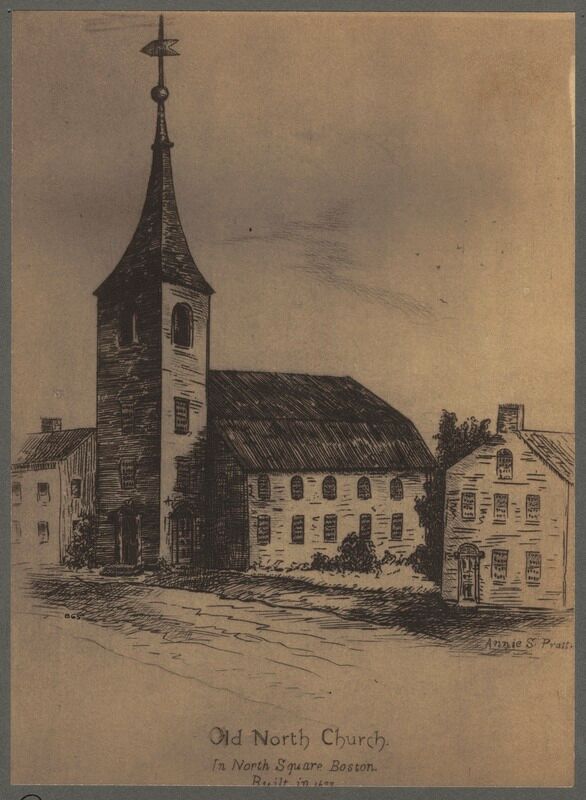
The Freedom Trail led us further north to the shady space known as Paul Revere Mall. We crossed through, past the equestrian statue of Revere himself, and when we emerged, we were within sight of our next stop — the Old North Church, and its famous steeple. Following that, we would be crossing the Charles River to Bunker Hill. Our time with Paul Revere, and Dr. Joseph Warren, is far from over.
*Thomas Brattle (1658-1713) — mathematician, astronomer, Harvard treasurer, witness to the Salem Witch Trials, and religious reformer — was yet another remarkable individual, and I would love to write more about him, but that would make this take even longer
SOURCES:
https://pmc.ncbi.nlm.nih.gov/articles/PMC2626357
https://www.wchsmuseum.org/josephwarren.html
Faneuil Hall; Boston Landmarks Commission Study Report (PDF)
https://www.oldsouth.org/samuel-adams-brattle-street-church-mystery
https://www.walkingboston.com/reveres-at-work-and-home/
Founding Martyr: The Life and Death of Dr. Joseph Warren — Christian Di Spigna
Paul Revere’s Ride — David Hackett Fischer
The Revolutionary Paul Revere — Joel Miller
Bunker Hill: A City, A Seige, A Revolution — Nathaniel Philbrick
Freedom Trail Boston: Ultimate Tour & History Guide by Steve Gladstone

