I’ve always known my reading tends to skew toward biography and memoir. What I didn’t realize is how completely it’s taken over my reading list. Of the 31 non-fiction books I got through this year, 24 of them were someone’s life story. But what’s not to like? You learn not only about an interesting person, but also about the era they lived in and its cultural context. I’ve considered trying to break away and broaden my palette, but why bother? Bios have it all. I hereby declare 2011 the Year of the Biography.

Here’s some highlights from my 2011 reading list (I’ve included a few pics of the Holy Bee’s personal library so you can see what I’ve chosen to surround myself with rather than actual people):
BOOK OF THE YEAR:
I Want My MTV: The Uncensored Story of the Music Video Revolution by Craig Marks & Rob Tannenbaum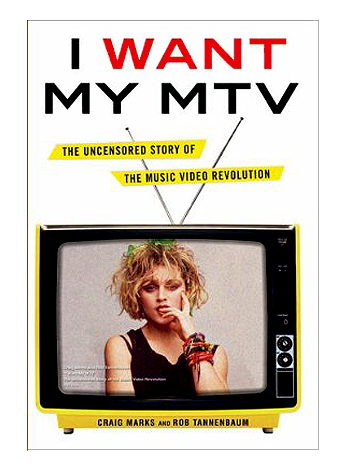
I don’t know if he invented it, but writer Studs Terkel certainly perfected the concept of an “oral history.” He would go out and interview a wide variety of people who created or influenced an aspect of American culture, and piece together a book on that topic out of their own words. In (relatively) recent years, two landmark works of oral history have been published — 1995’s Please Kill Me told the story of the rise and fall of punk rock in America and Britain in the words of the scene’s (surviving) participants, and 2002’s Live From New York dealt with the seemingly unkillable NBC late night comedy show Saturday Night Live. Marks and Tannenbaum acknowledge the influence of these two books in the introduction to their own (yes, I read the introductions to books), which gathers recollections from hundreds of artists, directors, executives, and on-air personalities (“VJs”) to explore the glory years (1981-92) of the revolutionary cable network Music Television.
MTV was a huge part of growing up for me, both through childhood and adolescence. In its early years (1981-85), my older sister and her friends would sit and stare at it for hours. It was a time for them to socialize, yes, but often they just watched, sometimes offering a little pre-Beavis & Butthead commentary. Occasionally, grade-school Holy Bee would join them as a welcome guest. Other times I had to sneak down after dark and hide behind the couch, half-listening as they talked about incomprehensible high school things, and watching images of Van Halen, Madonna, Lionel Richie, The Thompson Twins, The Eurythmics, and many others unspooling before my eyes as I peeked out through the crack between the couch and the wall. (Looking back, I’m pretty sure they knew I was there, but ignored me.)
Then, when my sister went off to college and my family moved to a rural area with no cable — no more MTV. As a result, there’s a noticeable gap in my knowledge of music and pop culture from 1986 through the first half of 1989. When people bring up the likes of Rick Astley or Frankie Goes To Hollywood (as they often do), I go a little blank. I wasn’t missing much, though. Evidently, ’86 to ’89 was hair metal’s time to shine, and the two biggest VJs were the absolutely odious Downtown Julie Brown and the pompous blowhard Adam Curry. (Want a quote from Curry straight from the book? “I called MTV ‘The Big M…’ I thought that was genius of me.” He’s serious. It’s on page 375.)
Starting high school and a return to a cable-friendly area coincided perfectly for me in the summer of ’89. I was back on the grid, literally and figuratively. These were “my” MTV years — ’89 to ’94. I didn’t know the behind-the-scenes issues that were slowly and imperceptibly changing the network even back then, I only knew it was on my bedroom TV from the time I got home from school at 3:30 to the time I nodded off shortly after midnight, and it was on in the background of every social occasion I attended.
It’s been a long-lamented fact that MTV no longer shows music videos. The way people my age and a little older (the original “MTV generation”) wail about this has become tiresome. I’m sure there were scroll enthusiasts who pitched a fit when moveable type was invented. Some things just can’t be viably saved, no matter how much they remind us of our rapidly-fading youth. The book makes it clear that just showing videos was ultimately a dead-end. Fewer people were tuning in to watch them. As video games became more sophisticated and popular, they became the after-school activity of choice for slack-jawed teenagers. And music genres were becoming increasingly separated — rap fans wouldn’t watch rock videos, and vice versa. The big, happy melting pot of the 80’s was long gone — as dictated by the viewers themselves.
The cold, hard numbers showed that the channel was slowly dying by the early 1990s, and original programming like The Real World saved it, at least as far as its ad revenues were concerned (which is the only reason any show is on any network, ever.) Kids who would no longer watch music videos would watch six over-entitled shitheads squabble in kooky-looking house. We can rail against the lack of “M” in “MTV” all we want, but its (d)evolution was absolutely inevitable. Why is still called “MTV” if there’s no “M”? Same reason it’s still “AT&T” (the second “T” being “telegraph.”) It’s just a name now. Or, in the words of Duran Duran keyboardist Nick Rhodes: “Now it stands for Money.”
Still, it was fun while it lasted. I’ll leave you with a quote from late-period VJ Dave Holmes: “I don’t think kids twenty-five years from now will be talking about a specific episode of My Super Sweet 16 the way we remember things about videos.”
People are getting stupider, though. They probably will, Dave. They probably will. Continue reading →













 Holy Bee of Ephesus