
John Hancock was likely a smuggler. But so was everyone else in his line of work. To a Boston merchant, finding creative ways to evade the Navigation Acts was just good business.
The series of Navigation Acts that began being passed in 1651 required that all shipments to and from the American colonies had to be on British-owned ships, and cargos had to pass through an English port no matter where they were coming from or where they were going so they could have import duties paid directly to the British government, along with a variety of other restrictions designed to line British pockets.
It was a policy that was outrageously unfair to colonial merchants, but almost impossible to enforce effectively, and for much of the 1700s, Britain didn’t try particularly hard. As a result, tons of “illegal” untaxed goods sailed into Boston Harbor, technically making a criminal of one of our nation’s founders long before he joined the treasonous revolutionaries. (When the British government actually tried to get tough on import duties, the result was the Boston Tea Party, more on which anon.)
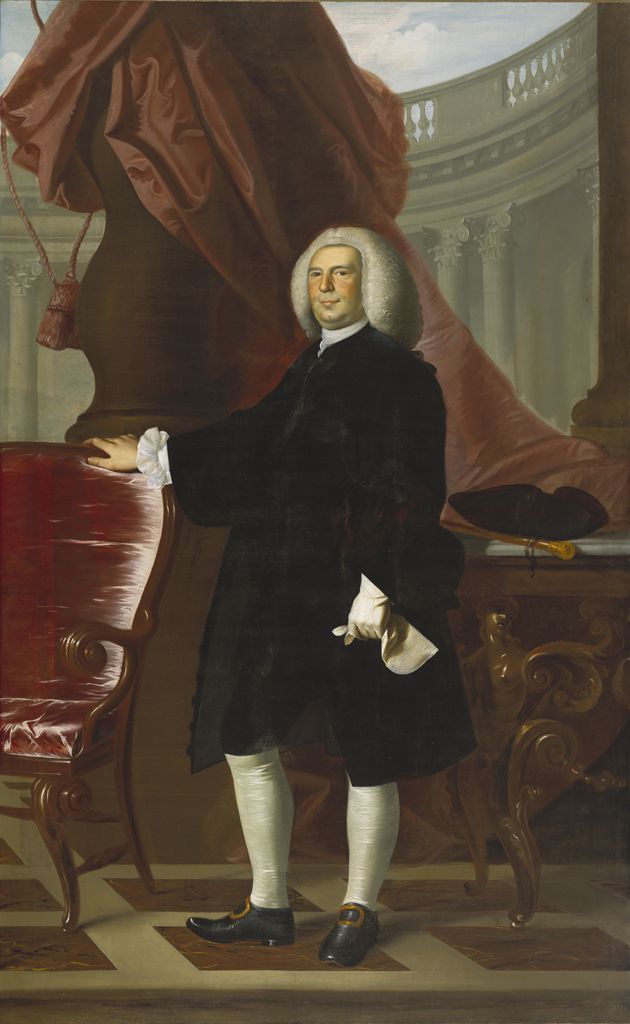
John Hancock’s father and grandfather were ministers. His father baptized the newborn future president John Adams in 1735. Hancock himself was born in 1737, and seemed destined to join the family trade. Those plans were derailed in 1744 when Hancock Senior dropped dead. Little John was sent to live with his uncle, Thomas Hancock. Hancock’s birth mother quickly re-married and vanished from his life, so Thomas’ wife Lydia became his beloved maternal figure.
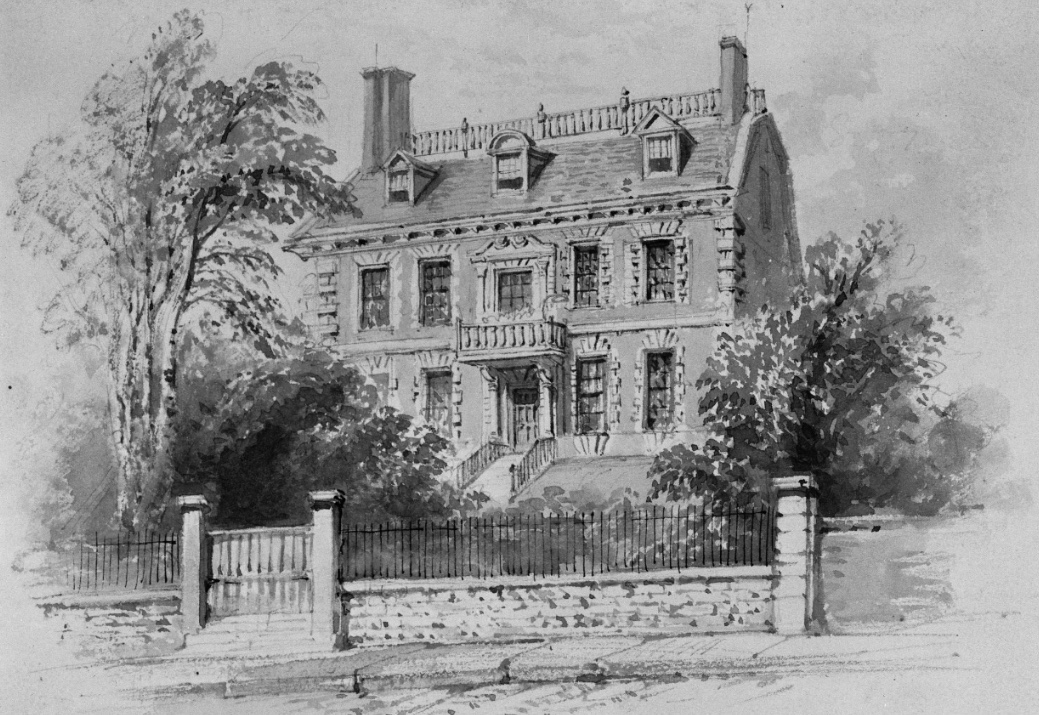
As a purveyor of “general merchandise,” Thomas Hancock had done quite well for himself. An early adopter of vertical integration, Thomas owned huge tracts of tree-filled land, a paper mill to turn the trees into paper, a bookbinding factory to make the paper into books, and a bookshop to sell the books, among many other interests. It was only natural that such a prosperous merchant should have a fine home, so in 1735, Thomas bought some land on the south slope of Beacon Hill next to the Common and began construction on what would be described as Boston’s most famous home — Hancock Manor, the first house built on that hill, which in those days was on the far edge of the city proper.

Two-and-a-half stories tall, the brown granite Georgian mansion sported three big dormer windows along the gambrel roof, a dozen main rooms, a dozen steps leading up to a broad front porch with a balcony above facing Beacon Street, and extensive gardens and orchards. The house had a commanding view of the city and the harbor. Thomas Hancock enjoyed his palatial estate for almost thirty years. When he died in 1764, he left all of his businesses — locks, stocks, and barrels — to nephew John. John had been working diligently for his uncle for the past decade, and had learned the import/export business inside and out. Aunt Lydia inherited Hancock Manor, but signed it over to John almost instantly with the understanding that she could continue to live there.
In one fell swoop, John Hancock was one of the wealthiest men in Massachusetts. He gave generously to the Boston community, covering the costs of the laying of paved walkways in the Common, the entire re-construction of the Brattle Street Church, and the free distribution of firewood to the poor during the winter months. His popularity gained him a place on both the town council and in the colonial assembly.
His deep pockets also funded the Sons of Liberty and their fight against British oppression. The savvy Samuel Adams took the political neophyte Hancock under his wing, knowing his local prominence as a successful businessman and his facility for using money to make more money could be very useful to the cause.
Adams and Hancock made an odd pair. The shabby Adams could usually be found in the taverns and down at the harbor in his threadbare coat, shaking hands, gathering news, making contacts and connections. The genteel, well-dressed Hancock preferred more elevated company, and many among his business associates and social circle were conservative Tories who may not have known there was a rebel in their midst. Odd couple or not, once the situation between Britain and the colonies turned violent, it did not take the British authorities in Massachusetts too long to single out the team of Adams and Hancock as the driving force of the incipient revolution.
In 1768, one of Hancock’s cargo ships, the Liberty (it was by now public knowledge where his political sympathies lie), was busted for smuggling. Try as they might, the British officials could not get the politically-motivated, trumped-up charges to stick, and the case was eventually dropped. But it galvanized Hancock against the British even more. To be clear, no official evidence of Hancock smuggling anything has ever come to light. But, c’mon…he was probably just really good at it…
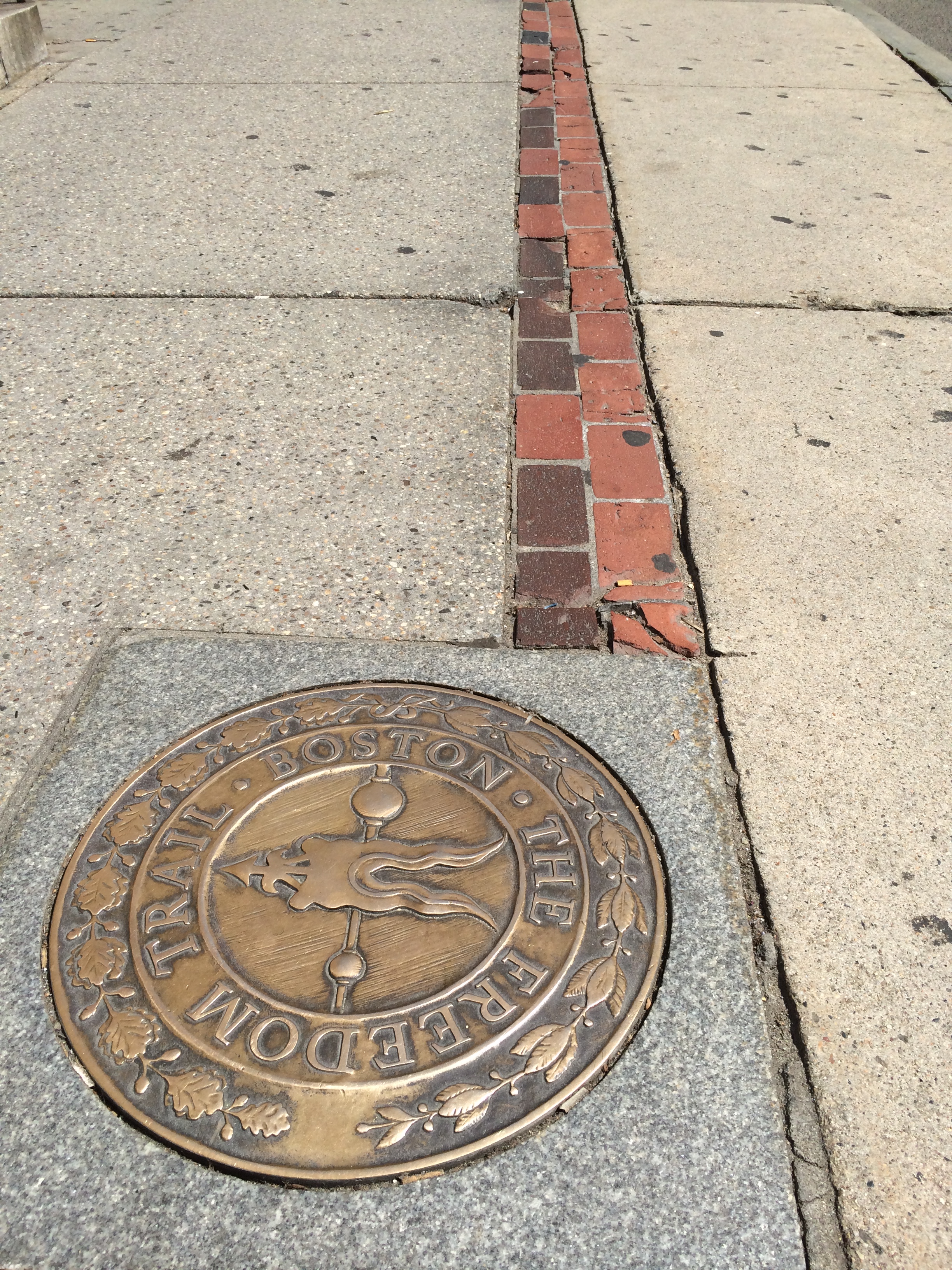
Once I had located the former sites of the Liberty Tree and the Great Elm, it was time to begin our walk along the Freedom Trail. The Freedom Trail was conceived in 1951 by journalist William Schofield, who thought a pedestrian trail that linked important Revolutionary landmarks in the relatively compact central Boston area would be a great idea. Local civic leaders and historians agreed, and a route was established using 30 painted signs to guide the way. This system was a little befuddling for the typical tourist, so in 1958 an idiot-proof path was laid directly on the ground using red bricks. In 1972, the Trail was extended across the river into Charleston in order to include Bunker Hill and the USS Constitution. As of 2025, over four million people walk the Freedom Trail every year.
The Freedom Trail officially consists of sixteen sites:
1. Boston Common
2. The Massachusetts State House
3. Park Street Church
4. Granary Burying Ground
5. King’s Chapel and Burying Ground
6. Boston Latin School
7. Old Corner Bookstore
8. Old South Meeting House
9. Old State House
10. Boston Massacre Site
11. Faneuil Hall
12. Paul Revere House
13. Old North Church
14. Copp’s Hill Burying Ground
15. USS Constitution
16. Bunker Hill Monument
#1 Boston Common was already discussed in the previous entry, so we’ll move on to the second stop on the Trail, which was…
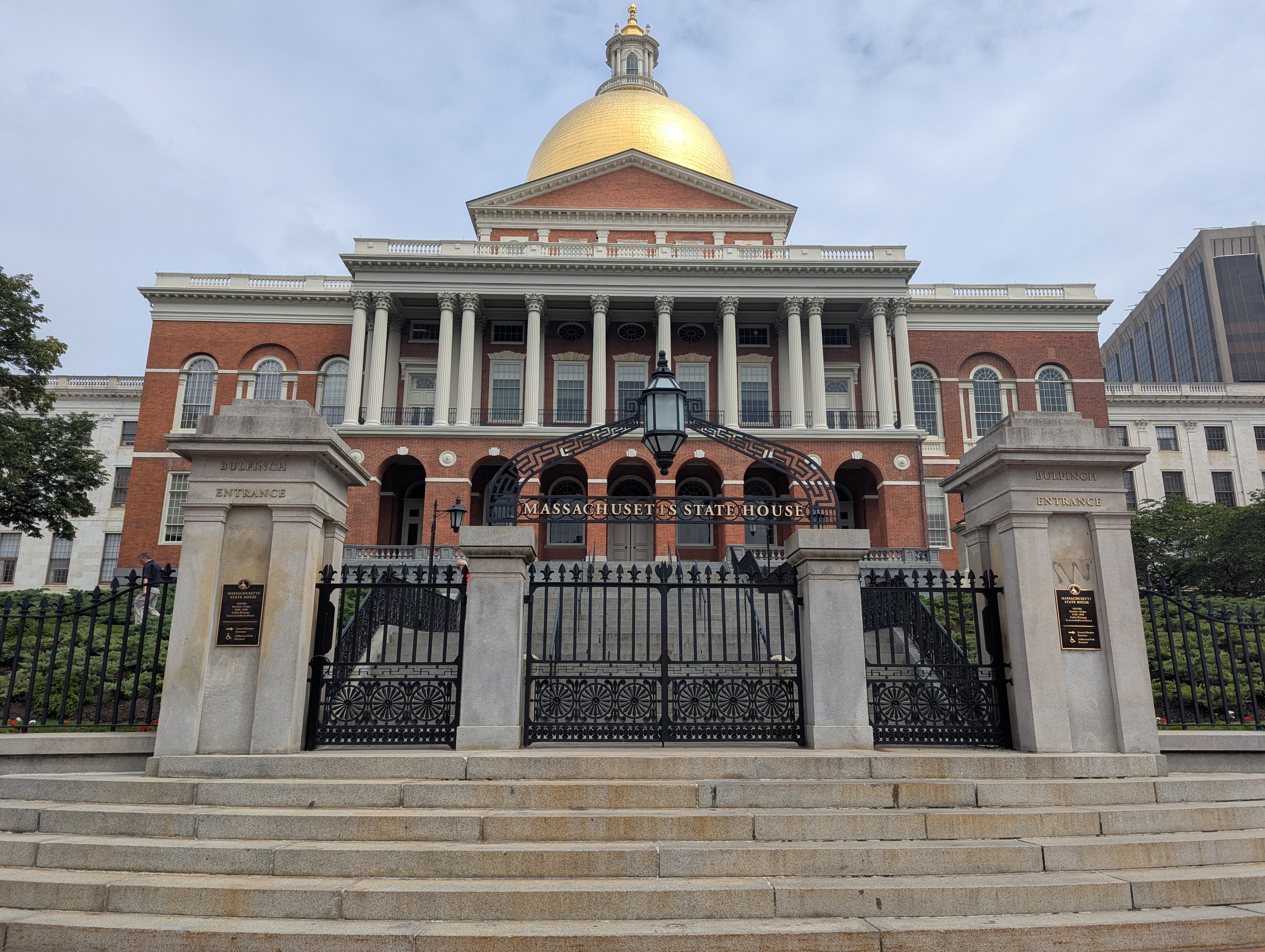
#2 The Massachusetts State House is just across Beacon Street from Boston Common. The parcel of land it was built on was mostly made up of Hancock Manor’s former cow pasture, sold off by Hancock’s wife in 1795 (Hancock himself had died two years earlier). Boston’s new young hotshot architect Charles Bulfinch was hired to design a grand new state capitol building to replace the too-small Old State House (more on that anon) where the Massachusetts assembly had been meeting since 1776. Bulfinch designed a red brick building in a Federal style, with an imposing central dome and white marble trim. It was right next door to Hancock Manor on the south slope of Beacon Hill, the summit of which rose up just behind them.
Continue reading Holy Bee of Ephesus