
Prologue: A Hard Day’s Night, Help!, and Ringo the Actor
When I was a super young Beatles fan in the early ‘80s (age 7-10 or so), there wasn’t much beyond the music itself and a couple of books out there to feed my fandom. So when PBS decided to show the 1982 documentary The Compleat Beatles a few years after it came out, I made sure I was rolling VHS tape on it. In subsequent years, I literally wore out the tape watching and re-watching it. It ended with a brief summary on the activities of each individual Beatle after the break-up. Here’s Ringo’s:

That always puzzled me. “An acting career in Hollywood?” I went to the movies a lot as a kid, and I’d never seen any movie starring Ringo Starr. This statement was also echoed in the handful of Beatles books I had collected. Everyone agreed without contradiction that Ringo became an actor in the 1970s.
As it turns out, this is a bit of an overstatement. Ringo’s acting career never amounted to much, and the film work he did was pretty well removed from anything that can be described as “Hollywood.”
But thinking about all this recently did get me interested in exploring the work of the solo Beatles on film, one element of their careers that I never delved into all that much.
Collectively, the Beatles were movie stars by the middle of 1964.
There was once a time (the mid-20th century) when a popular singer could reach such a level of universal fame that they would be elevated past being a mere “singer,” to become an “entertainer.” They would be expected to not only sing and continue to sell records by the bushel, but also act in films, and appear on television (frequently poking good-natured fun at themselves in comedy sketches and the like). Bing Crosby, Frank Sinatra, Elvis Presley, and several others made the cross-over. It was all just homogenous “show business” at a certain point. By the early 1960s, even bands like the Beatles were expected — almost required — to follow the established path. Of course, it was bands like the Beatles and their contemporaries who put an end to this kind of thing by creating the world of modern rock and rebelling against old-school showbiz traditions. But in their early years, they really felt they had no choice but to play along. In October 1963 (when they had been famous in Britain for less than a year and hadn’t broken in the US at all), Beatles manager Brian Epstein signed them to a three-picture deal with United Artists.
It didn’t matter that none of the Beatles expressed an iota of interest in acting, because United Artists didn’t have an iota of interest in the Beatles as actors. They wanted the lucrative rights to the soundtrack album, which they hoped to cash in on before the Beatles fad died (as everyone was certain it would, any week now). Someone could have filmed the Beatles reading the phone book against a blank wall, and as long as some songs were interspersed in there, UA would be happy. Luckily, that’s not what happened.
What happened was they ended up making a really good movie.

While contract negotiations were underway, United Artists producer Walter Shenson had a lunch with Richard Lester, who had just directed the Mouse That Roared sequel (The Mouse on the Moon) for Shenson and UA. When Shenson mentioned he would likely be handling an upcoming Beatles film, Lester eagerly asked if he could direct it. Shenson thought it was a wonderful idea.
Lester — described by singer/writer/eccentric George Melly as “an amiable space creature, very thin, with a great domed bald head, tiny childlike features and large kind eyes” — was born in Philadelphia, but had been working in television in the UK since the early 1950s, and had a couple of feature films under his belt by late 1963. He was 31 years old when he took on the Beatles’ first film, very youthful by today’s standards, but in the world of early ‘60s pop music, where both artists and fans were in their teens or not much past, he was an “adult.” A sophisticated lover of classical music who was a decent hand on the piano, no less. But unlike a lot of other “adults,” he did not necessarily look down on pop music, and the Beatles were on his radar pretty early. And when the Beatles heard Lester had been tapped to direct their movie, they approved wholeheartedly. They knew Lester had directed The Running Jumping & Standing Still Film, a surreal short featuring their comedy idols, Goon Show stars Spike Milligan and Peter Sellers.

Lester brought in Liverpool playwright Alun Owen to craft a script. (As a writer, Owen was so closely associated with Liverpool that Epstein reached out to him about the possibility of writing a Beatles script even before the UA deal was conceived, and likely pointed Lester in his direction.) Owen traveled with the band during their two-day trip to Ireland (November 7-8, 1963), and was able to distill their personalities and transcribe some of their witty remarks into his Oscar-nominated screenplay, which was an exaggerated “day in the life of the Beatles.” Aware that the group had no experience as professional actors, Owen made sure that no Beatle had more than one line at a time. Lester had a tight schedule (six weeks in March and early April 1964) and a modest (but by no means tiny) budget, so he used the limitations to his advantage, presenting the band in a gritty, black-and-white, semi-documentary style.
When A Hard Day’s Night hit cinemas in the summer of ‘64, the established film critics found themselves astonished that they actually enjoyed a movie about a bunch of pop musicians. Their positive reviews carried almost a puzzled air. Could this be possible? Lester’s film was fast-paced, inventive, and a great example of deadpan British humor. All of the Beatles acquitted themselves quite well, but one member was always singled out by the critics for individual praise — Ringo Starr. Ringo had a lengthy solo sequence two-thirds of the way through the film. Feeling put-upon by his bandmates, he ditches rehearsals to go on a lonely ramble along the Thames. He projects an air of melancholy and vulnerability, and the viewers’ hearts go right out to him. (His secret to “acting” this scene? He had been partying all night the night before, never went to bed, and was sleepy and hungover as the cameras rolled early in the morning.)
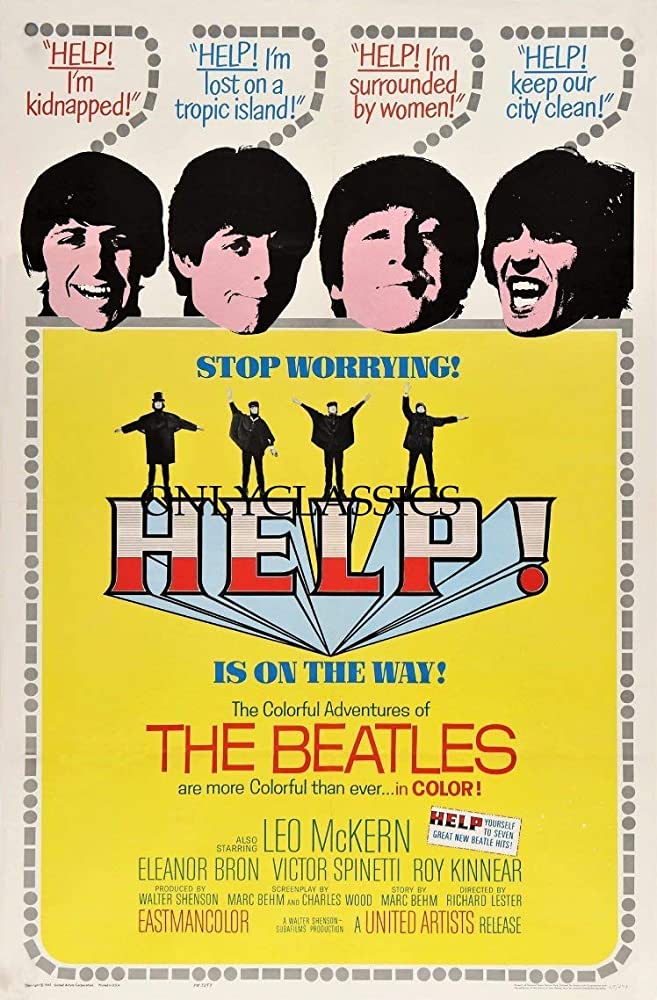
Although all the Beatles were natural performers — they just exuded charisma — everyone decided that Ringo was the one who had the potential to be a true actor. So he became the central figure (not exactly “star”) of the Beatles’ next film, 1965’s Help! Lester was once again at the helm, and engineered a complete departure from the Hard Day’s Night style — this time he went with glorious Pop Art color, and a pretty silly “story” (originally concocted as a Peter Sellers vehicle) about a cursed ring on Ringo’s finger. It was essentially a live-action cartoon, and the critics weren’t quite as effusive as they were for A Hard Day’s Night. But the music was as good as ever, spoofing the globe-trotting James Bond series was fun, and once again Ringo was noted for the special quality he brought to the screen. The band even paid tribute to the budding Brando in their midst by recording a cover of Buck Owens’ “Act Naturally” with Ringo singing lead. They enjoyed a good working relationship with Lester, and considered him a friend.
There was one more film left on their United Artists contract, and if they followed the pattern of 1964 and 1965, then they would produce a film (and accompanying soundtrack album) for a summer 1966 release.
It did not come to pass.
A Talent For Loving and Up Against It

In the 1500s, an Aztec curse is placed on a Spanish conquistador…he and all of his descendants until the end of time will be consumed by insatiable lust from the moment of their first carnal encounter. Flash forward three centuries…Mexico, 1871. A prosperous ranch owner (and victim of the curse) is trying to marry off his virginal daughter before the curse “ruins” her. A series of competitions between two young ranch hands will determine which one has enough physical stamina to meet her needs and keep her honorably faithful in the bonds of matrimony…
This is the plot of A Talent For Loving or, The Great Cowboy Race, a 1961 novel by Richard Condon (famous at the time as the author of The Manchurian Candidate). It was an interesting attempt to combine a post-modern Western tale with an irreverent sex farce. In an odd move, Brian Epstein secured the film rights, envisioning this as a potential vehicle for the Beatles.
At what point “Beatles” and “Old West comedy about nymphomania” blended together in Brian Epstein’s mind is unclear (or maybe it was someone else’s suggestion), but it seems that the Beatles were big western fans, and evidently they had been bitten by the acting bug. They wanted to play actual characters instead of “the Beatles.” A screenplay written by Condon and his wife Evelyn was completed by March 1965 (literally while Help! was shooting), and it was hoped they could film in September. “No reason why Liverpool lads shouldn’t be out there [in the West],” said Condon confidently, “complete with accents, lariats, and six-shooters.” Walter Shenson was brought into the picture that summer, confirming this was to be the Beatles’ third UA release. But the film went into re-write hell — it seems it was more difficult than anticipated to incorporate four Liverpudlians into a western set in Mexico. The September shooting window came and went, because no one was happy with the script. By December, the project was dead. Times were changing fast, the Beatles were growing artistically by leaps and bounds, and they had soured on the idea of “playing cowboys” in a comedy. They also had genuine concerns about recording an appropriate soundtrack (19th-century Mexican balladry was not their forte). If they had to do another movie, they wanted something modern and cutting-edge. Epstein and Shenson went back to script hunting, still hoping to get a Beatles film into theaters sometime in 1966.

Any time the Beatles’ possible participation in a western comes up in discussion on a website, it is universally accompanied by one or more of these cowboy-themed images from a September 1964 photo shoot at the end of their summer tour of the US
[A Talent For Loving was eventually made in 1969, with Shenson still producing. It starred Richard Widmark (playing a middle-aged Civil War vet), Cesar Romero (playing the ranch owner), and Topol (playing a Mexican generalissimo with as much subtlety as the Frito Bandito). Obviously, none of these parts were suitable for the Beatles. I can only speculate that the two cowboys in competition for the rancher’s daughter would have become four cowboys, the four cowboys would also be British immigrants, and the parts would be much more fleshed out and important than the two hunky empty hats in the released version. Good ol’ Ringo probably would have been the victor.]
It soon became apparent that there would be no 1966 Beatles movie, but a contract was a contract, and there was always 1967. In late ‘66, Walter Shenson commissioned writer Owen Holder to craft a script that would meet the “modern, cutting-edge” requirement. Holder came up with Shades of a Personality, the story of a young man (Holder envisioned Lennon in the lead role) with three separate personalities, to be embodied by the other three Beatles. (Classic rock fans will recognize this as very similar to the Who’s 1973 concept album Quadrophenia.)
Holder’s script was met with little enthusiasm from the group. They really did not want to do another “Beatles” movie at this point. So desperate were they to not appear in front of the cameras that they tried to give United Artists an independently-produced animated film that had their likenesses (but not their actual voices) and a few new songs. Yellow Submarine was distributed by UA in 1968, but it did not fulfill their contract.

Hoping to entice them with edgiest of cutting-edge, Brian Epstein gave the Holder screenplay to Joe Orton for a re-write. Orton was the “bad boy” of British theater at that time. Plays like Loot and What the Butler Saw caused a sensation due to their explicitness and dark-humored nihilism. Orton began working on the Beatles project in January of 1967. He injected the material with a healthy dose of sadomasochism, polyamory, and gay subtext. He submitted the revised script — now called Up Against It — to the Beatles’ management. After several months with no word, the script was simply returned to him without comment. Free to entertain other options on the script, Orton was due to attend a meeting with producer Oscar Lowenstein and director Richard Lester on August 9, 1967. His body was discovered that day in his London flat, having been bluedgeoned to death by his boyfriend Kenneth Halliwell (whose body was nearby — he committed suicide by overdose). Eighteen days later, Brian Epstein died of an accidental overdose. (Paul McCartney admitted in 1997 that the Beatles had been frightened off the Orton project by the homosexual themes in the script.)
Less than two months after the death of their manager, the very first solo Beatle film would be released.
Here’s my format for discussing the films of the solo Beatles:
No TV movies, no concert films, no documentaries, no popping up as themselves in a cameo. These are narrative films released in cinemas in which they play a character. (I fudged it a little on Give My Regards to Broad Street in which Paul McCartney plays a “fictional” rock star that, based on all observable evidence, is pretty much “Paul McCartney.”) I will watch each film in its entirety at least once, most of them for the first time in many years, and a few of them for the first time ever. Release dates will generally be for the British release, unless otherwise noted.
Continue reading Holy Bee of Ephesus