
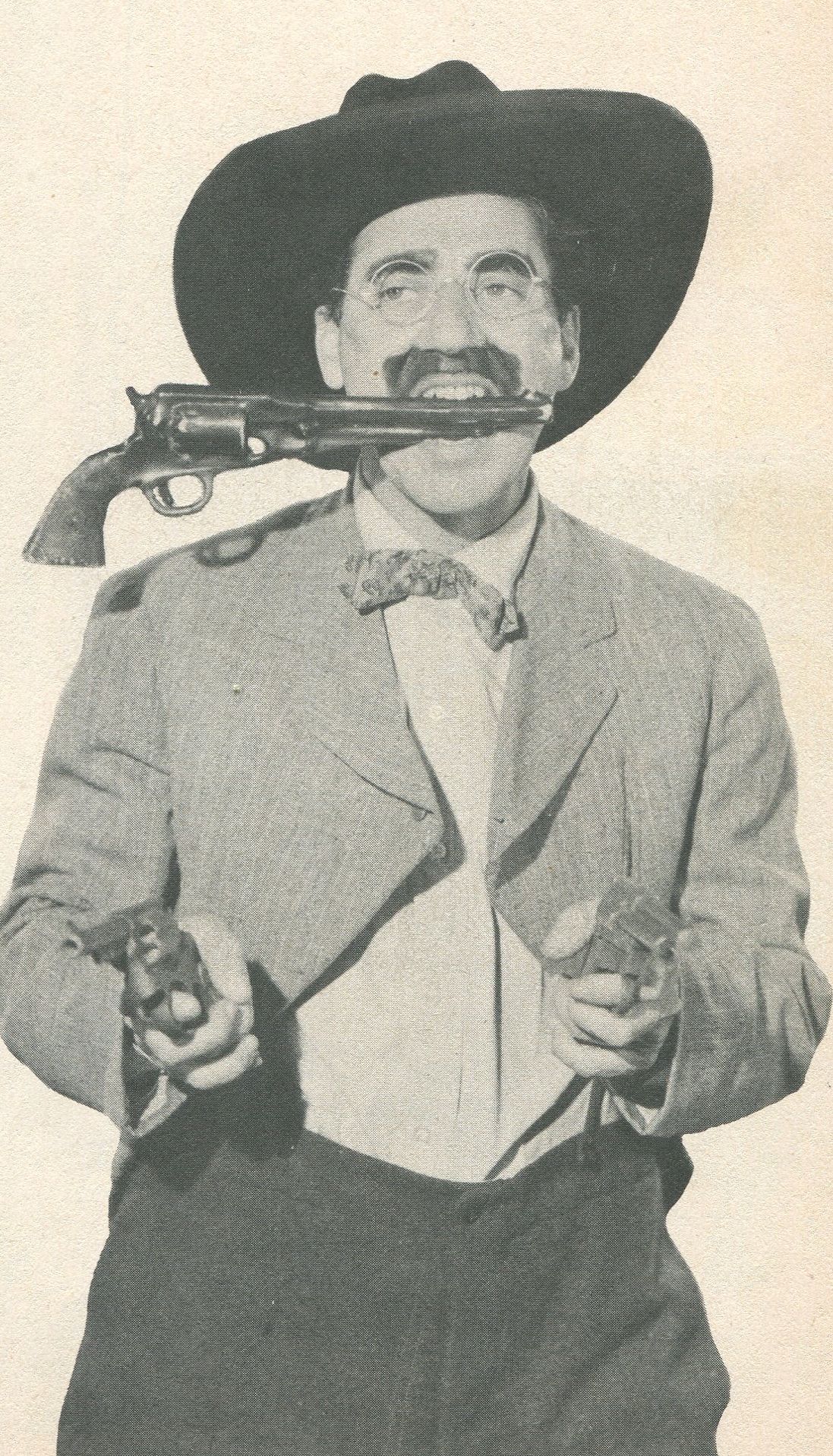
“Go West has again been postponed. I don’t know why the studio doesn’t come right out and say they’re afraid to make it.” — Groucho in a letter to his son Arthur
The Marx Brothers’ most recent movie, At the Circus, had lost money at the box office, so there was a lot riding on their next one. Go West was described pre-emptively by Groucho as “another turkey.” There were a lot of delays and head-scratching as MGM tried to figure out how to make the turkey profitable. With their usual lack of imagination and love of the formulaic, MGM decided the best bet was to repeat the exact same recipe as At the Circus, and just hope audiences would respond better. Same hack director (Eddie Buzzell). Same inexpensive rookie writer (Irving Brecher, still honing his craft). Same theft of the plot from another movie. Only instead of ripping themselves off (At the Circus was essentially the same story as A Day at the Races), the next Marx Brothers movie would steal the plot from Laurel & Hardy’s Way Out West.

Eddie Buzzell
Go West, as a title at least, had been kicking around for a while, begun in conjunction with A Day at the Races when Irving Thalberg was still in charge of the Marx Brothers’ output. Like several Marx Brothers movies (and probably many other comedies of the time), the process began with the title and worked from there. The first draft of Go West was written by old Marx friends Bert Kalmar and Harry Ruby, and submitted on August 19, 1936. Thalberg was dead less than a month later, and the project was shelved. When it was revived in late 1939, the Kalmar & Ruby script (basically “A Day at the Rodeo”) was dumped, and Brecher was back to just a title. He decided to make it a period piece, set in the actual Old West. John Carroll and Diana Lewis were cast as the yet-again entirely unmemorable romantic leads, and Opera’s Walter Woolf King returned as the bad guy. Margaret Dumont sat this one out. The production supervisor was Louis B. Mayer’s nephew Jack Cummings.

“Our picture is becoming a garbage can for the studio,” wrote Groucho to Arthur Sheekman. “[Diana Lewis] is no Helen Hayes, [and] happens, by an odd coincidence, to be William Powell’s wife. The unit manager is Cummings’s cousin, and his assistant is a son of Bill Goetz, who happens to be Mayer’s son-in-law. So you see the only ones in the picture who are not related to anyone except to each other are the Marx Brothers.”

Jack Cummings set the budget and signed off on the various departments’ choices, and then proceeded to do not much else, except approve of the one good idea applied to Go West’s pre-production process. It was another repeat — taking the key comedy routines on tour and playing them to audiences to gauge how well they worked and where (and how long) the laughs were. Scenes from Go West played in Joliet, Toledo, Detroit, Chicago, and L.A. from April 28 through May 27, 1940. Shooting Go West occurred from July to October of 1940. (As we’ve seen, such lengthy shooting schedules were by no means uncommon at MGM, even for a 90-minute comedy.)

Groucho’s character, S. Quentin Quale (a play on “San Quentin quail,” which was a slang term for underage jailbait) randomly meets up with Chico and Harpo, playing brothers Joe and Rusty Panello (finally a decent name for Harpo’s character — don’t get used to it) in a train station, where they attempt to out-fleece each other over ten dollars. The plot revolves around a land deed in the Panellos’ possession that was formerly worthless, but suddenly becomes valuable when a railroad company wants to put a line through the property.

There is another attempt to replicate the Night at the Opera stateroom scene (this time in a crowded stagecoach), and a frenetic chase on and around a moving train, which a lot of the old Marx Brothers books tout as a highlight of their filmography, but isn’t incredibly impressive to modern eyes. Technically well-staged for its time (there’s a lot of processed rear projection mixed in with a little location work in scenic Tuolumne County), its worst crime is it just isn’t all that funny. The best the sequence can do is have Harpo act as a human coupling between a pair of train cars, his limbs stretching like Silly Putty in a very cartoonish fashion. The whole thing is not exactly Il Trovatore getting destroyed or Freedonia going to war (or even the Huxley vs. Darwin football game).

Irving Brecher was getting better. He had gone on the tour with them, and the Brothers had grown to trust him. (The one moment of drama people remember from the production was Buzzell walking off the set in a huff when one of the Brothers went not to him but to Brecher one too many times for feedback on their performance.) Although nothing is on the Kaufman-Ryskind or Kalmar-Ruby level, the dialogue has a sprightly crackle all the way through, an element missing from the last two or three Marx movies. The touring clearly worked, and Brecher’s Best Screenplay Oscar nomination (for Meet Me in St. Louis) was only four years away. Although he once again received sole screenplay credit, Brecher’s work was said to be augmented by Arthur Sheekman, Nat Perrin, and Dore Schary. The result was a fairly passable piece of 1940 comedy. (Yes, damning with faint praise, but we take what we can get from 40s-era Marx material.)
I’ll never be a fan of mid-century movie songs, but here they are at least integrated into the story well and don’t stop the whole thing dead in its tracks. In fact, I’ll say that Go West’s songs are among the strongest in the Marx Brothers’ oeuvre, ranging from legitimately entertaining (the dancehall girl’s “You Can’t Argue With Love”) to low-key pleasant (the romantic couple’s duet “Ridin’ the Range”).

It seems no old comedy film can exist without some kind of racially offensive sequence, and Go West’s handling of interactions with Native Americans is fairly typical for the era. But it at least acknowledges the poor treatment Native Americans received at the hands of the white man (“Who put your head on the nickel, and then took the nickel away?”) and doesn’t quite make the modern viewer want to claw up the carpet and crawl under it the way Races and Circus does in similar situations.

And they’ve managed to dial in Groucho’s wig a little better. It’s frequently under a hat, but when it isn’t, at least it no longer looks like Groucho has the gutted carcass of a Scottish Terrier strapped to his head the way he did in At the Circus. (According to Groucho, there was an attempt to work with his natural hair in the lengthy run-up to shooting the film. “My theatrical career has dwindled to being fitted once a week for a pair of early-American pants and having my hair dyed every three weeks. This is a fine comedown for man who used to be the Toast of Broadway.”) Sadly, Groucho’s character is once again a flailing, cowardly object of ridicule, which seems to be Buzzell’s and Brecher’s preferred mode in which to present him (he was slightly worse in Circus).
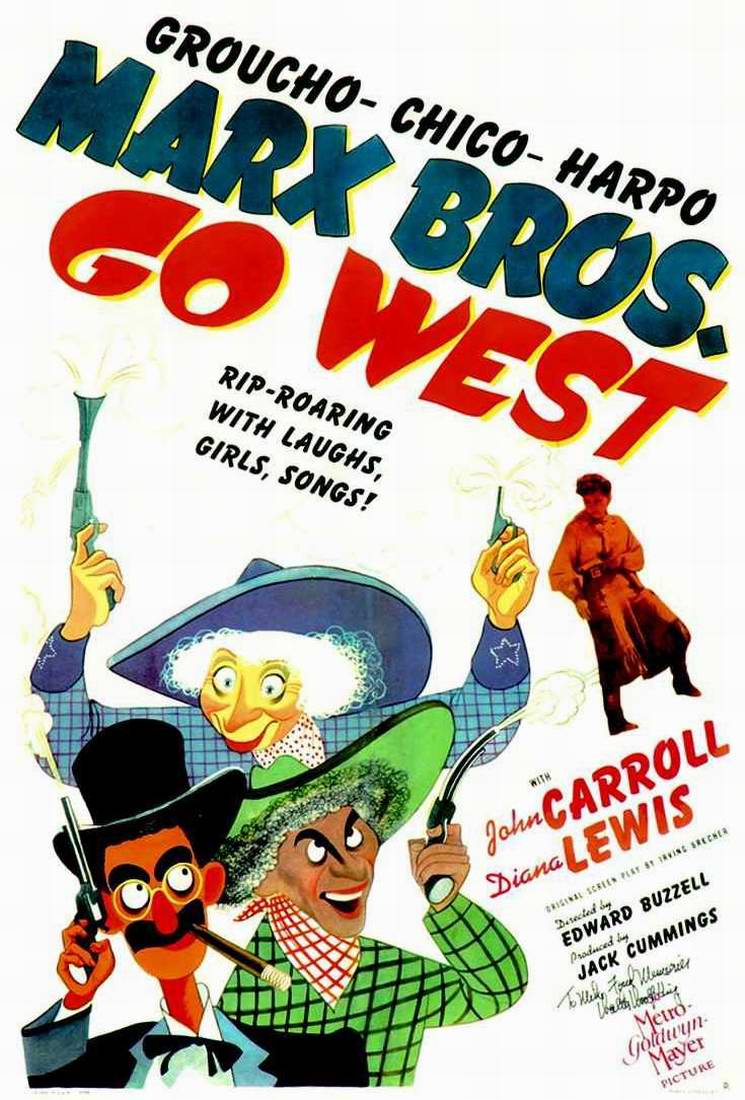
Go West hit theaters on December 6, 1940, and failed to recoup its production costs — their third movie in a row to flop. The writing was on the wall. With one film left on their contract, the Brothers began planning for the next stage of their careers. Harpo was the only one seriously considering full retirement. He had made some good investments, and was anticipating expanding his family with more adoptions. But Chico always needed the money, and Groucho always needed the applause, so Chico began setting up a tour with a jazz band, and Groucho figured he might make his living in the thriving medium of radio. (Around this time he put together a pilot for a family situation comedy with Irving Brecher, but it didn’t sell until three years later, under the title The Life of Riley, with the role intended for Groucho played by the warmer and less acerbic William Bendix.)
But first there was that one final, pesky movie left to do for MGM.
Continue reading Holy Bee of Ephesus