

It’s time to introduce our Fifth and Final Marx Brother, Zeppo.
Herbert Marx always felt like an afterthought. Born several years after his other siblings, he stayed home while they (and his mother) endlessly toured the country. Frenchie was also not the most hands-on parent, and too soft-hearted to be much of a disciplinarian. So it shouldn’t be surprising that Herbert became something of a juvenile delinquent, skipping school and roaming the streets of Chicago unsupervised, the way his brothers did in New York back at the turn of the century. Only instead of sneaking rides on streetcars and playing dice, Herbert was running with a genuine street gang, stealing cars and carrying a pistol.
When Minnie could spare him a thought, she despaired of his future. She felt the best way of saving him was to ease him into the family business as soon as possible. When they played Joliet in May of 1914, they were joined for a couple of performances by the adolescent Fifth Marx Brother, who in addition to being a heat-packing car thief, also had a passable “boy tenor” voice, and was quite happy to warble a few songs onstage when his mother asked. He also did a short tour of Michigan with the act in the summer of 1915. The chicken farm Minnie bought in 1917 to keep the older Brothers out of the draft had the added benefit of keeping her youngest off the mean streets…briefly.
It was during his sojourn on the farm that he finally earned his “o” nickname. Every Brother has his own story of where the name “Zeppo” came from, and none of them hold much water. The truth is, the older boys had been calling Herbert “Zip” for some time. Here’s why:
According to a story revealed many years later by Harpo’s son Bill, the label “Zip” came from a man suffering from microcephaly, and displayed at sideshows as a “freak” called Zip the Pinhead. His deformity included a deeply-receded forehead and a large, wedge-shaped nose that sloped straight into it, without the usual indentation between the eyes. Herbert also had a very distinctive nose bridge and slightly receding forehead. Nowhere near the point of deformity, but just different enough to be sensitive about as a young teen with self-esteem issues. And just the sort of thing that four much-older comedian siblings would delight in mercilessly teasing a little brother about. The taunting nickname “Zip” became “Zippo” to match his brothers’ names, and eventually evolved into “Zeppo.”
By the time he was seventeen, he had dropped out of school and was working as a mechanic for the Ford Motor Company (he demonstrated a remarkable aptitude for engineering and working with machinery from an early age). A steady job did not keep him out of Chicago pool halls and gambling dens. Like eldest brother Chico, Zeppo loved “action.” He had a head for numbers and a passionate love for playing cards and pursuing girls. “I’d have ended up in jail,” he confidently predicted. Minnie intervened to prevent that fate.
June 5, 1918…the phone rings in the Ford mechanic shop somewhere in Chicago. An insistent voice demands to speak to Zeppo. Zeppo is summoned, and wipes the grease off his hands, perhaps anticipating what is coming. “My mother called me…[and] said come home immediately,” remembered Zeppo. “I said, well I’m working. She says, well quit your job and come home immediately…And I said okay, so I came home…She says, your brother Gummo just joined the Army…you go and get packed and get on the train. Here’s the fare and go to Rockford, Illinois and join your brothers. You have to take Gummo’s place because I want the name of the Four Marx Brothers intact…So I acquiesced and joined the boys in Rockford, Illinois. I got right on, right on the stage. Didn’t know what the hell to do.”
Zeppo Marx, former auto mechanic and small-time Chicago hood, bravely faked his way through the last performances of Home Again ever staged (well, not quite — read on). “When I stepped out, Zeppo stepped in,” said Gummo. “I must say, though, that he was the only actor who ever had less talent than me.” The big question was what to do next.

Zeppo on board, 1918
From the Chicago Daily Tribune, Sept. 22, 1918: “The Four Marx Brothers, residents of this city, propose to eschew vaudeville, in which they are eminent, and take up musical comedy. At Grand Rapids September 28 [the show actually opened in Benton Harbor on the 26th] they will begin a career in The Street Cinderella, whose words are by Jo Swerling, once a good reporter for The Tribune…”
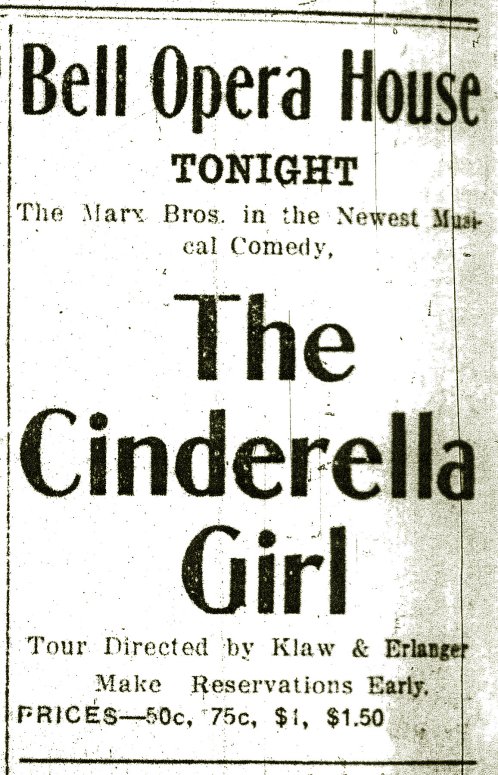
They decided to make an attempt at a “real” musical comedy. They commissioned an eager young scribe named Jo Swerling to write them an original self-contained show with a genuine plot and real characters. Gus Kahn and Egbert van Alstyne would provide the songs. Uncle Al would direct. Ads began to appear in Michigan newspapers for The Street Cinderella — “Minnie Palmer presents…a new farce comedy in three acts…beautiful girls, beautiful music, beautiful love story…”
The title went back and forth between The Street Cinderella and The Cinderella Girl, and it seems they settled on the latter at the last minute. No one remembers the plot, something about a romance between two “street singers.” No one remembers the characters the Brothers were supposed to play (presumably variations on their already established personas). When the curtain rose and the overture began playing at the Bell Opera House in Benton Creek, Michigan on September 26, 1918, the Four Marx Brothers stared out at a half-filled house. Deliberately half-filled. In a sight that would become depressingly familiar just over a hundred years later, every other seat was empty. Every other row was empty. The audience all wore masks over their noses and mouths.
The Marx Brothers’ newest show — meant to lift them out of the vaudeville ghetto and into legitimate theater — opened the same week as the deadly Spanish influenza epidemic hit the Midwest.
There was another problem: “It was a terrible act and we realized we couldn’t play it successfully,” said Groucho. It limped through two performances. Both times, according to Marx biographer Kyle Crichton, the Brothers did not bother to finish the storyline, going into their familiar Home Again material instead. All future bookings of The Cinderella Girl were cancelled, and it was written off as an expensive mistake. By mid-October, the flu epidemic had closed most of the country’s theaters anyway. The only thing that was salvageable from the experience, according to Groucho, was that actor Ed Metcalfe (who had the thankless role of “the policeman” in Home Again and also appeared in Cinderella Girl) introduced him to the works of Gilbert and Sullivan around this time. Groucho became possibly the world’s biggest G&S fan, obsessively listening to their comic operas, and collecting their material and memorabilia for the rest of his life.
Chagrined, the Brothers trudged back into vaudeville, and got themselves booked for the truncated 1918-19 season on the Keith-Albee Circuit. They sat down with Uncle Al, made a few updates to the old Home Again material, threw in some of the better Cinderella songs (not wanting to waste what they had spent good money on), and called the “new” show ‘N’ Everything.
Betty Marx had joined the act’s chorus, probably to keep an eye on Chico. One night as she was exiting the stage after a big musical number, Harpo spontaneously stretched out a foot and tripped her. She was sent scooting across the stage on her stomach as the audience roared. After the curtain, she took her hurt feelings to her brother-in-law, who did not exude sympathy. “What the hell are you complaining about?” said Harpo, scrubbing off his make-up. “You got a laugh, didn’t you?” You had to be tough to be a Marx.

Zeppo practiced diligently to replicate Gummo’s old “whirlwind dance.” His partner was initially Gene Maddox. When she left the act, one of the chorus girls, Ruth Johnson (sometimes rendered as “Johnstone,” and billed as “Ruth Tyrell”) was randomly promoted to take her place. She and Zeppo began casually dating…but Groucho had his eye on her. He bided his time, then pounced, stealing the shapely, strawberry blonde, snub-nosed chorus girl away from his little brother. You had to be tough to be a Marx.
Continue reading Holy Bee of Ephesus