
Prologue — The Holy Bee Discovers Monty Python
It must have been the spring of 1988…our family home was way out in the middle of nowhere, a rented farmhouse surrounded by thirteen acres of walnut trees. I was enduring a lengthy bus ride to and from the psychological threshing machine known as middle school. Due to our house’s isolated location, I spent the ages of 11 to 14 without cable. Just antenna-based stuff including the three big networks, a couple of regional UHF channels…and PBS. So I watched a little more public television than the average middle-schooler. In between all the nature shows and war documentaries would be an occasional short promo for something called Monty Python’s Flying Circus. I remember the promo being just a silly voice over a faux-Gilliam bit of cut-out, high-contrast photography where Jim Lehrer‘s head was replaced with Big Bird’s. I was a little intrigued, but didn’t yet go out of my way to try and catch the show. (The connection between Python and PBS will be explored in next month’s entry.) An older classmate would occasionally sing “I’m a lumberjack, and I’m okay/I sleep all night and I work all day,” but I never recall him saying where it came from, or singing any of the rest of it.
I had a little rabbit-eared TV in my bedroom. I used to stay up late to catch Saturday Night Live at 11:30 from under my covers. (After a big mid-80s cast shake-up, this was the second season featuring the classic late 80s-early 90s cast of Dana Carvey, Phil Hartman, Jan Hooks, Jon Lovitz, etc.) One night before the show started, I got up and wandered out to fix my favorite late-night snack (a plus-sized bowl of pre-sweetened cereal), and I passed my Dad in the living room, in front of the big console TV in his favorite TV-watching position (laying on the carpeted floor on his side, head propped up on his elbow). On the screen was one of the weirdest things I’d ever seen. An English-accented narrator was breathlessly hyping footage of what appeared to be a film trailer — someone was on a random beach in a fur coat, having a life-or-death struggle with a stuffed lion. Yes, the first bit of Python that ever passed before my eyes was their series 2, episode 10 sketch “Scott of the Sahara.” (I wouldn’t say Dad was a real Python fan, but he had a sophisticated sense of humor and was a great devourer of all things PBS. Also, TV options were limited.) I went back in my room, and after awhile, decided to switch over to PBS, just in time for “Fish Licence.” I was hooked from that moment on.
Monty Python’s Flying Circus went into my regular viewing rotation at that point. It was on Saturdays at 11, just after a Tom Baker episode of Doctor Who* and just before SNL. Right after Python, PBS would usually show the minutes-long astronomy show Jack Horkheimer: Star Hustler, informing viewers of any observable events going on in the cosmos that week. Its spacey, cheesy closing theme was always my signal to switch over to NBC just in time for the SNL cold open. When our family splurged on a new VCR, I took the old one and hooked it up to my little TV. I wish I could say I captured all 45 original episodes, but my local PBS station was pretty inconsistent, often repeating an episode within weeks of the first time I saw it (and never once dipping into the first series). But by the time we moved away from that farmhouse and back to cable-ready civilization, I had amassed most of series four, some of series three, and a few episodes of series two on a collection of slightly fuzzy VHS tapes that I watched over and over.
As far as Python audio went, my birthday in 1989 yielded me the double-CD compilation The Final Rip-Off, and under the Christmas tree that year were vinyl copies of Live At City Center and Contractual Obligation Album. More on all of those in Part 4. Pretty soon I was in high school in a bigger town, where Python was very much a known thing, and I was finally among my tribe (and I made a few converts with all the zeal of a missionary — thanks entirely to my painstakingly compiled mixtapes of Python audio, as PBS had stopped showing them by the early 1990s.)
And now on with our main discussion…
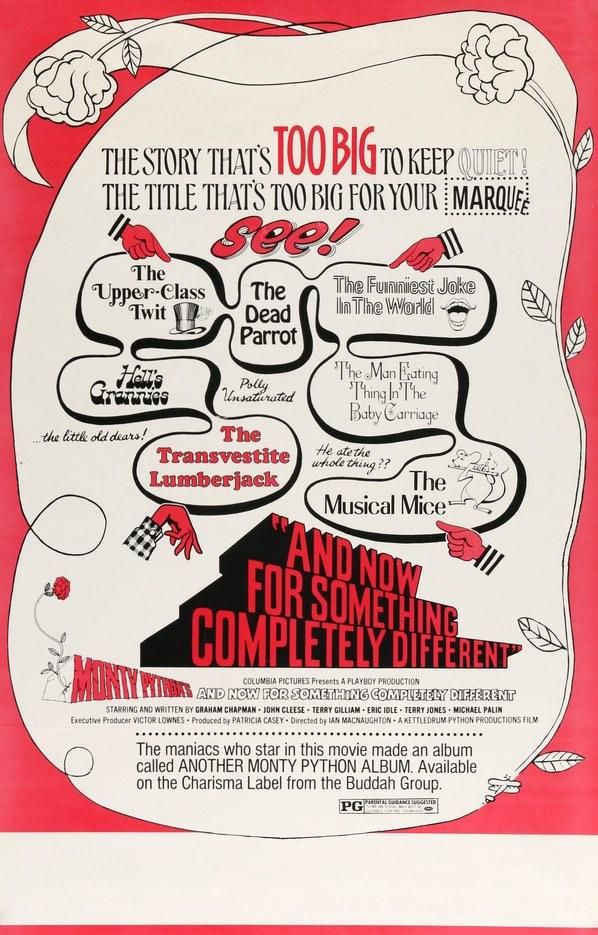
The group’s first film, And Now For Something Completely Different — a re-filmed collection of their best TV sketches intended to introduce the group to American audiences via “college cinemas” (again, those existed?) — came out in September of 1971 after languishing on the shelf for almost a year. Producer Victor Lownes had managed to shop it to Columbia Pictures…who put it out in Britain only! This flew in the face of the original intent and the Pythons were horrified that re-hashed material was being shown on their home turf. However, it actually did moderately well at the box office in a country where they already had a built-in market (despite some people, as predicted, carping about a bunch of material already seen on TV being presented as “something completely different”). The initial concept of being released exclusively to American college cinemas was dropped somewhere along the line. Columbia seemed to have no interest in releasing it in the U.S.

In the summer of 1972, Nancy Lewis was the head publicist for Buddah Records, a New York label specializing in bubblegum pop and light R&B. Just a few years before, she had been living in London, and had been captivated by Monty Python’s Flying Circus on TV. When Tony Stratton-Smith came over to New York to meet with the head of Buddah Records, Neil Bogart, to secure a U.S. deal for Charisma artists, the eagle-eyed Lewis spotted Another Monty Python Record in the stack of albums he was carrying. She energetically advocated for the group, and Buddah Records agreed to put out the album (and at least one future album) in the States. (Eagle-eyed, but maybe not elephant-memoried — she always recalls seeing both Another and Monty Python’s Previous Record in the Stratton-Smith’s stack, but Previous hadn’t even been recorded yet.)
It was Neil Bogart who convinced Columbia Pictures to finally release And Now For Something Completely Different in the U.S that August, with Buddah Records helping to cover the cost of promotion as they released Another Monty Python Record at the same time. Prints of the film were shipped across the country…to radio stations, who were then responsible for arranging screenings. At times, tickets were literally given away.

The group as they appeared in And Now For Something Completely Different‘s “Dirty Fork” sketch (with the non-performing Gilliam photo-bombing on the right)
Not all that surprisingly, the film bombed, despite Buddah’s enthusiastic-if-misguided cross-promotion efforts. “Some idiot designed a poster with a happy snake with a funny hat on,” griped John Cleese. It’s not clear if the idiot in question worked for Columbia or Buddah, but the team made sure going forward that all graphics and visuals associated with the Pythons would come from the mind of Terry Gilliam, at least for the foreseeable future. (In all my research, I have not been able to find the image of the be-hatted snake that Cleese found so irritating.)
And Now For Something Completely Different was written off (for now), but the album…it was starting to get some attention from FM radio stations. “The albums never sold in enormous numbers, but they provided a wonderful base,” says Lewis. Large chunks of first-rate Python material began hitting the American airwaves, usually in the overnight hours in the big city markets. “That FM stoner crowd was quite important,” says Michael Palin. “U.S. television was very commercial and safe but with a lot of rock DJs, Python was exactly the sort of stuff they were looking for…WNEW in New York would play Python clips all the time.”
By this time, the Pythons had long finished producing their third series of Flying Circus, but it remained unaired (due to a crowded BBC schedule, and head office concern over some of the edgier content). They were gearing up to do an original 45-minute episode for German TV (their second), and decided it was time for another album.
On Monty Python’s Previous Record, original material had roughly equal time with material drawn from the TV show, this time from the third series which had finally started being broadcast at the time of the album’s recording. (One sketch, “Fish License,” they pulled from all the way back in the second series.) Once again, the Jones/Palin team were in the producer’s seat, but just as Terry Jones shepherded the the second album (much to his distress), Michael Palin stepped up and took point on this one, bringing in Andre Jacquemin.
Andre Jacquemin was a teenage apprentice working at a London studio under the supervision of an old-school recording engineer, Alan Bailey (whose claim to fame was engineering several Cliff Richard sessions and working for Radio Luxembourg). One day in 1971, on his way out to lunch, he fortuitously bumped into Michael Palin, who was shopping around for a studio to record some voiceovers. With Bailey being all booked up, Jacquemin took on the session himself — and deeply impressed Palin. “What Andre was doing with music and sound effects was incredible,” remembers Palin. The debacle of recording Another was probably pretty fresh in his mind. “I asked him if he wanted to help me make [the next] album. Thankfully, he says ‘Yes.’”
“Mike explained what he needed and pointed to a three-foot high pile of scripts,” says Jacquemin. “He said ‘Just take those home and have a look at them, then you can tell us when you want us and what you want us to do.’ The only thing that kept going through my head was, ‘Oh God! These are all Cambridge and Oxford graduates…all I had was a swimming certificate and a bicycle proficiency test in terms of qualifications, so I thought ‘oh, crumbs! I’m in big trouble here…’ Anyway, I embraced it and told them I’d put together a budget and let them know.”
The album cover was a typical Gilliam flight of fancy, and the original inner sleeve advertised completely fictional albums supposedly also available from Charisma Records, such as Friday Night is Bath Night by J.P. Gumby, and Party Time! by Princess “Piano” Margaret. (Sadly, later pressings had an inner sleeve featuring actual Charisma products, and another good joke was ruined by the men in suits.)
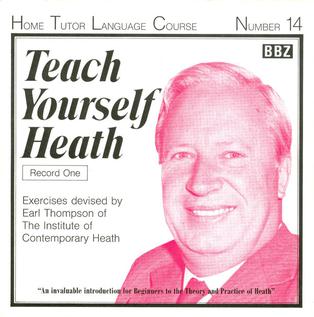
Included with the initial pressing was a small flexi-disc called “Teach Yourself Heath,” providing the record buyer with lessons on how to imitate the speech and mannerisms of Britain’s current Prime Minister. “Eric and I spent a day listening to Heath’s speeches,” says Palin. “At a certain point I went to sleep…I feel the record hasn’t done justice to the boredom and inanity of those party political speeches. If it is funny, thank Mr. Heath for that. It’s all him.”
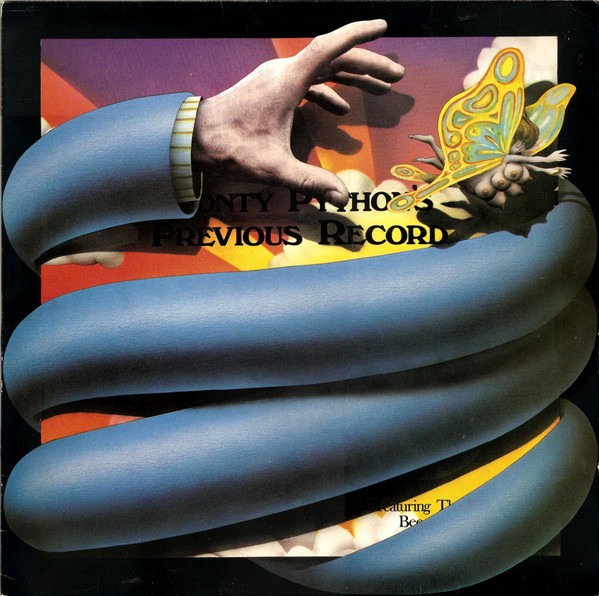
Monty Python’s Previous Record
Released: December 8, 1972 (U.K.); ? 1973 (U.S.)
Produced by Michael Palin, Terry Jones, Andre Jacquemin, and Alan Bailey
Track Listing:
Side One
1. Introduction
2. Are You Embarrassed Easily?
3. A Book at Bedtime
4. Dennis Moore (Part 1)
5. The Money Programme
6. The Money Song
7. Dennis Moore (Part 2)
8. Dennis Moore Theme Song (Part 1)
9. Australian Table Wines
10. Dennis Moore Theme Song (Part 2)
11. Argument Clinic
12. How To Do It
13. Dennis Moore Theme Song (Part 3)
14. Pepperpots (How To Put Your Budgie Down)
15. Personal Freedoms (Jean-Paul Sartre)
16. Dennis Moore Theme Song (Part 4)
17. Fish Licence
18. Eric the Half-a-Bee
19. Radio Quiz Game
20. Travel Agent
Side Two
1. A Massage from the Swedish Prime Minister (I)
2. Silly Noises
3. Anne Elk
4. The Yangtse Sketch
5. We Love the Yangtse
6. A Massage from the Swedish Prime Minister (II)
7. A Minute Passed
8. Eclipse of the Sun
9. Alistair Cooke
10. Wonderful World of Sound
11. Funerals at Prestatyn
12. A Massage from the Swedish Prime Minister (III)
13. A Fairy Tale (Happy Valley)
Beware starting this one with the volume too high. The listener is immediately jolted by the introduction on side one, which features Terry Jones screaming at the absolute top of his lungs “Not this record! Not this record! Not this record!” until the needle is pulled and we are lulled into a gentle attempt to get uptight British listeners over their innate embarrassment at certain words (“megaphone”) and sounds (which have to be heard to be appreciated, but they’re…rude.)
The well-known classics here are “Travel Agent” and “Argument Clinic,” but long-time fans will appreciate series three sketches such as “Anne Elk” (and her controversial theory about the brontosaurus), the Blue Peter parody “How To Do It” (“How to play the flute: blow here and move your fingers up and down there”), and the reappearance of Mr. Praline, who we last encountered trying to return a dead parrot to the pet shop. This time he’s applying for a license for his pet fish, Eric (a halibut). “Fish Licence” concludes with the only Python song to feature the deeply non-musical John Cleese singing a solo vocal part, “Eric the Half-a-Bee,” an album-only treat not included in the TV version of the sketch. It was never performed live, but you can always tell who’s a hardcore Python fan based on their deep love for this song. The running gag through side one is the adventures of Dennis Moore, a Robin Hood-style, 18th-century highwayman who can’t quite get the hang of redistributing wealth. More precisely, it’s Dennis Moore’s theme song that gets constantly revised. (The running gag through side two is a “massage from the Swedish prime minister” — but it doesn’t vary. Each time it appears, it says the exact same thing. There’s an explanation for that, see below.)
Continue reading Holy Bee of Ephesus