
“We were convinced Python wouldn’t go in America.” — Eric Idle

Variations on this statement have been uttered by all members of the Monty Python comedy team at one time or another, and it’s a statement to which I take patriotic exception. If that were true, if us stateside folks really were a bunch of provincial, close-minded xenophobic rubes who only wanted domestically-produced comedy on the level of The Three Stooges and Gilligan’s Island, then Python would have failed. (And by the way, Britain has their fair share of provincial, close-minded xenophobic rubes too.)
But they did not fail. They were — eventually — a resounding success. The Pythons are immortal because their material did work in the U.S. Unfair as it may seem, you don’t get multi-generation global approbation without breaking in America. No one outside the borders of the U.K. gives a tenth of a shit about British “superstars” like Cliff Richard (old) or Robbie Williams (relatively recent). Who? Exactly.
I’ve written about Monty Python several times in these virtual pages, and I’ve always felt the need to start off with a little potted history on them. This time will be no different.
The Monty Python troupe consisted of Graham Chapman, John Cleese, Terry Gilliam, Eric Idle, Terry Jones, and Michael Palin. All were products of either Cambridge or Oxford University, where — while pursuing professional degrees in things like law (Cleese) and medicine (Chapman) — they honed their peformance chops in traditional live theater, sketch revue shows, and after-hours cabaret. (The lone exception was the Minnesota-born Terry Gilliam, who was a typical overachiever — in his senior year of high school he was simultaneously class president, head cheerleader, and editor of the school paper. His subsequent years at Occidental College made him “honorary Oxford” in the group’s eyes.) But all of them abandoned traditional career paths as the lure of show business proved too strong to resist.
BBC-TV was going through an unusually experimental and indulgent phase in the mid to late 1960s. One of their flagship shows was the satirical Frost Report, considered a landmark of topical, cutting-edge humor. John Cleese was doubling as a writer and as part of its ensemble cast. The BBC took a shine to the tall, angular comedian, and almost casually offered him a show of his own which, after a couple of years and many twists and turns, became Monty Python’s Flying Circus (with Cleese declining headliner status — he wanted to be regarded solely as part of the team.) The hastily-assembled Python group came into the BBC’s headquarters in the spring of 1969 with the most hilariously uninformative pitch imaginable — they admitted they had no idea what the format of the show would be, or if there would be musical numbers, or guest stars, or…anything, really. They just offered a shrug and a collective sheepish grin. The result was they were offered “only” thirteen episodes at first, and told to get on with it.
As Idle put it, “We didn’t know what we were doing, but we insisted on doing it.”
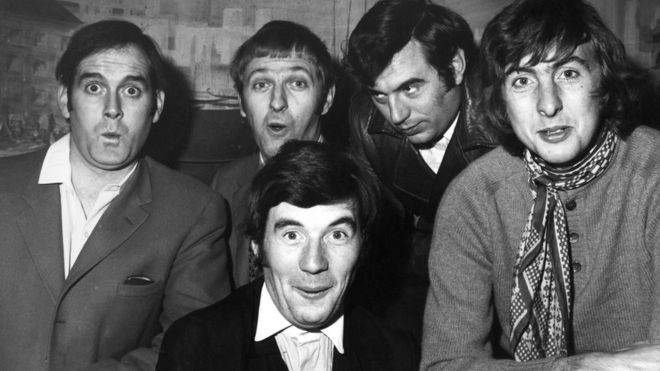
Early BBC photo session, 1969, missing Gilliam, whose role within the group hadn’t quite been decided by the BBC publicity department
The BBC were not as far out on a limb as it may have appeared. Although the Pythons were still all quite young at this point (the oldest, Cleese, turned 30 a few weeks after the show’s premiere), this was not their first rodeo. Except for Gilliam, their American animator and illustrator, they were all veterans of the Frost Report writers’ room. Moreover, they had all been writer-performers on their own TV shows already. Cleese and Chapman put together 1967’s sketch comedy show At Last the 1948 Show (for ITV, not the BBC) and Idle, Jones, and Palin created a surreally anarchic children’s show, Do Not Adjust Your Set (ITV, 1967-69) that had just as many adult fans as kids (distinguished solicitors and merchant bankers were said to have left work early to catch it each Thursday afternoon.) The fresh-off-the-boat Gilliam joined DNAYS as animator in its second series in 1968.
Did I say second “series”? Yes. As we all know, the Brits and the Yanks are two people separated by a common language. When they say “public school,” they mean “private school.” When we say “series,” we are referring to a TV show in its entirety. When they say “series,” they are referring to what we call a “season.” So Monty Python’s Flying Circus is divided into “Series 1” (13 episodes, 1969-70), “Series 2” (13 episodes, 1970), “Series 3” (13 episodes, 1972-73), and a truncated “Series 4” (6 episodes, 1974 — without Cleese, and with the title shortened to just Monty Python).
After a slow start, Monty Python’s Flying Circus gradually gained viewing numbers and was a critical hit in the U.K. by the end of its first series, and a popular hit by the end of its second. Could the brand be exported? The team themselves were skeptical, but knew they wanted to stretch their wings beyond the BBC.
The Pythons’ first shot at the American market was not their television show at all. It was a film (see below). It failed, confirming their suspicions.
Their second shot consisted of comedy albums. Those started getting people’s attention…
Yes, Python’s initial handful of American fans in the wild and woolly early 1970s thought of them as primarily purveyors of comedy albums, akin to the Firesign Theater and Cheech & Chong. It was actually vinyl LPs that got Monty Python’s trademark foot in the door of America — circulating through university dorm rooms and being played in the wee hours on progressive FM radio stations. Over the course of their lifespan as a full group (1969-83), Monty Python released ten albums, several of which are considered absolute masterpieces of original audio comedy, true companion pieces to their groundbreaking work in the television medium.

So with this series of essays, the Holy Bee hopes to put the development of those albums in the context of the group’s overall timeline and creative output…and explain how they helped in their American breakthrough.
Let’s start by asking why the Python team was so convinced their material would never fly in the United States.
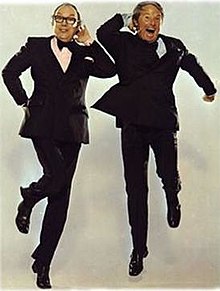
It comes down to the supposed difference between “British humo[u]r” and “American humor.” What sets British humor apart from its trans-Atlantic counterpart that speaks the same language? The more I researched this question, searching through Quora, Reddit, and simply asking people, the less clear the distinction became. It’s often stated that British humor is distinguishable because it’s dryer, “smarter,” irony-based, darker, and so on. American humor is broader, more obvious, maybe a little gentler and more sentimental. But examples abound that none of these traits solely belong to one side, nor does breaking formula result in a smaller audience. And that’s not just a recent development. In America, the dry-as-a-bone Button-Down Mind of Bob Newhart won a Grammy as far back as 1960 and sold by the truckload. The cerebral comedy team of Nichols and May had lines around the block when they hit Broadway the same year. A little later, American films like MASH and Harold and Maude were wickedly smart and incredibly dark, and had great success at the box office. On the other side of the spectrum, sappy, generic sitcoms, unimaginative “comedic” variety shows, and — God help us — the hideous sucking chest wound of British humor known as Benny Hill were all over British television for decades and watched by millions. The deeply moronic Carry On film series was a beloved British institution. American rednecks at the sports bar and British punters down the pub are a remarkably similar breed, and no one has a monopoly on a style of comedy.
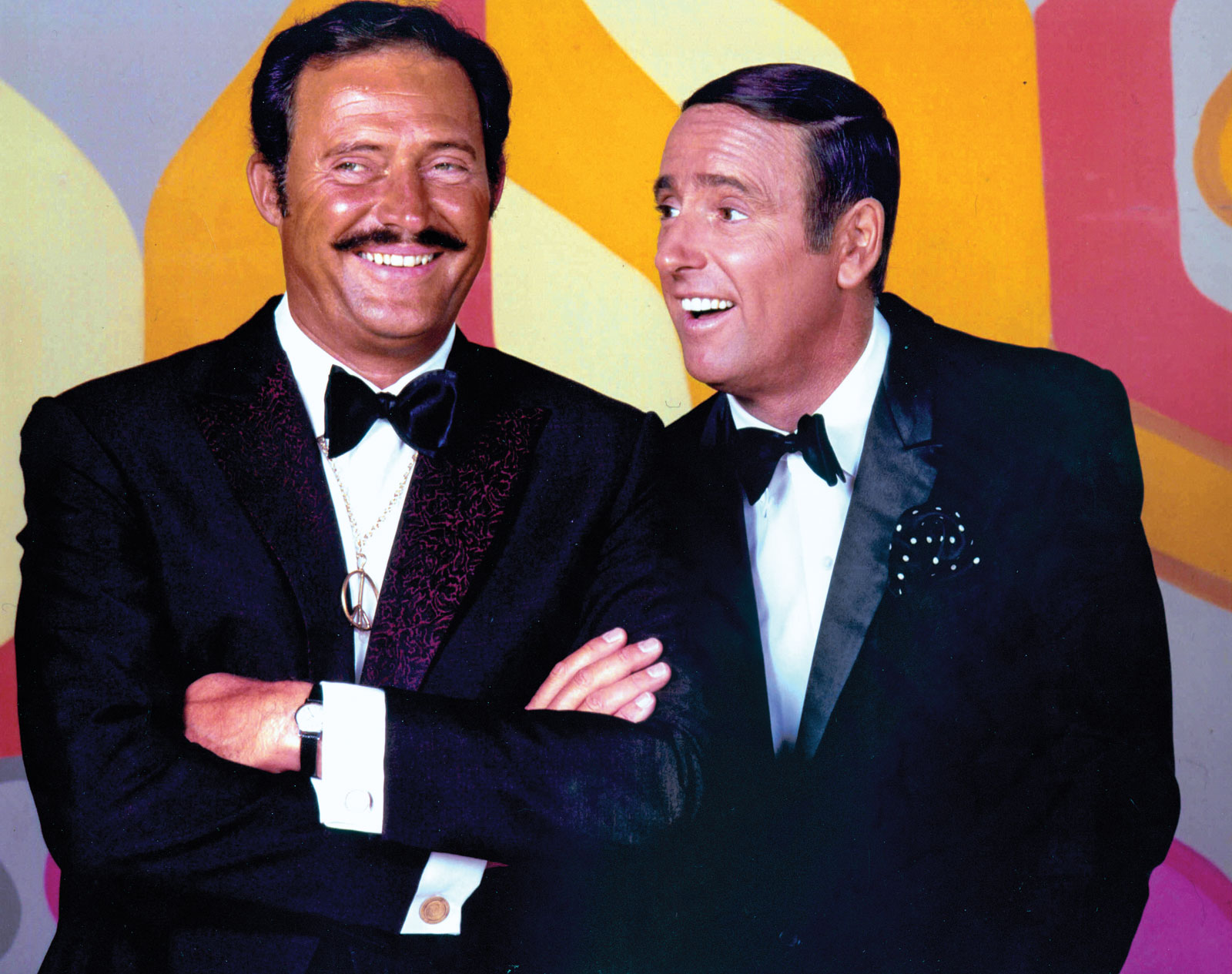
Some say most British humor comes off as “smarter.”
But Python’s intellectualism is surface-only. Take, for example, the Monty Python sketch known as “The All-England Summarize Proust Competition,” a game show-style televised contest to see which contestant could verbally condense French modernist Marcel Proust’s seven-volume philosophical novel A La Recherche du Temps Perdu in just fifteen seconds. Heady stuff…but, by their own admission, none of the Pythons had actually read Proust. They just knew him as a cool name to drop to sound smart. And lest we forget that the Pythons also excelled at lowbrow humor, the actual winner of the “All-England Summarize Proust Competition” was…“the girl with the biggest tits.” You don’t have to have graduated Oxford to laugh at the premise and the naughty punchline.
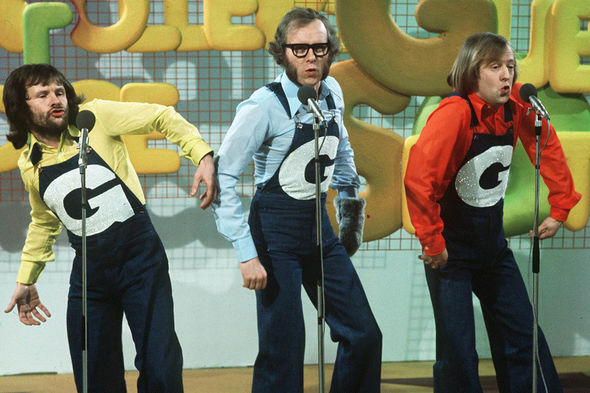
On the other hand, what happens when you eschew any level of smartness and go for pure silliness? Well, you get the Goodies — another British comedy team (Tim Brooke-Taylor, Bill Oddie, Graeme Garden) with identical backgrounds to the Pythons (Oxbridge educations followed by a comedy-writing apprenticeship at the BBC), and whose lifespan as a team was almost identical as well — but they dropped all pretensions of engaging their audience on an intellectual level…and their comedy suffered. Frankly, the Goodies often crossed the line from silly to flat-out stupid. And it was fake stupid (as opposed to Benny Hill, who at least came by his stupidity honestly). These were guys as smart as the Pythons, but deliberately dumbed themselves down. It backfired, and they ended up with no shelf life. (The Pythons have always been good friends with the Goodies, who were all incredibly talented individuals, and their creative paths have crossed several times on other projects. Also, RIP Tim Brooke-Taylor, co-creator of At Last the 1948 Show with Cleese and Chapman, and an early casualty of Covid-19 in April of 2020.)
So it seems that British humor is simultaneously smarter and sillier, referencing Proust, Sartre, and Bergson one moment, then making boob jokes the next. But this hybrid intellectual/silly/surreal blend — or at least its acknowledgement as the modern definition of “British humor” by Americans — may actually originate solely with Monty Python. It’s the reason the term “Pythonesque” is now in the Oxford English Dictionary. They were true originals, or at least the ones who put the pre-existing parts together for the first time.
The Pythons’ uniqueness led to their success, and ultimately proves that the gap between “British humor” and “American humor” is really no gap at all — Americans can do smart references, cutting irony, and dry sarcasm. And the Brits can do the broad, the formulaic, and the sentimental. In fact, both sides do all of those things an awful lot.
In the end, I think the perceived “gap” is explained by three very simple things.
1) The British — now and forever, upper class to working class — love cross-dressing and believe it’s inherently hilarious. Some Like It Hot aside, Americans have always been a little conservative about playing with gender. (And speaking of class, Americans really don’t get Britain’s all-consuming obsession with class levels.)
2) The use of terminology, slang, and cultural references that would only be recognizable to someone living in the British Isles.
3) Most importantly — stubborn American resistance to the English accent. I personally know people who claim even the clearest, most precise “received pronunciation” English accent makes them throw up their hands and insist everything being said is incomprehensible. And any English accent of any region sounds off-puttingly stuffy and pretentiously “smart” to many American ears. We still seem to have an inferiority complex when comparing ourselves to our supposedly more sophisticated English cousins — and the accent triggers it. Many will shut their ears and not even try, thinking it’s somehow above them. (In comedy, at least. Historical costume dramas seem to get a free pass. The accent suddenly makes sense in that context. And notice I’m specifically referring to English accents here. Irish, Welsh, and Scottish accents provide their own special array of befuddlement for us.)
So…the first series of Flying Circus had concluded in January 1970, to critical plaudits and increasing ratings. The group was deep into writing and assembling material for the second series when the BBC decided there was a market for an audio recording of the highlights of the show so far. The easiest thing would have been to just make a vinyl release of edited audio from the actual episodes, perhaps with a little helpful narration (which was common practice for BBC Records), but the Pythons insisted on re-recording the material. The BBC, somewhat surprisingly, agreed.
Not long before the recording date, the Pythons were dismayed to discover that the recording was not to be made in the controlled confines of a proper recording studio with state-of-the-art stereophonic equipment, but to be made in a theater in front of a live audience — old radio show-style.
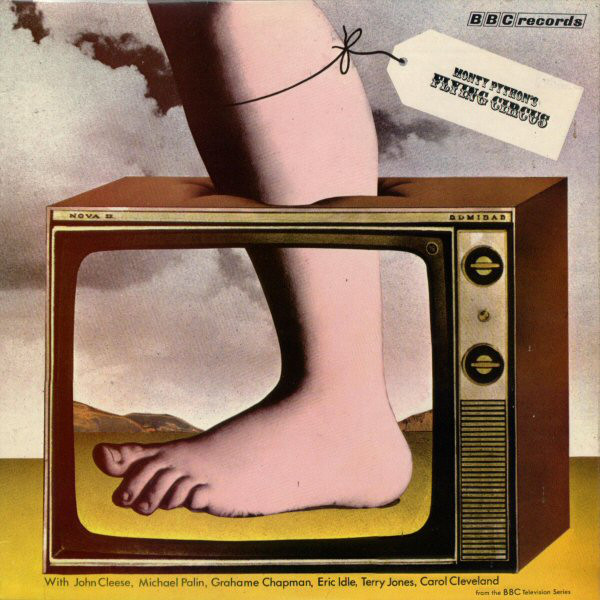
Monty Python’s Flying Circus
Released: November 6, 1970 (U.K. only)
Produced by Ian MacNaughton
Track Listing:
Side One
1. Flying Sheep
2. A Man with Three Buttocks
3. Crunchy Frog
4. Nudge Nudge
5. The Mouse Problem
6. Buying a Bed
7. Interesting People
8. Barber Shop
9. The Lumberjack Song
10. “It’s the Arts” Interview: Sir Edward Ross
Side Two
1. “It’s the Arts” Interview: Arthur “Two Sheds” Jackson
2. Children’s Stories
3. The Visitors
4. Albatross
5. Mr. Hilter
6. The North Minehead By-Election
7. Me, Doctor
8. Pet Shop (Dead Parrot)
9. Self-Defence
“Classic” sketches — the ones every Python fan can recite by heart — include the gross-out perennial “Crunchy Frog,” everyone’s favorite innuendo-fest “Nudge Nudge,” “The Lumberjack Song,” “Self-Defence” (or, “How to defend yourself against someone carrying different kinds of fresh fruit”), and the mighty “Pet Shop (Dead Parrot).”
Continue reading Holy Bee of Ephesus