
Dateline: Davis, CA. COVID-19 “shelter-in-place” quarantine, March 18 through…?, 2020
Continuing our in-depth examination of how Capitol Records handled the Beatles’ output in the U.S.A…
Tracks as yet “un-albumized” by Capitol will appear in bold, even if they’ve had a Capitol single release.
The Beatles had gone into the studio from February 25 to March 1, 1964 to finish their next single and the songs that would be featured in their film A Hard Day’s Night. They got under way by completing work on Can’t Buy Me Love, which they had started in EMI’s Paris studios during their residency at the Olympia Theatre the month before. It was definitely planned for inclusion in the film, but released as a single well before the film’s release. That way, the film could boast an already-proven hit song on its soundtrack. The single’s B-side “You Can’t Do That” was recorded as well. Its possible inclusion in the film was not assured, and it was snapped up by Second Album’s compilers. (In fact, a “You Can’t Do That” segment was filmed for the final concert sequence, but cut.) The songs intended for performance sequences in the movie were also recorded at these sessions — And I Love Her, I Should Have Known Better, Tell Me Why, If I Fell, I’m Happy Just To Dance With You, along with possible stand-alone British single “Long Tall Sally” and “I Call Your Name” which were quickly shipped stateside to be on Second Album.
The Beatles filmed A Hard Day’s Night through March and April under the working title Beatlemania. The film’s much-improved final title was thought of (based on a line in a Lennon poem, in turn based on expression of Ringo’s), and UA producer Walter Shenson asked the band to come up with a song to match. A Hard Day’s Night was rush-recorded towards the end of film shooting on April 16.

United Artists had no claim over the soundtrack’s release in the UK. As far as Parlophone was concerned, A Hard Day’s Night was first and foremost the Beatles’ third album, and a soundtrack by happenstance. But what they’d recorded so far would only fill one side of an LP. Parlophone needed side two…and Richard Lester indicated he needed one more song to finish off the film.
So on June 1 and 2, 1964 (after a well-earned break for most of May), the Beatles went back into the studio and recorded I’ll Cry Instead (the track they planned to give Lester), Any Time At All, Things We Said Today, When I Get Home, I’ll Be Back, and two covers: Ringo singing Carl Perkins’ Matchbox, and John tearing through Larry Williams’ Slow Down. (The raucous, wild-man Williams was considered New Orleans’ answer to Little Richard, and was a long-standing Beatles favorite.) Another session on June 3 was scrubbed when Ringo suddenly came down with tonsillitis. This may be the reason A Hard Day’s Night is only 13 tracks instead of the standard 14. Who knows what was to be recorded that day. The three healthy Beatles used the June 3 studio time to rehearse a replacmement drummer, Jimmy Nicol, for their upcoming tour, and to do very rough demos for “No Reply” (which ended up on the next album) and a partially-completed Harrison composition called “You Know What To Do” (which didn’t see release until Anthology.)
I’ll Cry Instead was dispatched to Lester, busy in the editing room, and UA made careful note of its inclusion. When Parlophone was prepping the British version of the album, they discovered if they included the B-side “You Can’t Do That” and dropped the two cover songs they could call it an all-original album — every track by Lennon-McCartney!
As they held off releasing the album until the film was ready, Parlophone decided to fill 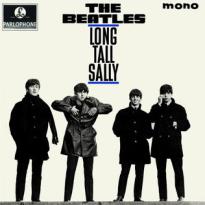 the demand for new Beatles product by expanding the potential “Long Tall Sally” single into an EP — an “extended play” four-song 45-rpm, a format that was quite popular in Britain but never caught on in the States.
The Beatles’ EP Long Tall Sally, featuring “Long Tall Sally” (from the U.S. Second Album) “I Call Your Name” (likewise), and the two covers cut from the album, Matchbox and Slow Down, was released in Britain on June 19.
UA wasn’t scheduled to release the film A Hard Day’s Night in the U.S. until August 11, but they were getting antsy to cash in on the soundtrack, so they put it out super early, on June 26. They had distribution rights only to the eight songs actually in the film, so they created a full-length album by adding four segments from George Martin’s score, which were orchestral re-workings of other Beatles songs.
- A Hard Day’s Night
- Tell Me Why
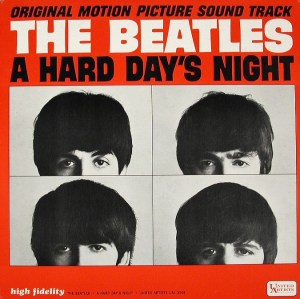
NOT Capitol! United Artists
- I’ll Cry Instead
- “I Should Have Known Better” (orch.)
- I’m Happy Just To Dance With You
- “And I Love Her” (orch.)
- I Should Have Known Better
- If I Fell
- And I Love Her
- “Ringo’s Theme (This Boy)” (orch.)
- Can’t Buy Me Love
- “A Hard Day’s Night” (orch.)
UA put the soundtrack out so early, I’ll Cry Instead remained on the album even though Lester dropped the song from the film at the last minute. (He didn’t think it was high-energy enough to match the action sequences it was intended for — either the frolicking-in-the-field segment, or the police chase segment — so he just used Can’t Buy Me Love twice. No one seemed to mind.)
So…EMI controlled these songs, and gave UA certain rights to them in the U.S., but what did these rights entail? It certainly seems the rights were not exclusive, because Capitol sure as hell went ahead and released them in various formats that summer. (And EMI eventually bought out the UA catalog in 1979, so all subsequent U.S. reissues of A Hard Day’s Night would be under the Capitol banner.)
The best explanation I’ve found is from the Beatles Music History website (great info, but the usual classic-rock website eyesore): Capitol could use the eight tracks in question — as long as they did not explicitly refer to or advertise whatever they put them on as a “motion picture soundtrack.” With that caveat, Capitol now had some choices to make as far as their third Beatles album was concerned.
The British version of A Hard Day’s Night came out as the Beatles third Parlophone  album on July 10, 1964, with the following track list: A Hard Day’s Night / I Should Have Known Better / If I Fell / I’m Happy Just To Dance With You / And I Love Her / Tell Me Why / Can’t Buy Me Love / Any Time At All / I’ll Cry Instead / Things We Said Today / When I Get Home / “You Can’t Do That” / I’ll Be Back.
Several writers have remarked that the Beatles’ musical growth was so rapid that the difference between Parlophone’s A Hard Day’s Night side one (recorded mostly in February) was quite noticeable from side two (recorded mostly in June).
A single can’t be a “soundtrack,” right? Capitol figured as much, and put out A Hard Day’s Night / I Should Have Known Better as a single on July 13. (Parlophone put out the title song as a single in the UK too — the “no singles on albums” rule in Britain didn’t apply when the singles were tied to the marketing of their films.)
Capitol desperately needed a third Beatles album out for the summer market. The six songs from the first three British singles, and the ten songs recorded for the first British album waaay back in early ‘63 were still part of Capitol’s legal wrangle with Vee-Jay Records (see previous entry.) Capitol had enough muscle to use them if they wanted to (and occasionally did), but they still regarded this stuff as not really worth the trouble.
That leaves the two German-language songs Sie Liebt Dich and Komm Gib Mir Deine Hand recorded in January ‘64 for the German market (an experiment not to be repeated), Matchbox and Slow Down from the British Long Tall Sally EP, and, technically, everything on the newly-released British album A Hard Day’s Night.
It was immediately decided that A Hard Day’s Night would not be included. Capitol had already capitalized on it as a single, and it skirted too close to UA’s “soundtrack” turf. Its Capitol B-side I Should Have Known Better was tossed, too, for no reason I can see. Maybe it was too closely associated with the movie’s title track due it’s being on the single’s B-side. Nor was Can’t Buy Me Love or I’ll Be Back considered. I have no idea why. Even with those omissions, that still left just enough gas in the tank.
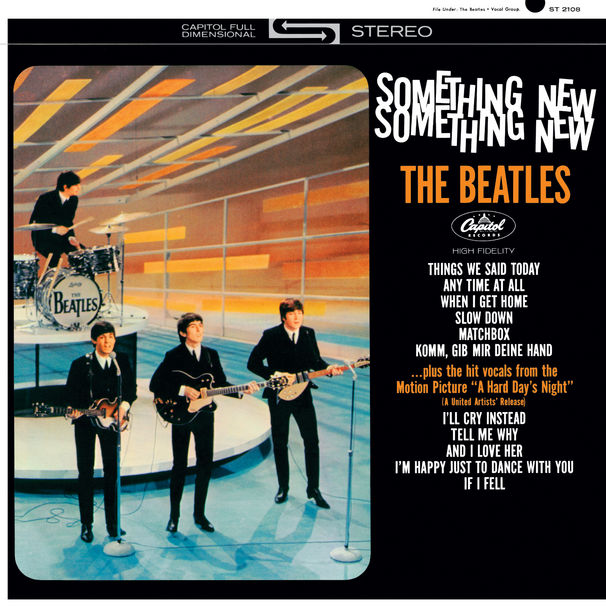
Something New (July 20, 1964)
- I’ll Cry Instead (UK A Hard Day’s Night)
- Things We Said Today (UK A Hard Day’s Night)
- Any Time At All (UK A Hard Day’s Night)
- When I Get Home (UK A Hard Day’s Night)
- Slow Down (Long Tall Sally EP)
- Matchbox (Long Tall Sally EP)
- Tell Me Why (UK A Hard Day’s Night)
- And I Love Her (UK A Hard Day’s Night)
- I’m Happy Just To Dance With You (UK A Hard Day’s Night)
- If I Fell (UK A Hard Day’s Night)
- Komm Gib Mir Deine Hand (German-language single on EMI’s Odeon Records, 2/4/64)
The cover is another shot from the Ed Sullivan appearance. The title seems a touch ironic as almost all of side two had been available to U.S. record buyers on the UA soundtrack for almost a month. The soundtrack kept Something New out of the #1 album spot, showing that the fans drew no distinction between UA and Capitol product.
And I can kind of follow Capitol’s logic in terms of song choice through this whole process…until the end of side two here. Why the hell did they include “Komm Gib Mir Deine Hand” when they still had other stuff to choose from? I can only guess as to why better options weren’t chosen instead. I’ll Be Back is a brilliant song, and would have made an infinitely better choice. I suppose it may have been a little too downbeat for an album that already included melancholy songs like “If I Fell” and “Things We Said Today.” Capitol was still trying to sell the Beatles based on excitement (!!) after all. Probably someone at Capitol thought the German song would be a fun novelty for the kids. (They used to put shit like that on early Beach Boys albums all the time). Actually, anything from the ‘63 sessions would have been a better call than that Teutonic atrocity. Continue reading
 Holy Bee of Ephesus