
It is a long-established trope among classic rock aficionados that 1966 has a special place in music history — something was in the air, something that pushed bands and artists to experiment and explore new sonic territory, producing their very best work. Music that made rock, pop, and soul “grow up” and become music for discerning adults, rather than disposable entertainment for the bubble-gum set. Any time there’s a poll in some dinosaur-rock magazine or website, three specific 1966 albums (you know what they are) always seem to swap around the top spots.
Fifty years down the road, is it time for a re-examination of 1966? Do the vaunted, classic albums actually hold up, or has “1966” just become a lazy shorthand for an incredibly brief period of musical development that will never be replicated in a space of twelve months ever again, while the actual albums themselves grow inflated and overrated, and at the same time, dusty and rarely listened to?
First of all, it must be remembered that in 1966, the rock album was still in its infancy. Bands like the Beatles and solo artists like Bob Dylan were working hard to change that, but even in 1966, the album charts were dominated by traditional, non-rock artists (Herb Alpert, Frank Sinatra), soundtracks (Dr. Zhivago), and left-field novelties (The Ballad of the Green Berets).
I had a good time re-listening to these recordings from almost nine years before my birth with an eye on their place in history, and I came to the conclusion that 1966’s reputation is deserved, but should be looked at as the beginning of something, the first of many peaks, at least as far as “good album years” are concerned. (1991, anyone?)
And the albums that made the year’s reputation — and kicked open the door to the format becoming commercially dominant — were actually very few in number. Both Britain and the U.S. each had a group of albums I call “The Big 5.” By general consensus, these are the what made 1966 “1966”:
A note on chart positions: The U.S. has one generally accepted music sales chart — Billboard. (There was also Cashbox for awhile, but it was considered very secondary.) The U.K. had several different publications — Disc, Record Retailer, New Musical Express, and Melody Maker — each with their own method of charting a record’s success, and each considered a viable source. I used whichever was the highest for a particular album.
TEAM U.K.
The Beatles — Revolver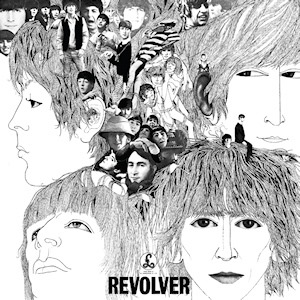
Release Date: August 5
Highest Chart Position: #1 (U.S. & U.K.)
The “what-is-the-best-Beatles-album” question is as pointless as it is personal. You’ve got the Abbey Road boosters, the Rubber Soul fanatics, the people who love the innocence and energy of their debut Please Please Me, and the people who love the hippie-baroque intricacies of Sgt. Pepper’s Lonely Hearts Club Band. Then there’s people like me, who say Revolver is their best (by a slim whisker — it’s the most formidable discography in popular music.) My group has has been growing larger over the past several years. Sgt. Pepper’s star has faded a little, and Revolver’s reputation has finally clawed its way past it. The swaggering confidence they had as masters of the recording studio has seeped into the grooves of this record. They opened a dizzying bag of studio tricks: varispeed, tape loops, flanging, phasing, everything tried backwards, upside down, and sideways. The sheer musical variety from track to track demonstrates their effortless ear for genre and pastiche. From Harrison’s classical Indian piece “Love You To” to McCartney’s brass-saturated Memphis soul tribute “Got To Get You Into My Life,” to Lennon’s attempt (often imitated, never bettered) to create the audio equivalent of an LSD trip on “Tomorrow Never Knows,” Revolver shows off a band at the absolute top of its game. And I didn’t even mention “Eleanor Rigby.” Or “Yellow Submarine.” Or “Taxman.” Or “Good Day Sunshine.” Or “She Said She Said.” Each worthy of an essay of their own. And there’s still more great stuff…it’s a hell of an album.
The Rolling Stones — Aftermath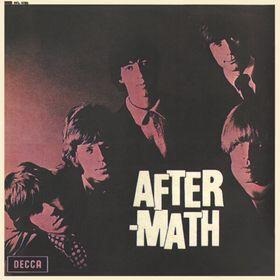
Release Date: April 15
Highest Chart Position: #1 (U.K.), #2 (U.S.)
The Stones started their career as a better-than-average R&B cover band, but didn’t truly come into their own until the Jagger-Richards songwriting team kicked into gear in ‘65 with two blistering singles, “The Last Time” and “(I Can’t Get No) Satisfaction.” By the spring of 1966, they were ready to unleash their first all-original album on an unsuspecting public. Their R&B roots were almost nowhere to be heard, replaced by a brittle, bitter form of power pop. The songs perfectly captured the mood of being a young, jaded rock star in Swinging London, and were underpinned by Charlie Watts’ light, jazzy touch on the drums. No heroics yet from future guitar god Keith Richards, who contributes a few stinging, fuzz-pedal lines here and there. The real show is band founder, multi-instrumentalist (and soon-to-be-ousted) Brian Jones, providing exotic textures on sitar, marimba, dulcimer, harpsichord, and a variety of bells, chimes, and random percussion. [Like many U.K. albums, Aftermath hit U.S. shores in altered form – a different cover and shorter track list. Unlike the clearly inferior U.S. version of Revolver, which simply cut the three Lennon tracks that had already appeared earlier in the year on the U.S.-only Yesterday…And Today, the American Aftermath is actually defensible – cutting four tracks (two of which were very sub-par) and adding the first-rate “Paint It, Black,” which had been a stand-alone single in the U.K.]
The Kinks — Face To Face
Release Date: October 28
Highest Chart Position: #8 (U.K.), #135 (U.S.)
The Kinks outgrew the aggressive, distorted riffs that made their early reputation (“You Really Got Me,” “All Day And All Of The Night”), and began taking a gentler, subtler approach. Chief writer Ray Davies began focusing on evocative and eccentric character studies (culminating in the awesome “Sunny Afternoon” which closes this album), all steeped in distinctly British pre-rock traditions — music hall, pub singalongs, light classical, and flourishes of Celtic folk. When he wasn’t writing about dandies, session musicians, exclusive residences for sale, or Hawaiian vacations, Davies turned inward, exploring his own fragile psyche (“Too Much On My Mind” “Rainy Day In June”). Sessions for the album began right after Davies’ recuperation from a much-discussed, Brian Wilson-esque nervous breakdown. The album was well-received in Britain, then faded from memory, even going out of print for several years. Its fortunes were revived when people began talking about 1966 in reverent tones, and it has received several deluxe reissues.
The Who — A Quick One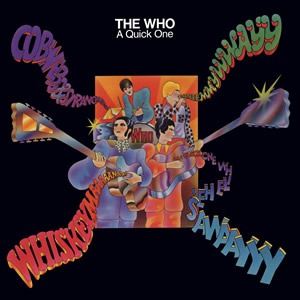
Release Date: December 9
Highest Chart Position: #4 (U.K.), #51 (U.S.)
By their own admission, the Who’s second album was a patchy affair based on the half-baked idea that other band members should contribute two original songs, rather than relying solely on Pete Townshend. Roger Daltrey coughed up one (the decent “See My Way”), and drummer Keith Moon cribbed the melody from a half-remembered TV theme song (Man From Interpol) and turned it into the brass band instrumental “Cobwebs And Strange.” Moon’s second offering was a haunting little trifle called “I Need You” (supposedly about the ego-bruising experience of nightclubbing with the Beatles), which I suspect received uncredited help from Townshend. A perfunctory cover of “Heatwave” does no favors. Luckily, the strengths of the album are noteworthy. A Quick One did boast some underrated Townshend gems, including the sublime “So Sad About Us,” and showed off John Entwistle’s skills as a darkly comic songwriter in the Ray Davies vein with “Whiskey Man” and “Boris The Spider.” (Every future Who album except Quadrophenia would feature at least one weird and wonderful Entwistle jam.) Finally, the last track on the album paved the way to the band’s future: the first “rock opera” — a nine-minute, multi-section suite about an extramarital affair called “A Quick One While He’s Away.” (The album’s generic “pop art” cover brought it down a notch. It’s quite hideous.)
John Mayall & The Bluesbreakers – Blues Breakers with Eric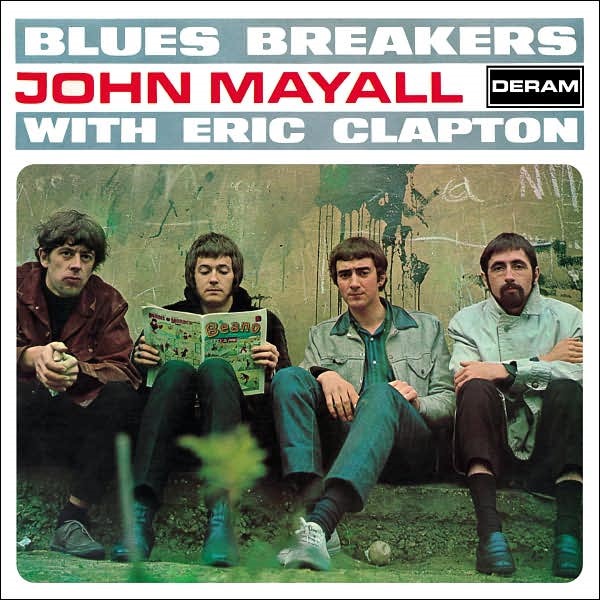 Clapton
Release Date: July 22
Highest Chart Position: #6 (U.K.), did not chart in the U.S.
Guitarist Eric Clapton had already established such a reputation during his time with the Yardbirds that bandleader John Mayall included his name in the actual title of the album. Mayall was one of the earliest performers to popularize American blues in Britain (second only to Alexis Korner), acting as an inspiration and mentor to younger acts like the Rolling Stones and the Animals. The Bluesbreakers line-up was always fluid, with Mayall switching off between keyboards and guitar, and a rotating cast of musicians backing him. The band that powered Blues Breakers with Eric Clapton consisted of Mayall (mostly on Hammond organ and harmonica), future Fleetwood Mac bassist John McVie, drummer Hughie Flint, and, of course, Eric Clapton and his sunburst Les Paul playing those impeccable licks that made him a legend. The songs themselves are tasteful and restrained versions (no side-long jamming just yet — it’s still 1966) of classic blues numbers originally by Otis Rush, Robert Johnson, Mose Allison, Little Walter, and others, along with a couple of Mayall originals. (Clapton shyly gives his first ever lead vocal performance on “Ramblin’ On My Mind.”) Continue reading
 Holy Bee of Ephesus